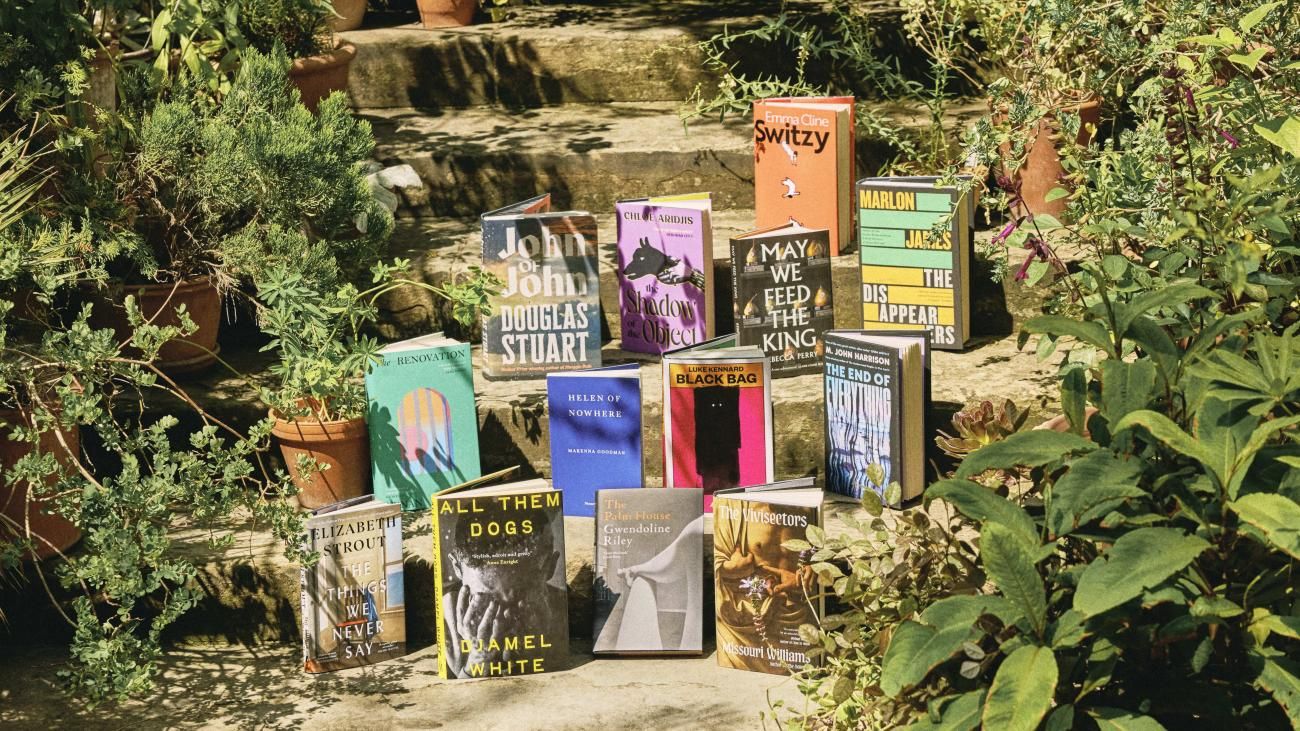
From humour to history to heartbreak, and from satire to sci-fi to surreality, here’s the lowdown on this year’s ‘Booker Dozen’
What our judges said about the Booker Prize 2026 longlist

What our judges said about the Booker Prize 2026 longlist
- Published
Wondering which of the 13 novels longlisted for the Booker Prize 2026 to read first? We asked our judges to summarise each book – and tell us why they loved them
The Shadow of the Object by Chloe Aridjis
Chloe Aridjis’s mysterious and free-wheeling novel begins when Flora, a jewellery polisher, is bitten by her family’s ageing Alsatian. The dog is unsettled to see Flora’s hand floating, as if disembodied, in mid-air. The subsequent story, which moves from Mexico City to London, is similarly rich in strange imagery that slips us between the real world and dream-states: a darkened figure in a hospital corridor; figures flickering on a wall; there’s even a vignette from the point of view of a mouse. We were charmed by the novel’s meditation on friendship and grief, and its suggestion that the most meaningful truths can be found in the shadows.

The Shadow of the Object by Chloe Aridjis
© Yuki Sugiura for Booker Prize Foundation
Switzy by Emma Cline
We live in a time ruled by overpowered and undersocialised wealthy boy kings; Emma Cline’s mordant novel considers what, if anything, remains at the end of one such luxurious yet lonely life. David is a retired American business executive with dementia who decides to be euthanised in a Swiss clinic. As he voyages across Europe, fuzzy memories from his life slip in and out of his consciousness. There are final gestures towards intimacy with family and friends, and a whimsical cartoon becomes a symbol of a bygone childhood. What makes a life? Cline writes vividly about the trappings of the elite – the private jets, the heirloom watches, all that time spent in the office – as well as their sad social cost in a story that feels immersive, elegiac, and very real. As one of us put it: ‘I travel a lot, and know these guys.’

Switzy by Emma Cline
© Yuki Sugiura for Booker Prize Foundation
Helen of Nowhere by Makenna Goodman
A spellbinding novel or a play with just four characters? In groundbreaking form, Helen of Nowhere blends both to challenge us with a seemingly simple question: How much are we truly willing to change ourselves in order to get back to nature? A fallen professor’s visit to a rural house leads to a surreal and destabilising encounter with a realtor, who shares the tale of Helen, the home’s former occupant. Philosophically, politically, and spiritually adventurous, this slim, ambitious volume has the power to transform.

Helen of Nowhere by Makenna Goodman
© Yuki Sugiura for Booker Prize Foundation
The End of Everything by M. John Harrison
Two beachcombers meet and exchange words at the intertidal; we are in Kent, and it is the near-future, but one that recognises itself to be in the middle of a catastrophe. The sky is glitching, and something strange, formless and growing is soon to come out of the sea, to imitate our speech, forms, and customs. Our left-behind inhabitants scavenge where and what they can, provisional alliances are made and broken, shocking violence occurs, and no one can agree on exactly what has happened. A book not just about everything but about now. Shimmering and oblique, it holds the reader to the surface of something very grave and deep.

The End of Everything by M. John Harrison
© Yuki Sugiura for Booker Prize Foundation
The Disappearers by Marlon James
The Disappearers is among Marlon James’s most ambitious and history-making works, a novel that examines territory Caribbean literature has rarely dared to occupy. Beginning in late 1980s Kingston, it follows eight male actors rehearsing what is billed as Jamaica’s first openly gay play. When the men become victims of brutal homophobic violence, the novel shifts register: in the years that follow, one survivor sets out to investigate the fates of the others, and what begins as a theatrical story becomes something closer to a reckoning.
James is a singular literary talent. His dialogue is sharp and propulsive, his phrasing is poetic, visceral and capable of moving from the painful to the darkly hilarious within a single exchange. The Disappearers could be read as a long overdue, clear-eyed confrontation with Jamaican homophobia: unflinching in its honesty, but written with the full complexity and love of someone who knows the place and its contradictions from the inside.

The Disappearers by Marlon James
© Yuki Sugiura for Booker Prize Foundation
Black Bag by Luke Kennard
How does an aspiring actor survive in contemporary London, where monthly living costs can rise well over a thousand pounds? The obvious solution – be born rich – has eluded Black Bag’s protagonist, a 37-year-old man who cobbles together an artistically and financially unsatisfying life performing in productions that stretch and undermine the meaning of theatre. That is until he gets a job showing up to student psychology lectures dressed in a black bag. Luke Kennard’s of-the-moment satire considers anonymity and disgust, the online rackets of cryptocurrency and energy drinks, and what it means to find love in our unstable times. There’ll be a lot of discussion about what the novel has to say about the state of modern masculinity (fractious; confused) – we also admired its sharply crafted sentences, memorable sex scenes, and humour.

Black Bag by Luke Kennard
© Yuki Sugiura for Booker Prize Foundation
The Renovation by Kenan Orhan
The Renovation starts with a surreal domestic disaster. Dilara, a Turkish exile living in an unremarkable Italian village, has asked some builders to renovate her bathroom. When they finish, she finds they have built her instead a brand-new prison cell, complete with a resident guard and mysteriously connected to a prison in Istanbul. It’s a hilarious fantasy which had some of the judges laughing out loud. But it’s more than that. It poses questions about political activism, about where you really belong, and about the different forms that ‘imprisonment’ can take (from dementia to exile). It’s humour with a decidedly unsettling side.

The Renovation by Kenan Orhan
© Yuki Sugiura for Booker Prize Foundation
May We Feed the King by Rebecca Perry
Perry combines the story of a reserved museum curator who recreates historical banquets, using a careful array of fake pies and pomegranates – with the story of a medieval king, reluctant to occupy the throne (and possibly unfit for it anyway). It’s a wonderfully enticing, and eye-opening, combination of themes, woven together with an extraordinary delicacy of touch. You can’t read May We Feed the King without reflecting on the fragile boundary between the present and the past. What’s the difference between historical fiction and historical fact? Can history ever be a safe place we can go to escape the present?

May We Feed the King by Rebecca Perry
© Yuki Sugiura for Booker Prize Foundation
The Palm House by Gwendoline Riley
Most chilling story ever told: our literary magazine has got a new editor, and he’s coming in with some big ideas. A note-perfect portrait not only of certain rarefied London intellectual spaces, but also of the people that actually bring their own bloodstreams, histories, tastes, families, first loves, and lonelinesses to them, to make up that impersonal thing we think of as the Establishment. Who, in these places, has power, and how is that power wielded? Are we fated never to get a word in, to remain always a little hungry, a little thirsty – and did we really choose this path because we love literature? Told in a series of thrown spotlights, in some of the best dialogue this side of Henry Green, The Palm House is minimalist, precise, and indelible.

The Palm House by Gwendoline Riley
© Yuki Sugiura for Booker Prize Foundation
The Things We Never Say by Elizabeth Strout
Set in the contemporary United States, Strout’s novel focuses on Artie Dam, a 50-something high-school history teacher in a small coastal town with decent friends and wholesome hobbies. The Things We Never Say quietly unpicks all that, to show that the ordinary is not quite as ordinary as it might seem. Strout’s prose is about as far from a rant as you could imagine, brilliantly understated and all the more powerful for that. It’s a devastating look at the dangerous cracks in family life and in the contemporary world at large.

The Things We Never Say by Elizabeth Strout
© Yuki Sugiura for Booker Prize Foundation
John of John by Douglas Stuart
A 22-year-old arts student reluctantly returns from Edinburgh to his home on the Isle of Harris in Douglas Stuart’s third novel. We loved the rich, textural detail of the story, which is set in the 90s and examines young Cal’s fraught relationship with his domineering father. There’s a vivid sense of time and place, as the island becomes the site of bristling tensions between secret lovers, feuding families, and a stand-off between tradition and modernity. This excavation of family, violence, and shame is woven through with beautiful imagistic detail, and – unexpectedly but wonderfully – shades of hope.

John of John by Douglas Stuart
© Yuki Sugiura for Booker Prize Foundation
All Them Dogs by Djamel White
All Them Dogs, the debut novel by Djamel White, is a mouthy, ballsy and bracingly unsentimental portrait of West Dublin gangland. Set well off the beaten track of the city’s usual literary landmarks. It charts the lives, loyalties and dealings of a semi-organised crime world. Yet, the novel’s real achievement lies in something quieter and more easily overlooked beneath the bullets and bone-breaking dramatics: a subtle, textured humanity woven among the violent hyper-masculine protagonists.
White is an impressive stylist. He has an ear for dialogue that is both racy and real, and a gift for atmospheric description that feels at once inventive and classically grounded. This writer understands that the vernacular of the street, handled with precision and care, can carry as much emotional and literary weight as any elevated register.

All Them Dogs by Djamel White
© Yuki Sugiura for Booker Prize Foundation
The Vivisectors by Missouri Williams
A bracing antidote to the cosy campus and the dark academia novel, The Vivisectors instead imagines higher education as a transparent citadel where human axolotls masquerading as professors and students are bent on drawing and quartering each other with no mercy, as their nameless city is overtaken by relentless vegetable growth. No one is protected, everyone is exposed, it is highly doubtful anyone is learning anything, and on top of all that vines are coming up your legs. Genuinely experimental, relentlessly and rollickingly told – in places truly menacing – The Vivisectors is the rare title that actually earns its name.

The Vivisectors by Missouri Williams
© Yuki Sugiura for Booker Prize Foundation


Features


- Reading guides
Reading guide: The End of Everything by M. John Harrison

- Reading guides
Reading guide: John of John by Douglas Stuart

- Reading guides
Reading guide: May We Feed the King by Rebecca Perry

- Reading guides
Reading guide: The Things We Never Say by Elizabeth Strout


- Book recommendations
The Booker Prize 2026 shortlist: what our judges said

- Reading guides
Reading guide: Black Bag by Luke Kennard

- Reading guides
