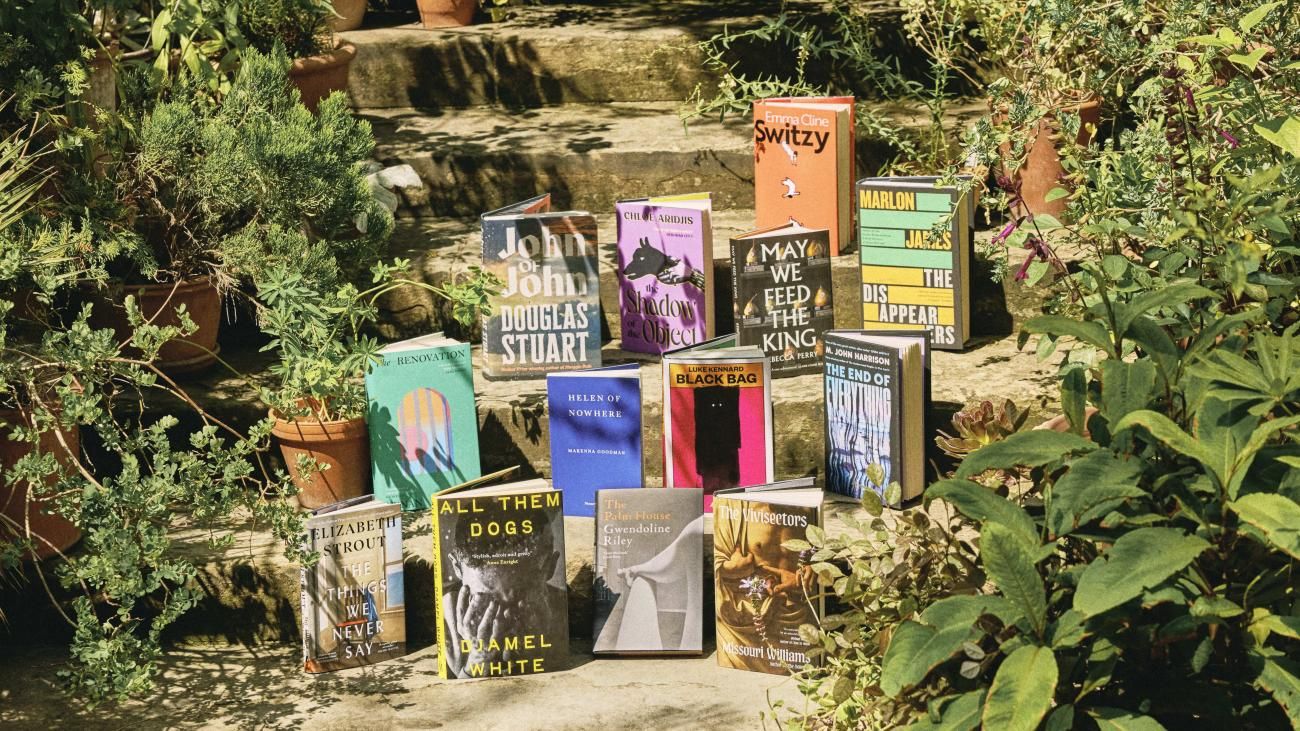
A novel of enduring friendships and small mercies, The Palm House offers us Gwendoline Riley’s trademark keen observation and wit, and leaves us – somehow – with a curious sense of possibility

The Palm House
Written by Gwendoline Riley
- Longlisted
- The Booker Prize 2026
- Published by Picador
Buy the book
A novel of enduring friendships and small mercies, The Palm House offers us Gwendoline Riley’s trademark keen observation and wit, and leaves us – somehow – with a curious sense of possibility
Laura Miller and Edmund Putnam have been friends for a long time. Theirs is a happy meeting of minds, with long evenings spent huddled in an ancient pub by the Thames, where they share office gossip, reflect on their teenage passions, and lament the state of the world.
Recently, though, Putnam has been harder to reach: he has lost his father, and the magazine to which he has dedicated his life has been hijacked by an insufferable new editor, Simon ‘call me Shove’ Halfpenny.
Laura has her own problems: with a prickly mother and a tricky past, and in a beautiful and indifferent city, her day-to-day life is precarious. But as Putnam starts to sink into despondency, she must try to bring him back.
The Palm House was longlisted for the Booker Prize 2026.

Gwendoline Riley on The Palm House
‘It’s mysterious how these things work. Each novel I write feels like the only move I can make in that moment. I sometimes feel a bit on the back foot about that. Scenes come to me and I work to get them right and then to get the structure of the novel right. I listen to the prosody. If things are arranged correctly, then the feeling comes through. I use what’s to hand: my observations of the world, and of how people live.’
Read the full interview here.
A note-perfect portrait of rarefied London intellectual spaces, and the people that make up that impersonal thing we think of as the Establishment. Minimalist, precise, and indelible
The Booker Prize 2026 judges
What the judges said
‘Most chilling story ever told: our literary magazine has got a new editor, and he’s coming in with some big ideas. A note-perfect portrait not only of certain rarefied London intellectual spaces, but also of the people who actually bring their own bloodstreams, histories, tastes, families, first loves, and lonelinesses to them, to make up that impersonal thing we think of as the Establishment. Who, in these places, has power, and how is that power wielded? Are we fated never to get a word in, to remain always a little hungry, a little thirsty – and did we really choose this path because we love literature? Told in a series of thrown spotlights, in some of the best dialogue this side of Henry Green, The Palm House is minimalist, precise, and indelible.’
What the critics said
Lynn Steger Strong, The New Yorker
‘Riley is much too sharp a writer to pose and answer a single question in her fiction. Being inside her novels is a singular, spiky, often deeply funny experience. But, insofar as “The Palm House” casts its keen eye on men, it lingers on the ways that stories about heroes, about conquering and winning, about what men are owed and deserve, can be just as much of a trap as the stories told to women about what we are or aren’t.’
D.J. Taylor, The Spectator
‘Style-wise, Riley is a fan of gaps, spaces, insinuations and stray glimpses that fleetingly illuminate her characters’ lives rather than drench them in arc light. Neatly and pertinently written, The Palm House seems oddly like a much longer work mischievously reproduced in shorthand. To borrow a line from the Fall’s Mark E. Smith: “Of what went on we only have this excerpt.”’
Lucy Thynne, The Telegraph
‘Riley’s prose is seamless. Much work has gone into buffing it down, smoothing it so that no effort shows: before you can consciously realise it, you’ve read one scene and are on to the next. Her mission to record and “get it right”, as Laura insists at one point, feels radical in our inattentive world, and the images she finds in doing so are beautiful. I liked “a heap of glittering frozen peas” and a cat’s “dainty switching hindquarters” (though none beats the narrator of her 2017 novel First Love, standing in a cramped shower “like a saint in its niche”).
‘Riley is also mordantly funny about immature men, and the brilliant dramatic irony that they offer to women trying not to laugh. One of Laura’s love interests in the present day is an actor, who wears tracksuits with “some kind of dried yellow friable drip on the knee”. He doesn’t understand the need for a paying job – “Shan’t!” – and is, we come to realise, a twisted echo of that comedian. What we desire so rarely changes.
‘The expression “at the height of a novelist’s powers” is bandied around too often, but it was the phrase that came to mind when reading The Palm House. Here is a writer who has worked for two decades on honing her work, and with uncompromising ambition. As a result, Riley has only got better and better – and I’m sure I won’t be the only one to say that The Palm House is her best novel yet.’
Clare Clarke, the Guardian
‘Like a Saharan dust storm, Gwendoline Riley’s work recasts our relationship with the familiar, transforming ordinary, unremarkable lives of her characters into something startling and new. Her female protagonists, often writers themselves, struggle with bad relationships: in First Love, shortlisted for the 2017 Women’s prize, Neve grapples with an abusive marriage, while Bridget in 2021’s quietly brutal My Phantoms is caught up with her desperately self-involved mother. The mothers in Riley’s novels are mostly monstrous and persistent, the fathers mostly monstrous and dead. Her stories are not structured around linear plots – nothing much happens – but Riley’s disquieting acuity and her spare and unsparing prose makes them shimmer with tension. She has a phenomenal ear for dialogue, for the myriad ways in which people unknowingly lay themselves bare, both in what they say and, more agonisingly, in what they don’t – or can’t. She is the laureate of disconnection, her bone-dry humour edged with the vertiginous lurch of despair.’

Features


- Book extract
An extract The Palm House by Gwendoline Riley

- Book recommendations