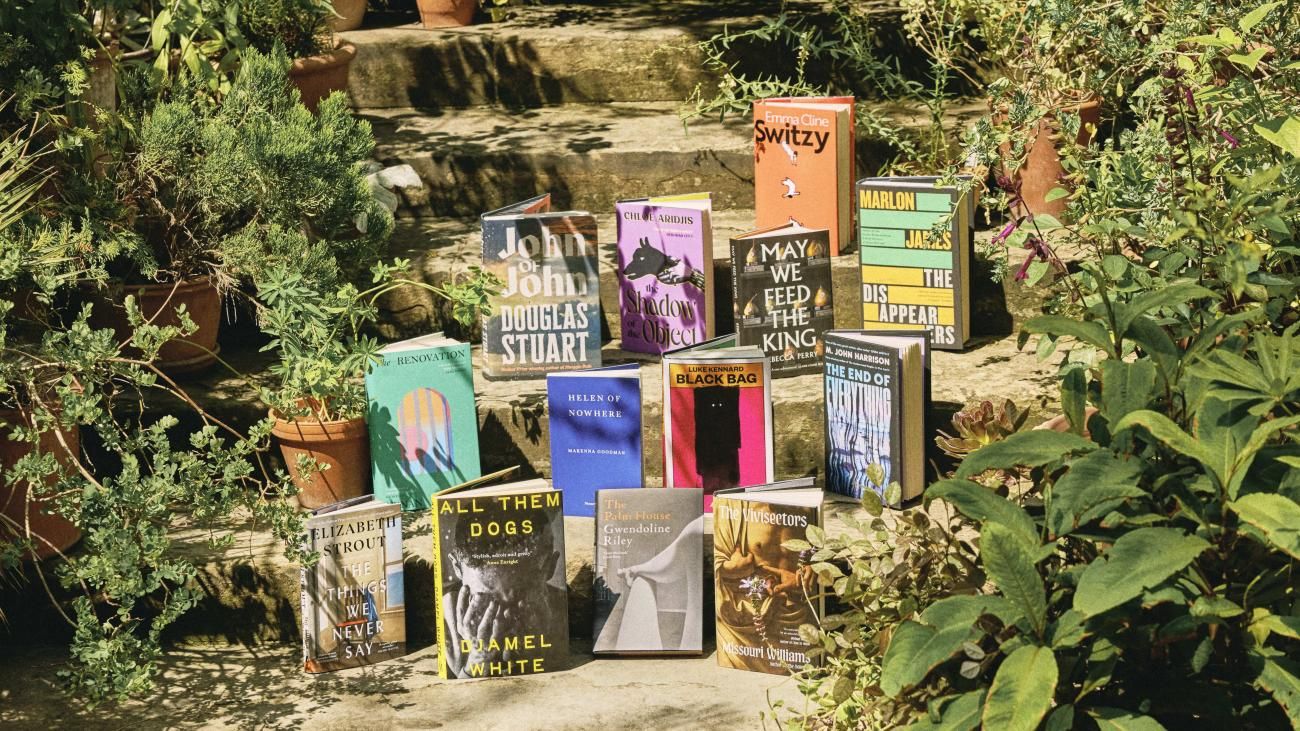
An extract The Palm House by Gwendoline Riley

An extract The Palm House by Gwendoline Riley
- Written by
- Gwendoline Riley
- Published
The Palm House is longlisted for the Booker Prize 2026. Read an extract here
A novel of enduring friendships and small mercies, The Palm House offers us Gwendoline Riley’s trademark keen observation and wit, and leaves us – somehow – with a curious sense of possibility
Laura Miller and Edmund Putnam have been friends for a long time. Theirs is a happy meeting of minds, with long evenings spent huddled in an ancient pub by the Thames, where they share office gossip, reflect on their teenage passions, and lament the state of the world.
Recently, though, Putnam has been harder to reach: he has lost his father, and the magazine to which he has dedicated his life has been hijacked by an insufferable new editor, Simon ‘call me Shove’ Halfpenny.
Laura has her own problems: with a prickly mother and a tricky past, and in a beautiful and indifferent city, her day-to-day life is precarious. But as Putnam starts to sink into despondency, she must try to bring him back.
Read extracts from the other books on the longlist here.
These were the murky effects: a dark yellow sky – like iodine – and brownish clouds, mounted in flat, extravagant, painterly puffs.
On Southwark Bridge, the lights in their trident-shaped lampposts had blinked on early.
‘It’s sand,’ said Putnam, looking up from his phone.
‘Saharan sand. It’s deflecting the shortwave light, apparently,’ he said. He waggled the fingers of his free hand to demonstrate.
More followed. Not just sand, but ash, too, from forest fires in Spain and Portugal; all this taken up by a hurricane.
‘I must have missed that,’ I said, swirling the ice around my empty glass.
‘Well, it’s a storm now,’ said Putnam. ‘Was a storm.’
‘I’m going to get another,’ I said. ‘Or shall we get some wine, maybe?’
‘Mm,’ said Putnam.
Putnam opened our second bag of salt and vinegar, then carefully split one seam and spread the crisps out a bit.
The phrase ‘It’s sand’ seemed to feature in several conversations outside the Anchor, where the terrace was filling up now, with the after-work crowd.
Some people took photographs. They walked to the railings and held up their phones. Others were less keen. I watched one young woman hurry past with a look of determined abstraction.
For my part, I found that funny, sallow atmosphere induced a peaceful sort of quiescence. Putnam and I didn’t say much. We drank, and ate our crisps. We had our own thoughts.
I remember he went through a phase of reading The Times in the morning. In the common room. Smoking, of course, as we all did. But the way he did it … You’d think, The fuck’s he up to?
The snarling sound of a speedboat broke the spell.
‘Oh, poor ducks,’ I said.
‘One more?’ said Putnam, standing up.
He lurched to grab our empty bottle, then lifted our glasses deftly between the fingers of his left hand.
‘Inside, maybe,’ he said.
‘One more. Inside,’ he nodded.
‘Into the past,’ said Putnam.
‘Eh?’
He was bringing our drinks, through a low, black-beamed doorway.
‘We used to live in here, in nineteen eighty-four.’
‘Ah.’
‘Nicer then.’
‘Of course.’
He sat down next to me, on a stool at the window. We were in the ‘Craft Snug’, a nicely forsaken nook, I thought, with no other drinkers, and no music. Dark fridges stood behind an unmanned bar.
‘Who’s we?’ I said.
‘Eh?’
‘The we who used to live here.’
‘Oh. Well. My gang, really. The three or four boys in my year who weren’t totally sociopathic. This was our spot … I think I first came in here with Barry Pymer. We used to sit up there,’ he said, indicating the bar, ‘and do lines from The Waste Land at each other.’
‘Oh, excellent.’
‘Or Beckett, we loved. Bits of Auden …’
‘How old were you?’
‘Sixteen. Seventeen. A-level age …’
‘Now,’ said Putnam, leaning over to peer at the wall beside the sill. ‘Yes, that’s gone, too.’
‘What has?’
‘They used to have a high-water mark there. A brass strip. It showed where the river rose to in seventeen-whenever. Flooded the whole area, obviously. I remember I said to Barry, Well, we’d have been done for, wouldn’t we? He enjoyed that.’
‘What did happen to Barry?’
‘After school?’
‘Mm.’
‘He went to LSE. After that I heard drugs. After that I don’t know. He was a strange cove.’
‘How so?’
Here Putnam frowned. He picked up his glass and held it to his temple.
‘He was just very adult,’ he said, finally.
‘Was he one of the sociopaths?’
‘Well, perhaps. But not then, or not in the same way. He wasn’t going to hang you out of the window by your ankles, like some of those kids used to.’
‘Was he a Cockney?’
‘No, no. North London boy. His voice was theatrical … sonorous. He used to call you “dear boy” or “old chap”. That kind of thing. Affected, but not trying to hide that it was affected, if that makes sense.’
‘Yes, I can hear that.’
‘And his manner was the same. Weirdly debonair, for a teenager. You have to picture … He was quite short.
And very thick-set. He had this great moon face.
Always these gobs of sleep in his eyes … Not terribly prepossessing. But he used to sort of roll along, down the corridor, like this,’ Putnam said, and here he= switched his shoulders, slowly and smoothly, to demonstrate.
‘Not the walk of a boy,’ Putnam said.
‘No, indeed,’ I said.
‘It was as if coming to school was just a jaunt for him,’ Putnam said. ‘He seemed to pass through the place on his own terms.’
‘I remember he went through a phase of reading The Times in the morning. In the common room. Smoking, of course, as we all did. But the way he did it … You’d think, The fuck’s he up to? Checking his shares? Seeing how some coup he’d fomented was coming along? He used to spread the paper out, as if he were surveying a battlefield map. Newspapers were big in those days.’
‘Yes, I know.’
‘Later it was the FT. I remember him getting very beady with the FT. Sucking on his cig like this,’ Putnam said, and here he mimed an exorbitant toke. ‘And peering. Like some ghastly old lag, ransacking the plans of a bank vault! Yes, he was a real shapeshifter, was Barry. A real puzzle. In here, he was suavity itself. Legs crossed, wrist bent back,’ (again Putnam demonstrated a smoking style) ‘like Harold Pinter or something.’
‘But you were friends.’
‘We were. Friends and allies, briefly.’
‘Because of English?’
‘Because of English,’ Putnam said. And here he smiled – a kind smile, for his younger self – before he picked up his glass and took another slow, helpful sip.

The Palm House
- Published by
- Picador
A novel of enduring friendships and small mercies, The Palm House offers us Gwendoline Riley’s trademark keen observation and wit, and leaves us – somehow – with a curious sense of possibility
Features


- Book recommendations