
Wondering which of the 13 Booker Prize 2026 longlisted books to read first? We asked our judges to summarise each novel – and tell us why they loved them
Everything you need to know about the Booker Prize 2026 longlist
Everything you need to know about the Booker Prize 2026 longlist
- Published
From humour to history to heartbreak, and from satire to sci-fi to surreality, here’s the lowdown on this year’s ‘Booker Dozen’
The Booker Prize 2026 longlist has now been announced – a selection of 13 superb works of long-form fiction, chosen from 163 titles written in English and published in the UK and/or Ireland between 1 October 2025 and 30 September 2026.
As Mary Beard, Chair of this year’s judges, says: ‘Great books have never been written to a single formula. We are confident that our longlist of books has something for everyone. There’s the funny and the unsettling (and in some cases the funny and unsettling); there’s dystopian fantasy and domestic drama; there’s the gritty and the magically mysterious; there are some that will please and some that may shock.’
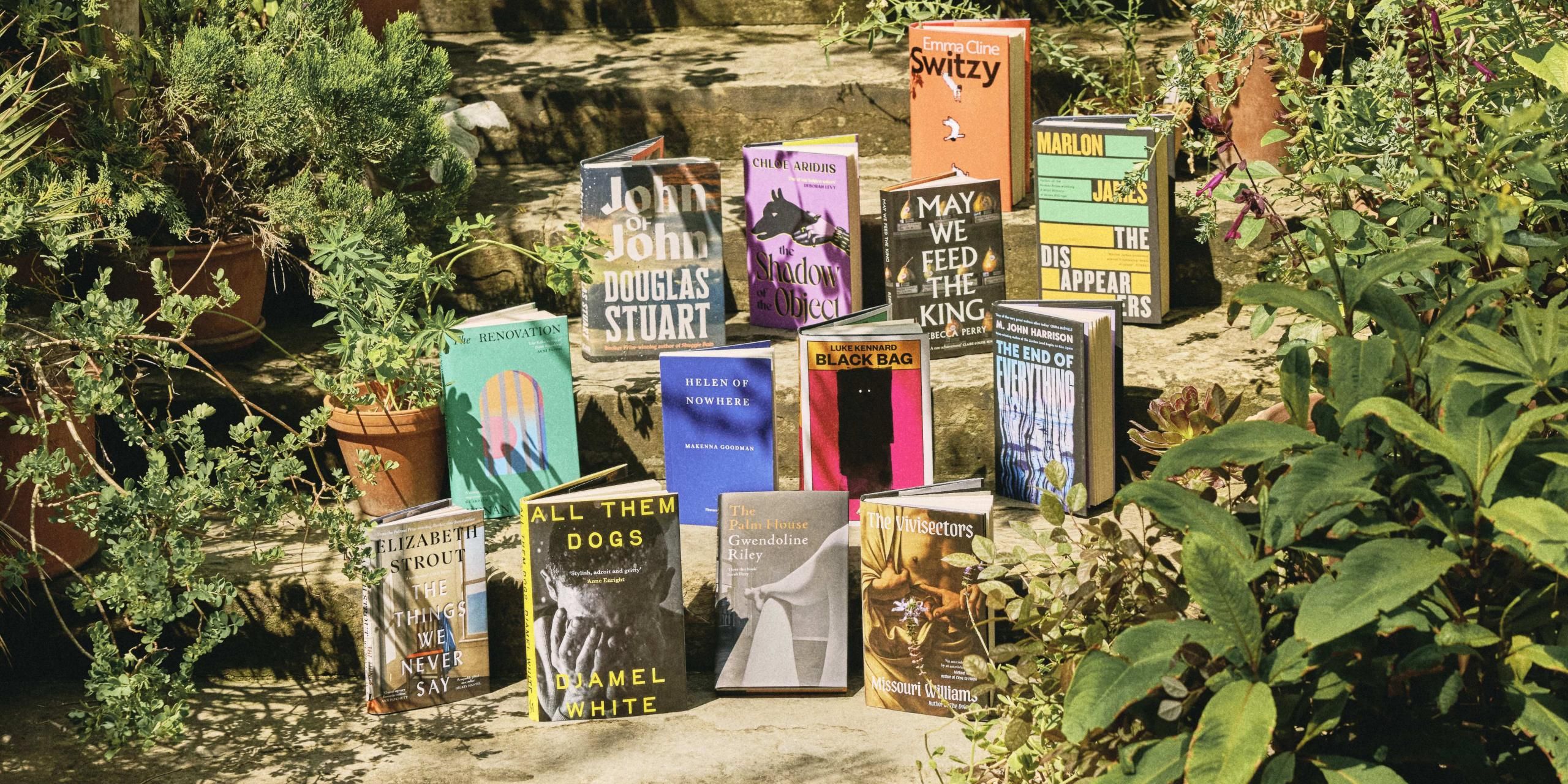
The 13 nominated books, and their UK publishers, are:
- The Shadow of the Object by Chloe Aridjis (Chatto & Windus)
- Switzy by Emma Cline (Chatto & Windus)
- Helen of Nowhere by Makenna Goodman (Fitzcarraldo Editions)
- The End of Everything by M. John Harrison (Serpent’s Tail)
- The Disappearers by Marlon James (Hamish Hamilton)
- Black Bag by Luke Kennard (John Murray)
- The Renovation by Kenan Orhan (Hamish Hamilton)
- May We Feed the King by Rebecca Perry (Granta)
- The Palm House by Gwendoline Riley (Picador)
- The Things We Never Say by Elizabeth Strout (Viking)
- John of John by Douglas Stuart (Picador)
- All Them Dogs by Djamel White (John Murray)
- The Vivisectors by Missouri Williams (4th Estate)

The Booker Prize 2026 longlist
© Yuki Sugiura for Booker Prize Foundation
Facts and figures: the longlist in numbers
The longlist features authors representing seven countries: Jamaica, Mexico, Turkey, England, Scotland, Ireland and the United States. Chloe Aridjis, who is Mexican-British, would be the first author of Mexican heritage to win the prize. Kenan Orhan, who is Turkish-American, would be the first writer of Turkish heritage to win.
The longest book on the list is Marlon James’s The Disappearers, weighing in at over 600 pages, while the shortest is Helen of Nowhere by Makenna Goodman – which is just over 140 pages, and one of six books on this year’s list that are under 250 pages long. The shortest winning novel in the history of the prize was Offshore by Penelope Fitzgerald, at 132 pages, in 1979; the longest was The Luminaries by Eleanor Catton, in 2013, at 832 pages.
The list features two previous winners – Scottish-American writer Douglas Stuart, who won with Shuggie Bain in 2020, and Jamaican author Marlon James, who won with A Brief History of Seven Killings in 2015. Only four authors have won the Booker Prize twice: J.M. Coetzee (1983 and 1999), Peter Carey (1988 and 2001), Hilary Mantel (2009 and 2012) and Margaret Atwood (2000 and 2019). Elizabeth Strout is the only other author on the list who has been nominated previously. She was shortlisted in 2022 for Oh William! and longlisted in 2016 for My Name is Lucy Barton.
One previous Booker Prize judge appears on the list: English writer M. John Harrison judged the prize in 2022. Should he win, he would be the prize’s oldest-ever winner, at the age of 81. That title is currently held by Margaret Atwood, who was 79 when she jointly won the prize in 2019. The youngest writer on this year’s list, at 28, is Djamel White.
The list includes three independent publishers/imprints – Fitzcarraldo Editions, Serpent’s Tail and Granta. Five books published by Penguin Random House imprints are nominated, including two apiece published by Chatto & Windus and Hamish Hamilton, plus one from Viking. Picador, an imprint of Pan Macmillan, is represented twice, as is John Murray, part of Hachette. 4th Estate, part of HarperCollins, has a book on the list,too.

The Booker Prize 2026 longlist
© Yuki Sugiura for Booker Prize Foundation
What are the books about... and what are people saying about them?
As Mary Beard says, the longlisted books are ‘set anywhere and everywhere: Ireland and Italy, Mexico and Massachusetts, Jamaica and the Hebrides, universities, private planes and pubs, past, present and future. But there’s one thing they all share. Every writer on our longlist brilliantly musters the power of words on the page to take the reader to new places, to see old places from new angles, to change minds.’
The books transport readers from a hospital in Mexico City (The Shadow of the Object) to the Kent seaside in a post-apocalyptic Britain (The End of Everything), from an unnamed medieval court (May We Feed the King) to a prison cell that defies all logic (The Renovation).
There’s humour and heartbreak, satire and surreality. There are fresh takes on dystopian sci-fi, royal history, the crime thriller and the campus novel. There are books about memory, mortality, metamorphosis and murder; about old lives and new worlds; about the things we hide from those around us and the limits of human understanding; about reconciliation and retribution; and about the many ways we reckon with the past.
In Chloe Aridjis’ The Shadow of the Object, Flora is recovering from an operation in a Mexico City hospital where she befriends an elderly German woman, Wilhelmina, a collector of antique toys. Our judges were ‘charmed by the novel’s meditation on friendship and grief, and its suggestion that the most meaningful truths can be found in the shadows’.
In Emma Cline’s darkly humorous and profoundly moving Switzy, a private plane transports David, a retired executive, across Europe en route to his final destination: an assisted suicide clinic in Zurich. Switzy explores what’s left of a person when their life’s achievements, relationships, contradictions and compromises are stripped away. Our judges called it ‘a story that feels immersive, elegiac, and very real’.
Brief, poetic, and sometimes surreal, Makenna Goodman’s Helen of Nowhere finds a disgraced university professor, known only as ‘Man’, seeking a new life in the countryside following the collapse of his marriage and career. In the Guardian, Jo Hamya called it ‘a perfect fairytale for our times’, while in the New York Review of Books, Joanna Biggs said it ‘offers up, exhilaratingly and naughtily, a myth for the man who needs to be shuffled offstage one way or another’. Our judges called it ‘philosophically, politically, and spiritually adventurous’.
M. John Harrison’s bleakly satirical and dystopian The End of Everything, his first novel in six years, follows Phillip Tennant, a scavenger eking out an existence with his aunt on the Kent coast, against a backdrop of societal collapse and a mysterious alien invasion. In the Financial Times, Catherine Taylor called it a ‘casually horrifying’ and ‘unexpectedly compassionate’ book. Our judges described it as ‘shimmering’ and ‘oblique’,and as ‘a book not just about everything, but about now’.
In The Disappearers, Marlon James returns to the late 20th century Jamaica that provided the backdrop to his Booker-winning A Brief History of Seven Killings to explore the murder of gay man – an actor rehearsing for a play – and its tragic consequences. Our judges said the book ‘examines territory Caribbean literature has rarely dared to occupy’, and is ‘written with the full complexity and love of someone who knows the place and its contradictions from the inside’.
Inspired by a true story and not to be confused with the 2025 spy movie, Black Bag by Luke Kennard finds a struggling actor accepting a role as part of a psychological university experiment: spend a term attending lectures zipped inside a large black bag to see how the other students react. A twisted campus satire and a love story of sorts, the book was admired by our judges for ‘its sharply crafted sentences, memorable sex scenes, and humour’. They added: ‘There’ll be a lot of discussion about what the novel has to say about the state of modern masculinity (fractious; confused)’.
Kenan Orhan’s debut novel The Renovation – which began life as a short story in the Atlantic – is built on a bizarre premise. When Dilara hires builders to install a new bathroom after her elderly father moves in with her, she finds that the workmen have instead created what appears to be a Turkish jail cell. Not a replica, but a magical portal to a fully functioning prison. Our judges said they were drawn to its ‘humour with a decidedly unsettling side’. They added: ‘It poses questions about political activism, about where you really belong, and about the different forms that “imprisonment” can take (from dementia to exile).’
Rebecca Perry’s debut novel May We Feed the King sets the tribulations of a reluctant monarch in an unnamed medieval court against the work of an unnamed modern-day curator dressing public displays in an historic palace. In the Guardian, Melissa Harrison called it ‘a highly wrought puzzle-box of a book which deliberately wrongfoots the reader at every turn’, while our judges described it as ‘a wonderfully enticing and eye-opening combination of themes, woven together with an extraordinary delicacy of touch’.
Gwendoline Riley’s keenly observed The Palm House follows two old friends, Laura and Edmund, whose social lives revolve around long evenings in a Southwark pub, setting the world to rights and navigating grief. Our judges called it ‘minimalist, precise, and indelible’, with ‘some of the best dialogue this side of Henry Green’.
Elizabeth Strout’s The Things We Never Say introduces us to Artie Dam, an ordinary Massachusetts teacher with an apparently comfortable life – yet who is quietly gripped with feelings of isolation and despair. In the FT, Diana Evans called it a ‘profound, resplendent novel that stares our present moment in the face while throwing a lifeboat to cling to in the storm’. Our judges said it was ‘brilliantly understated and all the more powerful for that’.
Douglas Stuart’s John of John follows the eponymous John-Calum MacLeod, a young art graduate, who returns reluctantly to his windswept, repressive and deeply religious home on the Isle of Harris to resume – and confront – his old life. Our judges said, ‘This excavation of family, violence and shame is woven through with beautiful imagistic detail.’
Djamel White’s savage and tender All Them Dogs plunges readers deep into West Dublin’s gangland, where murderous associates Tony Ward and ‘Flute’ Walsh find their criminal endeavours complicated by feelings of mutual attraction. Our judges praised the book’s ‘subtle, textured humanity’ hidden beneath its brutal, hyper-masculine exterior.
Last but not least, Missouri Williams’ gothic, otherworldly The Vivisectors, set in a verdant and crumbling university town, introduces fraudulent professors, militant gardeners, abusive mothers and cancel-culture conflicts. Pitched as a new kind of love story for a broken era, it was described by our judges as ‘genuinely experimental’, ‘rollickingly told’ and ‘a bracing antidote to the cozy campus novel’.

The Booker Prize 2026 longlist
© Yuki Sugiura for Booker Prize Foundation
Who are the authors?
The list contains a mix of fresh talent and established voices; up-and-coming writers and others who are deep into their careers. There are three debut novels – Kenan Orhan’s The Renovation, Djamel White’s All Them Dogs and Rebecca Perry’s May We Feed the King – the latter won the Waterstones Debut Fiction Prize earlier this month (July). Six debut novels have won the Booker in its 57-year history, the most recent being Douglas Stuart’s Shuggie Bain.
At the other end of the scale, M. John Harrison is the author of 13 novels, five short-story collections and an ‘anti-memoir’. The Things We Never Say is Elizabeth Strout’s 11th novel, while Luke Kennard has published seven full-length poetry collections – Black Bag is his third novel. The Palm House is Gwendoline Riley’s eighth novel.
While three of the longlisted authors have been recognised by the Booker Prize in the past, all 13 of them boast impressive literary credentials, with a number of accolades to their name.
In addition to winning the Booker, New York-based Jamaican writer Marlon James has won the American Book Award, the Los Angeles Times’ Ray Bradbury Prize for Science Fiction, the Anisfield-Wolf Book Awardand the Dayton Literary Peace Prize. Fellow Booker winner Douglas Stuart – who was born in Glasgow and lives in New York – has also won Debut of the Year and Book of the Year at the British Book Awards and been shortlisted for the National Book Award. As well as being nominated for the Booker twice prior to this year, Elizabeth Strout, who lives in Maine, is a Pulitzer Prize winner and has been nominated for the PEN/Faulkner Award and the International Dublin Literary Award.
Chloe Aridjis has won the Prix du Premier Roman Etranger in France and the PEN/Faulkner Award for Fiction. Emma Cline, from California, is, like Chloe Aridjis, the recipient of a Guggenheim Fellowship. She has also won an O’Henry Award and the Plimpton Prize from the Paris Review, and was chosen as one of Granta’s Best Young American Novelists.
American author Makenna Goodman’s first novel, The Shame, was named a Best Book of the Year by Harvard Review and The White Review; Helen of Nowhere is a finalist for the Vermont Book Award. Shopshire-based M. John Harrison has won the Boardman Tasker Prize, the Arthur C. Clarke Award and the Goldsmiths Prize.
Luke Kennard is an award-winning poet and Professor of Creative Writing at the University of Birmingham was named one of the ‘Next Generation Poets’ by the Poetry Book Society in their once-per-decade list in 2014. He has won the Forward prize for Best Poetry Collection and been longlisted for the Desmond Elliott Prize. Kenan Orhan, who is based in Kansas, has been a finalist for the PEN/Robert W. Bingham Prize and longlisted for the Story Prize.
Rebecca Perry is the British author of two full-length poetry collections – she has been shortlisted for the T. S. Eliot Prize and won the Michael Murphy Memorial Prize.
London-born Gwendoline Riley has won the Geoffrey Faber Memorial Prize for fiction, a Betty Trask Award and a Somerset Maugham Award, and has been shortlisted for the John Llewellyn Rhys Prize and the Rathbones Folio Prize. Djamel White is the recipient of a Literature Bursary Award and an Agility Award from the Arts Council of Ireland, while Missouri Williams, an English novelist based in Prague, is the winner of a Republic of Consciousness Prize, and has been shortlisted for the VCU Cabell First Novelist Award.
Away from writing fiction, they bring a wide range of personal experiences and varied back stories, too: Djamel White has managed a tattoo shop, Rebecca Perry has competed internationally as a trampolinist, Douglas Stuart worked in fashion design, and Marlon James was an advertising copywriter. Emma Cline says she was ‘a very bad child actor’ while Elizabeth Strout was, briefly, a self-described ‘terrible lawyer’.

The Booker Prize 2026 longlist
© Yuki Sugiura for Booker Prize Foundation


Features


- Reading guides
Reading guide: The End of Everything by M. John Harrison

- Reading guides
Reading guide: John of John by Douglas Stuart

- Reading guides
Reading guide: May We Feed the King by Rebecca Perry

- Reading guides
Reading guide: The Things We Never Say by Elizabeth Strout


- Book recommendations
The Booker Prize 2026 shortlist: what our judges said

- Reading guides
Reading guide: Black Bag by Luke Kennard

- Reading guides
