

Wolf Hall
by Hilary Mantel (prize winner)
In her Booker Prize 2026 shortlisted novel, Rebecca Perry moves between our present-day world and a medieval court and unsettles the idea that there’s ever one universal historical truth
Whether you’re new to May We Feed the King or have read it and would like to explore it more deeply, here is our comprehensive guide, featuring insights from critics, our judges, and the book’s author, as well as discussion points and suggestions for further reading.
She is a curator, who spends her time dressing the rooms of historic buildings to bring them to life. But in the lush private quarters of a medieval palace, she finds herself so transfixed by the reign of an almost-forgotten King that the edges of her life begin to blur.
He is a reluctant ruler with no hunger for power, rushed to the throne after the untimely deaths of his older brothers. But it isn’t long before whispers begin to fly around the court. And with the growing belief that the King is not fit for the throne comes the idea that another might rule in his stead.
May We Feed the King dances between the lives of a historical subject who risks the future of his kingdom and a woman who turns to the past to hide from her present.
May We Feed the King was shortlisted for the Booker Prize 2026.
The King
A reluctant monarch who unexpectedly inherits the throne following the deaths of his two older brothers. He has little appetite for power, yet finds himself at the centre of a court. Gradually, rumours emerge that he may be unfit to rule. He is seen largely through the observations and gossip of those around him, and remains an elusive figure while his reign becomes increasingly precarious.
The curator
An unnamed museum curator in the present day, who works to bring the past to life by dressing the rooms of historic buildings. She is reserved and becomes increasingly absorbed by the medieval world she is reconstructing, and turns to history as a refuge from her own life.
Rebecca Perry is an author and poet. She is the author of two full-length poetry collections – Beauty/Beauty and Stone Fruit – as well as four pamphlets. Her poetry has been shortlisted for awards including the TS Eliot Prize and her first collection won the Michael Murphy Memorial Prize. Her first work of creative non-fiction – On Trampolining – was published in 2023.
May We Feed the King won the Waterstones Debut Fiction Prize 2026. Perry is from London, where she also lives.
Rebecca Perry
© Robin Christian
Melissa Harrison, the Guardian
‘The King is given ultimate power – he can start wars, launch fleets, have subjects killed at a word – and yet its exercise requires total personal surrender: “the King sees an apple he would like to pick and someone is called to free it from the branch”. His growing misery is that of someone raised as a subject who has objecthood forced upon him, and we sympathise with his quiet and then not-so-quiet rebellion as he seeks to escape his plight. More widely, the novel asks us to admit that we can know almost nothing about history, or even about the lives of people with whom we live contemporaneously. To read May We Feed the King is to be richly entertained but forced to sit with frustration: we want clues, we want certainty, we want a story about the King that makes sense, and Perry withholds it, instead making us watch our own minds scrabble about, compulsively putting together the scattered pieces of the past.’
Olivia Ovenden, The Observer
‘May We Feed the King is lyrical and rich, but despite its poetic chapter titles and artistic observations, it bears the marks of a novelist’s intricate plotting and sense of pace. The mounting dread of the king, who “wears the face of a man who has been dropped in the middle of the ocean without warning”, sets the story off at a sprint. Perry captures the players of the court and the chain of gossip so successfully it feels as though we are observing history as it plays out. But what the book has to say about whether we can trust historical texts and records, and the propaganda they might inadvertently contain, is far more interesting.’
Clemme Reid, Times Literary Supplement
‘Most of all, May We Feed the King feels like a love story between the present and the past, especially when it returns to the curator and considers both the intimacy and the loss involved in recreating history. Hilary Mantel suggested in her Reith Lectures (2017) that historical fiction is an act of resurrection, that, “if we want to meet the dead looking alive, we turn to art”. In Rebecca Perry’s novel, we witness two kinds of resurrection: that found in the art of fiction and that found in the art of curation, both bringing the dead vividly back to life.’
Johanna Thomas-Corr, The Times
‘This is mishmash medievalism rendered in short sentences and snappy chapters with striking titles (Pussy, for example). Perry is a TS Eliot prize-shortlisted poet and her novel — much like the work of her friend AK Blakemore, author of The Glutton (2023) — prioritises poetic imagery, sensations and atmosphere over narrative, portraiture or historical inquiry. The vibes are strong, but it never quite approaches the domain of the real. Then again, perhaps that’s entirely appropriate. What Perry is interested in is interrogating our ideas of monarchy. A maid-of-honour sometimes imagines having a threesome with the king and queen, and sometimes imagines killing them, depending on her mood. Kings and queens really do inhabit two realms, one real, one symbolic, as projections of our fantasies, sometimes sexual, sometimes murderous. Considering our nation’s relationship with the royals, it’s hard to evade the sense that nothing much has changed there.’
‘Two characters – a woman using replica food scenes to conjure spirits in her home and a young attendant to a dying King – came to me separately, and I was writing them in two short stories. At a certain point I realised their world, in a way, was the same one and I embarked on the novel.
‘I knew I wanted to write historical fiction somewhat outside of the genre and, as the book developed, I became preoccupied by questions of memory, agency and imagination. Concurrently, horrifying global events unfolding on the orders of cruel, tyrannical men began feeding into questions the book had about power and responsibility.’
Rebecca Perry in an interview with the Booker Prizes.
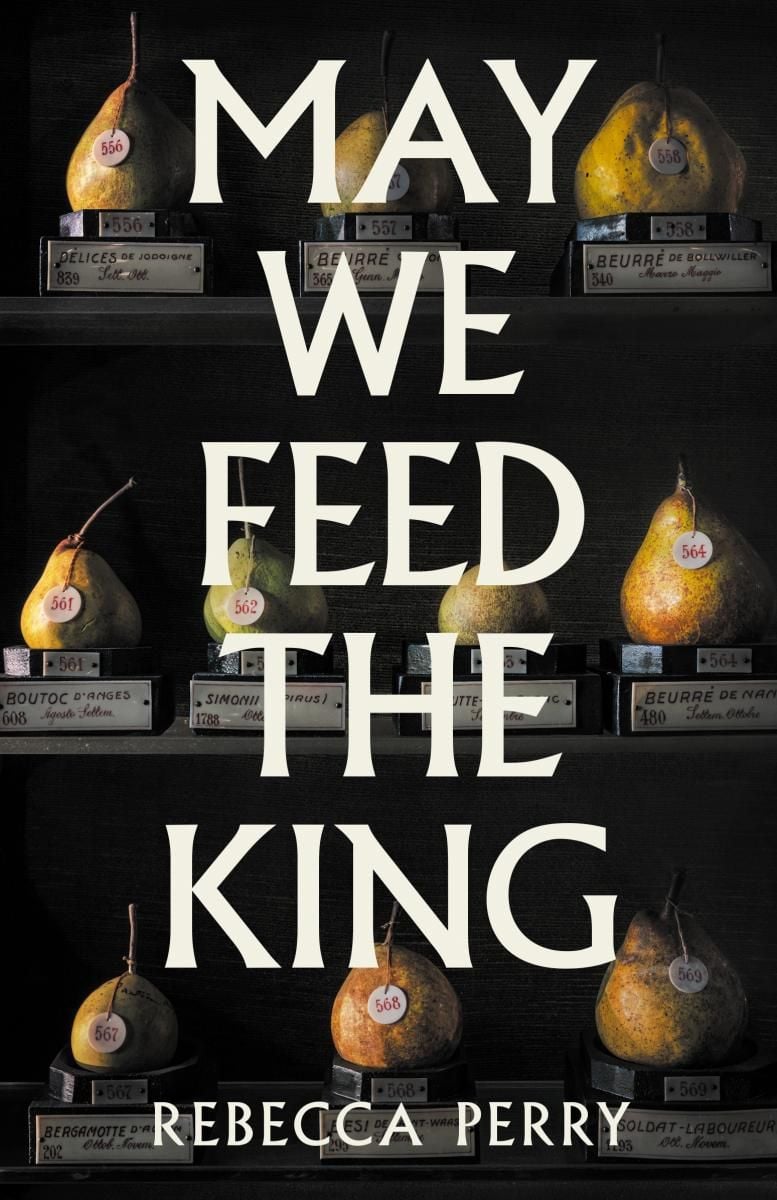
‘Perry combines the story of a reserved museum curator who recreates historical banquets, using a careful array of fake pies and pomegranates – with the story of a medieval king, reluctant to occupy the throne (and possibly unfit for it anyway). It’s a wonderfully enticing, and eye-opening, combination of themes, woven together with an extraordinary delicacy of touch. You can’t read May We Feed the King without reflecting on the fragile boundary between the present and the past. What’s the difference between historical fiction and historical fact? Can history ever be a safe place we can go to escape the present?’
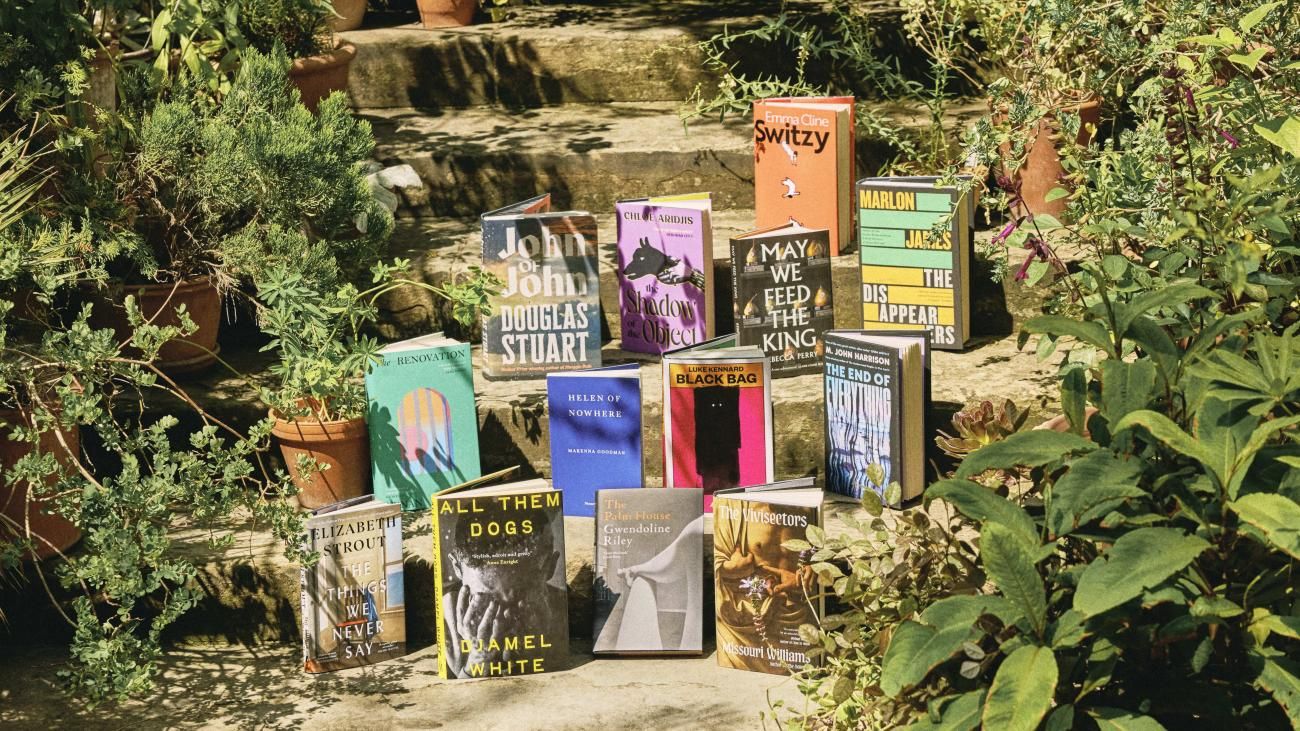
The Booker Prize 2026 judges – Raymond Antrobus, Patricia Lockwood, Rebecca Liu, Jarvis Cocker and Mary Beard – with the longlisted books
© Neo Gilder for Booker Prize Foundation
May We Feed the King is written with a dual narrative at its heart: that of the unnamed curator in the present, and a king in the past. How do these two strands speak to one another, and what does each add to the novel?
The text deliberately omits character names, dates and even locations. Why do you think Perry chose to exclude details that are usually considered so fundamental to plot?
The reluctant monarch is the third of his siblings to take the throne, following the deaths of his older brothers. How does the commonly known phrase ‘The King is dead, Long live the king’ (page 81), which Perry uses throughout the text, illuminate the tension between the mortality of an individual ruler and the continuity of the monarchy?
A review in the Guardian described the novel as one that deliberately ‘wrongfoots’ the reader at every turn. Which moments most unsettled your expectations, and how does the author use uncertainty to shape the way readers experience the story?
Perry creates a strong sense of the king’s character despite never giving us direct access to his inner world. Instead, we observe him through stolen and side glances, and through the accounts of others – some of these salacious, unreliable or even politically motivated. To what extent did you feel like a witness to events, and how does this indirect perspective mirror the way we understand others in real life?
Food recurs as a theme throughout May We Feed the King, from the title’s offer to the king’s own refusal or inability to eat. How does Perry use food – and the acts of feeding, feasting and fasting – to explore power and control?
A sense of unease runs through the text, reminding us that every monarch’s rule must come to an end, willingly or not. This finality is made explicit in the retold story of a missing king who is eventually found in a forest with his queen: ‘They were a long time dead, the King’s head resting on the Queen’s shoulder, the Queen’s hand of bones, bedecked with jewels, resting on his thigh. Vermin weaved in and out of the skeletons, one even asleep inside the King’s head.’ (Page 224). What might this scene suggest about mortality, and the legacy of monarchy?
The Booker Prize 2026 judges said the novel queried ‘the difference between historical fiction and historical fact’ and asked ‘can history ever be a safe place we can go to escape the present?’ Discuss whether we can ever fully trust historical records, and how bias or whitewashing shape those that are preserved.
Perry is also a poet, and her writing is suffused with wordplay. The novel is structured in short chapters and paragraphs, framed by abstract chapter headings. How did these stylistic and structural choices shape your reading experience?
In an interview with Waterstones, Perry said she did the bulk of her writing at a time ‘of particular global horror—the ongoing genocide in Gaza with Netanyahu at the helm, backed by a cast of chilling supporters in Trump and Putin, and not least our own government.’ How might contemporary political events and the wider political climate have influenced May We Feed the King?
Cold Magazine: Rebecca Perry on Her Debut ‘May We Feed the King’
Waterstones: An Exclusive Q&A with Rebecca Perry on May We Feed the King
The Guardian: Rebecca Perry: ‘Lorca hit me like a bolt of lightning’
by Hilary Mantel (prize winner)
by Hilary Mantel (prize winner)
by Penelope Lively (prize winner)