The Renovation is a heartbreaking portrait of one family caught in the tides of history, grappling with grief, exile, politics and the painful absurdity of love
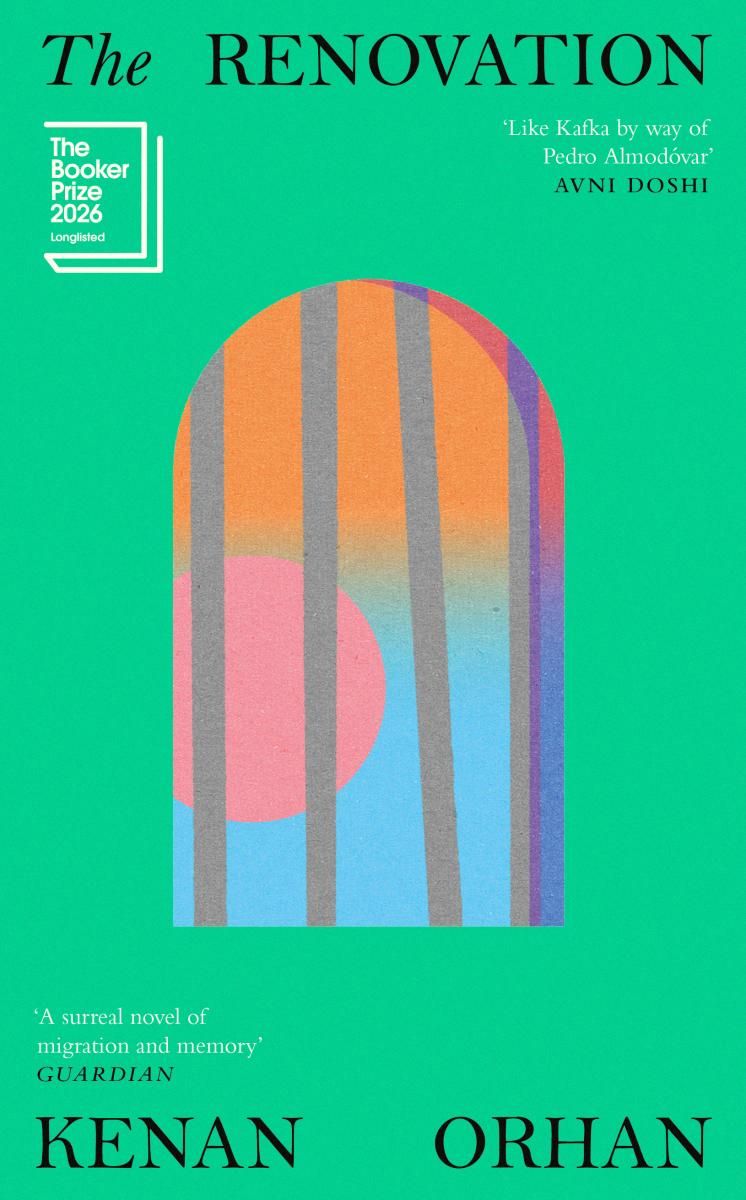
The Renovation
Written by Kenan Orhan
- Longlisted
- The Booker Prize 2026
- Published by Hamish Hamilton
Buy the book
The Renovation is a heartbreaking portrait of one family caught in the tides of history, grappling with grief, exile, politics and the painful absurdity of love
Dilara’s father is disappearing.
He has dementia and the disease steals a little more of him each day. Dilara has persuaded him to move in with her, hiring builders to adapt her apartment in preparation, but when the renovation is complete she discovers a big problem. Instead of a new bathroom, the builders have installed a Turkish prison cell.
At first she is outraged. There has surely been some mistake. Dilara’s family are exiles – they left Turkey many years ago and have never been back. The last thing she wants is a piece of her estranged homeland appearing uninvited in her new home.
But as the weeks pass, her indignation gives way to curiosity. Beyond the cell door, she glimpses Turkish guards going about their work. Through the cell walls, she hears Turkish prisoners murmuring, rustling, crying out in their sleep. And in the strange, impossible air of the cell itself, she smells the sesame scent of freshly baked simit, she tastes the fine dust of the Anatolian steppe on her tongue.
Even as she struggles to care for her father, to keep the family finances afloat and stop the wheels coming off her marriage, Dilara is drawn back again and again to the mysterious prison cell, and through it to a city that once belonged to her – to the salt wind off the Marmara, the sky full of gulls and domes and minarets – back to Istanbul.
The Renovation was longlisted for the Booker Prize 2026.

Kenan Orhan on The Renovation
‘The Renovation was born out of several obsessions, anxieties and angers all coming to a head at the same time. My frustration with Erdogan’s regime, the heartbreaking outcome of the 2023 elections, the political violence, human rights abuses, economic catastrophe, environmental and geological disasters all piling up – and then in parallel my longing to see the relatives in Turkey who I’d not been able to visit for years, and starting to notice my beloved grandmother’s lapses of memory, noticing too my own trouble holding onto images of the past. It seemed as if everything – my family, Istanbul, Turkey itself – was disintegrating, threatening to become unrecognisable and leave me hollow.’
Read the full interview here.
A hilarious fantasy which had some of the judges laughing out loud. But it also poses questions about political activism, belonging, and the different forms imprisonment can take
The Booker Prize 2026 judges
What the judges said
‘The Renovation starts with a surreal domestic disaster. Dilara, a Turkish exile living in an unremarkable Italian village, has asked some builders to renovate her bathroom. When they finish, she finds they have built her instead a brand-new prison cell, complete with a resident guard and mysteriously connected to a prison in Istanbul. It’s a hilarious fantasy which had some of the judges laughing out loud. But it’s more than that. It poses questions about political activism, about where you really belong, and about the different forms that ‘imprisonment’ can take (from dementia to exile). It’s humour with a decidedly unsettling side.’
What the critics said
Kirkus
‘There’s a lot of emotional power between the drama and the premise here—what seems merely impossible is quickly overwhelmed by the tale’s connecting thread, this inability to recover what has been lost. It’s an odd, elegant little book with disarming sincerity that belies its metaphysical hocus pocus, held aloft by keen literary wordplay and an evocative exploration of what homeland really means.
A one-way trip to the Twilight Zone via a self-imposed life sentence.’
Victoria Zhuang, Harvard Review Online
‘Exile for many immigrants is its own form of imprisonment, Orhan suggests. Secluded in the mountains outside Salerno, Dilara has become invisible, bereft. Attempting to assimilate once she moved, she rarely spoke her mother tongue but failed anyway to find work in her former occupation as a school psychologist. She resigned herself to becoming a housewife. Her once passionate marriage became stale. “Life becomes a silt around your relationships, and before you know it, you’re half buried and unable to adjust,” she observes.
Orhan’s prose, though, is like a continual breaking out of that silt. His words are resonant, limpid, and wistful, like a series of camera flashes with the resultant frames whirring by in a reassuring succession of committed motions.‘

Features


- Book extract
An extract from The Renovation by Kenan Orhan

- Book recommendations