


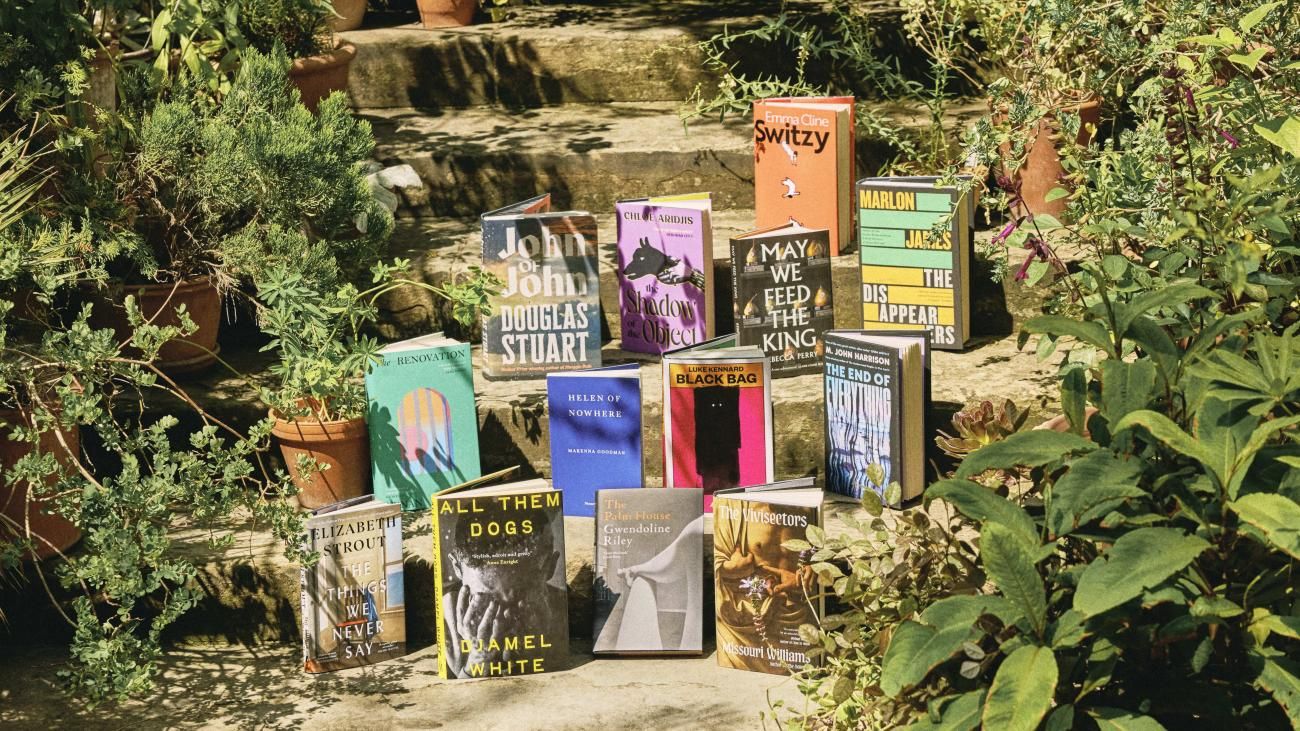
A novel of enduring friendships and small mercies, The Palm House offers us Gwendoline Riley’s trademark keen observation and wit, and leaves us – somehow – with a curious sense of possibility
- Published
The author of The Palm House, longlisted for the Booker Prize 2026, talks about Shakespeare, Sherlock Holmes and the feeling of apprehension behind her writing career
Buy the book
The inspirations behind my Booker-longlisted book
It’s mysterious how these things work. Each novel I write feels like the only move I can make in that moment. I sometimes feel a bit on the back foot about that. Scenes come to me and I work to get them right and then to get the structure of the novel right. I listen to the prosody. If things are arranged correctly, then the feeling comes through. I use what’s to hand: my observations of the world, and of how people live.
The book that made me fall in love with reading
Reading is a dimension of life I’m grateful for, but I’m not in love with reading. If the question is what I read as a child, I liked The Swiss Family Robinson, and after that, Sherlock Holmes stories.
The book that made me want to become a writer
That wasn’t how it worked for me. It comes back to what I said about being on the back foot. It was a feeling of apprehension – in several senses of the word – that indicated that I had to write novels.
The book I read again and again
Every couple of years I seem to have a phase of puzzling out Shakespeare’s sonnets. And then Villette, and Dr. Glas by Hjalmar Söderberg.
The book that changed the way I think about the world
In my twenties I read a lot by an American novelist whose work had a vitality and a righteousness to it that I felt very invested in. I didn’t see what else was there. Decades on, I know why: I think the phrase is ‘adaptive preference’. That was a symptom of how I thought about the world. Books that have deepened my understanding of life would include Annie Ernaux’s Happening and Chekhov’s A Journey to the End of the Russian Empire. Both detail a determined author’s trek into the unknown. Both impressed upon me indelible scenes of human variety, of squalor, endeavour, and nobility.
In the summer, I’m at my desk very early in the morning. I like ambient street sounds, which I have in my flat
The book that changed the way I think about the novel
I’d like to think I’ve no fixed ideas about the novel. If I do, they’re likely hiding in plain sight. Maybe they’re even rightly unassailable! Novels, for me, are looking to get closer to the truth by showing the truth. I can’t fail to mention Rachel Cusk’s Outline trilogy here. That knocked some barnacles off. In my recent reading, Big Kiss, Bye-Bye by Claire-Louise Bennett and Trieste by Daša Drndić took approaches I hadn’t seen elsewhere. But literature does interesting things by definition. Like any reader, I enjoy writing that is vivid, accurate and resourceful.
The book I’m reading right now
I’m trying to write something set in Europe, and on the coast, so I’m reading around that: a Simenon novel set in Batumi, some Chekhov stories: ‘The Duel’ and ‘Ariadne.’ I might end up pinching the structure of ‘Ariadne’, which opens on a boat. I’ve just started on some Ovid – Tristia and the Black Sea Letters, translated by Peter Green.
Where I most like to read
Recently I’ve been on a few long train journeys around Europe. That was a good situation. Those trains aren’t like England’s trains.
Where and when I most like to write, and the tools I need
In the summer, I’m at my desk very early in the morning. I like ambient street sounds, which I have in my flat.
The Booker-nominated book everyone should read
I wonder if I’m lighting on In a Free State, by V.S. Naipaul, because that begins on a boat, too, with the prologue ‘The Tramp at Piraeus’. The Enigma of Arrival is another favourite of mine by him, and has a similar, unusual structure.
The Palm House
- Published by
- Picador
A novel of enduring friendships and small mercies, The Palm House offers us Gwendoline Riley’s trademark keen observation and wit, and leaves us – somehow – with a curious sense of possibility


Features

- Book extract
An extract The Palm House by Gwendoline Riley
- Book recommendations