
This selection of books from the Booker Library promises jaw-dropping twists that showcase the art of great storytelling
10 of the best memoirs by Booker Prize-winning authors
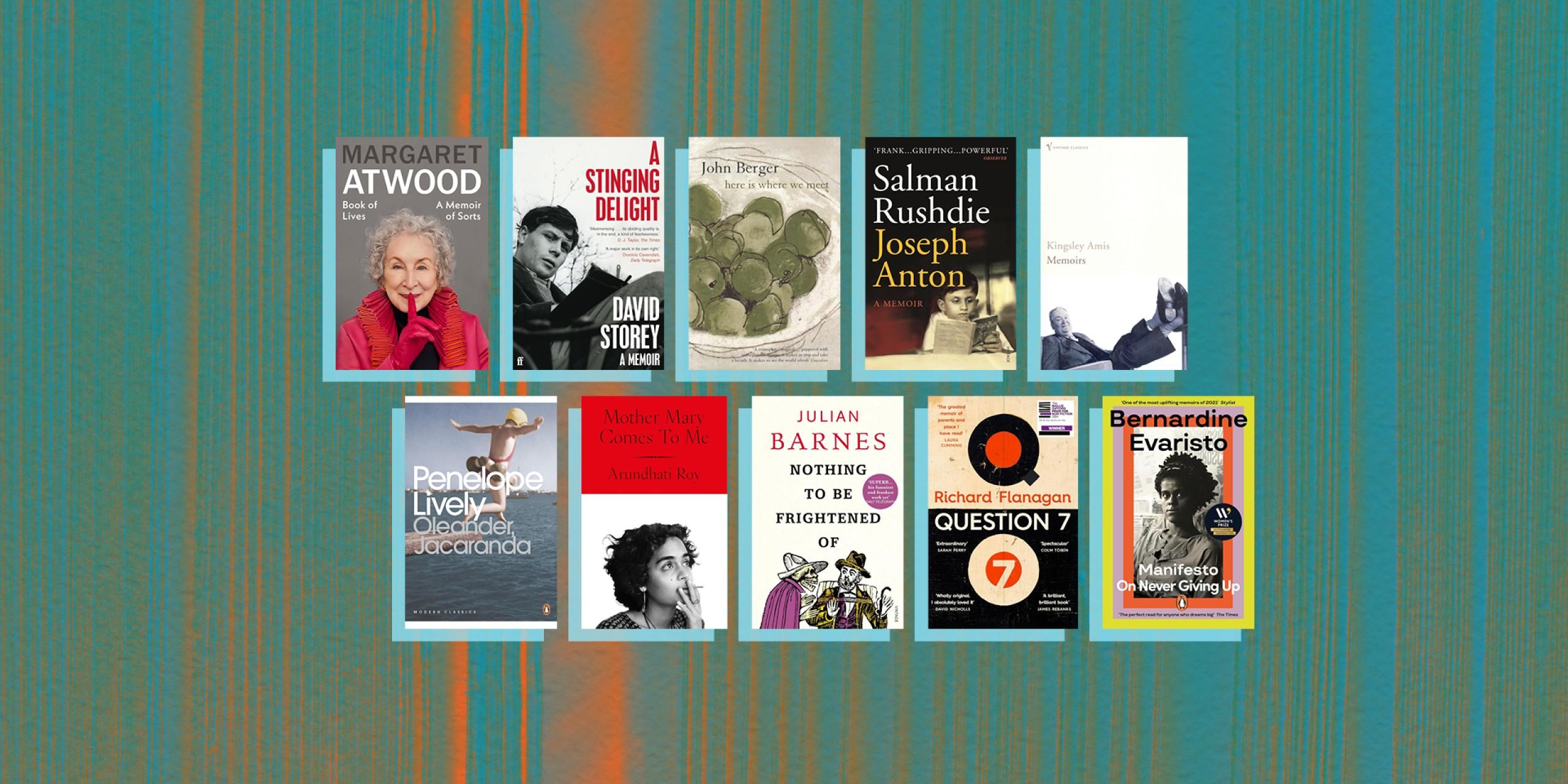
10 of the best memoirs by Booker Prize-winning authors
- Written by
- John Self
- Published
Discover the personal lives of some of the greatest Booker-winning authors with our handpicked list of captivating autobiographies, and find out why truth can be just as compelling as fiction
Every novelist leaves a trace of themselves on every page, but not all are willing to share the true story of their lives. In fact, of the 55 writers who have won the Booker Prize, only a small number have written an autobiography. Some have played with the idea, such as 1975 winner Ruth Prawer Jhabvala, whose 2004 book My Nine Lives is a ‘potentially autobiographical’ account of ‘nine possible lives’ she might have lived.
As double Booker winner Margaret Atwood publishes her own long-awaited memoir, Book of Lives, we cast an eye over 10 Booker winners who have published their life story – in one form or another – and what we learned about them.
Oleander, Jacaranda by Penelope Lively
Lively won the Booker in 1987 for Moon Tiger, a novel about personal and collective memories. They are also the subject of her memoir Oleander, Jacaranda (1994), which focuses on her childhood in Egypt in the 1930s and 40s – or at least her childhood as ‘distorted by the wisdoms of maturity’.
If all childhoods are at once universal and unique, then Lively’s is more intensely divided than most. ‘Egypt was my home,’ she writes, ‘but I realised that in some perverse way I was not truly a part of it.’ What was ordinary for her – a governess rather than going to school, servants, ‘more like another century than another place’ – was, as she came to realise, extraordinary. Her family was part of the extended reach of the British Empire, marked in pink in her childhood atlas, like ‘a global rash’. She recognised her privileged upbringing, too: she didn’t encounter working-class Britons until soldiers arrived during the Second World War.
This is a book full of colour and extraordinary details, like the snake charmer who came to their home as ‘an esoteric form of spring cleaning’. And there is a reflective vein running throughout: for example, the pyramids in Egypt were just a part of childhood, ‘neither here nor there’, yet when Lively saw them again as an adult, they were laden with cultural significance, and she could no longer see them as she had when young. And she shares her love for reading – from Dickens to Kipling to the King James Bible (‘it gave me a grounding in the English language’). Her love for books also led to a rare example of punishment in an otherwise kind environment: having her Oxford Book of English Verse confiscated, for reading it under the bedclothes at night.

Penelope Lively
© Roberto Ricciuti/Getty Images
A Stinging Delight by David Storey
Storey, who won the Booker Prize in 1976 for Saville, was born in the same year as Penelope Lively – 1933 – but his upbringing in the north of England, and the memoir that came out of it, could not be more different. Storey wrote his memoir in the 1990s but shied away from publishing it; it only appeared in 2021, four years after his death.
Immediately we can see why. This is an exceptional memoir: stark – even bleak – and entirely unsparing in its account of Storey’s suffering throughout his life. It opens with a powerful address to Storey’s older brother, Neville, who died as a child while Storey was in his mother’s womb. His mother, traumatised, was unable to love her new son, and Storey attributes to this the sense of mental distress which never left him through his life. This is exemplified in a shocking account of almost throwing himself in front of a London Underground train, and periods in psychiatric hospitals in later life due to mental ill health. The whole book is addressed to Neville, which gives it an intimacy but also a distant quality, though the opacity of Storey’s feelings is not surprising for an author whose books were full of loss and had closed titles like Saville, Pasmore (shortlisted, 1972) and Radcliffe.
But there is energy here, too, driven by Storey’s many lives. He was an artist, a playwright and a poet, as well as a novelist who began his first book on the toilet at home: the only place he could find quiet. (‘How long are you going to be in there?’) On top of this he was a teacher – there’s a scene of visceral violence when he punches two pupils who try to attack him in a gang – and a professional rugby player: his £400 signing fee was ‘the largest single sum of money anyone in our family had ever seen’. Storey brings his novelist’s skills to snappy scenes of his professional dealings with actors and filmmakers. But the tenderest moment in this tough book is addressed to Neville, again, when Storey reflects that as a writer in London, ‘I would come as close as I could to the David I might have been had your death not occurred: untortured, accessible, eager to begin’.

David Storey
© Associated Press / Alamy
Nothing to be Frightened Of / Levels of Life by Julian Barnes
‘This is not, by the way, “my autobiography”,’ writes Julian Barnes in Nothing to be Frightened Of (2008). Never believe anything a novelist tells you. Although the book is predominantly an exploration of death, it also contains family memories. We learn about Barnes’s warm relationship with his older brother, and about his father’s decline, ‘after medical science had prolonged his life to a point where the terms on which it was being offered were unimpressive’.
There are lighter elements, too, like how his mother was so disturbed by the ‘filth’ in Barnes’s debut novel Metroland (1980) that ‘she would show friends the cover of the book, but not allow them to look inside’. And surprises: Barnes sees himself as ‘soppy’, not ‘cerebral’, which is odd coming from one of our coolest, most analytical prose writers, and from the man who later says, ‘I have never visited the grave of a single member of my family’. It’s apt that Barnes blends forms (essay, memoir, history) when writing about his life: he has always been a restless novelist, mixing essays and fiction (Flaubert’s Parrot, shortlisted 1984), satire and politics (England, England, shortlisted 1998), historical facts and switching narrative viewpoints (Arthur and George, shortlisted 2005).
The same multi-format approach appears in Levels of Life (2013), part of which addresses ‘the turmoil of my brain’ following the death in 2008 of his wife, Pat Kavanagh. It is a powerful account, offering bitter comedy (‘I was advised to get a dog. I replied sarcastically that this did not seem much of a substitute for a wife’) and the darkest honesty: Barnes contemplated suicide but, as ‘I was her principal rememberer … I could not kill myself because then I would also be killing her’.
Like his Booker winner The Sense of an Ending (2011), Barnes’s memoir writing looks to life in the past and death in the future. The same pattern appears in his forthcoming – and final – book Departure(s), where he writes about his own experiences of ageing and ill health. Once again, he warns against ‘lapsing into the easy garrulity of autobiography’. Once again, he’s lying to us.

Julian Barnes
© Alan Edwards / Alamy
Memoirs by Kingsley Amis
For pure entertainment value, Amis’s memoirs – published in 1991, five years after he won the Booker Prize with The Old Devils – are hard to beat. He makes it clear that this will not be a sequential account of his life. ‘I have already written an account of myself in twenty or more volumes, most of them called novels.’ He despatches his main life events in two paragraphs at the end of his preface. Instead, this is a selection of anecdotes and revelations about the people he met during his career.
Highlights include meeting Roald Dahl, who advised Amis there was good money in children’s fiction. When Amis said he had ‘no feeling for that kind of thing’, Dahl replied, ‘Never mind, the little bastards swallow it’. There are nuggets for Booker followers, too. Judge Philip Toynbee, having dinner at the home of the novelist Ivy Compton-Burnett in order to write a profile of her, got so drunk with nerves beforehand that he ‘passed out with his head in the fish course and remained unconscious for some hours’. Meanwhile, Malcolm Muggeridge, who resigned from the Booker judging panel in 1971, was ‘the laziest television interviewer’ Amis had ever experienced.
And it includes Amis’s account of the 1986 Booker Prize, where in his acceptance speech he joked that ‘until just now I had thought the Booker Prize a rather trivial, showbizzy caper, but now I considered it a very serious, reliable indicator of literary merit’. When some newspapers reported this as a straight disparagement of the prize, Amis made a note to himself. ‘Never make a joke against or about yourself that some little bastard can turn into a piece of shit and send your way.’

Kingsley Amis
© Trinity Mirror / Mirrorpix / Alamy
Manifesto: On Never Giving Up by Bernardine Evaristo
This 2021 memoir covers a remarkable range of events and phases in Bernardine Evaristo’s life in a short space, with not a word wasted. We get Evaristo’s origins, and how her white mother and Black father faced opposition to their mixed-race marriage from those closest to them: ‘it was seen as the worst thing to happen to my mother’s family’. And also how their family’s class ambition, to ‘better themselves within the system, not bash away at its walls’, gave Evaristo opportunities that led later to her artistic and literary success.
Evaristo also talks frankly about the development of her sexuality in her youth, the men and women she has loved, and the ‘reservoirs of emotion’ and ‘gallons of tears’ involved. One particularly resonant account is of Evaristo’s relationship with the domineering and emotionally abusive woman she refers to as ‘The Mental Dominatrix’ – and readers of her Booker-winning Girl, Woman, Other (2019) may recognise elements of the controlling relationship in which the character Nzinga holds Dominique.
And on her writing, Evaristo is fascinating about the difficult process involved in creating her fiction, which often blends poetry and prose – ‘my experimental gene, the need to be different, has always been there’ – though as the book’s subtitle suggests, the true key to her success has been to never, ever quit.

Bernardine Evaristo
© Jennie Scott
Book of Lives by Margaret Atwood
Atwood’s memoir is a whopper of a book, but she reveals little of her inner life: this is a book of busy entertainment about her upbringing, marriage and work. And best of all, she gives accounts of most of her six Booker Prize shortlistings (including two victories).
Atwood’s first shortlisting was in 1986 for The Handmaid’s Tale – for which she credits the book’s long life. She knew she didn’t ‘have a hope in hell of winning’, and when Kingsley Amis took the prize, her fellow shortlisted Canadian, Robertson Davies, remarked to her, ‘The English are very kind to their old entertainers’. Her second shortlisting, for Cat’s Eye in 1989, was also disappointing. But, she observes, ‘no literary prize depends on your own active participation, so you can’t exactly fail at it. More like Best Pig in Show: the pig stands there looking fat as someone else pins a ribbon on it’.
For Alias Grace (shortlisted in 1996), Atwood also knew she wouldn’t win since the chair of the judges, Carmen Callil, ‘announced in her speech that we’d had enough of colonials and the Celtic fringe, and it was time for an English man to win’. (Graham Swift duly took the prize.) Finally, in 2000, her wait was over – as was her long-running wager with Beryl Bainbridge ‘as to which of us could get nominated for the Booker Prize the most times without actually winning’. The Blind Assassin won. ‘Whew, I thought. I no longer have to deal with reporters asking why I didn’t win,’ she writes, ‘only with the ones who’ll be saying why I shouldn’t have.’

Margaret Atwood
© Luis Mora
Joseph Anton / Knife by Salman Rushdie
‘He had seven good years,’ writes Salman Rushdie, who writes about himself in the third person in his 2012 memoir Joseph Anton. The seven years were between Midnight’s Children (1981) winning the Booker Prize, and the publication of The Satanic Verses (shortlisted, 1988), which led to a death sentence from Iran’s leadership.
The book is a page-turning, tense, but surprisingly funny account of Rushdie’s exile under the fatwa: the police protection, the pressure on his already failing marriage, the absurdity of being unable to walk out of a terrible film because he can’t be seen in public. Rushdie names all those who supported him in his ordeal – including Ian McEwan and Michael Foot – as well as those who didn’t, such as George Steiner and the ‘big unfriendly giant’ Roald Dahl. The greatest pressure of all, however, might have been receiving Harold Pinter’s poems. ‘If Harold had your fax number these poems would arrive from time to time and needed to be praised as soon as possible.’
The energetic spirit of Joseph Anton is a little diminished in Rushdie’s second memoir, Knife, written after the fatwa-inspired stabbing in 2022 which almost killed him. Rushdie ‘just stood there like a piñata and let him smash me,’ he writes. He has no sense of humour for the friend who joked in an interview of the famously sociable Rushdie that ‘now that I couldn’t go to cocktail parties I could finally focus on my writing’. Yet the message that comes through from Knife is that love – of his new wife, of his old friends, of the act of writing – will always win in the end.

Salman Rushdie
© Joerg Carstensen/Alamy
Here is Where We Meet by John Berger
Berger was always an iconoclastic writer – he famously attacked both the concept of literary awards and the Booker Prize sponsors in his acceptance speech when he won for G. in 1972 – and his approach to autobiography is no different. Here is Where We Meet, published in 2005, shows Berger mellowed but no less original: the book is structured as autofictional encounters with the ghosts of people Berger knew through his life. It is a work of great charm and beauty.
These include memories of his daughter Katya, or Hubert, a neighbour in Islington – this was, Berger wants to make clear, before the area became fashionable – who looked ‘like a 19th century bookbinder’. The most beautifully recounted friendship is with Ken: ‘for six or seven years he was the most influential person in my life’. Berger was a teenager at a ‘lunatic boarding school’ when he met 40-year-old Ken: ‘the apoplectic headmaster threw a dining-room chair at the Latin teacher, and Ken, who happened to be between them, caught it with one hand in mid-flight’. There’s a beautiful scene where Ken and young John play cards and quoits with John’s parents, who can see how Ken’s mentorship has made their son grow up and ready to make his own life.
Berger’s father did not cope well with his son going his own way: there were ‘cruel and bitter fights’, Berger writes, adding that ‘I’m writing this with a worn pencil whose marks are faint […] for what I’m saying, twenty-five years after his death, can still only be said in a whisper’. And mothers can never be fooled, even after death: in one imagined conversation, when Berger makes a reference to Leopold Bloom from James Joyce’s Ulysses, ‘Don’t show off!’ his mother retorts. ‘There’s nobody here to notice.’

John Berger
© Ulf Andersen/Getty Images
Mother Mary Comes to Me by Arundhati Roy
‘Most of us are a living, breathing soup of memory and imagination,’ writes Arundhati Roy, acknowledging both the ambiguities and creative impulses in her 2025 memoir. It is a tribute to, and a reckoning with, her mother, the ‘crazy, unpredictable, magical, fierce, free Mrs Roy’. Her mother was a woman of drive and ambition, who set up her own school, turning boys into ‘respectful men’ and transforming girls: ‘she gave them spines, she gave them wings, she set them free’.
But the other side of her strength was cruelty, and as Roy’s brother reminds her, ‘she treated nobody as badly as she treated you’. ‘After all these years of thinking about it,’ Roy adds, ‘I have concluded that I grew up in a cult.’ In this book she recreates her mother, in full colour and larger than life.
This is also a book about Roy herself, how she became a writer – her literary education came from her mother, too – and how winning the Booker Prize in 1997 for The God of Small Things led her to live in a ‘cage […] made of privilege, money and property’. It is a passionate, funny, engrossing life story – and as a bonus, another of the authors in this list makes a guest appearance. After a literary event, Roy spent the day in Ferrara, Italy with her friend John Berger, shopping for bras for Mrs Roy. ‘Each time we entered a shop, I hung back to experience the sheer delight of this extremely handsome eighty-something man say in his British-accented Italian, “Excuse me, could you show us what you have in a size 44DD?”’

Arundhati Roy
© David Levenson/Getty Images
Question 7 by Richard Flanagan
‘Do you need all these books?’ Richard Flanagan’s father would ask him. ‘Doesn’t the library have them?’ This instilled in Flanagan a sense of shame at his bookshelves and their ‘vulgar display of possession’ – and such tormented emotions run all through his 2024 memoir Question 7. Like Julian Barnes’s memoirs, it blends personal history with essay – such as about the development of the atom bomb which saved the life of Flanagan’s father, a prisoner of war in Japan in 1945. (Readers of his 2014 Booker winner The Narrow Road to the Deep North will recognise the setting.) There is personal memory, too, in a breathtaking account of how Flanagan as a youth almost died – in some senses he feels he did die – while kayaking.
Flanagan’s father was reserved, especially about his wartime experiences – when young Richard asked ‘how many Japs he had killed’, his father rejected the question with a ‘ferocity’ he had never shown before – but his mother was the opposite. Yet she was constrained by her society, in mid-century Tasmania. ‘She needed adventures and vistas [but] she had to make do with stillness, a suburban backlot […] and six kids.’
Question 7 also acknowledges that these people who gave us life can never truly be recreated in words. One section of the book consists simply of the words ‘My mother and my father—’ before breaking off into silence.

Richard Flanagan
© Ulf Andersen/Gamma-Rapho via Getty Images


Features

- Book recommendations
Seven Booker Prize-nominated post-apocalyptic books

- Book recommendations
11 epics from the Booker Library for fans of The Odyssey

- Book recommendations
South Asian Heritage Month: 12 books to read from the Booker Library

- Book recommendations
Staff picks: our favourite Booker Prize-winning books

- Book recommendations
10 Booker Prize-nominated books featuring complicated sibling relationships

- Book recommendations
10 Booker Prize-nominated books that explore sapphic love

- Book recommendations
10 Booker Prize-nominated books that explore mid-life crises

- Book recommendations
11 of the best debut novels that were nominated for the Booker Prize

- Book recommendations
The best children’s books for Christmas written by Booker Prize authors

- Book recommendations