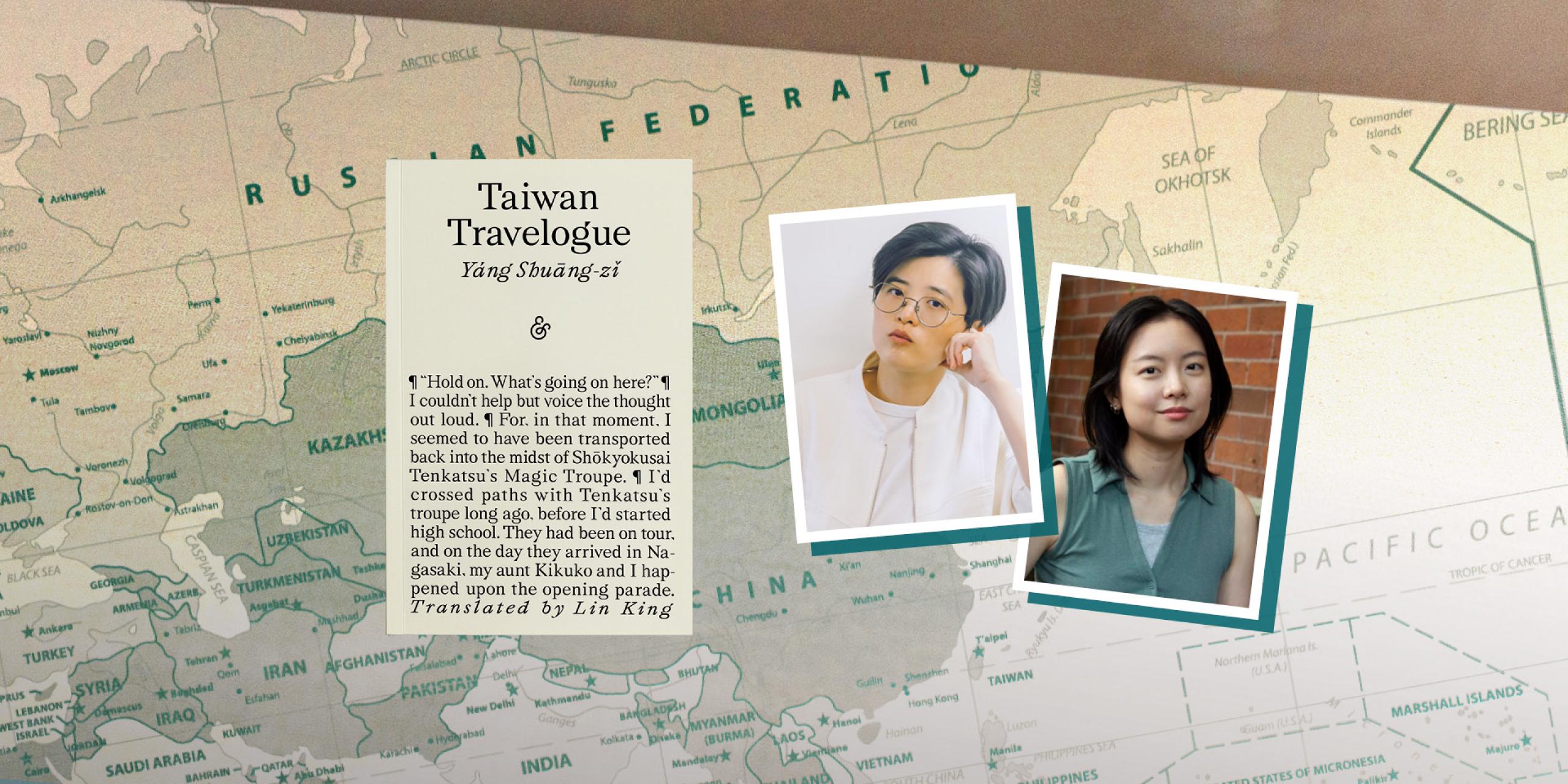

‘“Hold on. What’s going on here?” I couldn’t help but voice the thought out loud. For, in that moment, I seemed to have been transported back into the midst of Shōkyokusai Tenkatsu’s Magic Troupe. I’d crossed paths with Tenkatsu’s troupe long ago, before I’d started high school.’
- Published
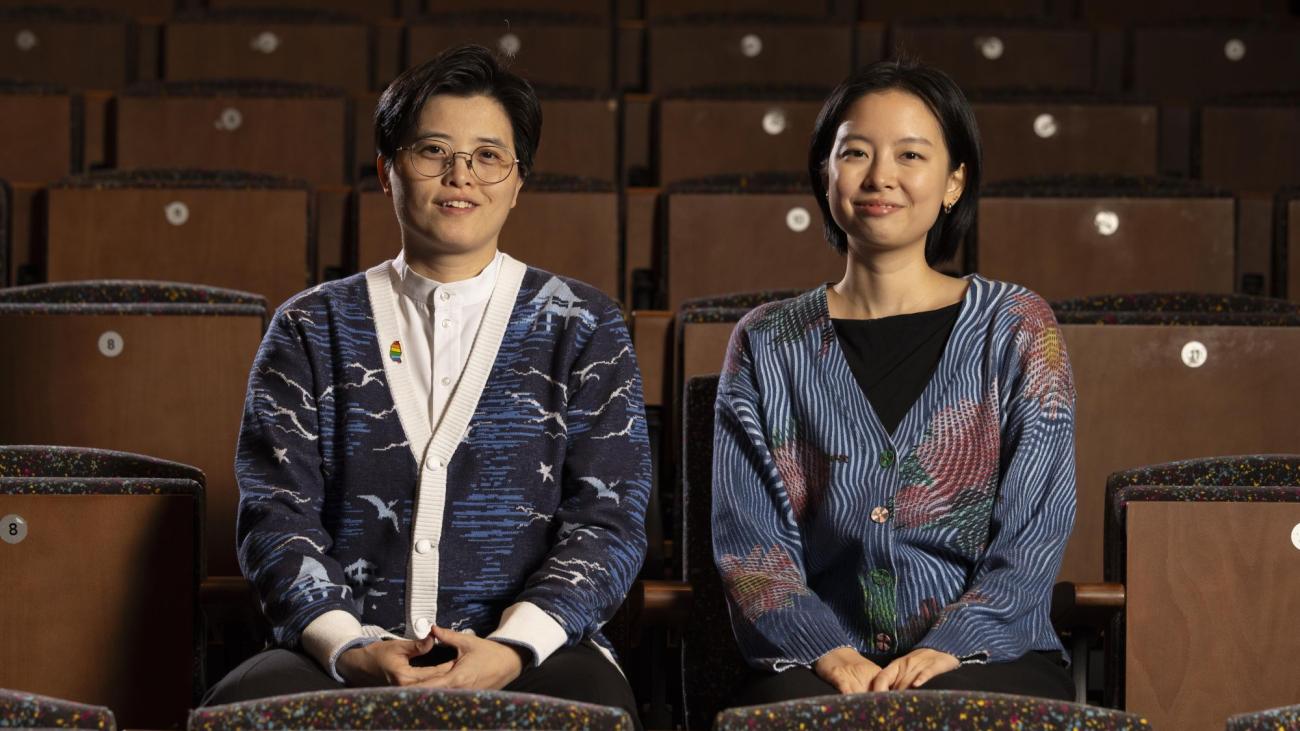
The International Booker Prize 2026 winning author and translator on untangling complex colonial histories, and why reading books in translation is the best kind of travel
Yáng Shuāng-zǐ
Could you tell us about the inspirations behind Taiwan Travelogue?
Both Korea and Taiwan were once colonies of the Japanese Empire, but Koreans seem to feel uniformly resentful of that history, whereas Taiwanese people regard it with a much more conflicted mix of distaste and nostalgia. Using a contemporary Taiwanese lens, I wanted to untangle the complex circumstances that Taiwan’s people faced in the past, and to explore what kind of future we ought to strive toward.
How did you go about writing the novel?
Sometime in the second half of 2017, I came up with an outline and wrote the first chapter. I didn’t formally begin working on the project until 18 February, 2019, and completed the first draft on 20 August of the same year. Research for the novel’s central themes of travel and food changed my life in two obvious ways: my savings went down; my weight went up.
The theme of this year’s International Booker Prize campaign is ‘Fiction beyond borders’ – how do you think translated fiction helps readers see beyond geographical boundaries, and why is that important?
For someone like me, who can only read in one language, my field of vision looking out into the world would be drastically reduced if not for translation. Translated literature is a second pair of eyes for me. But that’s not all – to me, translators are essential guides who lead readers deep down the rugged roads of unfamiliar lands.
The International Booker Prize is celebrating its 10th birthday in its current form this year – how do you think the award has changed the perception of translated fiction over the last decade?
Over the past 10 years, the International Booker Prize has given equal recognition to authors and translators. This emphasis on equality has helped change how people understand translated literature, and I think it has genuinely helped readers appreciate that literary translation is only possible through the collaboration between two creatives.

Yáng Shuāng-zǐ
© YJ Chen
Researching central themes of travel and food changed my life in two obvious ways: my savings went down; my weight went up
Yáng Shuāng-zǐ
Could you tell us about a book that made you fall in love with reading as a child?
Dragon Ball by Akira Toriyama. Its serialisation began in 1984, the year I was born, and concluded when I was 11 – a total of 42 collected volumes. It’s a work that showed me how to read and how to create stories. It was the starting point for me in my resolve to become a creative.
And could you tell us about a book that made you want to become a writer?
Unfortunately, there’s no single book that I can name. What first drove me to write fiction was the mid-1990s popularity boom of Taiwan’s homegrown romance novels. My middle school classmates decided to form a writing group together, though of the five of us, I’m the only one who kept writing.
Is there a book that changed the way you think about the world?
The Analects, the foundational text of Confucianism composed about 2,000 years ago. When I read it as a teenager, it bestowed in me a fierce admiration for the Chinese culture that was centred on Confucianist thought, which led me to major in Chinese literature in college. In my adulthood, it was this same text that drove me to interrogate how this school of thought had been used by exploitative regimes over the course of history. At that point, I decided to build a new foundation of thought for myself.
Which book written in Mandarin should everyone read?
I don’t believe that any book is a ‘must-read’. For those who wish to understand the worldview present in all cultures that use Han characters, The Analects is a worthwhile source to learn about the origins of this ethos. That said, I would encourage approaching the text with a sceptical lens.
And, finally, which International Booker-nominated book do you think everyone should read?
Per my answer to the previous question, I don’t believe that any book should be read by everyone. But I personally find The Stolen Bicycle by Wu Ming-Yi, translated by Derryl Sterk and longlisted for the 2018 International Booker Prize, to be a wonderful novel.
Lin King
Could you tell us what it was about Taiwan Travelogue that made you want to translate it?
I personally dislike historical fiction that is strictly miserable. These stories ring to me as untrue, because no matter how difficult times are, I believe that humans always manage to find flickers of levity and deep wells of love.
Were Taiwan’s peoples oppressed and mistreated under Japanese rule? Yes, but that does not mean their identities and personalities were bulldozed over by their suffering. There was still humour, good food, movies, school, petty fights, and romance. To suggest otherwise is to reduce a culture to its trauma. That’s what I appreciate about Taiwan Travelogue.
How did you go about translating the book?
This was my first time translating a full-length novel, and I made the mistake of being intimidated by my author. I had little professional credibility and was scared to ask Shuāng-zǐ too many questions for fear that she would find me unfit for the job. That’s a mistake I hope not to repeat.
On the other hand, I worked very closely with my editor at Graywolf [the book’s US publisher], Yuka Igarashi, who trusted me to run wild with a complex mix of languages, notations, and footnotes. We took a maximalist approach, broke countless translation ‘rules’, and ended up with an experimental, multilayered work that we can be proud of.
The theme of this year’s International Booker Prize campaign is ‘Fiction beyond borders’ – how do you think translated fiction helps readers see beyond geographical boundaries, and why is that important?
I often find tourism dispiriting. Even with prior research, when you’re in an unfamiliar place, it’s easy to fall into capitalist traps and accidentally contribute to cycles of exploitation. To me, the best form of travel is with a friend who knows our destination well and can provide context, commentary, and stories. Translated fiction is like one such friend. With rising geopolitical tensions everywhere, travel via translation becomes even more important for fostering empathy across borders.
The International Booker Prize is celebrating its 10th birthday in its current form this year – how do you think the award has changed the perception of translated fiction over the last decade?
The anglophone world famously publishes relatively little in translation. For literary awards to recognise and promote translated fiction as ‘just as important’ has been critical for broadening readers’ exposure to different worldviews.
The current reality, with English still being the dominant lingua franca, is that a prestigious anglophone award like the Booker Prize brings attention not only to the books in English translation, but also in the books’ home countries and among publishers in other languages. Every year, the Booker catapults these diverse and important stories not just across the anglosphere, but all over the world.

Lin King
© Annette An-Jen Liu
With rising geopolitical tensions everywhere, travel via translation becomes even more important for fostering empathy
Lin King
Could you tell us about a book that made you fall in love with reading as a child?
I wasn’t fluent in English until I was about 11 years old, and one of the first English chapter books that I managed to read on my own was Matilda by Roald Dahl. As a child who only had books to compensate for my little flimsy limbs that inevitably failed me in gym class, Matilda’s adventures were both gratifying and encouraging. And funny!
And could you tell us about a book that made you want to become a translator?
The Neapolitan novels by Elena Ferrante. The English translations by Ann Goldstein became hugely popular around when I graduated college. The series showed me, at a point in my life when I wasn’t sure whether to pursue a career in literature, that fiction can be very ‘local’ and still win over the hearts of readers in other cultures.
It shattered for me an outdated notion that stories must be ‘seamless’ and ‘easily understood by a generic English reader’ in order to be well-received in translation. I saw that it’s possible to achieve ‘universal’ relatability without sacrificing cultural specificity.
Is there a translator whose work you always look out for?
Leri Price’s translations from Arabic. She manages to render such difficult narratives into emotionally and informationally dense English that somehow still remains clear. Her translation feels like a firm but gentle hand ushering me through landscapes that I have little knowledge of, making sure I don’t get lost while also challenging my expectations along the way.
Is there a work of fiction originally written in Mandarin that you’d recommend to English-language readers?
I highly recommend Spent Bullets by Terao Tetsuya (pen name of Taiwanese writer Tsao Sheng-Hao), translated by Kevin Wang. The book is both a queer coming-of-age and a document of Taiwan’s academic rat race that feeds directly into Silicon Valley. It grapples with themes of BDSM, institutional prestige, depression, and self-worth in ways I hadn’t seen in any literature of any language. Kevin’s prose here is supple – at times coy and clever, at times staid and restrained. The book is a wild ride through the minds of nihilistic geniuses.
And, finally, which International Booker-nominated book do you think everyone should read?
I haven’t had a chance to read this year’s nominated titles yet (I am writing one week after the announcement), but I really admired The Employees by Olga Ravn and Martin Aitken and so am looking forward to The Wax Child. Of last year’s nominations, Perfection by Vincenzo Latronico and Sophie Hughes as well as Hunchback by Saou Ichikawa and Polly Barton both shook me to the core.