
From witchcraft to warfare, trauma to transformation, resilience to cruelty, this year’s longlist shines a light on a vast range of experiences
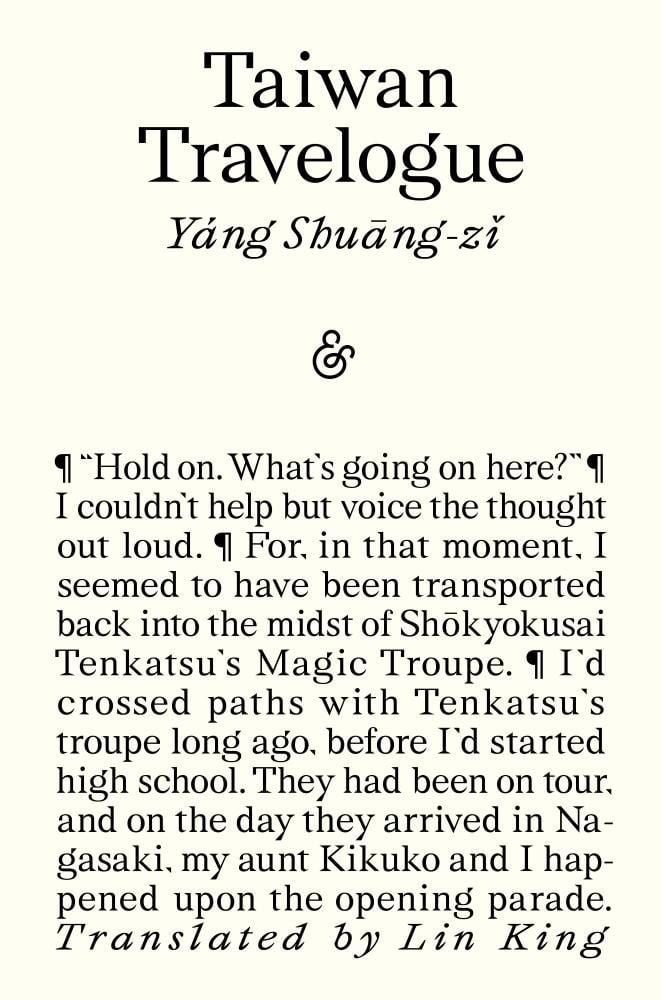
An extract from Taiwan Travelogue by Yáng Shuāng-zǐ, translated by Lin King
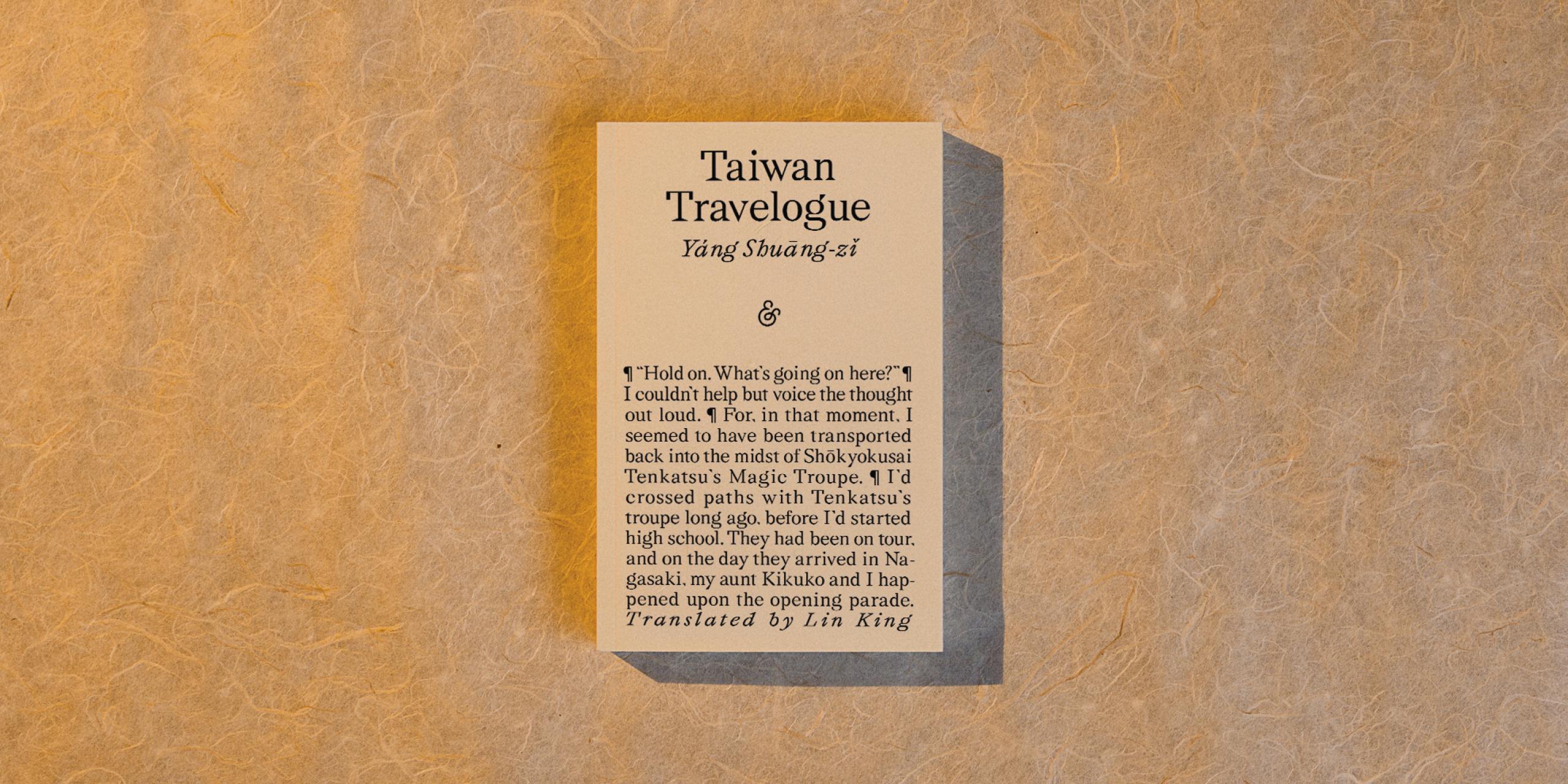
An extract from Taiwan Travelogue by Yáng Shuāng-zǐ, translated by Lin King
- Published
Taiwan Travelogue is the winner of the International Booker Prize 2026. Read an extract here
Taiwan Travelogue is a bittersweet story of love between two women, nested in an artful exploration of language, history and power.
May 1938. The young novelist Aoyama Chizuko has sailed from her home in Nagasaki, Japan, and arrived in Taiwan. She’s been invited there by the Japanese government ruling the island, though she has no interest in their official banquets or imperialist agenda. Instead, Chizuko longs to experience real island life and to taste as much of its authentic cuisine as her famously monstrous appetite can bear.
Soon a Taiwanese woman – who is younger even than she is, and who shares the characters of her name – is hired as her interpreter and makes her dreams come true. The charming, erudite, meticulous Chizuru arranges Chizuko’s travels all over the Land of the South and also proves to be an exceptional cook.
Over scenic train rides and braised pork rice, lively banter and winter melon tea, Chizuko grows infatuated with her companion and intent on drawing her closer. But something causes Chizuru to keep her distance. It’s only after a heartbreaking separation that Chizuko begins to grasp what the ‘something’ is.
Disguised as a translation of a rediscovered text by a Japanese writer, Taiwan Travelogue unearths lost colonial histories and deftly reveals how power dynamics inflect our most intimate relationships.
The novel is published in the UK by And Other Stories. This extract is taken from the first chapter.
Buy the book
“Hold on. What’s going on here?”
I couldn’t help but voice the thought out loud.
For, in that moment, I seemed to have been transported back into the midst of Shōkyokusai Tenkatsu’s Magic Troupe.
I’d crossed paths with Tenkatsu’s troupe long ago, before I’d started high school. They had been on tour, and on the day they arrived in Nagasaki, my aunt Kikuko and I happened upon the opening parade.
The procession comprised a majestic formation of rickshaws, rows and rows of them with no end in sight—enough to rival an army regiment. The band rode at the frontmost rickshaws, performing with remarkable gusto; after them came the women magicians, beaming and waving at the crowd in exquisite maquillage; they were followed by the male magicians in top hats. Other troupe members went on foot, encircling the rickshaws and ushering them along. They held up long poles with brightly colored flags—streaks of crimson, white, violet, and azure that were no less commanding than the band’s spirited music. My chest thrummed and lifted, as though something had been strung from my navel all the way up into the sky.
And here I was, decades later, on the outpost island of Taiwan, reliving this old reverie. It was May, in the thirteenth year of Shōwa, yet the sights and sounds coursing before me were just like those of Tenkatsu’s Magic Troupe.
Rows of red-brick Shina-style buildings stretched endlessly into the distance.
Round vermilion lanterns hung from the roofs alongside sunset-coloured ones shaped like seeds.
Squares of white tarp blossomed overhead.
Kanji signs of all colors and patterns flashed past my sightline.
And then the stalls: vegetables—utterly alien to me—piled into green, yellow, white hills.
Blood-red meat carved into strips, hanging from hooks like flesh tapestries.
Mud-brown and swamp-green herbs bound into bundles, or else scattered in wicker baskets, or else stewed into inky, emerald concoctions.
One vendor had an imposing spread of large glass jars that glinted in the light. Each contained treats I could not name: pale red, dark red, light yellow, deep yellow, pitch black, bone white.
There were several stalls where people stood eating desserts from soup bowls, which contained nugget-like delicacies. Some were white and soft and others yellow and semi-transparent; still others were like the darkest of pearls.
Inside one greengrocer’s shop, bunches of bananas dangled over tea-green and lacquer-red fruits. I was only able to identify a few of them—watermelon, peach, and something that was perhaps namuka.
My eyes did not know where to turn first.
Outside the stately Taichū Station, the ribbon- like Midori River threaded its way across Tachibana District. On the other side of the riverbank stood First Market and Taichū Hotel. The crowds, too, were like water; I’d come here, to Kanjō Bridge Avenue, because I’d been told that it was where the Islanders gathered, and the sheer number of pedestrians proved my source correct. Thick willows lined the river on both sides, and the stream itself glittered with undulating ripples. I felt dizzied and dazzled— the May sun was a wheel of searing light that made every color more saturated and every scent more fragrant. The smell of the river, plants, raw meat, herbs, fruits— everything teemed and surged toward me under the cobalt sky.
There was something else mixed into that current: voices, speaking an Island language that I couldn’t understand.
“XXXXXX XXXXXXX XXXXXXXX?”
“X XXXXXXXX XXXXXXXXX!”
“XXXXX XXXXXXXXXX.”
My gut somersaulted to my chest. The corners of my mouth couldn’t help but curl with glee.
Ah— so this was Taiwan, Land of the South!
No matter what, I must visit Taiwan at least once in my life.
I’d first made this resolution while standing out back on the deck of a large passenger ship heading home to Kyūshū Island from Okinawa. I’d been wondering whether the hazy shore I could see in the distance was Miyako Island or Ishigaki Island— or was it in fact Taiwan Island, right there, just across the water?
After my novel was adapted into a film, my royalties saw a notable increase. Leading up to my Okinawa trip, magazines I’d never worked with came to my door offering, quite literally, handfuls of cash.
“If Aoyama- sensei is amenable, you can feel free to leave all the arrangements to us— the travel expenses, everything. We would love for you to write a serialized novel set in the South Pacific,” said Editor F of a certain magazine, flashing an eager smile. “I have heard that Aoyama-sensei is an avid traveler. This is a wonderful opportunity, is it not?”
“A story set in the South Pacific … is that meant to complement the Southern Expansion Policy?”
“I— I am not quite sure what Aoyama-sensei means.”
“I beg your pardon. I only mean that, if the premise of the novel is to promote the Empire of the Sun, I am afraid I will be a poor candidate. You see, I do not believe I can produce any interesting work on the subject, which would be a shame for the magazine as well as for its readers— do you not agree, sir?” I pushed the neat stack of bills back toward Editor F’s knees. “Besides, I have already purchased tickets to my next destination, Okinawa, which would mean delaying your project— that is, unless you are interested in serializing a historical tale of the Ryūkyū Kingdom.”
“Ah … but if Aoyama-sensei is fond of Okinawa, then would you not consider visiting Taiwan in the future? It is also an Island of the Southern Country.”
I didn’t wish to continue this pesky song and dance and put an end to the meeting without making any promises. But ever since that conversation, Taiwan, Island of the Southern Country, became a small seed in the field of my heart.
As fall deepened into winter that year, I concluded my brief trip to Okinawa. Ryūkyū, the chain of islands that stretched from Kyūshū to Taiwan and a Kingdom of the South in its own right, boasted a warm climate, and as I stood homebound on the deck, the salt- laced sea breeze brought no chill to my skin. Taiwan was even deeper in the South— what was it like in November? I recalled the large cargo ships that passed through Moji Port in Kyūshū, bringing crates of bananas from Taiwan day in and day out. The memory was enough to fill the air around me with that fresh yet fragrant scent.
A thought germinated and took root. The next time I travel, it will be to Taiwan.
Once I returned to Nagasaki, I began researching for this future journey. I’d learned my lesson from an earlier trip up north to Hokkaido that, to be sufficiently immersed in any locale, the stay must be substantial— half a year or more, ideally. But six months’ worth of transportation, lodging, and, most important, dining expenses was no negligible sum. After completing an estimate, I clutched my head in frustration.
“Aunt Kikuko …”
I entered the earthen-floored kitchen, where my aunt and our young servant Haruno were hard at work. Steam was wafting from a clay pot; from the scent alone, I could tell that the white rice cooking within was of a caliber that would be delicious with a sprinkle of sesame salt and nothing else. Watching the pot was enough to make my stomach groan.
“Chizuko-san, dinner is not ready yet,” Haruno said, giving me a knowing smile.
Hmph! As if I was here to ask about dinner! “Aunt Kikuko … do we have five hundred yen for me to go to Taiwan?”
Haruno’s jaw dropped.
Aunt Kikuko looked at me sedately. “What are you talking about, silly child?”
“I hardly look like a child, dear aunt.” Age aside, I was tall enough to walk shoulder to shoulder with the foreigners in Nagasaki’s streets. My nickname back in my school days was the Great Cedar.
Aunt Kikuko gave a gentle “hmm” and said, “Didn’t that magazine editor say they’d be happy to finance you?”
“But all that Southern Expansion stuff— I can’t write about something like that.”
“Then go to Kumamoto and make an appeal to the head family.”
“The head family! Forget about going to Taiwan, the Aoyamas in Kumamoto will be dragging me to the altar.”
“It is high time you got married.”
“Please oh please— ”
“What a bothersome child. Maybe you should visit the shrine and ask the gods for your travel funds.”
Now here was a conundrum. I hadn’t anticipated that my babyish begging would have absolutely no effect whatsoever.
Sighing, I said, “Can it be true? Is it possible that Suwa Shrine is my only ally? Ah! But they do sell delectable Castella cakes and Siberia cakes over there. Surely the gods cannot refuse me— not with such offerings!”
“Chizuko-san is just naming her personal favorites,” Haruno said, blowing my cover.
“Oh, dear gods, why oh why is our Chizuko such a hopeless glutton?” Aunt Kikuko asked.
Despite such ruthless attacks on my strategy, the gods did appear to accept my bribe of desserts. Not long after, at a time when I wasn’t expecting it, I received an invitation from the Government-General of Taiwan and a Taiwan-based women’s group.

Taiwan Travelogue
© India Hobson for Booker Prize Foundation
Taiwan Travelogue
Winner of The International Booker Prize 2026
- Translated by
- Lin King
- Published by
- And Other Stories
Winner of the International Booker Prize 2026, Taiwan Travelogue is a bittersweet story of love between two women, nested in an artful exploration of language, history and power