
The International Booker Prize 2026 winning author and translator on untangling complex colonial histories, and why reading books in translation is the best kind of travel
- Written by
- Grace Sansom
- Published
We speak to the team at And Other Stories – the small press with big ambition – about their two consecutive International Booker Prize wins, their commitment to championing adventurous authors, and the ‘special magic’ at the heart of their books
And Other Stories base their offices in Sheffield’s City Library, behind the Steel City’s metalwork archives. They are a one-of-a-kind independent press. With back-to-back International Booker Prize wins for Heart Lamp in 2025 and Taiwan Travelogue earlier this year, And Other Stories is forging an exciting future for translated fiction on a global stage.
Their readers stretch across the world, with fans including Booker Prize alumni: Ali Smith has said they were ‘inspired’, and Max Porter called them ‘publisher of the month, of the year, of the decade!’. It’s easy to see why their books have found such a devoted readership.
Following their most recent win, we had a conversation with Stefan Tobler, Founder, and Tara Tobler, Senior Editor, about the impact of these prize wins, the place of independents in the industry today, and much more.

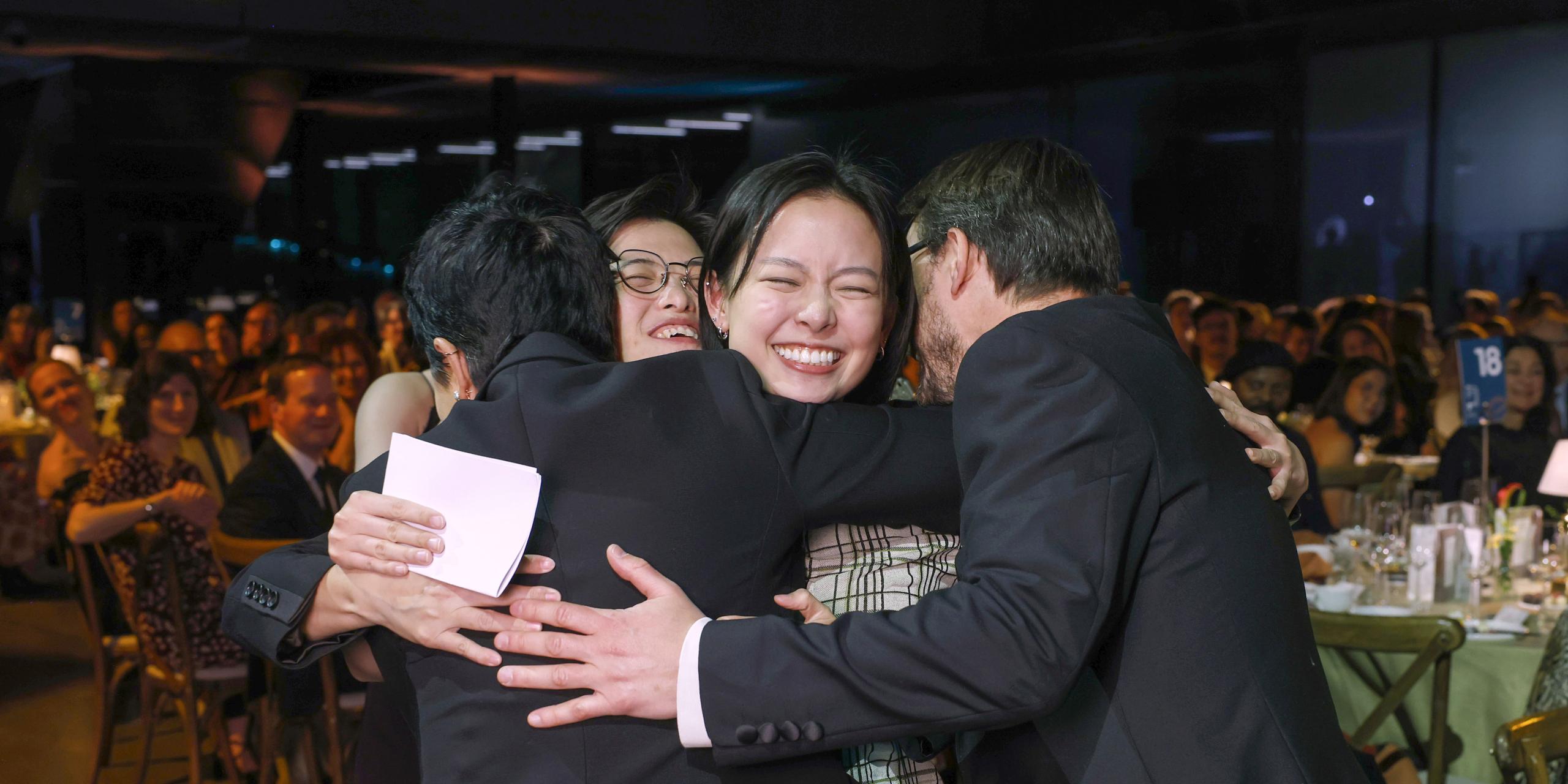
Stefan and Tara Tobler at the International Booker Prize ceremony 2026
© Neo Gilder for Booker Prize Foundation
What roles do you both have at And Other Stories and how do they differ? What is the dynamic like?
Tara: I am extremely lucky because I get to spend almost all of my time faffing around with text. I’m the Senior Editor here. I work mainly with fiction, but I do some non-fiction as well. Stefan does a mix of books.
I get to read and bid for books and then work on them. And then, when I’m dragged kicking and screaming into the office… I will write cover copy and help with marketing. But only when forced to.
Stefan: Because I set things up 15 years ago, I ended up doing a bit of everything. It’s been nice over the years, as we’ve grown slowly, to say that some of those things have become other people’s specialities. I still end up doing a bit of everything, but we are a bit of everything.
How did And Other Stories come to be? What inspired you to set up and start? Did you spot a gap in the market, or was it more about turning a personal passion into a business venture?
Stefan: I was a translator and was struggling to find publishers who wanted to take on interesting writers who were writing in their own languages. At that point, in the late 2000s, it was quite dire in the UK.
There were a lot of great books that just weren’t going to be published, and there was a general realisation that there wasn’t enough being published in translation, which is thankfully very different now. It’s hard to exaggerate how much the market has changed.
Tara: The public perception of what translated literature can do has changed, in terms of the perception of the marketability of translation. We believe in books having some special magic of their own – some kind of note in the zeitgeist that draws people to them specifically.
After relocating from High Wycombe in Buckinghamshire in 2017, And Other Stories has been based in Sheffield for nearly 10 years now. How has it been and what does being in the North of England bring to your publishing?
Stefan: I am sort of an unpaid member of the Sheffield tourist board now! Sheffield is brilliant for us – we’ve noticed that being in a smaller city can make your horizons feel wider. You inevitably end up rubbing shoulders with a bigger variety of people. And then we notice books and authors and translators that we maybe would not notice as much if we were somewhere else.
It’s not always been the easiest choice from a publishing point of view. But the flip side of that is that we are one of the few presses that’s able to offer jobs to people in publishing in the North.
What makes an And Other Stories book?
Stefan: I don’t like to try and pin it down too much. The whole point of literature is that you read an author because they are original and not something you can fit into a box. Somewhere, early on, Stuart Evers, an author and journalist, said that we were looking for shamelessly literary things, and I’m happy with that.
It really does come down to the fact that each book gets discussed in the team and, somehow, we come to more and less agree. That eclecticism is part and parcel of who we are. We’ve always been a press whose mandate is to blow wide the doors of English literature and turn the gaze of the average English reader outwards towards the world.
Tara: As a globally focused press, we have a commitment to representation and diversity. Since 2025, we’ve been aiming to have the majority of our books written by the Global Majority. We’re now working with more Global Majority translators as well. It only seems appropriate.
But spectacular, groundbreaking, innovative writing is always the baseline that we look for. And it’s happening all over the world. You just need to be canny enough to figure out where and how and who.
The veteran publisher Christopher MacLehose has said that, ‘The corporate publishers aren’t where it’s happening. Any editor today who wants to be interesting must work for an independent.’ As a successful indie, would you agree?
Tara: It’s easier for independents to maintain one sense of artistic integrity, that’s certain. I’ve never once in my life had to pitch to a board or ask an author to change their text to make it more marketable. When you’re dealing with market forces that skew towards, to put it bluntly, what middle-class white Britain thinks as quality fiction or needs explaining to them, that puts pressure on authors of all stripes to conform to their narratives in certain ways. You’d think that would be something of the past, but the number of stories we’ve had from people who have said, ‘they want me to do this or that and I’m not comfortable with it’.
Stefan: There are editors publishing incredible books in the corporates, but they’ve got their battles cut out for them. That must take a lot of energy, to maintain and fight for authors in that kind of environment. It comes at a personal and emotional cost. It’s heavy, heavy lifting.

Tara Tobler at the International Booker Prize ceremony 2026
© Neo Gilder for Booker Prize Foundation
We’ve always been a press whose mandate is to blow wide the doors of English literature and turn the gaze of the average English reader outwards towards the world
You’ve had two International Booker Prize wins, back-to-back, with Heart Lamp, and most recently Taiwan Travelogue. How did that first win feel?
Tara: Surreal. Extraordinary. They’ve definitely been pinch-me moments.
The win for Heart Lamp was absolutely electric. A village of people came together to make that book. It started with the PEN Presents programme: our contributing editor, Preti Taneja, who was the chair of that committee, was trying to recognise emerging translators from South Asia. Heart Lamp immediately stood out from what she recommended. We acquired it; working on it was a very intense but wonderful process. Deepa [Bhasthi, Heart Lamp’s translator] and I were going back and forth on so many points about the politics of translation, which had come into our work previously.
This was, if we’re being honest, one of these books we didn’t have great sales expectations for. It was short stories by an author who was virtually unknown in the UK.
Not only was it our first International Booker Prize win, but the first time a short story collection had won, the first time a translator from India had won, the first time a non-white translator had won. There were so many ceilings that got smashed with this book. And of course, the mind-boggling reception in India.
Banu retrained as a lawyer in her 30s, after she was married. She became a human rights activist, and it was amazing to see her have this sort of platform to say what she had to say after the win. She’d been writing stories for decades and had some critical reception within India, but also some negative reception. She had a fatwa issued against her by more conservative forces and she had an audience, but not anything close to the scale after the win. There were new editions published within India and many new translations. [Prior to its longlisting, translation rights to Heart Lamp had been sold in eight languages, seven of which were Indian subcontinent languages. It has now sold a total of 30 languages, 13 of which are Indian subcontinent languages.] [And Other Stories reports it had sold 10,000 copies of Taiwan Travelogue across UK retailers; those sales have now increased to 49,000 copies.]
How did it feel to win again this year with Taiwan Travelogue?
Stefan: When we won in 2025, we were sat right up at the front. This year, we saw our table to the side and thought we knew we hadn’t won… So, we just enjoyed the night, thinking we hadn’t won! Then, suddenly, the chair of the judges, Natasha Brown, was saying words that sounded awfully like ours. And so it was.
What is the secret to these back-to-back IBP wins? Did you believe both books could win? Do you feel you’ve cracked the magic formula for winning prizes?
Stefan: You can’t crack the magic. And it’s a bit of a lottery as to who the judges are each year because each set of judges will make their own choices.
Tara: Both of these books do share things. They both call attention to the artistic power of translation: what translation can do when it sets out to be really ambitious. Both translators were actively pushing back on assumptions about the limits of translation and doing so beautifully.
These shared factors were definitely in both of their favour, even though they’re very different books in every other way.
And they’re both very political. Heart Lamp and Taiwan Travelogue are books that are deeply engaged with what decolonising English looks like on a very small, microscopic level on the page.
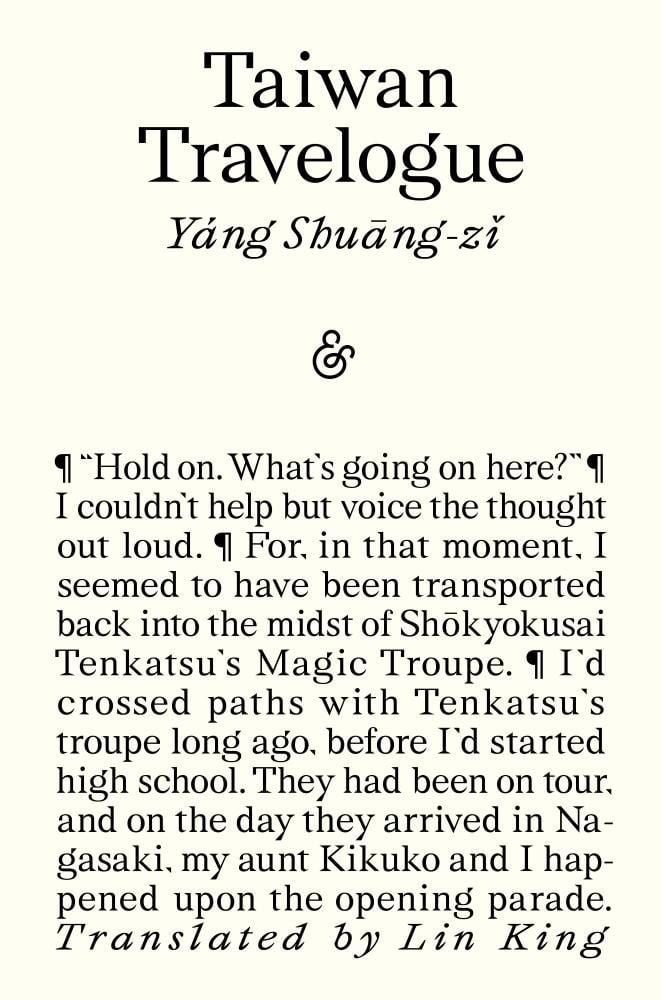
Your cover designs – black text only, on a cream background, with no images – are very distinctive. Can you tell us about this design decision and process for your covers?
Stefan: Our choice of cover comes back to the eclecticism of And Other Stories. The one thing that holds our list together is the fact that you should be able to pick up any number of our books and feel the merit on the first page. That’s our USP, so let’s just put it on the cover. This is what our books are – this is what sells them.
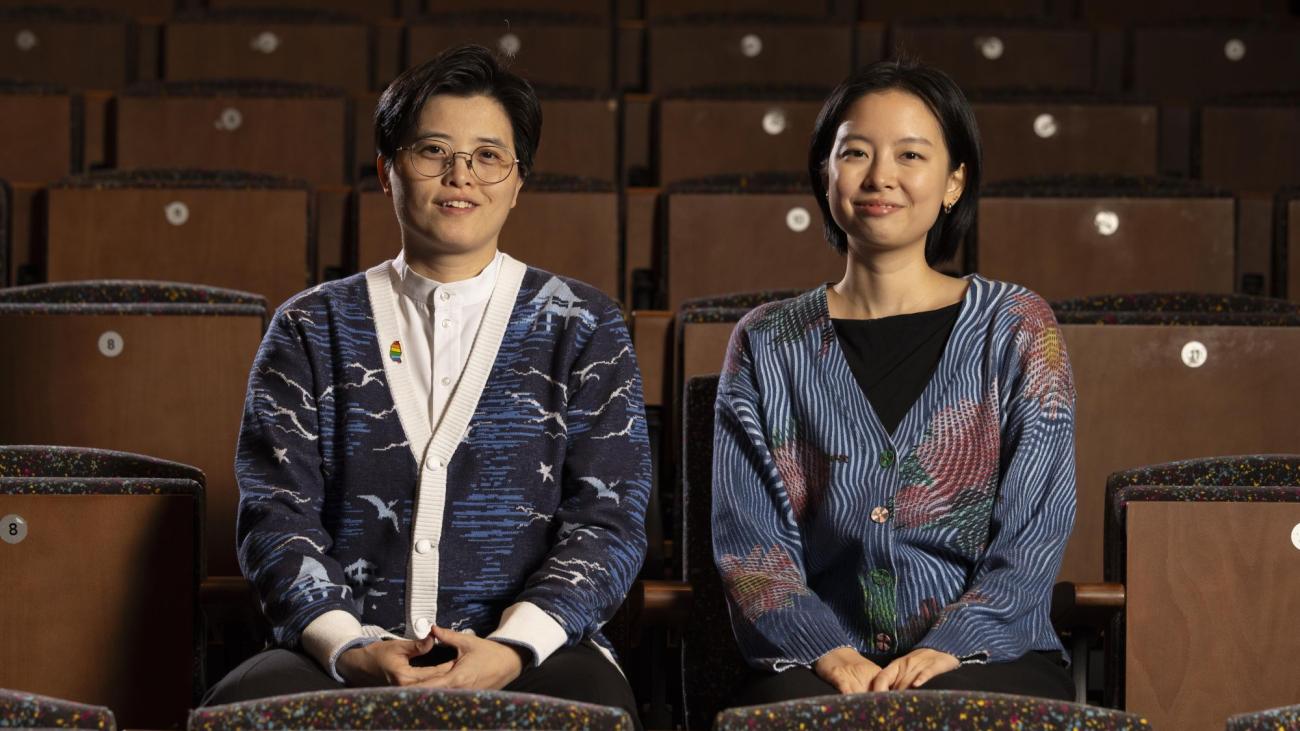
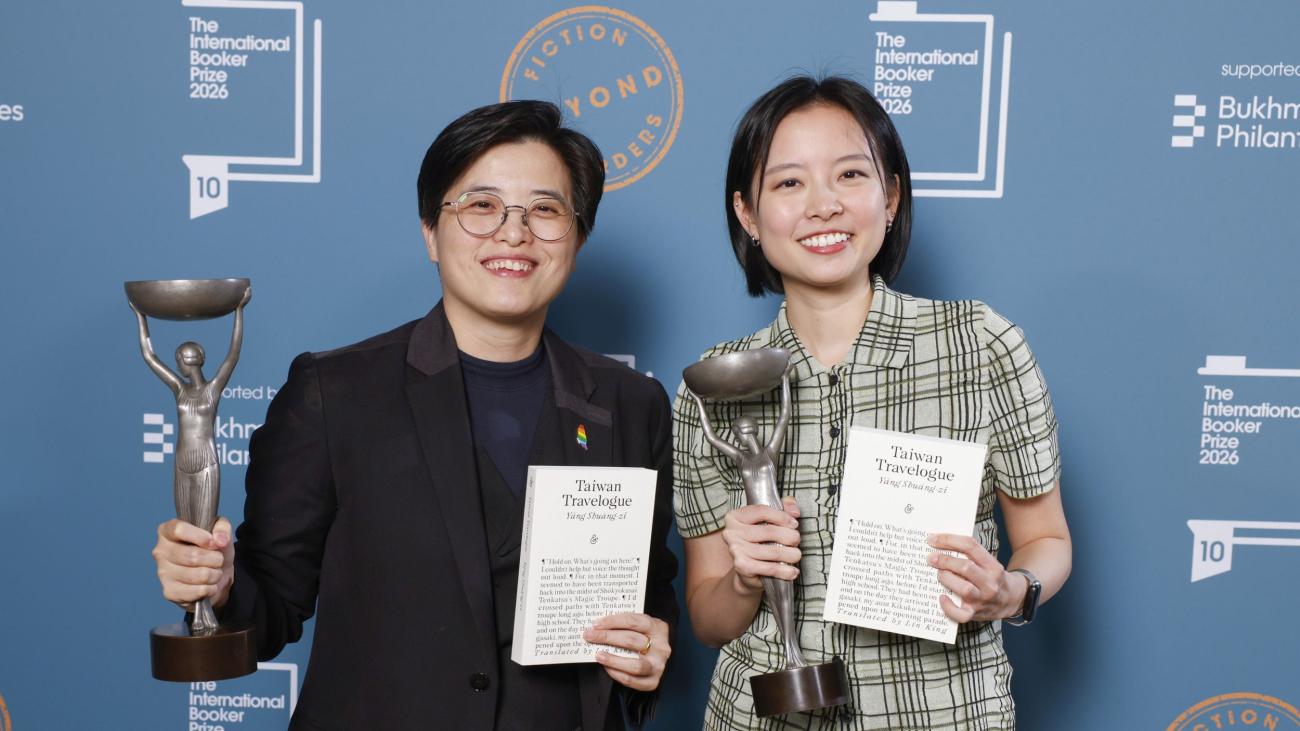
In her winner’s speech, Lin King (translator of Taiwan Travelogue) mentioned that she and Yáng Shuāng-zǐ couldn’t find a UK publisher who would put the translator’s name on the cover until And Other Stories came along. Why do you think it’s important to recognise translators on your covers?
Tara: Because translators are artists and deserve to be recognised as such. We don’t understand why other publishers don’t do it. Except, perhaps, that it’s a hangover from this idea that texts in translation will be inferior reading experiences, which is ludicrous – but still holds sway in some corners. We know as editors, that the choice of the translator is make-or-break for the book.
Reflecting on this year’s win, Tara said that ‘translation isn’t the art of seeming seamless. Translation is the seam’. Can you expand on this?
Tara: Taiwan Travelogue beautifully demonstrates that translation can serve as a cross-cultural artifact to show us points of connection and intersection. It is an intersectional art form, you know, and that’s something to celebrate. The idea that translation is there to make the source text, the source culture, something easily digested and familiar to the culture that’s consuming it reduces it to a commodity.
This is one of the main themes of Taiwan Travelogue, the uneasy relationship between empire and cultural consumption. I think that holding on to those two places: that place where two things are desperately trying to hang on together, but keep their own integrity, is a really grounding way of looking at the process for me.

Stefan and Tara Tobler with Lin King at the International Booker Prize ceremony 2026
© David Parry for Booker Prize Foundation
The idea that translation is there to be something easily digested and familiar to the culture that’s consuming it, reduces it to a commodity
As independent publishers, what do you think of the International Booker Prize in general?
Tara: The team working for the International Booker has been so incredible and has given translation the sort of glamour that it’s never had before in the UK. We can really feel how hard the Booker Prizes are working to make sure that the International Prize is on par with the English-language prize, and that is incredibly gratifying. I don’t feel like there’s been a major prize working to that end in any English-language market.
What role do you feel you play in the industry of translated fiction? How have things changed in the industry since And Other Stories began?
Tara: We do all the cool shit!
Stefan: It is so different now. Seventeen years ago, it felt like something that was really being called out for. Now it feels like we have reached this wonderful place where those books are coming out, and from so many wonderful presses. And people still buy from us as well!
Tara: One of the best things about independent publishing is that you still have a chance to feel connected to that kind of grassroots enthusiasm that spreads the word about titles, without big media or big prizes necessarily involved. The International Booker Prize has been transformational for us in the last couple of years, but we also have a strong network of booksellers and critics and friends. You put the book in their hands, at the right time, and they are very happy to start spreading the word.
So, what’s next for And Other Stories?
Stefan: It’s all exciting. We are celebrating 15 years of publishing this autumn. There will be parties and our authors reading at Off the Shelf literary festival in Sheffield. And a London party too.
I’m also excited that we have our first British poet being published in September. He’s called Colin Bramwell. He’s also a translator, translating languages including Scots, so uses multiple languages in his poetry. It feels fitting for us.
Tara: We also have our first short-story collection from Urdu that’s coming out in the near future. And lots, lots more! We’ve just been through a big round of acquisition talks and are ironing out what will go where for the next three years. All the puzzle pieces are still moving, but we’re looking forward to it.
When we first started, we only published four books a year. Now, we’re heading for 20 and have the opportunity to reach in different directions.
Heart Lamp and Taiwan Travelogue are books that are deeply engaged with what decolonising English looks like on a very small, microscopic level on the page
Taiwan Travelogue
Winner of The International Booker Prize 2026
- Translated by
- Lin King
- Published by
- And Other Stories
Winner of the International Booker Prize 2026, Taiwan Travelogue is a bittersweet story of love between two women, nested in an artful exploration of language, history and power


Features

- Book recommendations
South Asian Heritage Month: 12 books to read from the Booker Library


- Book recommendations