
‘Why am I in this car? I’ll sit still. Sometimes, if you don’t move, your memory comes back. But it’s not working. One thing is certain, the driver is smoking. The vehicle is filled with heavy smoke. My eyes are burning. I feel sick.’
- Published
The International Booker Prize 2026 nominated author and translator discuss moral slipperiness and everyday complicities, and how to recreate a lost film on paper
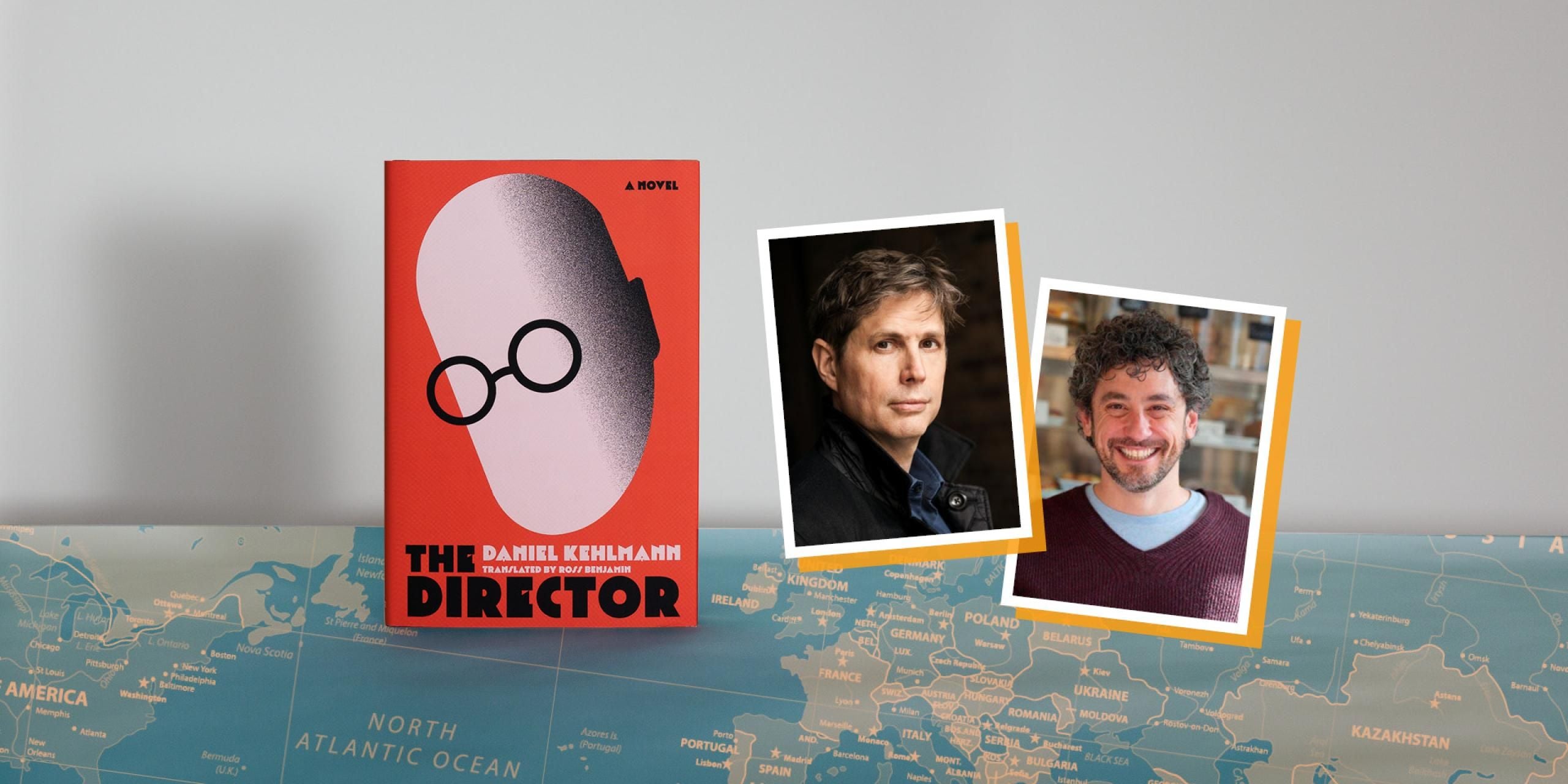
Daniel Kehlmann
Could you tell us about the inspirations behind The Director?
The initial spark was film: the strange moral glamour of the medium, and the way it can make compromise look like professionalism. Pabst’s life offered me an entrance into a dictatorship from the angle of someone returning from ‘a free country’ and learning the rules as he goes.
I wasn’t interested in the monstrous villains – others have written the necessary books about them – but in the everyday complicities: the small workplace bargains, the club meetings, the casual blindness. And then there was the delicious novelistic temptation of a vanished film: to ‘shoot’ it on paper, and let the reader watch.
How did you go about writing the novel?
I work the way I always work: by producing something imperfect and then trying to rescue it through rewriting. I still write a lot by hand – paper is the only device that doesn’t offer email or texts – and I like the physical pleasure of filling pages; notebooks become a visible record of the book’s first life.
Once the draft exists, I type, reshape, cut, and re-order. For this novel I also had to do unglamorous research, especially about how films were edited in the 1940s; for once the internet was not helpful at all, so I relied on conversations with people who remembered the technology.
The theme of this year’s International Booker Prize is ‘Fiction beyond borders’ – how do you think translated fiction helps readers see beyond geographical boundaries, and why is that important?
Translated fiction makes you step into a mind that was formed elsewhere, in different weather, different jokes, different taboos. And suddenly you notice that the fundamental human concerns are the same. In a time when borders are being fetishised again, that double movement – toward difference and toward recognisable humanity – matters. It makes the world larger, and it makes nationalism look smaller.
The International Booker Prize is celebrating its 10th birthday in its current form this year – how do you think the award has changed the perception of translated fiction over the last decade?
Over the last decade the International Booker has done something deceptively simple: it has made translation visible as an art, not a service. The equal recognition of author and translator changes how readers talk about books, and how publishers decide what risks to take.
You can see the effect in bookshops: the range of contemporary translated fiction available in English has expanded, and readers now browse translated fiction with the same casual confidence they once reserved only for Anglo-American fiction. That shift is cultural, and it’s long overdue.

Daniel Kehlmann
© Heike Steinweg
There was the delicious novelistic temptation of a vanished film: to “shoot” it on paper, and let the reader watch
Daniel Kehlmann
Could you tell us about a book that made you fall in love with reading as a child?
Michael Ende’s The Neverending Story opened the door. It wasn’t just escapism; it was the first time I felt a book thinking about itself – about storytelling as a place you can enter, and get lost in, and come back from changed. Soon after came Tolkien’s The Lord of the Rings, which I have probably re-read more than any other book. What was special about both, for me, was their seriousness about the invented world: the sense that imagination is not the opposite of reality, but one of its instruments.
And could you tell us about a book that made you want to become a writer?
Salinger’s Nine Stories was very important. I remember reading it and feeling two contradictory emotions: gratitude for something so beautiful, and envy so sharp it was almost painful. It wasn’t that I wanted to copy Salinger; it was that the book made the ambition of writing feel precise. A story could be funny, brutal, tender, metaphysical – often in a single paragraph – without announcing its intentions. That combination of restraint and emotional force is still, for me, a kind of benchmark. After Nine Stories, becoming a writer stopped being a vague dream and became a problem of craft.
Is there a book that changed the way you think about the world?
To give you a serious answer that would probably be the collected discourses of the Buddha. It proposes a radically different relationship to the self: less as a solid identity, more as a process, a swarm of habits without a core. That idea quietly rearranges how you read characters, and how you read your own life. And it has the added advantage of being probably true.
Which book written in German should everyone read, and why?
Everyone should read Kafka’s contemporary Leo Perutz, and if I must choose one: By Night under the Stone Bridge. It’s a set of interlocking tales that move between history, dream, and something like metaphysics, without ever losing narrative speed. Perutz can do Prague legend and political intrigue, erotic comedy and genuine dread, in a few pages, and he does it with an elegance that never feels ‘literary’. He’s one of those writers who make you wonder why the canon is so provincial. Perutz is proof that German prose can be nimble, playful, and unnervingly intelligent at once.
And, finally, which International Booker-nominated book do you think everyone should read?
Yōko Ogawa’s The Memory Police is a small masterpiece of political imagination. On an unnamed island, things disappear, and the population learns to behave as if the loss is natural. It’s a fable about authoritarianism, yes, but also about grief, language, and the way people collaborate with reality by agreeing not to notice. The prose is calm, almost polite, which makes the horror sharper.
Ross Benjamin
Could you tell us what it was about The Director that made you want to translate it?
Its subject is at once historically specific and brutally current: how complicity happens – not in one grand betrayal, but through a series of smaller moves that gradually become muscle memory.
Kehlmann portrays this with striking formal invention across episodes by turns stark, surreal, and darkly comic, borrowing cinematic techniques – cuts, tilts, dissolves – to make the moral slipperiness felt rather than explained. As a reader and translator, I was particularly drawn to the mix of propulsion and unease, nightmare and slapstick, evil and absurdity, history and hallucination.
How did you go about translating the novel?
The main challenge was reproducing the book’s formal and tonal volatility without taming it or sacrificing precision. One place this particularly mattered was the rhythm and feel of the dialogue: when it hesitates, where it breaks off, what remains unsaid.
Because the characters live in an atmosphere of mutual surveillance and fear, I was always listening for the pressure on their sentences – when they’re speaking freely and when they’re speaking with an awareness of possible consequences. The aim was an English that keeps the ‘ordinary’ conversational surface while letting the underlying danger register.
The theme of this year’s International Booker Prize campaign is ‘Fiction beyond borders’ – how do you think translated fiction helps readers see beyond geographical boundaries, and why is that important?
Translated fiction can challenge the tendency to feel that our habits of thought – our reflexes, our default ways of making sense of experience, our familiar uses of language – are simply inevitable. By letting us inhabit different cultural and linguistic perspectives, it can loosen our certainties and unsettle our complacency. Like great literature in general, it can remind us that our received assumptions are not the measure of all things.
The International Booker Prize is celebrating its 10th birthday in its current form this year – how do you think the award has changed the perception of translated fiction over the last decade?
The International Booker Prize has helped make translation a more central part of literary conversation, rather than an aside or an afterthought. It has also made translators’ work visible in a way that’s fed a growing appetite among readers, who are increasingly curious about translation – about the how and why of the choices translators make. That visibility changes what publishers will risk and what readers will try.

Ross Benjamin
© David Schloss
I was drawn to the mix of propulsion and unease, nightmare and slapstick, evil and absurdity, history and hallucination
Ross Benjamin
Could you tell us about a book that made you fall in love with reading as a child?
Isaac Asimov’s Foundation trilogy. What I loved was that the excitement is mostly verbal: stratagems, persuasion, people trying to talk their way through problems that are bigger than any one of them. A scene – and, given the stakes of the stories, the future of the Galactic Empire – can turn on a line of dialogue, on someone reframing the situation, on a piece of reasoning that suddenly makes everything else fall into place. And the books don’t hold your hand; they trust you to keep up and reward you when you do. That feeling of having my intelligence and attentiveness taken seriously as a reader was electrifying.
And could you tell us about a book that made you want to become a translator?
John Felstiner’s Paul Celan: Poet, Survivor, Jew. I wrote my undergraduate thesis on Celan, and it didn’t take long to see that with him translation isn’t ancillary; it’s one of the ways into his work.
I was fascinated by Celan’s own translations of Shakespeare’s sonnets. They’re radically transformative, but not gratuitously so – rather as an attempt to be faithful in a German poetic language that can no longer take itself for granted after Auschwitz. Felstiner’s book, moving between Celan’s life, his poems, and Felstiner’s own translator’s workshop, opened up the art of translation to me in a way I found intensely appealing.
Is there a translator whose work you always look out for?
Lydia Davis. I’ve learned from her translations – and from what she’s written about translation – that exactitude isn’t a constraint so much as an engine of possibility. What I admire most in her work is her refusal to standardise or prettify the prose: she doesn’t smooth away what’s awkward or abrasive in the original; she doesn’t inflate; she lets the sentences keep their edges.
Is there a work of fiction originally written in German that you’d recommend to English-language readers?
Thomas Mann’s Lotte in Weimar. Through conversation and projection, Mann’s Goethe becomes less a person than a local industry. When Mann finally brings him onstage, he’s no marble bust: you get to eavesdrop on an inner life that’s physical, vain, brilliant, prickly.
The novel is witty and gossipy, and it’s also circling how cultural authority gets made, used, and defended. Mann unmistakably measures himself against his subject, and he’s writing with a second time frame in view; Goethe’s Weimar keeps flashing with implications beyond itself for Mann and his readers in 1939.
And, finally, which International Booker-nominated book do you think everyone should read?
Benjamín Labatut’s When We Cease to Understand the World, translated by Adrian Nathan West. Labatut reimagines the breakthroughs of figures like Fritz Haber, Alexander Grothendieck, and Werner Heisenberg as perilous tests of the line between ingenuity and self-destruction, lucidity and obsession, insight and delusion, creation and ruin.
West’s translation brings the book’s momentum and strangeness vividly into English. It moves deftly from cool, report-like narration into something feverish and hallucinatory, with the enigmas undiminished. The book leaves you thinking about what the attempt to push past the limits of understanding does to the people who pursue it.