Reading guide: The Dangers of Smoking in Bed by Mariana Enríquez, translated by Megan McDowell
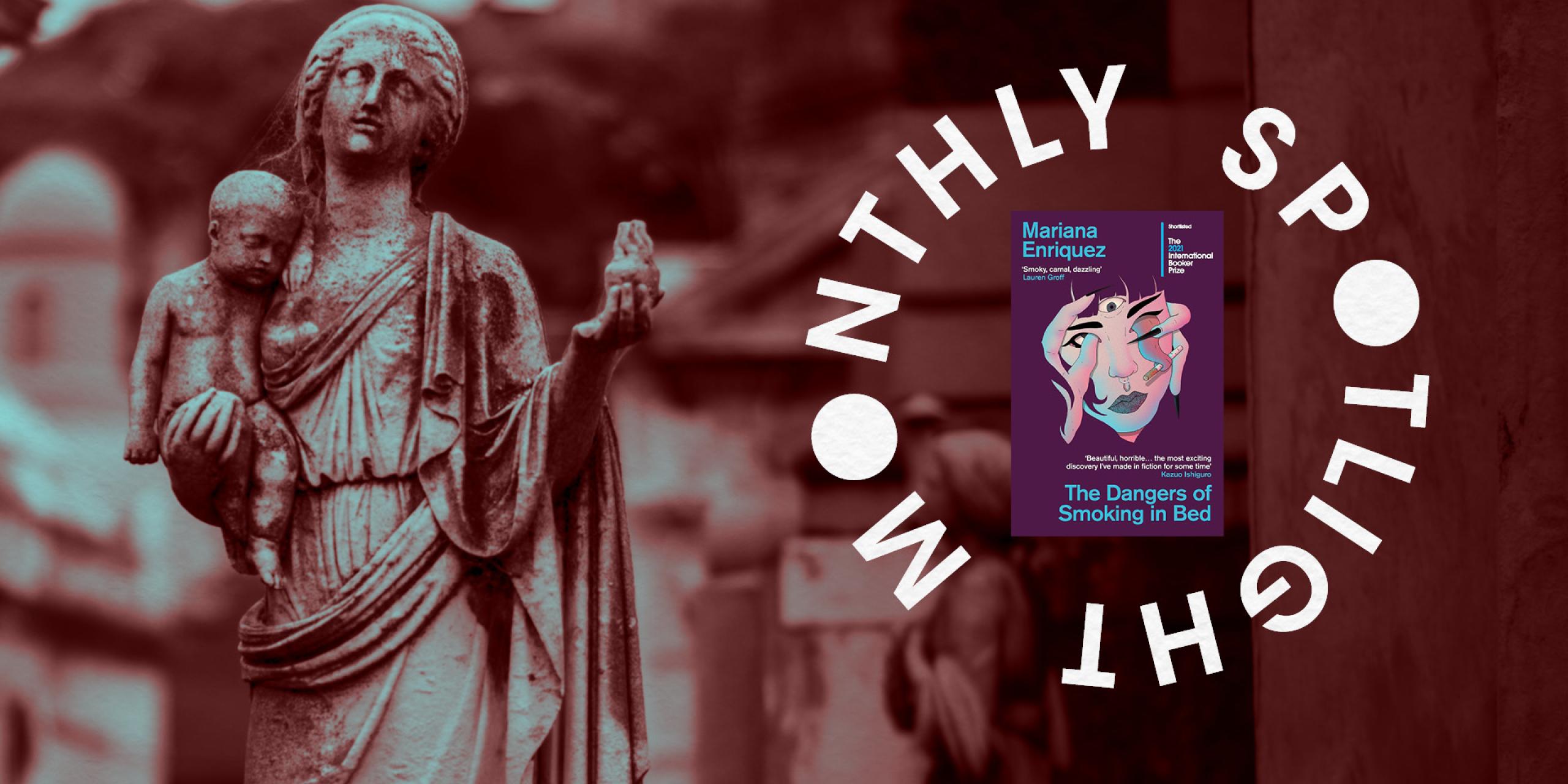
Reading guide: The Dangers of Smoking in Bed by Mariana Enríquez, translated by Megan McDowell
- Written by
- Grace Sansom
- Published
As terrifying as they are socially conscious, the 12 short stories in The Dangers of Smoking in Bed press into the unspoken with bracing urgency
Whether you’re new to The Dangers of Smoking in Bed or have read it and would like to explore it more deeply, here is our comprehensive guide, featuring insights from critics, our judges, and the book’s author, as well as discussion points and suggestions for further reading.
Synopsis
Mariana Enríquez populates contemporary urban Argentina with a macabre cast of crooked witches, unruly teenagers, homeless ghosts and hungry women.
As terrifying as they are socially conscious, the 12 short stories press into the unspoken - fetish, illness, the female body, the darkness of human history - with bracing urgency. A woman is sexually obsessed with the human heart; a lost, rotting baby crawls out of a backyard and into a bedroom; a pair of teenage girls can’t let go of their idol; an entire neighbourhood is cursed to death when it fails to respond correctly to a moral dilemma.
The Dangers of Smoking in Bed was longlisted for the International Booker Prize 2021.
The main characters
Paula
Paula is the protagonist in the collection’s title. story. She is an isolated woman dealing with physical ageing and wallows in self-pity. In her festering, she becomes fixated on a neighbour who burned to death from smoking in bed.
Mechi
Mechi is the main character in the collection’s longest story, ‘Kids Who Come Back’. She works in an archive that records the lost and disappeared children in Buenos Aires.
Marcela
Marcela is a troubled young woman in ‘No Birthdays or Baptism’. She self-harms in her sleep and invites a camera crew to film her at night.
Angelita
Angelita is the half-rotted and reeking child ghost/spectre who haunts the narrator in ‘Angelita Unearthed’.
About the author
Mariana Enríquez was shortlisted for the International Booker Prize 2021. She is a novelist, journalist and short story writer from Argentina.
As well as Things We Lost in the Fire and The Dangers of Smoking in Bed, she is the author of a collection of travel writings, a novella and three novels. In 2019 her novel Our Share of Night was awarded the prestigious Premio Herralde de Novela. She is an editor at Página/12, a newspaper based in Buenos Aires.

Mariana Enriquez. © Ariel Grinberg
About the translator
Megan McDowell has translated books by many contemporary South American and Spanish authors, including Samanta Schweblin, Alejandro Zambra and Mariana Enriquez.
Her translations have won the National Book Award for Translated Literature, the English PEN award and the Premio Valle-Inclán, and she has been nominated four times for the International Booker Prize. Her short-story translations have been published in the New Yorker, the Paris Review, the New York Times Magazine, Tin House, McSweeney’s and Granta, among others. In 2020 she won an Award in Literature from the American Academy of Arts and Letters. Originally from Richmond, Kentucky, she lives in Santiago, Chile.

Megan McDowell © Sebastian Escalona
What the critics said
Chelsea Leu, the New York Times
‘There’s something thrilling about other people’s suffering — at least within this collection’s 12 stories of death, sex and the occult. Horrors are relayed in a stylish deadpan … Enriquez’s plots deteriorate with satisfying celerity … Largely it’s insatiable women, raggedy slum dwellers and dead children — those who are ordinarily powerless — who wield unholy power in this collection, and they seem uninterested in being reasonable. And Enriquez is particularly adept at capturing the single-minded intensity of teenage girls … If some of these stories end vaguely, the best ones close on the verge of some transgressive climax … To Enriquez, there’s pleasure in the perverse.’
Meredith Boe, Chicago Review of Books
‘Enríquez again delivers intrigue and brutality … Stories of spirits and disappearances collectively address the mystery of loss through narratives that are as gripping as they are chilling. The not-quite-horror tales address death while showcasing the intensity and resiliency of the human soul, particularly souls of women … The title story is the book’s shortest and in just a few pages delivers a tragic glimpse into a lonely woman’s existence. Experiments with fire point to the delicate boundaries of life … These stories play with reality, questioning the very fabric of the ingrained beliefs and infrastructures that hold us up. They reveal how frighteningly precarious they really are.’
Lucy Scholes, the Financial Times
‘The connection between the violence in these pages and that in the country’s past is, by and large, ingeniously oblique … Although Enriquez writes about a world that’s haunted by the horrors of the past—both the all-too-real incidents of history and the more nebulous menace associated with superstition and folklore—these tales aren’t traditional ghost stories. But she is interested in the way past darkness contaminates the present … Enriquez pushes into territory that makes most of us uncomfortable … Well worth any upset they cause, these glittering, gothic stories are a force to be reckoned with, and Enriquez’s talent and fearlessness is something to behold.’
Hephzibah Anderson, the Observer
‘When it comes to book reviewing cliches, the word ‘haunting’ is surely among the tattiest, yet Mariana Enríquez’s newly translated short story collection restores to that tired adjective all its most mysterious, fearful strangeness … Pornography, paedophilia, necrophilia – nothing is out of bounds here, but there is jet-black humour, too … She’s already attracted comparisons with Shirley Jackson, but lashings of local mysticism and a flair for transgressive imagery make her an arrestingly original talent.’
What Mariana Enríquez said about The Dangers of Smoking in Bed
‘I write specifically about the south of Buenos Aires, for Buenos Aires is massive and has a lot of personalities. The personality I relate to most is the south. It’s the place I know best. When I moved from Lanús, I lived there in the city’s south, which is crossed by the Riachuelo River. A natural frontier that is now completely unnatural because it is polluted beyond recognition. The rest of central Buenos Aires is different – richer – because obviously the people who can don’t want to live near that pollution and all the polluting industries, which are basically related to meat. The south, then, becomes a great metaphor for what makes the country rich and horrendous at the same time. Or what fucked it up.’
Mariana Enríquez in an interview with The London Magazine
Questions and discussion points
The Dangers of Smoking in Bed is a collection of 12 short stories. In an interview with the Booker Prizes, Enríquez said the medium of the short story is very important in the ‘tradition of Argentinian literature’ and referenced the impact of writers such as Borges and Cortázar. ‘There are no fixed rules in short stories,’ she asserted. Discuss this choice of form. What might a short story allow Enríquez to do that a longer narrative work might not?
What role does fear play in the collection? Which kind of fear did you find most unsettling: the supernatural, the psychological, or the everyday dangers experienced by the characters?
Enríquez grew up in Argentina, which, in recent history, was under a military dictatorship during her childhood. The International Booker Prize judges said the book was ‘an extraordinarily intelligent collection of short stories that knowingly uses the tropes of the horror story, the ghost story and even pulp fiction to think about Argentina’s painful past.’ What might the author’s use of horror reveal about the ways a country’s history can haunt its people?
Enríquez often places otherworldly horrors alongside the ordinary and mundane. How does this duality affect the reading experience?
In ‘Angelita Unearthed’, a dead baby comes to haunt a young woman. The baby is described as an ‘angel baby ’, but in reality, she is a corpse, rotting from the inside out. What might the author be suggesting with this contrast, and how does she play with readers’ expectations?
Buenos Aires and Argentina feature heavily throughout the collection. Discuss whether the setting feels like a backdrop or more like characters in their own right.
Many of the stories feature characters who are outsiders or people living on the fringes and margins. How does Enríquez use these characters to explore wider social inequalities?
In the short story titled ‘Meat’, Julieta and Mariela are obsessed with a pop star called Santiago Espina. After Espina dies by suicide, the girls’ obsession and lust for him only continues to grow. They sneak into the cemetery where he is buried, dig up his grave, and eat his remains. How does the author use this grotesque act of cannibalism to explore the darker side of idolisation?
The voices in the stories across the collection could be described as nonchalant, and often they are almost dismissive of the supernatural elements. What effect does this have, and why might the author have felt it was of merit to create this tension?
Writing in The AV Club, critic Ashley Naftule said most of the women in the collection are ‘just trying to take charge of their own lives and break free from the chauvinistic society that often poses a greater threat to them than the spectres do’. Discuss how Enríquez uses the supernatural and violence as an allegory for the real-world dangers women face, particularly in South America.
Resources and further reading
The London Magazine: Mariana Enríquez Seven Questions
World Literature Today: In Search of Ambivalent Horror: Mariana Enriquez on Rediscovering the Horrific in Everyday Injustices
Latin America Literature Today: “I See Myself as a Latin American Writer”: An Interview with Mariana Enriquez
If you enjoyed this book, why not try



Features
- Book recommendations
Six body horror books nominated for the Booker and International Booker Prize

- Book recommendations