

The author of The Dangers of Smoking in bed on the importance of the short story in Argentinian literature; growing up under a dictatorship, and the horror stories that shaped her as a writer
An extract from The Dangers of Smoking in Bed by Mariana Enríquez, translated by Megan McDowell
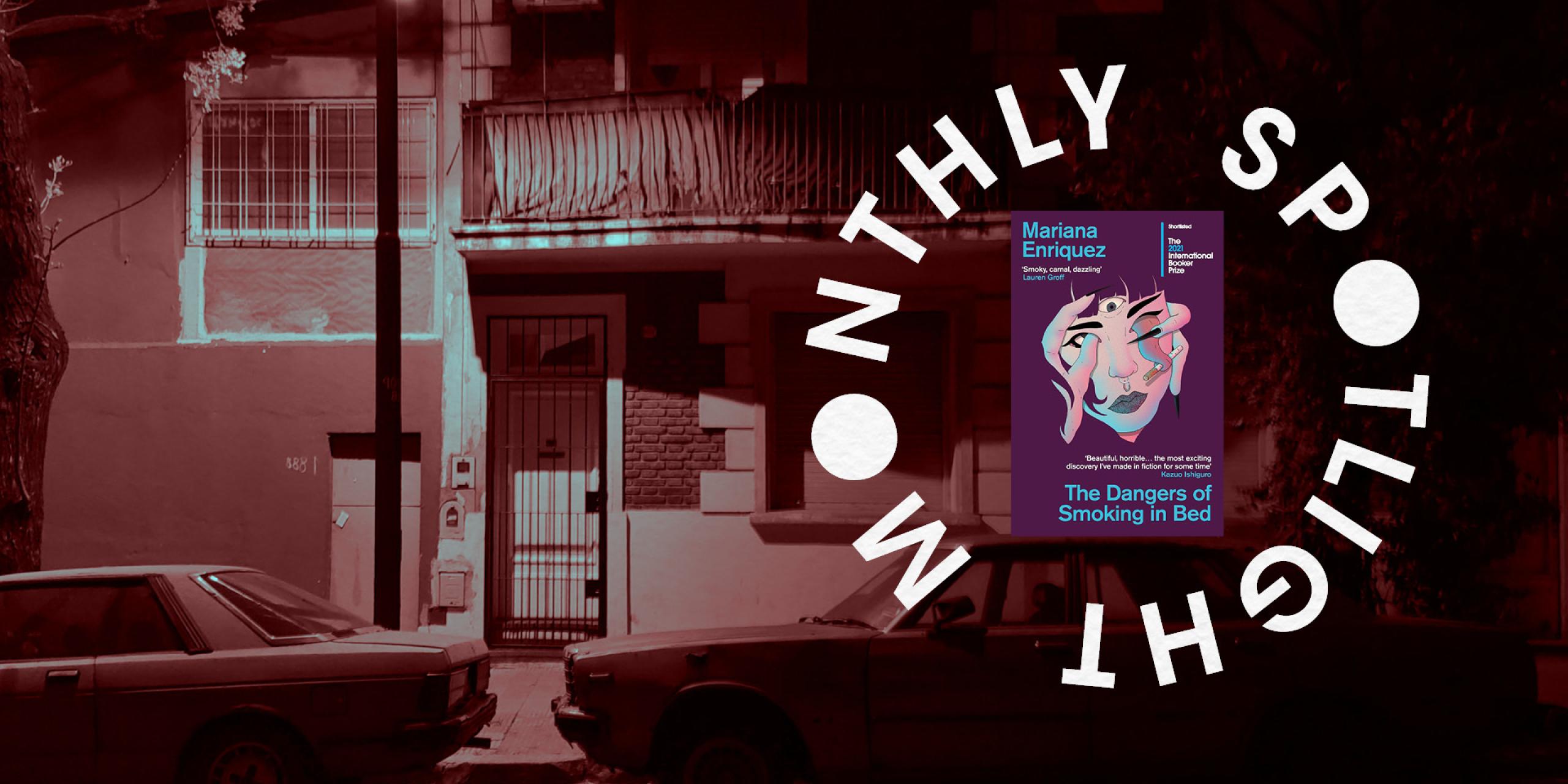
An extract from The Dangers of Smoking in Bed by Mariana Enríquez, translated by Megan McDowell
- Published
In her International Booker Prize-shortlisted collection, Mariana Enríquez populates contemporary urban Argentina with a macabre cast of crooked witches, unruly teenagers, homeless ghosts and hungry women
As terrifying as they are socially conscious, the 12 short stories press into the unspoken – fetish, illness, the female body, the darkness of human history – with bracing urgency. A woman is sexually obsessed with the human heart; a lost, rotting baby crawls out of a backyard and into a bedroom; a pair of teenage girls can’t let go of their idol; an entire neighbourhood is cursed to death when it fails to respond correctly to a moral dilemma.
Buy the book
Was it a nocturnal butterfly or a moth? She had never been able to tell the difference. But one thing was sure: nighttime butterflies turned to dust in your fingers, as if they had no organs or blood, almost like the still cigarette ash in the ashtray if you barely touched it. It wasn’t gross to kill them and you could leave them on the floor, because they disintegrated in just a few days. Another thing: it wasn’t true that they immediately burned up when they got too close to heat. Someone had told her that’s what happened, they caught fire as soon as they brushed against a hot bulb, but she had seen them hit against the lamp bulb over and over, as if they enjoyed the impact, and be left unhurt. Sometimes they got bored and flew out the window. Others, it was true, died inside the floor lamp: they got tired, or maybe they gave up or their time came. Just as they did outside, they burned up slowly, fluttering against the shade until they lay still. Sometimes she got up in the middle of the night to empty the lamp of dead butterfly-moths, when the burnt smell made her nose sting and wouldn’t let her sleep. Rarely did she remember to turn out the light before going to bed.
But one night in early spring it was another kind of burning smell that woke her up. Wrapped in the gray travel blanket she used when it was chilly, she checked the kitchen to see if she had left anything on a lit burner. It wasn’t coming from there. Nor was it the moths—she’d turned off the light that night. The smell wasn’t coming from the hallway of the building, either. She raised the blinds. Outside, there was smoke and rain. Something was burning in the rain and she could hear the fire truck siren and the murmur of some neighbors in the street, awakened in the early morning, surely with raincoats thrown over their pajamas. She heard one of them, a man with a cracked voice, say, “Poor woman.” The fire was far away, and Paula went back to bed. Later, she learned from the ever-informed doorman that it had been a fifth-floor apartment in a building around the corner that burned. There was one casualty, a paralyzed, bedridden woman who had fallen asleep in bed with a lit cigarette between her fingers. Her daughter, who took care of her—and who was fairly old herself, around sixty—had realized too late, when the smoke woke her up coughing, choking, and she couldn’t save her mother. “Poor lady, it’s an infernal habit,” said the doorman, and he added that the woman smoked a lot and never went out. Paula wanted to ask him, “How do you know the woman smoked so much, when you’ve just told me she never went out? When did you ever see her smoking then, huh?” But she kept her mouth shut because it was impossible to argue with the doorman, and because she was starting to picture how the woman on the fifth floor must have watched the flames climb up from her feet, and since she couldn’t feel anything in her legs, she must have let the blanket burn. And surely she must have thought, Why not just let the fire keep going and do its job? It must be painful, but how long could it be before a woman like her, old and with exhausted lungs, would faint? What a relief for the daughter, too.
Nighttime butterflies turned to dust in your fingers, as if they had no organs or blood, almost like the still cigarette ash in the ashtray if you barely touched it
The doorman pulled her from that vaguely soothing world of burnt old women, bringing her back to the landing to inform her that during the week a guy was going to come through and fumigate the apartments. Paula told him great, and then she decided that if she heard the doorbell she was going to let the fumigator in. Although there weren’t that many bugs in her apartment, except for the butterfly-moths, and she was sure the poison wouldn’t kill them because they didn’t live there, they came in from the street. Nothing lived in her house, not even the plants, which had assiduously died in recent weeks, one after another. She was the only living thing in her house.
She said goodbye to the doorman and went straight to bed. The sheets were imbued with the smell of chicken cutlets. She had made two in the oven the night before. It had been hard to wrest them out of the freezer because the plastic bag was stuck to the ice. She had to use very hot water, almost boiling, and some of the drops had burned her bare legs. It turned out to be a fruitless method, and then she tried to pry them out with a knife, and she laughed at herself through tears of self-pity, thinking that she must look like a serial killer as she stabbed at the freezer, her arm up and the knife coming down like an ice pick. Finally she extracted the cut-lets, her hands numbed from cold, and put them into the oven. They burned a little, but aside from that they were barely edible because they were infused with other foul flavors: the oven leaked gas, and she hadn’t cleaned it once in the three years she’d been renting the place. So she hadn’t been able to eat them, and now she was hungry again and the apartment stank and the smell wouldn’t let her sleep and she hated it, so much that she had to cry, and she cried because of the smell, because the incense she lit to get rid of it reeked even worse, because she never remembered to buy air freshener—which also smelled terrible—and because the cigarettes must also make everything stink but she couldn’t tell because she smoked so much, and because she had never been able to have one of those clean and luminous houses that smelled of sunlight, lemons, and wood.
She made a tent in the bed, propping up the sheet with her knees and covering her head. Underneath, the only light came from the tip of her cigarette, which trembled and seemed to rekindle when the smoke whirled around it. The sheets were all stained by ashes. Paula opened her legs, and with the index finger of her free hand she started to caress her clitoris, first in circles, then with a vertical motion, then with delicate tugs, and finally side to side. It didn’t work at all anymore; used to be she would feel the start of that shiver right away, and the heat of the blood rushing and then her finger could feel the skin of the vulva grow a little rougher, granulated, and with the great final tremor came the wetness, she really felt like she peed herself—that’s how it used to be. But for so long now nothing happened, and she rubbed to the point of irritation and pain but stopped before the blood came; she knew that blood was the only wetness she could still squeeze out of herself.
She put the bedside lamp under the sheets. Her inner thighs were dotted with small, superficial red spots; it looked like an irritation from heat or allergy, but it was something called keratosis, and she also had it on her arms, her hips, and a little on her ribs. The dermatologist had told her that with a lot of treatment it could get better, that it was nothing like more terrible conditions like psoriasis or eczema, but she thought it was plenty terrible, just like her yellow teeth and the blood that flowed every morning from her gums when she brushed her teeth—not a momentary bleeding, real streams of blood that dripped into the white sink. It was called periodontitis, though these days dentists used another, fancier name that she couldn’t remember now. Anyway, she preferred the truth, she preferred periodontitis. Her body was failing in many more ways that she didn’t want to think about. Who would ever love her like that, with dandruff, depression, zits on her back, cellulite, hemorrhoids, and everything dry, so dry.
She lit another cigarette under the sheet and used the smoke to chase a butterfly that had snuck into her refuge, until it died. So you could suffocate them with smoke? What a weak and stupid animal. She let it convulse between her legs, and she saw the butterfly-moth’s legs that looked like tiny maggot-worms; for the first time she felt disgust, and she kicked it out of her bed and onto the floor. She made smoke rings inside the tent until she got bored, then decided to touch the ember to the sheet and watch as the orange-edged circle grew until it seemed dangerous, until the flame crackled and rose. Then she put out the fire on the sheet by hitting it, and the remnants of burnt cloth floated in the tent. She laughed at the small circular fires. If she poked her head out of the tent and peered into the semidarkness of her room, the burnt circles in the sheet let the lamplight through, and the beams shone onto the ceiling so it seemed to be covered in stars.
She had to burn more holes, because as soon as she saw that, she knew the only thing she wanted was a starry sky over her head. It was the only thing she wanted.
The Dangers of Smoking in Bed
- Translated by
- Megan McDowell
- Published by
- Granta Books
Mariana Enríquez populates contemporary urban Argentina with a macabre cast of crooked witches, unruly teenagers, homeless ghosts and hungry women


Features
- Book recommendations
Six body horror books nominated for the Booker and International Booker Prize

- Book recommendations
Eight Booker-nominated books for fans of Wuthering Heights

- Book recommendations
11 of the best books of short stories from the Booker Library


- Book recommendations
12 of the best Booker-nominated books by Latin American authors

- Book recommendations
