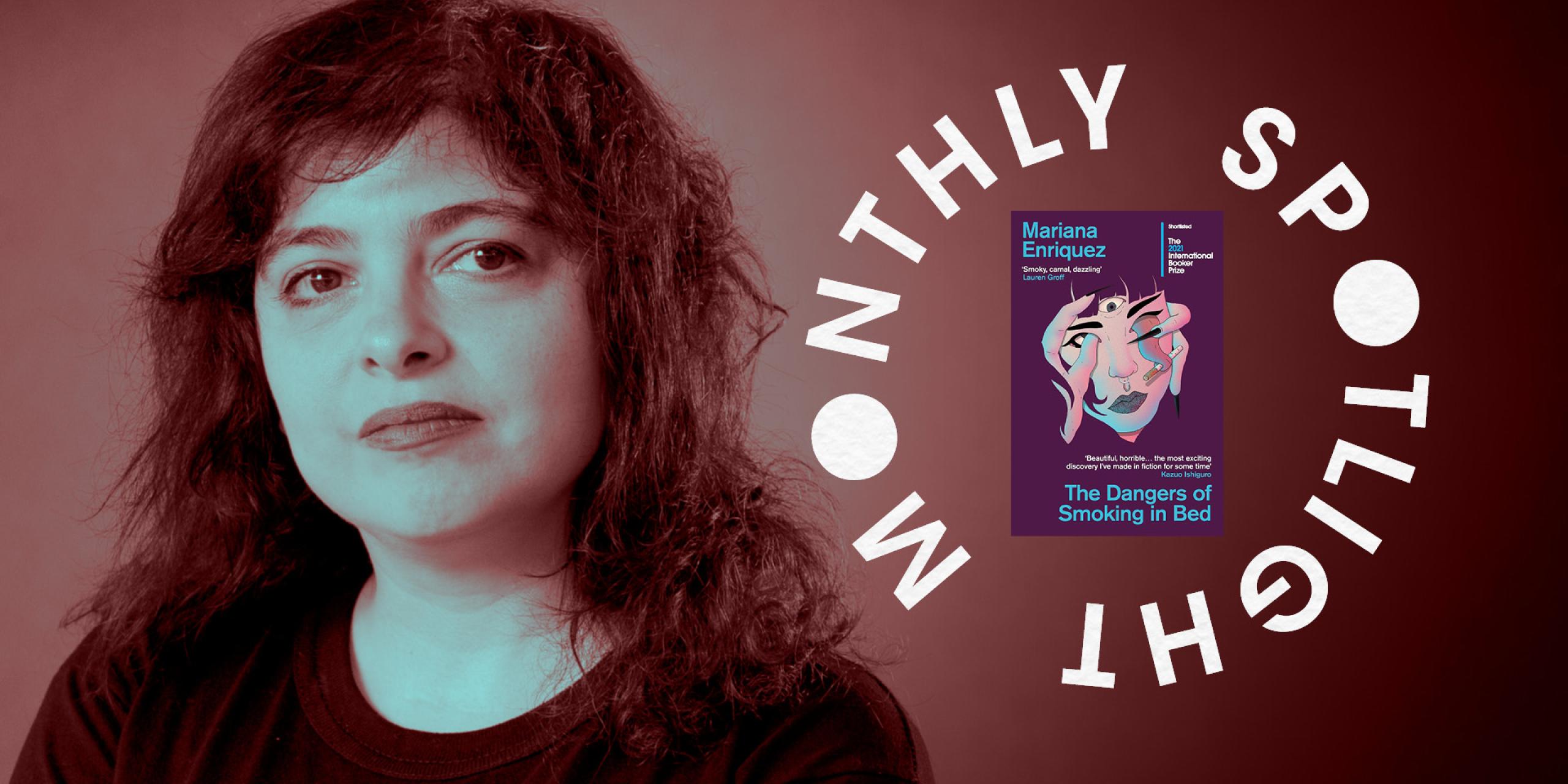
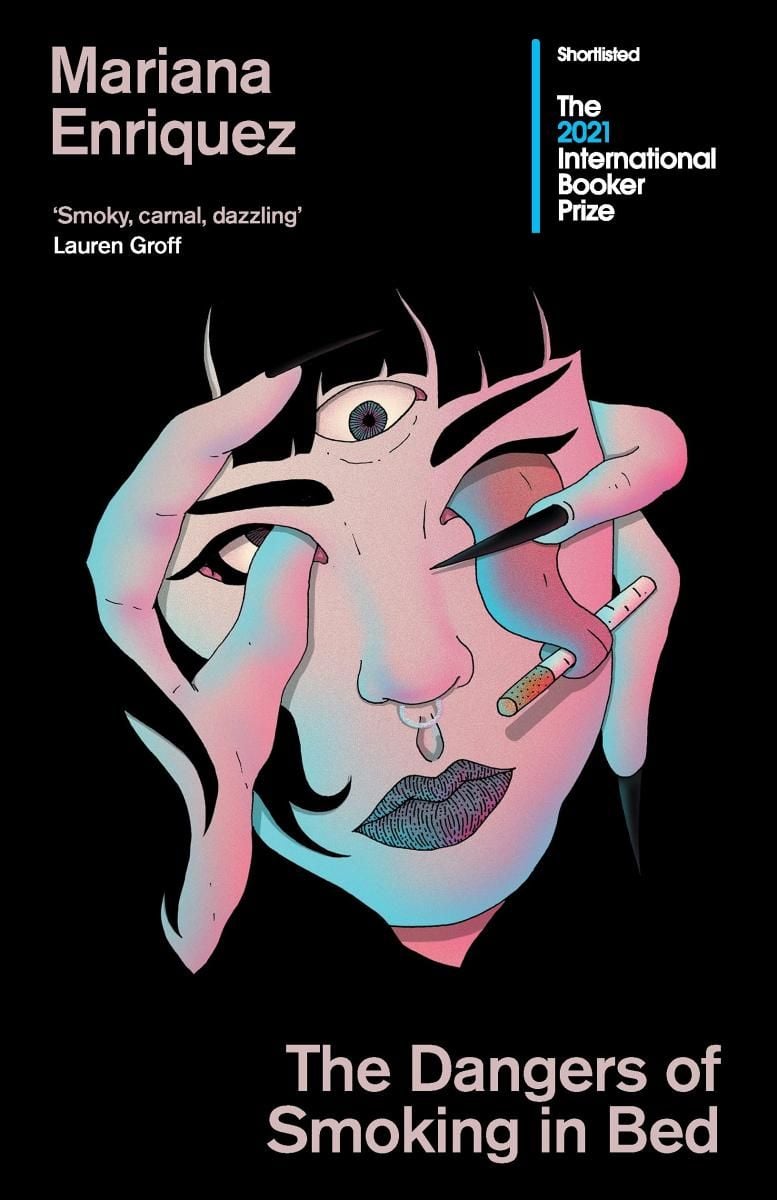

As terrifying as they are socially conscious, the 12 short stories in The Dangers of Smoking in Bed press into the unspoken with bracing urgency
- Published
The author of The Dangers of Smoking in bed discusses the importance of the short story in Argentinian literature, growing up under a dictatorship, and the horror stories that shaped her as a writer
Buy the book
The stories in The Dangers of Smoking in Bed often find horror in the everyday details. What draws you to push ordinary experiences into the uncanny?
I think that’s what contemporary horror should do or, better put, that’s the kind of horror I find interesting. To me, there’s nothing more disquieting than realising everyday life could be terrifying. It’s not just the Freudian uncanny, but the distancing from reality, the feeling of being unsafe, the unknown not being in a far-away land or dimension, but right here next to you. Our own bodies, our mind, the neighbours, our family.
The Dangers of Smoking in Bed is a collection of short stories, but you are also known for writing other forms: novels, journalism, and non-fiction books. Do you feel more at home in one form than the other, or do they simply require different ways of thinking? What makes a great short story, and why did you pick that format for this collection?
I’m Argentinian, and to me the short story is the form that feels nearer, easier, and let’s say natural, because the short story is very important in the tradition of Argentinian literature – it’s short stories that you read in school, for example. It’s Borges and Cortázar, but also others who are not that famous internationally, but very important, like Silvina Ocampo (surrealist, deeply weird), Hebe Uhart (super realistic, autofictional), Abelardo Castillo (the 1970s tradition), Manuel Mujica Lainez (historical fiction), Horacio Quiroga (horror and the fantastic), so there’s also a huge range of the short story and what it can do. I feel more at home in the short story, but then feeling at home is not that important to me; it really is what the idea or project requires, in the end. I love short stories. To me, there are no fixed rules in short stories. Chejov and Borges and Munro and Cheever and Carver and Aickman and Mishima, they are all different and all extraordinary.
Your work has a fascination with the macabre and the unsettling and you’ve spoken about being influenced by writers such as Shirley Jackson and Stephen King. Where did that interest begin, and how has your relationship with the darker side of storytelling developed over the course of your career?
As with many fascinations, it started in childhood, but I can’t say there was a special moment. It’s just what I gravitated to. There was a small book of folk tales from the Northeast of Argentina, a region where a lot of the mythology of the Guaraníes – the original people of the land – survives, mixed with Catholicism, and my favourites were the dark ones, the stories about evil beings and damnation. Also, the Bible: the Old Testament is very intense and morbid, and some parts of the New Testament too. I was raised Catholic, though my parents are not religious, but the school was – why they sent me to a religious school, I still have no idea; I think the level was better. Anyway, I was a believer and was fascinated with the demons and the raising of the dead. From there I found Jane Eyre and Poe and Wuthering Heights and Spielberg and A Nightmare on Elm Street, and to me it was all the same gorgeous storytelling that was exciting and fun and dangerous, and made me feel something. I guess it’s a very childhood experience – maybe not – but it stuck. Through the years, people have asked me if growing up in a dictatorship had anything to do with it, and maybe yes, but not in any conscious way. And I guess there would be many people who just would not touch horror because they lived real horror. I don’t know.

Mariana Enriquez. © Ariel Grinberg
You’ve spoken about being influenced by writers such as Shirley Jackson and Stephen King. What did you discover in those writers that made you want to write in this genre too?
With both of them, it was, and is, the marriage of realism and horror as a genre. In King, it is that he is capable, especially in his early work, of choosing the most recognisable stuff in a society and everyday life – a bullied girl, high school, religious fanaticism, domestic violence, grief, pets, illness, being a parent – and turning it into a phobic nightmare and also a fantastic tale, with gore and violence, but also deeply social and psychological. Jackson’s ethics and themes are different, but in the same vein, she chooses the house, the home, as the most horrific space. The small town in ‘The Summer People’ or ‘The Lottery’. The husband that comes home different. That which is close.
Body horror often features in your work, whether through illness, violence, or transformation. What is it about the body that makes it such a powerful vehicle for horror?
The body is all we have! When the body gets sick or is in pain or in danger, we are in danger. In many ways, the body is more the experience of the self than the mind, or, let’s say, it’s very difficult to tear them apart. Isn’t the mind in the brain anyway, and a brain is an organ? Damage or a malfunction of the body is, at the very least, menacing. The idea and the fantasy of the body transforming is very rooted in culture; every culture considers metamorphosis a punishment, from the ancient Greeks to the Japanese or the stories of indigenous people all over the world. Losing your body is horror.
There’s a strong sense of place in your writing. How do Buenos Aires and Argentina shape the stories you tell?
Buenos Aires is a character in my stories. It’s a place and a character. It’s not the only one, of course; I use the Mesopotamia of Argentina a lot, but the city is an incredible character and great for writing place because it morphs. You can say, well, everything morphs, and it’s true, but not like a city. Buenos Aires has a lot of personalities and a lot of stories. It can be super rich and aristocratic; it can be very poor and abandoned; it can be a South American metropolis, and it can be a quiet suburb. And the human or beings that are imagined interact with this other character-place, and it shapes them because they respond to the city and its many moods.
Which book are you currently reading, and what made you pick it up?
I’m reading several, because nowadays I read many at the same time. I’m currently reading Riding the Nightmare by Lisa Tuttle because I read My Death by her and thought it was a genius novella and wanted to read all of her work. Also, Un destino común, conversations with Argentinian film director Lucrecia Martel, because I think she is a brilliant mind; Koljós by Emmanuele Carrere because I adore his Russian non-fiction saga; and the poetry of Antigone Kefala. I also just read the new Jenni Fagan and had a lot of fun.
The idea and the fantasy of the body transforming its very rooted in culture; every culture considers metamorphosis a punishment
Tell us about a book that changed the way you think about the world.
Perhaps La Virgen de los sicarios, by Fernando Vallejo. I read it at a fairly young age, and it was the first time I was confronted by hatred of that kind, of himself, of his country, of his desire – and all with the most gorgeous language. That short novel is a clash of aesthetics, and I dare say morality; it’s sick and sad and gorgeous, and surely dangerous.
Tell us about a book by an Argentinian or Latin American writer that you’d recommend to English-language readers.
The Islands by Carlos Gamerro, a cyber thriller with the Malvinas (Falklands) War. It’s insane, a bit Joyce, a bit Borges, a bit Burroughs, Atwood, some Pynchon, yet totally his own. It’s bizarre and probably a masterpiece.
Do you have a favourite book nominated for the Booker or International Booker Prize? What do you love about it?
There are so many! I guess in International I adore Solenoid by Mircea Cărtărescu [translated by Sean Cotter] and no offence, but I don’t understand who else could’ve won that year! I love maximalist novels, and that is one of the best in recent years. I love Possession by A.S. Byatt and The Comfort of Strangers by Ian McEwan – it’s so perverse and cruel. A General Theory of Oblivion by José Eduardo Agualusa [translated by Daniel Hahn] is amazing. And of course, Fever Dream by Samanta Schweblin [translated by Megan McDowell] is one of the best Argentinian novels ever.
Lastly, could you recommend some of your favourite ghost stories for readers to enjoy in the run-up to Halloween?
The Turn of the Screw by Henry James, Ring by Koji Suzuki, and Ringing the Changes by Robert Aickman are the scariest stories I have ever read. ‘El huésped’ by Amparo Dávila. Anything ghostly by Diego Muzzio. It’s not strictly a ghost story, but close: Handling the Undead by John Ajvide Lindqvist. The Next in Line by Ray Bradbury has no ghosts, but it’s horrific.
The Dangers of Smoking in Bed
- Translated by
- Megan McDowell
- Published by
- Granta Books
Mariana Enríquez populates contemporary urban Argentina with a macabre cast of crooked witches, unruly teenagers, homeless ghosts and hungry women


Features
- Book recommendations
Six body horror books nominated for the Booker and International Booker Prize
- Book recommendations
Eight Booker-nominated books for fans of Wuthering Heights

- Book recommendations
11 of the best books of short stories from the Booker Library


- Book recommendations
12 of the best Booker-nominated books by Latin American authors
- Book recommendations
