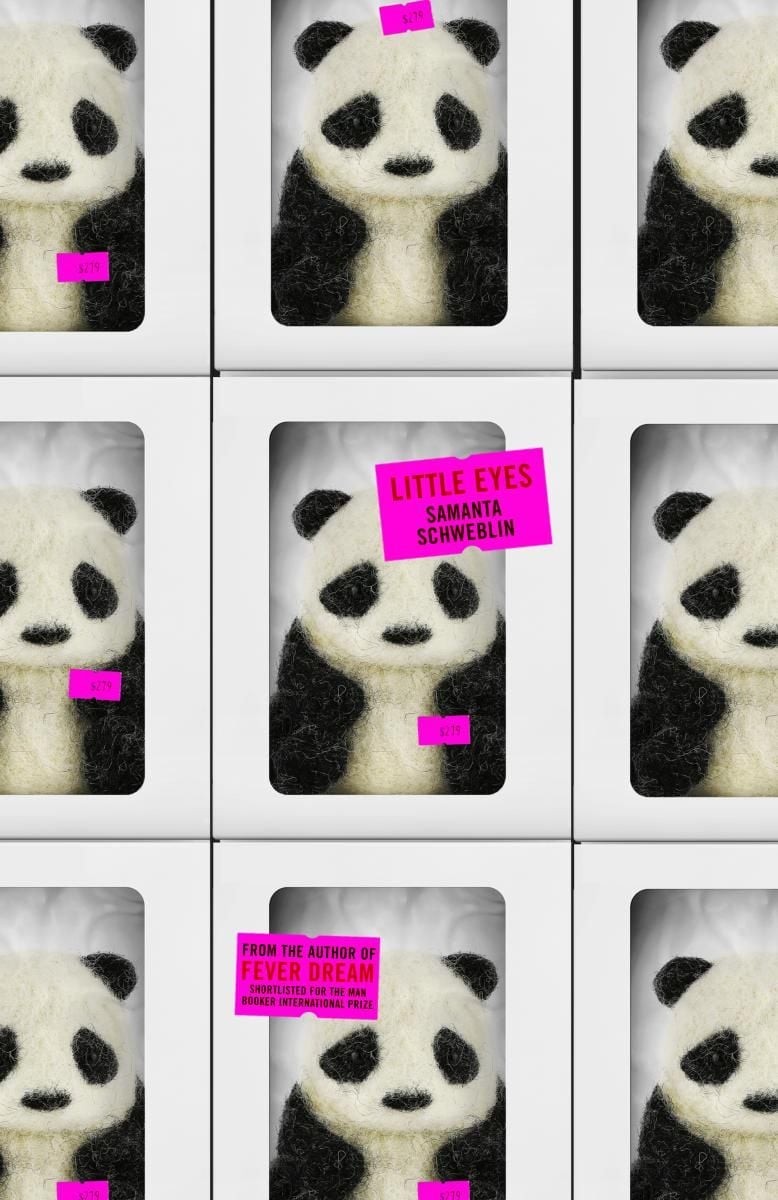

Samanta Schweblin’s wildly imaginative novel – longlisted for the International Booker Prize in 2020 – explores the voyeurism and exhibitionism inherent in our digital lives
An extract from Little Eyes by Samanta Schweblin, translated by Megan McDowell

An extract from Little Eyes by Samanta Schweblin, translated by Megan McDowell
- Published
Samanta Schweblin creates a dark and complex world that is both familiar and unsettling in this thought-provoking novel about digital innovation and human connections
They’ve infiltrated homes in Hong Kong, shops in Vancouver, schools in Tel Aviv, bedrooms in Indiana. They’re not pets, nor ghosts, nor AI robots – they’re kentukis, and they are real people. Schweblin’s wildly imaginative novel reveals the beauty of connection between far-flung souls – but also exposes the ugly truth of our increasingly linked world. Trusting strangers with intimate, unfiltered details of our lives can lead to unexpected love, playful encounters and marvellous adventures, but what if it can also pave the way for unimaginable terror?
The book is published in the UK by Oneworld.
Buy the book
Sitting on his father’s desk chair, Marvin swung his feet, which didn’t quite reach the floor. He drew spirals in the margins of his school notes while he waited, and every once in a while he checked the message on his tablet; for more than ten minutes now it had been displaying the words Establishing connection. Below that was the warning This procedure could take some time. It was information meant for those who had never started up a kentuki before. Marvin, on the other hand, had already witnessed the exciting first connections that two of his friends had made. He knew what steps to follow.
A week before, when his father had discovered Marvin’s real grades, he’d made him promise to sit in the study for three hours every day, surrounded by books, doing homework. Marvin had said, “I swear to God that I will sit for three hours a day at the desk surrounded by books,” but he hadn’t said anything about studying, so he wasn’t really going back on his word. And it would be months before his father caught on that he’d installed a kentuki on the tablet—that is, if his father ever found the time to discover anything else about his son again. Marvin had paid for the kentuki connection using his mother’s savings account. It was digital money, the only kind the dead can have. Marvin had already used that account on other occasions, and he was starting to suspect that not even his father knew it existed.
Finally the serial number was accepted. Marvin started in his chair and leaned over the screen. He didn’t know how well a kentuki would work from his tablet. His friends who were already kentukis—one in Trinidad and the other in Dubai—used virtual reality headsets; that’s what he had learned on, and he was afraid the experience wouldn’t be as good on his old tablet. On the screen, the camera came on and everything went white. “Dragon, dragon, dragon,” murmured Marvin, his fingers crossed. He wanted to be a dragon, though he knew he had to be open to whatever animal he got. His friends had also wanted to be dragons, but God had known better than they did what each of them really needed: the one who was a rabbit spent his days wandering around the bedroom of a woman who, at night, let him watch while she showered. The one who was a mole spent twelve hours a week in an apartment that looked out over the turquoise waters of the Persian Gulf.
Marvin tried to growl, and he managed a soft, sad noise, so deep that, more than a dragon’s cry, it sounded like he had a burnt transformer
The screen of his tablet was still white, and it took a minute before Marvin realized the problem: the kentuki was facing a wall, and he was too close to focus. He backed up. The application on the tablet was almost as good as the headsets, and still it was hard for him to tell where he was. He turned around and finally saw something: four compact vacuum cleaners lined up one behind the other, almost all the same height as his kentuki. They were shiny and modern; his mother would have loved them. When he moved in the other direction he began to understand: the fourth wall was made of glass and it looked out onto the street. He was in a shop window. It was nighttime, and someone went by outside wearing a hood, so bundled up that Marvin couldn’t even guess whether it was a man or a woman, or how old the person was. And then he saw it: snow. It was snowing! Marvin’s feet jiggled under the desk. Whatever his friends may have had, none of them had snow. None of them had ever touched snow in their lives, and he could see it now right there in front of him. “One day I’m going to take you to see snow,” his mother used to promise him, before Marvin even knew what snow was. “When you touch it, your fingertips will hurt,” she’d say, and then she’d threaten to tickle him.
He looked for a way out of the display window. He circled the vacuum cleaners and checked the four corners around him. In the street, a woman stopped for a moment to look at him. Marvin tried to growl, and he managed a soft, sad noise, so deep that, more than a dragon’s cry, it sounded like he had a burnt transformer. What animal was he? The woman went on with her walk. Marvin tried to push one of the vacuums. It was too heavy, and he could only turn it a little. He moved closer to the glass and spent a while looking for his reflection, but he couldn’t get the light in his favor, and so he sat watching the snowflakes fall and turn to liquid as soon as they touched the ground. How much more would it have to snow before it would stick and cover everything in white?
Marvin practiced shortcuts a couple of times on his tablet, making sure he could quickly change from the kentuki controller to Wikipedia if his father came into the room. Then he sat looking at the photo of his mother that hung between his father’s old wooden crucifix and a prayer card of the Virgin of Mercy. Maybe God was waiting for the right moment to reveal what kind of animal he would be. He leaned over the screen again. In the display window, he brought the kentuki’s forehead up against the glass and sat looking at the empty street. He would find a way out, he thought. At least in this other life, he wouldn’t let himself be locked up.


Little Eyes
- Translated by
- Megan McDowell
- Published by
- Oneworld
Samanta Schweblin creates a dark and complex world that is both familiar and unsettling – largely because we recognise it as the one we live in