
Samanta Schweblin’s wildly imaginative novel – longlisted for the International Booker Prize in 2020 – explores the voyeurism and exhibitionism inherent in our digital lives
First person
Opinion
Vincenzo Latronico: ‘Little Eyes reveals the ways our lives are both harmed and enriched by digital innovation’
First person
Opinion
Vincenzo Latronico: ‘Little Eyes reveals the ways our lives are both harmed and enriched by digital innovation’
- Written by
- Vincenzo Latronico
- Published
International Booker Prize-nominated author Vincenzo Latronico on the challenge of writing fiction that truly reflects the role digital technology plays in our lives, and how Samanta Schweblin does it so successfully in Little Eyes
If Odysseus had had GPS, his journey would have lasted but a few weeks. A basic face recognition app would have allowed Parisian socialites to quickly identify revenge-hungry Edmond Dantès under the mask of the mysterious Count of Montecristo. The dating app Raya is full of single men in possession of good fortunes. And so on. You get the gist.
It might seem like just a fun game to play, but it is one that also reveals a truth about the relationship between storytelling and technological progress. Technology plays a role in defining the perimeters of fiction, since it dictates the plots that are plausible and the ones that are not.
This has never been much of a problem for novelists, since progress was slow enough to allow their stories to remain plausible for decades, even centuries. Eventually, a footnote or a preface might be necessary, but likely not in their lifetimes. But as the digital age has dramatically increased the pace of technological transformation, the shelf-life of believability has drastically shortened.
A campus novel written less than 20 years ago is already likely to contain details that are incomprehensible to anyone who isn’t aware of every tiny aspect of tech life at the time. Back then, Facebook was new and exciting, open only to a select few colleges, iPhones could be easily hacked to expand their functionality, and ‘viral’ still related to disease. In my own second novel, the tension of a whole chapter was predicated on the fact that the protagonist’s BlackBerry phone couldn’t open PDFs. This was 2011. It’s not that long ago.
So, novelists today are in a bind. On the one hand, you want to write stories that are detailed and realistic, a fine-grained rendition of what it feels like to be alive right now. One of the most salient aspects of our time involves being affected, emotionally, materially and politically, by digital technologies. On the other hand, you want those stories to be understandable independently of whether this app or that website is still around 18 months from now.
There is no obvious solution. Writers who’ve tried to include as much tech as there is in our lives in their novels – like Jonathan Franzen in Purity or Dave Eggers in The Circle – ended up writing books that at times feel as if they were about tech itself rather than the people using it. Today, barely a decade after publication, they already read like documents of a bygone era.
Others, like Sally Rooney, chose to focus on their characters while smudging over the specifics of their digital lives. This allows for more vivid, credible and long-lasting plots, but the price is a loss of specificity, a loosening of the bond between the story and the particular way in which we live. Rooney’s novels often give the sense of taking place in a sort of vague 2009, a time when tech was indeed a part of life but nowhere as central as it is today. Nobody, in 2021, would have written emails that long.
Writers who’ve tried to include as much tech as there is in our lives in their novels have ended up writing books that feel as if they were about tech itself rather than the people using it
Then there is Samanta Schweblin’s Little Eyes.
The premise is simple. A new digital toy is launched: an always-connected plush animal equipped with a camera, a microphone and tiny wheels. It’s called a ‘kentuki’. Anyone can buy one, but anyone can also buy a subscription to inhabit one, assigned at random, anywhere in the world. They can move it around, play at being a pet, snooping on the owner’s life without being able to communicate with them.
Such a toy is technologically possible, which means Little Eyes is not science fiction. Its potential for harm and abuse means it’s very unlikely it could practically be brought to market in the real world, but Schweblin’s narrative talent makes readers unquestioningly accept them. We, as users, have welcomed technologies that are just as harmful and invasive of our privacy into our lives. This makes kentukis a perfect metaphor for the ways in which our lives are both constrained and expanded, harmed and enriched by digital innovations.
But kentukis are not metaphors; they are toys, and as such they enter the lives of people all over the world. An old woman in South America becomes fascinated, then alarmed, by the sex life of a young woman in Germany. An ageing Italian projects onto his digital pet the bond he has failed to develop with his son. A child in Guatemala explores a Norwegian town in a quest to finally see snow. A Croatian man comes up with a money-making scheme by buying and reselling interesting Kentuki connections. And so on.
Schweblin is interested in the subtle ways in which any digital innovation immediately alters the interplay of our hopes and fears, our desires and insecurities. Her stories show how Kentukis change the lives of several normal people, with normal ratios of nobility to venality – some better, some worse. There is monstrosity but also kindness and wit, and a pervasive sense of wonder that the frenzied pace of innovation often makes us forget.
Dystopias tend to depict new technologies as inevitably bringing about the worst outcomes, due to the pessimistic idea that violence, greed and thirst for power ultimately outweigh other aims and values. Utopias often hinge on the optimistic obverse. Little Eyes maps the grey area in between the two, which is the one we actually inhabit. This – not any specific app or piece of tech – is what Schweblin has been uniquely, miraculously able to capture.


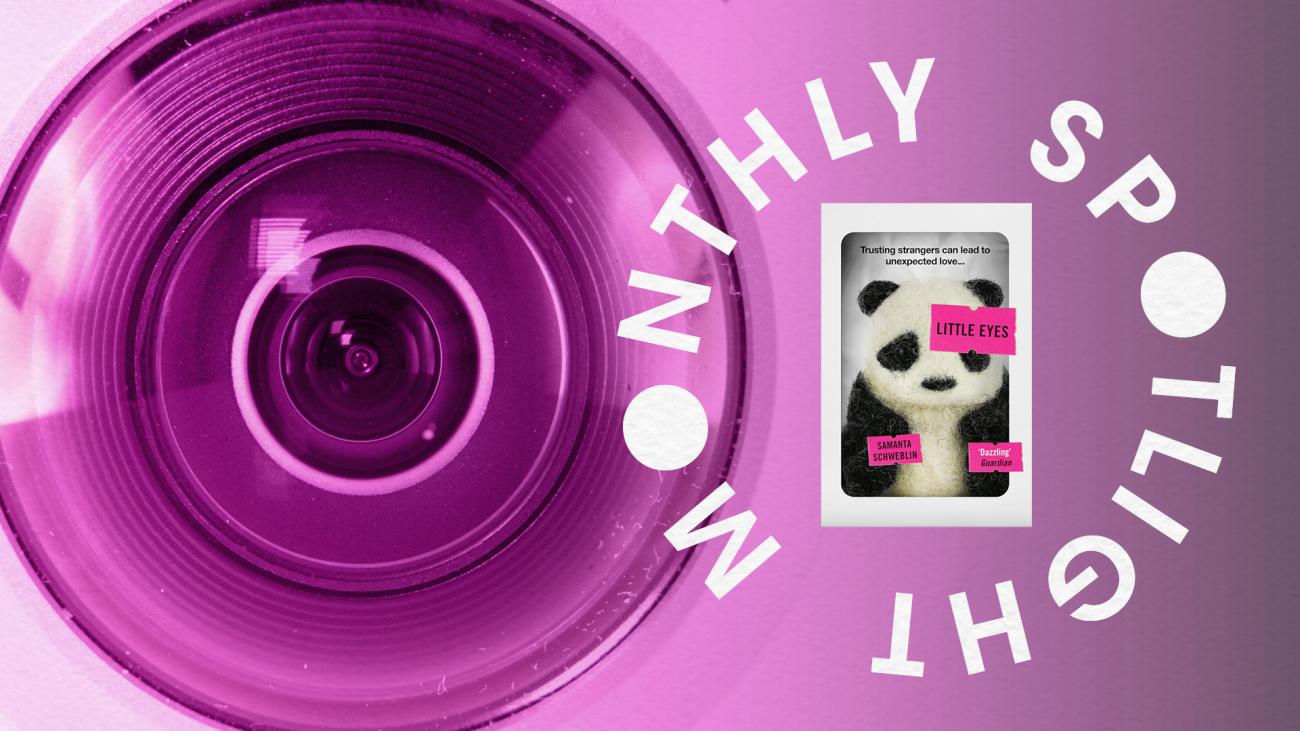


Little Eyes
- Translated by
- Megan McDowell
- Published by
- Oneworld
Samanta Schweblin creates a dark and complex world that is both familiar and unsettling – largely because we recognise it as the one we live in
Features


- Book recommendations
Taiwan Travelogue and 10 more Booker-nominated novels that are perfect for foodies


- Book recommendations