Reading guide: Little Eyes by Samanta Schweblin, translated by Megan McDowell

Reading guide: Little Eyes by Samanta Schweblin, translated by Megan McDowell
- Published
Samanta Schweblin’s wildly imaginative novel – longlisted for the International Booker Prize in 2020 – explores the voyeurism and exhibitionism inherent in our digital lives
Whether you’re new to Little Eyes or have read it and would like to explore it more deeply, here is our comprehensive guide, featuring insights from critics, our judges and the book’s author and translator, as well as discussion points and suggestions for further reading.
Synopsis
Buy the book
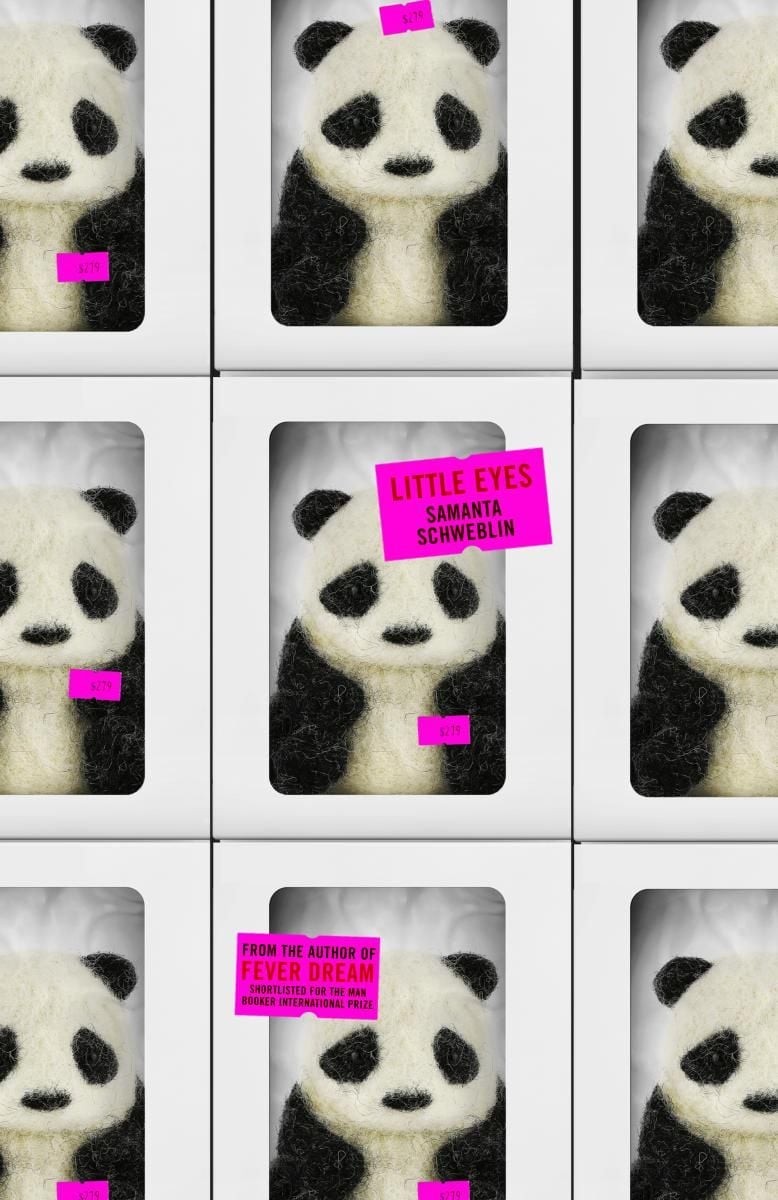
They’ve infiltrated homes in Hong Kong, shops in Vancouver, schools in Tel Aviv and bedrooms in Indiana. They’re not pets, nor ghosts, nor robots. They’re real people, anonymous and untraceable, connected remotely, and disguised as cute, cuddly toys. Samanta Schweblin’s wildly imaginative novel reveals the beauty of connection between far-flung souls, the ugly truth of our increasingly linked world, as well as the voyeurism and exhibitionism inherent in our digital lives. In the world of the novel, trusting strangers can lead to unexpected love, playful encounters and marvellous adventures, but what if it can also pave the way for unimaginable terror?
Little Eyes, translated into English from Spanish by Megan McDowell, was longlisted for the International Booker Prize in 2020.
The main characters
Alina
Alina has moved to Oaxaca, Mexico, to live with her artist boyfriend, Sven. But she starts to become lonely and decides to buy a kentuki for herself, a crow-shaped model named Colonel Sanders. Initially sceptical of the creature, and frustrated with her troubled relationship with Sven, Alina starts mistreating it.
Emilia
Emilia is a retired single mother, living in Peru, whose son has moved to Hong Kong. Struggling with the weight of his absence, she is gifted a kentuki connection, and matches with Eva, who lives in Germany. She starts to become protective of the woman and worries about her welfare.
Marvin
Marvin is a young boy who lives in Antigua. Grieving the death of his mother and feeling pressured by his strict father, he connects to a kentuki in a small town in Norway, hoping to achieve his dream of touching snow.
Grigor
Struggling with money issues, Grigor, who lives in Croatia, decides to use kentukis for financial gain, buying as many as he can and selling connections for maximum profit. But after a situation goes awry, Grigor has to face up to the consequences of his actions.
About the author
Samanta Schweblin is the author of three story collections that have won numerous awards, and she has been nominated for the International Booker Prize three times. Her debut novel, Fever Dream, was shortlisted for the International Booker Prize 2017. In 2019, she was longlisted for the prize for Mouthful of Birds. She was longlisted again in 2020 for Little Eyes.
In 2011, she was selected by Granta magazine as one of the 22 best young novelists writing in Spanish. Her books have been translated into over 30 languages, and her work has appeared in English in the New Yorker and Harper’s magazine. Originally from Buenos Aires, she lives in Berlin.

Samanta Schweblin
© Roberto Ricciuti / Getty Images
About the translator
Megan McDowell has translated books by many contemporary South American and Spanish authors, including Samanta Schweblin, Alejandro Zambra and Mariana Enriquez.
Her translations have won the National Book Award for Translated Literature, the English PEN award and the Premio Valle-Inclán, and she has been nominated four times for the International Booker Prize. Her short-story translations have been published in the New Yorker, the Paris Review, the New York Times Magazine, Tin House, McSweeney’s and Granta. In 2020 she won an Award in Literature from the American Academy of Arts and Letters. Originally from Richmond, Kentucky, she lives in Santiago, Chile.

Megan McDowell © Sebastian Escalona
What the critics said
Mia Levitin, Financial Times
‘Schweblin enjoys hovering just above the normal. Inspired by Samuel Beckett, she is interested in exposing absurdities … Little Eyes presents a plausible picture of unintended consequences from the surveillance by smart technology in our homes and our pockets.’
Houman Barekat, Literary Review
‘The element of farce in these proceedings makes for enjoyable reading. As a mildly absurdist situational comedy riffing on everyday human foibles – jealousy, capriciousness, existential restlessness – Little Eyes is competently crafted; the understatedly arch tone is well served by Megan McDowell’s translation, which is so slick that one hardly seems to be reading a translated work.’
Leslie Pariseau, Los Angeles Times
‘Little Eyes operates on the tension created by dread, situating Schweblin within a canon of writers (Shirley Jackson, Ray Bradbury, Octavia Butler, Toni Morrison) whose rendering of horror ultimately exposes the gorgeous, rotten and wounded parts of ourselves … a lucid reality drawn with clinical precision that unburdens the reader from grappling with the absurdity of furry robots on wheels but also creates the illusion of solid ground. At no point does Schweblin subject her world to internal interpretation; she leaves this job to the reader, trusting us to extract our own conclusions and project our own anxieties onto her surreality.’
Barbara Hoffert, Library Journal
‘As situations escalate, readers will be fascinated by the kentuki-human interactions, which smartly reveal how hungry we are for connection in a technology-bent world … this jittery eye-opener will appeal to a wide range of readers.’
Boyd Tonkin, Spectator
‘So, yes – if you want a spookily prescient vision of human isolation both assuaged and deepened by inscrutable, glitch-prone tech, then Little Eyes more than fits the brief. Its fairly rudimentary kit – smartly, Schweblin makes the spy-toys’ low-spec clunkiness a key element – allows claustrophobic intimacy to flourish alongside physical distancing … Adroitly served by Megan McDowell’s winningly deadpan translation, these stories deal not in “truly brutal plots” but “desperately human and quotidian” urges, fears and scams.’
What the author said
‘Animals, toys, robots, all have in common a strange moral force that they exercise over us. There’s something in those eyes, in the way we see ourselves reflected, that destabilizes us. The digital world is full of strangers, real people without faces or bodies. If we could see their facial expressions and gestures, would we behave the same way with them?
‘Pets watch how we live, they know we’re real, and we like to be looked at and adored. But it also soothes us to know that an animal looks but doesn’t talk, adores but doesn’t offer an opinion.’
‘When I first got the idea I didn’t think about a novel, I thought of it as a device: if something as complex as a drone already exists, how could it be that a kentuki doesn’t? It would be so cheap, so attractive, so perverse: a win-win for the market. I went for dinner with my dad and he jokingly suggested copyrighting it, which I didn’t want to do. In a disappointed tone of voice he said: “Well, if you don’t want to earn money, just write a novel, as you know how to do that.”’
What the translator said
‘Alina in Oaxaca is the character I identified with most, which is why her violence with the Colonel was particularly shocking (and why the ending was particularly disturbing). Several of the storylines filled me with a particular sense of dread – Emilia’s and Grigor’s, for example. You know something bad is going to happen with them, but it’s hard to have any idea just what it will be. I think some of the “one-off” storylines have some moving and brutal images that really stuck with me. There’s a scene at a retirement home when an old woman wades desperately into a fountain to chase a suicidal kentuki – that one gets me.’
Questions and discussion points
Kentukis are cute but tacky soft toys with small wheels and cameras in their eyes – in the novel, we encounter a plush dragon, mole, bunny, panda and crow. Why do you think Schweblin used these particular animals to represent the kentukis? Do you think there was a disconnect between their benign, cuddly appearance and their function?
There’s a sharp contrast between the people who choose to have kentukis in their homes (‘keepers’) and those who choose to operate them from afar (‘dwellers’). One character in the novel, Emilia, thinks about the differences between the two ways of being and is pushed to experiment – disastrously – with both. What do you think are the key differences between keepers and dwellers? Do you think it would be better to be one or the other?
It’s impossible to switch a kentuki off – it either runs out of battery or needs to be destroyed. Keepers often end up physically harming their kentukis: mutilating them, drowning them, burying them alive. Why do you think Schweblin made it so difficult for the kentukis to be turned off? Did you find the scenes where keepers were cruel to their kentukis shocking?
The book features multiple characters of all ages, spread across the world, with short sections that focus on various keepers’ and dwellers’ experiences with the kentukis. Did you feel that Schweblin devoted enough time to each character or would you have preferred the book if it had a single central character?
In an interview for the Booker Prizes website, Samanta Schweblin said, ‘We want to see what’s behind the curtain, not just out of morbid curiosity, but also out of fear, or the anxiety of anticipation, out of a desire to capture the truest essence of the other, right when they don’t know they’re being watched’. Do you agree?
The book highlights how technology can transform and also harm our lives. Writing for the Booker Prizes website, International Booker Prize 2025- shortlisted author Vincenzo Latronico said that: ‘We, as users, have welcomed technologies that are just as harmful and invasive of our privacy into our lives. This makes kentukis a perfect metaphor for the ways in which our lives are both constrained and expanded, harmed and enriched by digital innovations.’ What piece of contemporary technology is most kentuki-like for you? Has reading Little Eyes changed how you feel about the digital technology in your life?
The kentukis can serve as a way for the dwellers to escape their ordinary lives and inhabit others, seeking out more exciting experiences. But they can also be used as a way for dwellers to run away from their own problems. For example, Marvin is experiencing grief after the death of his mother, while his father is pressuring him to study as he falls behind in school. What other examples have you seen within the characters’ lives where they seem to be trying to escape difficult circumstances?
A keeper is able to communicate with the dweller by talking to the kentuki as the kentuki can hear and translate what the keeper is saying. Dwellers however, aren’t able to communicate back, and can only make animal noises. Why do you think Schweblin decided not to make the dwellers able to communicate with the keepers?
Each kentuki’s main function seems to be to provide strangers (dwellers) with a voyeuristic view into the life of the toy’s keeper. Considering that kentukis cost almost 300 dollars, and that the device seems to provide limited tangible benefits to its keeper, why do you think so many keepers are buying them?
In an interview with the Booker Prizes website, translator Megan McDowell said: ‘Some of the translation decisions for this particular book had to do with names: “keeper” and “dweller” are not the obvious translations for “amo” and “ser” (something like “master” and “being”).’ Do you think the words ‘keeper’ and ‘dweller’ accurately describe the two ways of interacting with kentukis, or could you think of better descriptions?
Resources and further reading
Sydney Review of Books: Temporal lines: An interview with Pedro Mairal, Samanta Schweblin, Fabian Martinez
New York Times: Samanta Schweblin Talks About Her Creepy New Novel
Lit Hub: Samanta Schweblin on Writer’s Block, Kjell Askildsen, and The Twilight Zone
Yale Review: Samanta Schweblin: The novelist on paying attention to what others ignore
Bomb Magazine: Fuzzy, Friendly, Invasive: On Samanta Schweblin’s Little Eyes
If you enjoyed this book, why not try...









Little Eyes
- Translated by
- Megan McDowell
- Published by
- Oneworld