
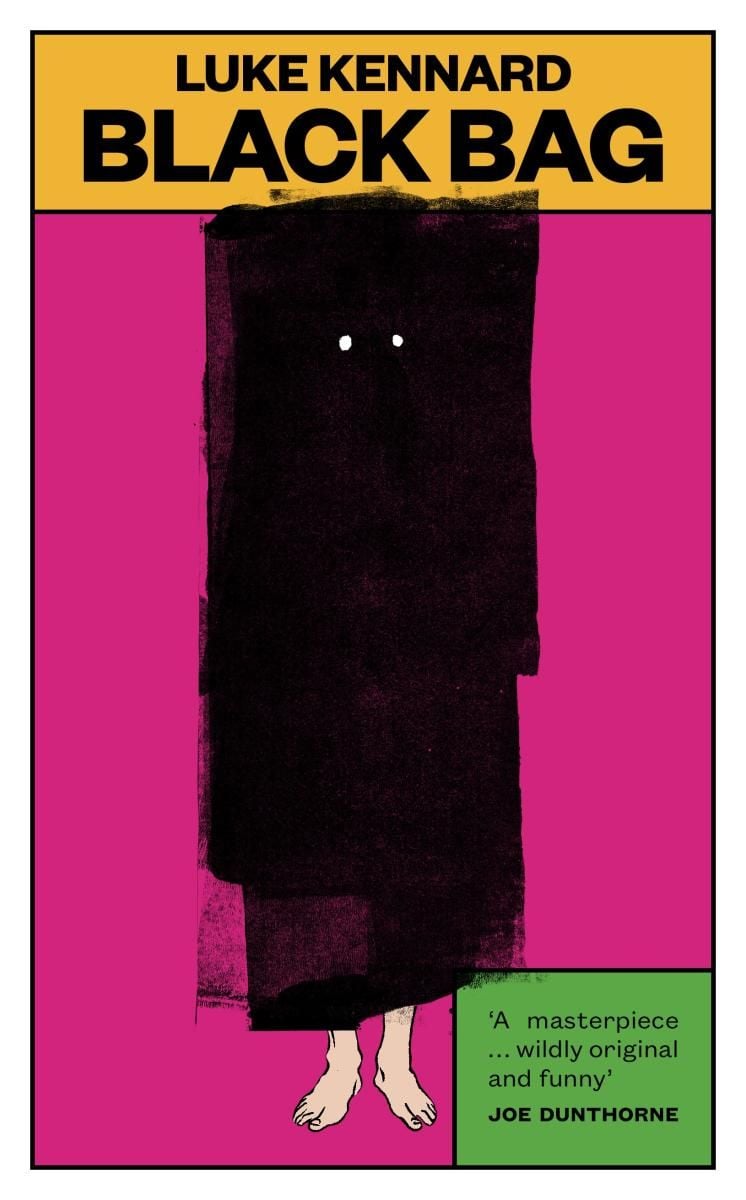

A warped campus novel, an investigation into the crisis of masculinity and an off-kilter love story, Black Bag is a firework of a novel: blazingly funny and profoundly humane
- Published
The author of Black Bag, shortisted for the Booker Prize 2026, on the Moomins, reading on trains, and the 1960s experiment that inspired his book
Buy the book
The inspirations behind my Booker-longlisted book
I came across the original 1960s black bag experiment by accident when I was researching something else. It caught my attention, but I was more interested in the person playing black bag than the results of the study. My narrator is a struggling actor, but I think it’s about trying to be an artist of any kind in the current moment, when arts and culture are so systematically undervalued, when the doubts seem to loom larger than the possibilities. It really tests your hubristic self-belief, and leaves you with a kind of all-pervading shame, which is always a good subject matter for fiction.
The book that made me fall in love with reading
As a child I read and re-read Comet in Moominland and Andre Maurois’ Fattypuffs and Thinifers as if they were favourite geographical locations to revisit. I think it was probably Rosemary Sutcliff’s The Eagle of the Ninth that first really blew my mind, that felt transporting and made me fear for the characters – one of those books where you can smell the mud and feel the disappointment. Then I spent several years immersed in post-war science fiction and it took quite a lot of encouragement to get me to read anything else. J. G. Ballard was my bridge into literary fiction.
The book that made me want to become a writer
I think it might have been Iain Banks’s The Bridge – the one with the car accident where the narrator spends the whole novel in a coma vision of a city state in the shape of a giant bridge (it owes a bit to Alisdair Gray’s Lanark, which I read much later). Something in that detailed creation of a world that’s simultaneously magical and mind-numbingly bureaucratic – a fantasy that sabotages itself! For a while, as a teenager, everything I wrote was a rip-off of The Bridge.
The book I read again and again
In all honesty, with the really substantial classics I feel like once is enough – they can just become part of my inner horizon. I could re-read The Portrait of a Lady any time, though, and I go back to The Brothers Karamazov for its hyper-real imagining of the second coming, and for Ivan’s vision of crawling through the dark for 7,000 years (the first millennia is probably the hardest). When there are several very different translations of a classic it feels particularly good to re-read, and I’m looking forward to Michael R. Katz’s version. Also the father is such a timelessly great portrayal of male bitterness; sometimes you just want to remind yourself how a writer managed to do something.
The book that changed the way I think about the world
Italo Calvino’s If on a Winter’s Night a Traveller hooked me, at an impressionable age, with its metafictional swerves and fourth-wall breaks, but it also felt like a level of complexity necessary to meet a multifaceted world, allowing him to comment on the culture industry, art compromised by political forces, as well as the classic themes of love, sex, death, etc. But in terms of how I see the world, Sven Lindqvist’s Exterminate all the Brutes, Brian Fawcett’s Cambodia and Lara Pawson’s Spent Light have all made me look at things with fewer illusions.
My narrator is a struggling actor, but I think it’s about trying to be an artist of any kind in the current moment, when arts and culture are so systematically undervalued
The book that changed the way I think about the novel
Kazuo Ishiguro’s The Unconsoled is an extended anxiety dream where a contemporary classical pianist comes to an unnamed European city and never gets to play a note – he’s hampered by social favours and debts, inscrutable local etiquette and customs, the psychological weight of his own past… it’s like being trapped in a nightmare and I didn’t want it to end. If I can ever write something even half that absorbing I’ll be happy.
The book I’m reading right now
I was lucky enough to get a proof of Donald Antrim’s forthcoming My Eliot which comes out in 2027 – his first novel in over 20 years. It’s wonderfully unhinged, and wrongfoots you delightfully, setting out as a reconsideration of his father’s self-published monograph about T. S. Eliot’s concept of language and then swerving into this trippy, heartbroken story of hallucinogenic parsnips and animal metamorphosis. His timing and his tone are a singular achievement.
Where I most like to read
I remember ages ago reading Howards End on a single train journey and thinking, that seems to work quite well for my attention span: isolation! This was, of course, before smartphones, but trains are still a kind of enchanted venue. If I’m alone, in my big orange chair in my office, I drink a strong coffee, toss my phone across the room and sit in a contorted position like a cat.
Where and when I most like to write, and the tools I need
I usually write from 9pm onwards, when my kids are asleep and there’s no point in answering any more emails. I slap myself in the face a couple of times and open a Word document. It’s fine – it’s enough to imagine filling pages of a beautifully bound notebook in a walled garden, and there’s also something lovely in the suburban dusk, the occasional bark or siren. I do think I write best under pressure, and I need that sense of defiance, like I’m trying to prove to myself that I can do it. I have no problem with background noise – tuning it out or letting it in.
The Booker-nominated book everyone should read
I have never stopped giving people copies of Magnus Mills’ The Restraint of Beasts – I find his work achingly funny and menacing, profound on the conditions of labour and community, and also he’s one of my favourite prose stylists of all time. It’s so enjoyable looking over the lists from the 70s and 80s. I think we should all read more Beryl Bainbridge and David Storey – Pasmore is really great. More recently The Kills by Richard House is startlingly ambitious but elegantly composed and geopolitically timely.
Black Bag
- By
- Luke Kennard
- Published by
- John Murray
A warped campus novel, an investigation into the crisis of masculinity and an off-kilter love story, Black Bag is a firework of a novel: blazingly funny and profoundly humane


Features


- Book recommendations
The Booker Prize 2026 shortlist: what our judges said

- Reading guides
Reading guide: Black Bag by Luke Kennard


- Book recommendations
Back to school: 10 Booker Prize novels set in classrooms, colleges and campuses
- Book extract
An extract from Black Bag by Luke Kennard
- Book recommendations