
‘King of kings they called him, and they said, We rejoice in him, we rejoice in his wife and her beauty; they said, We love this country, and then we said, We love this country. We had to rejoice in his newborn son, for longer than we ever would a birth in our own family, his newborn son, in the far-off Palace of Flowers.’
- Published
The International Booker Prize 2026 nominated author and translator discuss how real life feeds into fiction, why translation cultivates empathy, and the writers that ignited their love of books
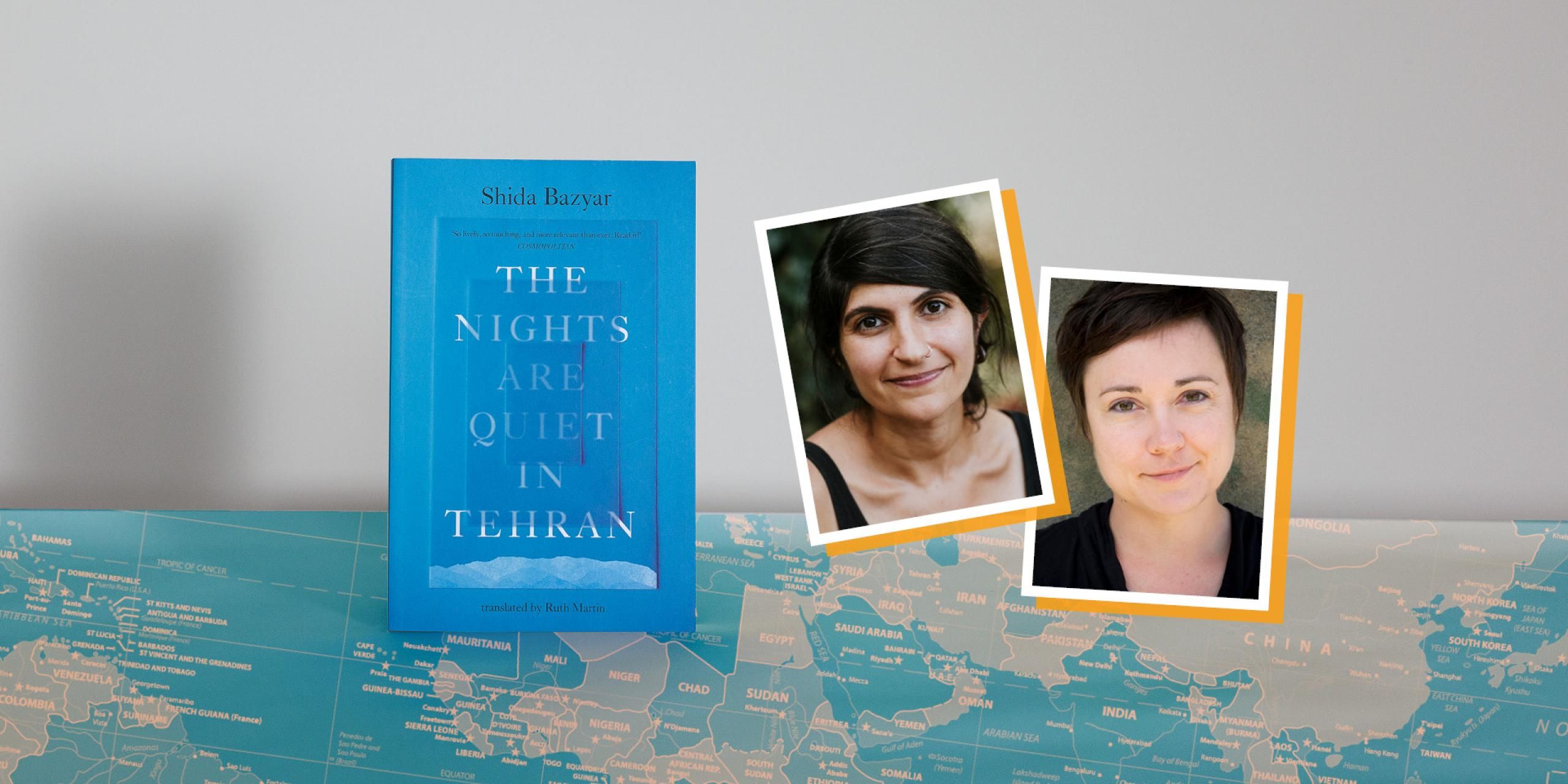
Shida Bazyar
Could you tell us about the inspirations behind The Nights Are Quiet in Tehran?
The main thing I wanted was to understand my parents’ story. The book isn’t autobiographical, but I spent many hours interviewing my parents for research, to find out what their political life was like in Iran, what their resistance looked like, and how they ended up fleeing to Germany, where I was born.
These are all things that, as a rule, parents don’t tell their children, or only half tell them – but an agreed ‘interview’ for ‘research’ provides an opportunity to speak. And I am very glad to have everything my parents shared with me.
How did you go about writing the novel?
I wrote most of the novel while I was still a student. So I was living in grubby flat-shares and could sleep as long as I liked – but I had a rule that I’ve stuck to ever since: write three pages every day. They don’t have to be good or meaningful, as long as I stay in touch with my characters and themes. And of course in the end I hardly slept at all, because focusing on the political situation in Iran and the trauma of fleeing was really emotionally draining.
I spent hours watching videos of the 2009 protests that were supressed with such brutality, or home videos from my trips to Iran, which showed me all the relatives I was missing. I looked at pictures of Khomeini’s return from exile, and of the women who demonstrated quite early on against the compulsory hijab and were deserted by their allies. Once I’d written my three pages, I would be out at parties or in pubs with fellow students, completely unable to get my head around the world we were living in.
The theme of this year’s International Booker Prize campaign is ‘Fiction beyond borders’ – how do you think translated fiction helps readers see beyond geographical boundaries, and why is that important?
In a world where neither human rights nor democratic principles are being adequately defended, where wars keep breaking out and fascism is on the rise, even the most enlightened people feel so helpless that they start preferring simple bogeymen to complex realities.
I hope that the more we read, the less susceptible we’ll be to simple answers, because novels are a means of making concurrences and contradictions visible and manageable. Literature is also the art form that helps us to see people. Not nations, not statesmen, not ideologies – people. But in order for us to strengthen our empathy for other people in other contexts, literature has to be translated into other contexts and languages, and so I’m grateful to the publishers who take that leap of faith.
The International Booker Prize is celebrating its 10th birthday in its current form this year – how do you think the award has changed the perception of translated fiction over the last decade?
Congratulations! These last 10 years have been very important for international literature, and crucially they have seen a lot of change. Interestingly, the effect of the prize hasn’t been restricted to literature translated into English. When Jenny Erpenbeck’s wonderful novel Kairos won, all the critics in Germany threw up their hands, wondering why this novel hadn’t got the attention it deserved in its original language. An international jury seems to see and value new things in a book. Another argument for continuing to support and appreciate translations.

Shida Bazyar
– author photo supplied by Scribe UK
Novels are a means of making concurrences and contradictions visible and manageable
Shida Bazyar
Could you tell us about a book that made you fall in love with reading as a child?
When I was a child, at the start of every Christmas holiday I would borrow Little Women by Louisa May Alcott from the small public library in our town. It was only as an adult that I realised I could see myself in the novel, although you wouldn’t think it given the different historical and cultural backgrounds.
But I too grew up with sisters, in a household overshadowed by the absence of family members. Our circumstances were precarious, but despite it all we made things as nice as we could for ourselves. And like the March sisters, that was thanks to our own creativity, and to art. I didn’t consider that as a child, of course. I simply felt at home in that novel.
And could you tell us about a book that made you want to become a writer?
Given my answer to the previous question, this won’t come as any surprise, but: Little Women by Louisa May Alcott. I remember being frozen in awe as a child when I realised that Jo March – the writer, obviously my favourite character – was the alter ego of the book’s actual author.
Of course, in hindsight we always tell ourselves things in a way that makes sense. But I think in my case it’s true: if I hadn’t realised when I was young that the simple life of an impoverished woman and her sisters was worthy of being written about, I wouldn’t have had the idea that my own family history could be the template for a novel.
Is there a book that changed the way you think about the world?
Not a novel, but a history book (though what would we authors be without history books?) about the place where I was born: Juden im Gaumusterdorf, Auf den Spuren ehemaliger jüdischer Nachbarn in Hermeskeil (Jews in the ideal Nazi village: in search of former Jewish neighbours in Hermeskeil), by Heinz Ganz-Ohlig. It came out in 2018 and was the first book to document the former Jewish community in this small town, and describe the crimes of its inhabitants.
I knew a lot about the persecution of the Jews and the Nazi period, but it was this book that made me understand the real horrors of it. And helped me to connect my own biography with it: this town in which – like everywhere in Germany – people persecuted and threatened their own neighbours, was the same place where my parents found sanctuary, and where I was born. It was only reading regional history that made me aware of this, and changed my view of Germany. And this is why it will be the subject of my next novel.
Which book written in German should everyone read?
Ein von Schatten begrenzter Raum (A Space Bounded by Shadows) by Emine Sevgi Özdamar is a must-read. I am deeply impressed by the author’s fearlessness in throwing out all the rules and telling a story the way she wants to tell it, sliding between different years and places. Everything factual in it is always also magical, and vice-versa. In the end, you not only feel that you’ve been on a journey with an artist through the years, between Turkey and Germany, but that you have seen the world in new and very idiosyncratic colours along the way.
And, finally, which International Booker-nominated book do you think everyone should read?
Minor Detail by Adania Shibli, translated by Elisabeth Jaquette. Shibli is another author who impresses me with the idiosyncratic and consistent way her own language permeates the text. Everything she describes, every single image, however brutal, remains permanently embedded in the reader’s mind, though the descriptions are anything but opulent or decorative. I think this is truly high art.
Ruth Martin
What was it about The Nights Are Quiet in Tehran that made you want to translate it?
I had already translated a novel by Shida (Sisters in Arms) and loved her writing – but this was a new challenge, a polyphonic novel with four very different narrative voices. Finding those voices in English, and finding the voice of the novel as a whole, the thing that ties them all together, was what drew me in. And then each member of the family is portrayed with such compassion and such intimacy, you really feel for them. Even Mo, who is kind of an inconsiderate slob – the reader can still see he has a good heart, and he’ll grow out of it.
How did you go about translating the book?
The novel is set in Germany and Iran, so I did a lot of reading about Iranian history, and consulted a colleague on the transliteration of Persian words and names. Shida was typically generous in answering my questions as well.
I always like to listen to any music that’s mentioned in a book I’m translating, and cook the food; it may not have a direct impact on the text, but it deepens my understanding and helps me to immerse myself in the world of the book.
The theme of this year’s International Booker Prize campaign is ‘Fiction beyond borders’ – how do you think translated fiction helps readers see beyond geographical boundaries, and why is that important?
In the past year alone I have translated work by German writers who were born in Romania, Georgia and Israel respectively. We live in a globalised world, people and their stories migrate, and languages don’t stop neatly at international borders. We might think of translated fiction as bringing a story from one country or culture to another, but very often it’s more complicated than that. Understanding these multicultural, multilingual perspectives, and cultivating our empathy as readers and as citizens, helps us combat the polarisation we see in so many places today.
The International Booker Prize is celebrating its 10th birthday in its current form this year – how do you think the award has changed the perception of translated fiction over the last decade?
The Booker name being attached to this prize has given the nominated books a profile that you don’t get from most of the other prizes that translations are eligible for. It has helped to raise the profile of translators, too: our names are more likely to be on the cover now, and few publishers argue, as they used to, that advertising a book as being translated might put readers off.

Ruth Martin
© Adrian Pope
We live in a globalised world, people and their stories migrate, and languages don’t stop neatly at international borders
Ruth Martin
Could you tell us about a book that made you fall in love with reading as a child?
Two narrative poems by Richard Adams: ‘The Tyger Voyage’, illustrated by Nicola Bayley, and ‘The Ship’s Cat’, illustrated by Allan Aldridge. I bought this one again recently for the pictures, which are compositionally very striking and filled with fantastic detail, but it was the rhythm of the language and the clever rhymes that captured my imagination as a child. In ‘The Tyger Voyage’, no one seems bothered by the fact that the narrator’s neighbours are tigers; they just worry about them going to sea in a flimsy boat, and I like the acceptance of difference implicit there.
And could you tell us about a book that made you want to become a translator?
I remember reading Patrick Süskind’s Perfume while I was doing my A-Levels. We started it in German in our little German book club, and when the language assistant realised it was far too difficult we switched to the English edition (translated by John E. Woods), and compared the two. I think that was the first time I was aware of translation as a craft, as an art form, because the language was so rich and evocative in both versions. That was a formative experience – though it took me another 10 years to figure out that I could maybe do it professionally.
Is there a translator whose work you always look out for?
There are several translators whose work I will always buy, including Anton Hur and Sophie Hughes, but of course it’s easiest to appreciate the skill of someone working in your own language pair. Susan Bernofsky’s translations, particularly of 20th-century classics like Kafka and Hermann Hesse, are incredible. The depth and rigour of her research, and her ability to choose the perfect word or turn of phrase – not always the most obvious, but absolutely the right one – are things that I aspire to.
Is there a work of fiction originally written in German that you’d recommend to English-language readers?
Djinns by Fatma Aydemir, translated by Jon Cho-Polizzi. Another novel narrated from several different perspectives, as a family gathers in Istanbul for the funeral of Hüseyin, the father. I love how the family secrets are slowly revealed by the changes of perspective, and how the relationship dynamics are developed – the way these complex characters orbit and impact one another.
And, finally, which International Booker-nominated book do you think everyone should read?
I’m not sure I want to impose my tastes on everyone, but the book I have recommended to people most often is Cursed Bunny by Bora Chung, translated by Anton Hur. It’s deliciously weird and unsettling, and will stay with you for a long time (possibly infiltrating your dreams).


Features

- Book recommendations
11 epics from the Booker Library for fans of The Odyssey


- Book recommendations