

Flashlight
by Susan Choi
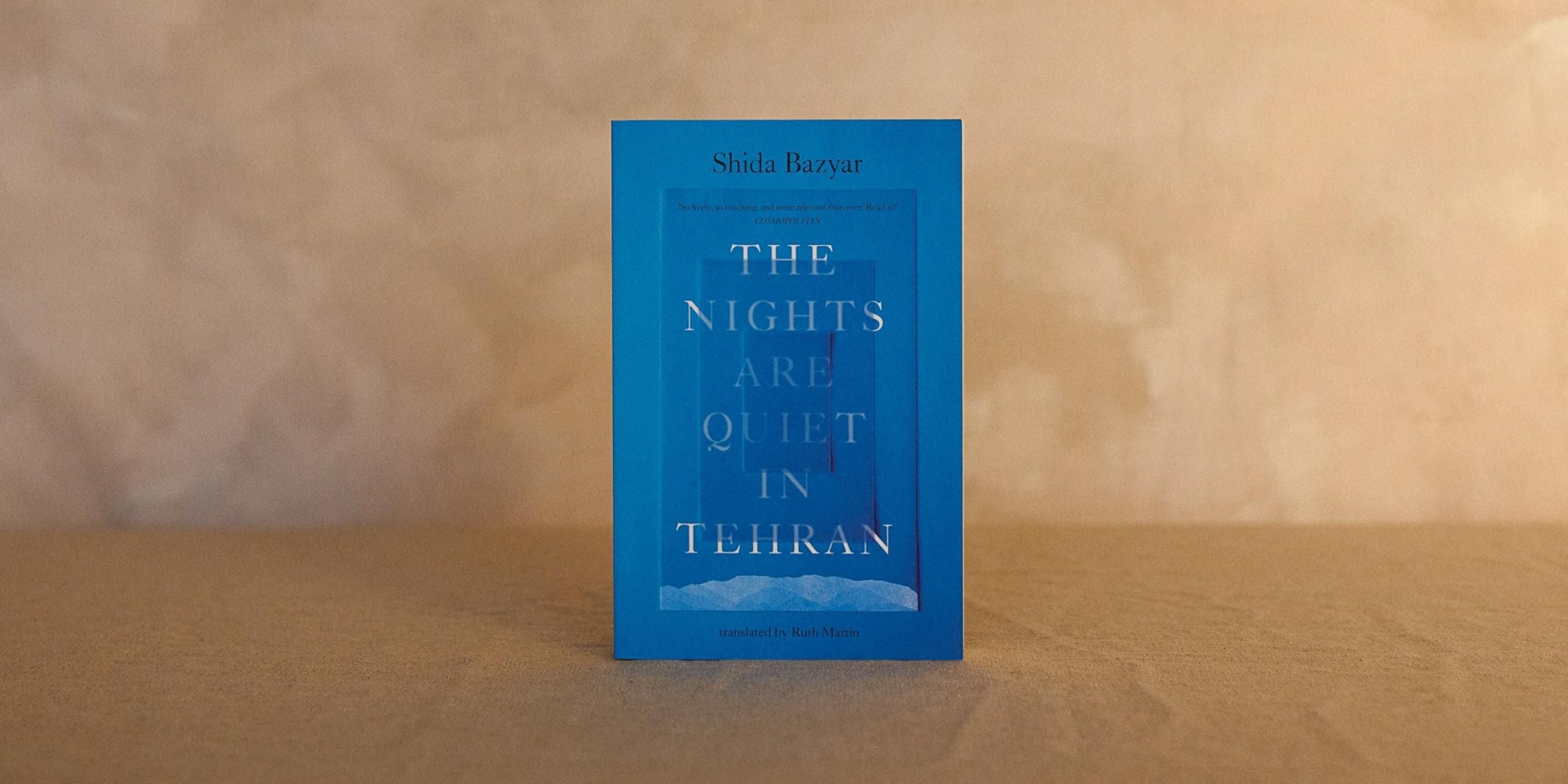
Set across four decades, The Nights Are Quiet in Tehran is about revolution, oppression, resistance and freedom, charting one family’s flight from and return to Iran
Whether you’re new to The Nights Are Quiet in Tehran or have read it and would like to explore it more deeply, here is our comprehensive guide, featuring insights from critics, our judges and the book’s author and translator, as well as discussion points and suggestions for further reading.
1979: Behzad, a young communist revolutionary, fights with his friends for a new order after the Shah’s expulsion. He tells of sparking hope, of clandestine political actions, and of how he finds the love of his life in the courageous, intelligent Nahid.
1989: Nahid lives her new life in West Germany with Behzad. With their young children, they spend hour after hour listening to the radio, hoping for news of others who went into hiding after the mullahs came to power.
1999: Laleh returns to Iran with her mother, Nahid. Between beauty rituals and family secrets, she gets to know a Tehran that hardly matches her childhood memories.
2009: Laleh’s younger brother Mo is more concerned with a friend’s love life than with student demonstrations in Germany. But then the Green Revolution breaks out in Iran and turns the world upside down.
The Nights Are Quiet in Tehran was shortlisted for the International Booker Prize in 2026.
Behzad
We first meet Behzad as a politically active young communist in 1979, just after the Shah has fallen from power. Behzad is caught up in ideas of revolution and the fight for freedom, often taking part in risky activism, alongside his friends and comrades. He falls in love with fellow revolutionary Nahid. They later marry and become parents to Laleh, Morad and Tara.
Nahid
We get to know Nahid in 1989, once she and her husband Behzad are living in West Germany having been forced to flee from Iran. She’s the mother of Laleh and Morad, and, later, Tara. Nahid reflects on her multilayered life as a refugee, and longs for her family and friends back home in Iran.
Laleh
Laleh is a teenager when she, her mother and younger sister Tara travel from Germany to Iran to stay with family, in 1999. She feels torn between the two places, immersed in both but not quite at home in either. During the three-week trip, Laleh learns more about her parents’ lives before they were forced to flee.
Morad
Mo is a university student when we get to know him in 2009, living away from home. He’s caught up in the dramas of friendship, first love and student politics, but becomes increasingly preoccupied with events unfolding in Iran, which burgeoning social media channels allow him to witness from afar.
Tara
A relatively minor character compared to the others, Tara is Laleh and Mo’s younger sister who, unlike them, was born in Germany. A carefree child during a trip to Iran in 1999, by the end of the novel she’s a feminist activist and beloved aunt.
Shida Bazyar studied writing in Hildesheim, northern Germany, and worked in youth education for many years. She is the author of the novels The Nights Are Quiet in Tehran and Sisters in Arms.
Originally written in German, The Nights Are Quiet in Tehran has won the Blogger Literary Award, Ulla Hahn Prize, and Uwe Johnson Prize, and has been translated into Dutch, English, Farsi, French, and Turkish.
Shida Bazyar
– author photo supplied by Scribe UK
Ruth Martin studied English literature before gaining a PhD in German. She has been translating fiction and non-fiction books since 2010, by authors ranging from Joseph Roth and Hannah Arendt to Volker Weidermann and Shida Bazyar.
Martin has taught translation at the University of Kent and the Bristol Translates summer school, and is a former co-chair of the Society of Authors Translators Association.
Ruth Martin
© Adrian Pope
‘What actually happens after a revolution? Through cycles of flight and return, exile and assimilation, Shida Bazyar takes readers through four decades in the lives of an Iranian family – two of them young revolutionaries, Behzad and Nahid, who flee to West Germany with their children. One generation yearns for their homeland; the other makes new beginnings; some visit home, some dream of return, some find going back too painful.
‘The pages of The Nights Are Quiet in Tehran pulse with solidarities and betrayal, with heartache and humour. And for all exiles, migrants, once-and-future revolutionaries, Bazyar captures what it means to always live in hope.’
Rhoda Kwan, The Saturday Paper
‘In Ruth Martin’s lilting translation of the German novel, Bazyar’s lyrical sentences exude a deep sensitivity to the “permanent pain” of the relentless yearning for home… A quietly beautiful exploration of the trauma of losing one’s homeland to a savage regime, the novel is testament to how hope and the revolutionary spirit endure in the face of crushing tyranny, how courage cannot be fully stamped out.’
The Nights Are Quiet in Tehran
© India Hobson for Booker Prize Foundation
‘The book isn’t autobiographical, but I spent many hours interviewing my parents for research, to find out what their political life was like in Iran, what their resistance looked like, and how they ended up fleeing to Germany, where I was born…
‘I wrote most of the novel while I was still a student. So I was living in grubby flat-shares and could sleep as long as I liked – but I had a rule that I’ve stuck to ever since: write three pages every day. They don’t have to be good or meaningful, as long as I stay in touch with my characters and themes. And of course in the end I hardly slept at all, because focusing on the political situation in Iran and the trauma of fleeing was really emotionally draining.’
‘This was a new challenge, a polyphonic novel with four very different narrative voices. Finding those voices in English, and finding the voice of the novel as a whole, the thing that ties them all together, was what drew me in. And then each member of the family is portrayed with such compassion and such intimacy, you really feel for them. Even Mo, who is kind of an inconsiderate slob – the reader can still see he has a good heart, and he’ll grow out of it.’
The book is set across four decades and split into four parts, with each one narrated by a different family member. In an interview with the Booker Prizes, translator Ruth Martin described The Nights Are Quiet in Tehran as ‘a polyphonic novel with four very different narrative voices’. What did you think of the novel’s structure? Was there a narrator whose voice you especially enjoyed?
We first encounter Behzad and Nahid as young revolutionaries, but their lives alter dramatically when they’re forced to flee Iran. From then on, they battle daily with the loneliness of exile while trying to forge a new life for themselves and their children. How did your feelings about Behzad and Nahid shift as time passed and the novel progressed?
Laleh and Mo are both born in Iran but move to Germany as young children. The International Booker Prize 2026 judges commented on the siblings’ ‘immense curiosity about a homeland that is not home’. How does the novel explore what it feels like to be rooted in two places at once? What does it reveal about the definition of ‘home’?
In an interview with the Booker Prizes, author Shida Bazyar said that fiction is ‘the art form that helps us to see people. Not nations, not statesmen, not ideologies – people.’ Do you agree? In what ways does The Nights Are Quiet in Tehran centre people rather than politics?
The book ends with a short epilogue, narrated by Tara at an unspecified time in the future, but one where she is much older. What did you think of this ending? In what year do you think it might take place?
The International Booker judges also said, ‘The pages of The Nights Are Quiet in Tehran pulse with solidarities and betrayal, with heartache and humour… Bazyar captures what it means to always live in hope.’ What did you think of the balance between moments of light and shade in the book? Did you finish the novel feeling hopeful or something else?
The Nights Are Quiet in Tehran
© India Hobson for Booker Prize Foundation
University of Cambridge: Shida Bazyar in conversation with Dr Tara Talwar Windsor and Miriam Schwarz in 2024
Harshaneeyam Podcast: Ruth Martin on translating The Nights Are Quiet in Tehran
by Susan Choi
by Jhumpa Lahiri
by Hisham Matar
by Ledia Xhoga