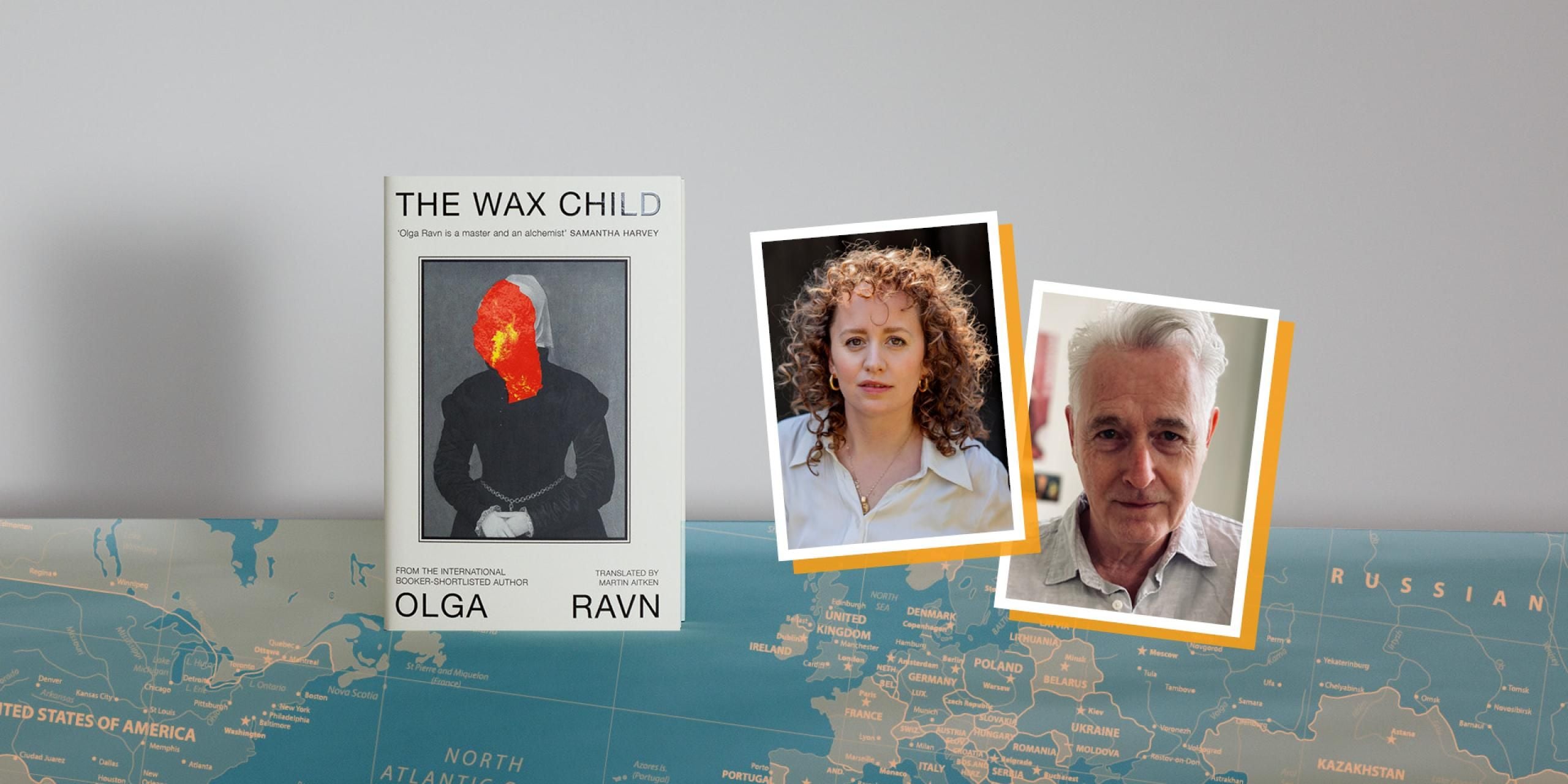

‘I am a child shaped in beeswax. I am made like a doll the size of a human forearm. They have given me hair and fingernail parings from the person who is to suffer. I was borne by my mistress for forty weeks under her right arm as if I was a proper child, and my wax was softened by her warmth.’
- Published
The International Booker Prize 2026 nominated author and translator on folk magic and non-human characters, and on accessing other realms through translated fiction
Olga Ravn
Could you tell us about the inspirations behind The Wax Child?
With this book I wanted to engage in dialogue with the language of folk magic. I did a lot of real magic while writing this book. I researched for years and years, going to archives and travelling through Denmark to visit the places where the historical events took place.
While writing the book I realised that I was less interested in witches and more interested in the mentality shift from the Middle Ages into the Enlightenment and how modernity as we know it today begins to take shape. It became clear to me that our ideas of what a good citizen is, where the borders are between human and world, what consciousness is even, are all inextricably linked to the criminalisation of witchcraft.
How did you go about writing the novel?
I’ve been preoccupied with witches and the occult since childhood, where I was convinced I was a witch and taught myself to read and write runes and had an altar and stuff. I thought I wouldn’t write a historical novel about those accused of witchcraft, since I have a deep mistrust of the historical novel as a genre. I often sense the contemporary writer hiding between the lines, judging historical figures with modern morals.
So instead of writing, I did radio, visual art and performances about witchcraft, and then I wrote a play about witches, and while writing it I realised that I had come across a narrator for a novel: a sort of voodoo doll, a wax child from a historical case. I knew immediately that this was a narrator. You’re always looking for them. There it was.
I love a non-human character. I’m interested in giving voice to objects, to non-human entities. Folk magic understands this, because in folk magic everything is alive, and you cannot really come into your own being without entering a common ecology of being which contains all things: grass, stars, stains, babies, warships.
The theme of this year’s International Booker Prize campaign is ‘Fiction beyond borders’ – how do you think translated fiction helps readers see beyond geographical boundaries, and why is that important?
The collective relationship to information, political speech, the written word and language, meaning itself, is changing with rapid speed. We must engage with language, art, literature, we must engage with the world – literature is formed by ideology, by the weather, by the state within it is written, by the landscape, by family structures, by the singular voice writing it. By reading literature from outside of our respective home countries, our consciousness and understanding of not only the world but of language and literature itself is deepened. Without it, we live half-lives.
The International Booker Prize is celebrating its 10th birthday in its current form this year – how do you think the award has changed the perception of translated fiction over the last decade?
As a non-English speaker I’m a little bemused with the term ‘translated literature’, as if English fiction is the norm. Just looking at the numbers worldwide, more fiction is being written in other languages than English.
BUT! When my novel The Employees in Martin Aitken’s translation was nominated for the International Booker in 2021, I can say that it changed my life. It paved the way for me to have so many readers from all over the world. In that sense the International Booker Prize is hugely important, it lifts so many exciting voices and give them the opportunity to reach a wider readership. And it gives readers so many new places to go. You could also say: A tide lifts all boats. I think overall it has been great for translated fiction to have this prize.

Olga Ravn
© Lærke Posselt
I wanted to engage in dialogue with the language of folk magic. I did a lot of real magic while writing this book
Olga Ravn
Could you tell us about a book that made you fall in love with reading as a child?
Grimms’ Fairy Tales. I like that people were being cooked alive.
And could you tell us about a book that made you want to become a writer?
Oral tradition came to me first! My mother would read to me, and we would make tea and biscuits and sit close together. Then I would retell the stories she read for me to this tape recorder we had.
I clearly remember a day when I realised that I could combine elements of a story into a new story and make it up as I went along, and feeling the flow of it, such a deep joy. I just remember a wave of books, and I wanted to be close to them. I wanted to be close to literature through writing.
Which book written in Danish should everyone read?
Everyone has to read the poetry collection Alphabet by the Danish poet Inger Christensen. I’m sure other Danish Booker-nominated writers have mentioned this book because it is simply one of the greatest poetry collections WRITTEN IN THE WORLD (YES!). Susanna Nied did a wonderful English translation. It also has great German and Swedish translations, and probably more I’m unaware of. Everyone should reprint it now.
It’s like a mathematical song inspired by both the alphabet and the Fibonacci numbers. It has eco-critique and nuclear war and apricots and potato peeling. I clearly remember sitting under a huge chestnut tree on Enghavevej (a street in Copenhagen), outside a cafe that’s closed now, it was June and I was 22 years old, and when halfway through the book she used an ‘I’ for the first time I almost fell off my chair with shock. I understood in a new way the immense power of the ‘I’, both dangerous and compelling.
It made me realise how so many books use the ‘I’ without giving it any thought. Here was a writer who, by introducing it at the right time, suddenly made me feel a new tenderness for the ‘I’. I saw it as a word in line with so many other words. It was as if there were two voices in her book: the voice of an ‘I’ and the voice of language itself. Oh my god, I get hyped just thinking about it.
And, finally, which International Booker-nominated book do you think everyone should read?
I’m very excited to see Shahrnush Parsipur’s Women Without Men on this year’s list! I think it’s a feminist classic. I love it when characters turn into trees. In this way Parsipur’s novel is in dialogue with The Vegetarian by Han Kang, another Booker-winner that I really like (it also has a woman who turns into a tree!). What else? Oh, I adored Fever Dream by Samanta Schweblin and Minor Detail by Adania Shibli.
Martin Aitken
Could you tell us what it was about The Wax Child that made you want to translate it?
It’s an unsettling novel in every respect, grounded in those appalling historical facts. Olga had explored the material in various artistic contexts, shaping aspects of it into theatre, performance and visual exhibitions, as well as into the form of the novel, so the scope of her engagement was already immense and familiar to me. And it’s a startling novel indeed. The all-seeing, all-hearing wax child, left in the soil over centuries, is an ingenious narrative device.
But what really struck me alongside the form-bending, inventive daring of the storytelling, was the coming together of old world and modernity in the language, that very singular voice, its imageries and tones – the sheer poetic materiality of the writing.
How did you go about translating the novel?
It was all about capturing that particular voice. It’s not something you can do deliberately by numbers, but is more about levitating onto that other plane and finding the flow, trying to channel it. I feel it happened for me (which is a more accurate way of putting it than saying I succeeded – that would imply there was a plan as to how to go about it). Sometimes though, that same flow will whisk you away, and that’s where dialogue with author and editors keeps you in check and cuts out the occasional excess.
The theme of this year’s International Booker Prize campaign is ‘Fiction beyond borders’ – how do you think translated fiction helps readers see beyond geographical boundaries, and why is that important?
There are other realms. Without translation we wouldn’t know Dostoyevsky or Proust, Clarice Lispector or Annie Ernaux, Han Kang or Michel Houellebecq. Culturally, the realms writers inhabit may be similar to those we know, or differ from them greatly. What’s important is that literature itself is unbounded.
The International Booker Prize is celebrating its 10th birthday in its current form this year – how do you think the award has changed the perception of translated fiction over the last decade?
Congratulations! I think generally there’s been a widening of interest and a greater embrace of translated fiction among readers over quite some time. Translation is more widely recognised, both as a literary form and as a subject of academic study, and the role of the translator has become positively highlighted. The award has been pivotal in heightening that awareness, bringing non-anglophone literature more forcefully into the literary picture and moving the conversation on from that vacuous ‘lost in translation’ trope. The award’s equal recognition of author and translator is a hugely important signal.

Martin Aitken
– author photo supplied by Viking
Reading was all about being transported away into other worlds, other mental landscapes – as it still is
Martin Aitken
Could you tell us about a book that made you fall in love with reading as a child?
Like most people who write, I suppose, I read from a very early age. I was first fascinated by the Ladybird books, the historical ones in particular, especially the one about King Alfred the Great. I can still see the cover if I close my eyes. Then there were the Enid Blyton adventures, and the Jennings books by Anthony Buckeridge. I remember Ivanhoe in there in some form or other, and Jules Verne. Reading was all about being transported away into other worlds, other mental landscapes – as it still is.
And could you tell us about a book that made you want to become a translator?
After I learned enough Danish, one of the first authors whose work really grabbed me was the great Faroese writer, composer and visual artist William Heinesen (1900-1991). His novels and stories are absolutely magical, filled with cosmos and the everyday, especially The Lost Musicians (1950), which is perhaps his masterpiece. Still being relatively new to the language at that time, I realised I was interested not only in the novel as such, but also in the interplay between the Danish I was reading and processing and the English that was quietly operating in the background.
Is there a translator whose work you always look out for?
Tiina Nunnally’s work translating Heinesen as well as Tove Ditlevsen back in the late 1980s, published by her own Fjord Press in Seattle, inspired me a lot and also planted the idea in me that maybe I could translate too, though I’d veer off into academia for quite a few years before I actually did.
Anthea Bell, Michael Hulse, Frank Wynne and Michael Hofmann are all names I’m excited to see on any cover or title page. I’d buy anything they’ve done, partly because they guarantee the quality of the original work, and partly because as translators they’re all such outstanding writers themselves.
Is there a work of fiction originally written in Danish that you’d recommend to English-language readers?
Tom Kristensen’s Havoc, first published in 1930, with Carl Malmberg’s 1968 translation republished in 2016, charts the spiralling, Scream-like downfall of journalist intellectual Ole Jastrau into the abyss of self-doubt and rampant alcoholism in 1920s Copenhagen, and leaves you devastated.
And, finally, which International Booker-nominated book do you think everyone should read?
I’m looking forward to reading as many titles as I can from this year’s list. From previous years, Jon Fosse’s Septology is remarkable, while Olga Tokarczuk’s Drive Your Plow Over the Bones of the Dead and Jenny Erpenbeck’s Kairos stand out strongly in my mind.


Features

- Book recommendations
Seven Booker Prize-nominated novels that explore AI

- Book recommendations
10 Booker Prize-nominated books with unique settings


- Book recommendations
