
‘Little is left, men or animals. Hoes and sickles lie where they were dropped, in the corners of fields dried up for lack of rain. A narrow, stinking creek provides water, but it dwindles visibly day by day, sucked dry by the fierce heat evaporating it, making the air humid and heavy.’
- Published
The International Booker Prize 2026 nominated author and translator discuss who and what inspires them most, and why contemporary international fiction isn’t just for nerds
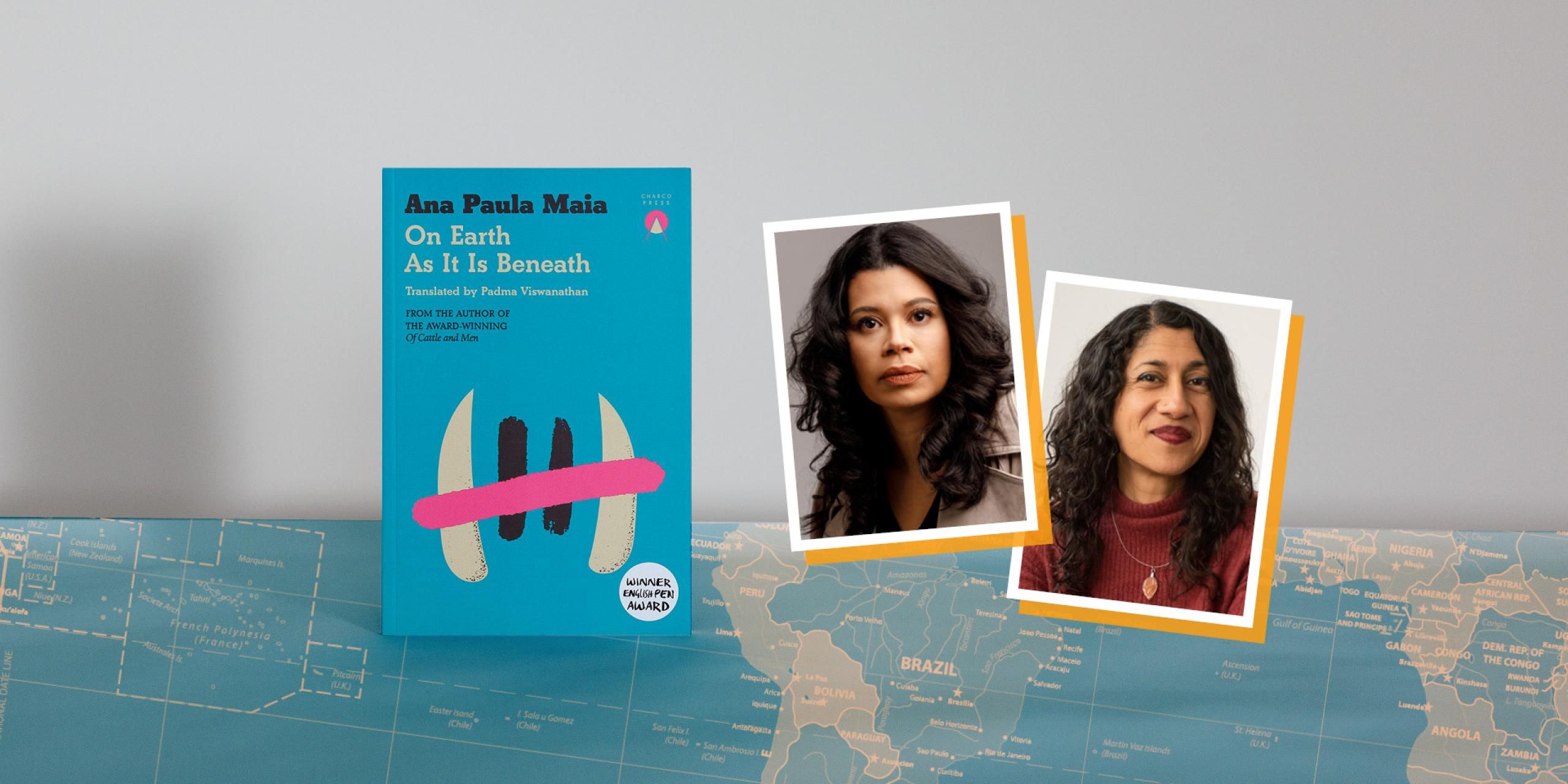
Ana Paula Maia
Could you tell us about the inspirations behind On Earth As It Is Beneath?
I write stories that reflect man’s relationship with work, and how performing certain daily tasks affects and shapes his worldview, and builds his character and opinions.
This structure is part of all my books, and in the case of On Earth As It Is Beneath specifically, the confined space in which convicted criminals receive a second sentence was challenging. Kafka’s short story ‘In the Penal Colony’ and the ideas of Foucault in Discipline and Punish helped me construct this narrative.
How did you go about writing the novel?
I wanted to talk about the prison system. Not to judge it, but to try and get a deeper understanding of it. It took me about seven months to write this book. I did a lot of research reading newspaper articles, public statements, and so forth, but more than anything else, I spent a lot of time reflecting about it all.
The more I reflected on the prison system in Brazil and other parts of the world, the more I realised that beyond the application of laws to criminals, in the end, we are all imprisoned in this world, with walls that may or may not be visible.
The theme of this year’s International Booker Prize is ‘Fiction beyond borders’ – how do you think translated fiction helps readers reach beyond geographical boundaries, and why is that important?
This is an immense opportunity for different writings from so many different parts of the world to come together. Ultimately, despite our cultural differences, we are so similar insofar as we are all human beings. Understanding that pain and misery, love and moments of joy, are felt by everyone. The barriers we put up between ourselves and others distance us mostly from who we are, considering that we are all equal.
The International Booker Prize is celebrating its 10th birthday in its current form this year – how do you think the award has changed the perception of translated fiction over the last decade?
The award has greatly increased the visibility of literature produced by countries that are not always recognised or represented for their cultural production. With the circulation of new authors and the possibility of other stories being visible, being read, we understand other peoples and other perspectives better.
The power of literature and the opportunity of spreading stories that would have previously reached only a small group of people who speak a language that is not understood by many, as is the case with Portuguese, is only possible thanks to important initiatives such as this one, that encourage literature in translation.

Ana Paula Maia
© Pablo Contreras
I wanted to talk about the prison system. Not to judge it, but to try and get a deeper understanding of it
Ana Paula Maia
Could you tell us about a book that made you fall in love with reading as a child?
The first book I remember reading as a child that had a huge impact on me was a short story about a girl who lived in a small village with her grandfather. It hadn’t rained for a long time and everyone was suffering because of it. Until one day, the rain finally came. The girl danced happily in the rain, but then death took her grandfather. I was utterly devastated. It was such a sad tale. I don’t remember the name of that story. But it was a beautifully illustrated hardcover book. Strangely, I started to enjoy the act of reading after the experience that this book gave me.
And could you tell us about a book that made you want to become a writer?
I don’t think there was one specific book, but what prompted me to start writing was my constant reading of philosophy: Plato’s dialogues, in particular. I believe this is one of the main reasons why I enjoy writing dialogues in my novels so much. Reading philosophy helped me organise my thoughts, and I began to put my perceptions of everything around me down on paper. I would also say that a good dose of Dostoyevsky was deeply inspiring for me in terms of becoming a writer.
Is there a book that changed the way you think about the world?
The Old Man and the Sea by Ernest Hemingway. I remember it being one of the books that had a profound impact on me. It deals with death, loneliness, and the wear and tear of human life. My books also tend to address these themes. It was definitely a key book for my development as a writer.
Which book written in Portuguese should everyone read?
I highly recommend the complete oeuvre of Campos de Carvalho. A rare, dark, and brilliant body of writing, highly unknown in English. Among his few published books is O púcaro búlgaro (The Bulgarian Pitcher), a surrealist novel published in 1964 and his final work. It is a strange and powerful story exploring themes such as travel, absence, and existential non-being. I believe it should be made available and read widely.
And, finally, which International Booker-nominated book do you think everyone should read?
Not a River by Selva Almada, translated by Annie McDermott.
Padma Viswanathan
Could you tell us what it was about On Earth As It Is Beneath that made you want to translate it?
When Charco, an Edinburgh-based independent press with exquisite taste in Latin-American literature, sent me the book, I could see why they thought I might be suited to it. My only book-length translation at that point was São Bernardo by Graciliano Ramos, which has in common with On Earth As It Is Beneath a remote and brutal setting as well as tinges of dark, dry, ironic humour.
So, I knew I could convey those qualities, and I was intrigued by the challenging rhythms of Ana Paula’s language. Above all, though, I was attracted to the novel’s two intensely sympathetic protagonists.
How did you go about translating the book?
Looking back, I see I wrote about 10 pages of notes to myself on this novel, as well as charts and instructions on how to approach Ana’s style. I wanted to capture the book’s blocky, roughhewn language, tenderness toward the prisoners and occasional elevation into lyricism or vaguely biblical tones.
Repetition is key, with the original sin of slavery echoing as a curse down the ages. The vocabulary is straitened and incantatory, a constant reminder of the men’s confinement and the way the penal colony bears the past’s unreconciled atrocities into the present – cycles of haunting that tighten until they throttle whoever is left.
The theme of this year’s International Booker Prize campaign is ‘Fiction beyond borders’ – how do you think translated fiction helps readers see beyond geographical boundaries, and why is that important?
Just as each of us has a literal genealogy, each reader is the product of a literary genealogy, constructed over the course of our reading lives. We might discover at any time a book that we will press to our heart and that will, from that moment, become part of our ‘genetic’ makeup, changing the way we see the world and function within it.
When I introduce my American students to international writers I love – Viswanatha Satyanarayana, say, or Dorothy Tse, or Caio Fernando Abreu – I see them embrace perspectives they might never have encountered if not for intrepid translators smuggling them across borders.
The International Booker Prize is celebrating its 10th birthday in its current form this year – how do you think the award has changed the perception of translated fiction over the last decade?
It seems to me that a decade ago, contemporary international writers belonged to the cognoscenti, to nerds. If we talked about literature in translation with regular readers, we were mostly talking about western classics: Tolstoy vs. Dostoevsky, maybe, or Proust in a new translation.
But the International Booker Prize helped normalise conversations about contemporary international literature and made translators more visible within those conversations. It means that any reader might be absorbed in a Mariana Enriquez collection on her commute, and that that she might next pick up a Samanta Schweblin novel because she’s curious to know what else Megan McDowell has translated.

Padma Viswanathan
© Alex Tran
We might discover at any time a book that we will press to our heart and that will change the way we see the world
Padma Viswanathan
Could you tell us about a book that made you fall in love with reading as a child?
The crucial three for me were Harriet the Spy, From the Mixed-up Files of Mrs. Basil E. Frankweiler and Anne of Green Gables. Although very different in style and substance, they were all books in which a girl is possessed of a curiosity that exceeds all boundaries, making her behave badly but also ultimately saving her.
I grew up in a Canadian suburb that I thought colourless, and so when I encountered any eccentric or unusual or passionate personality or incident, it quenched a thirst in me. Within that world, these books were some of my dearest friends and certainly my beacons.
And could you tell us about a book that made you want to become a translator?
An early seed was Lakshmi Holmstrom’s anthology of Indian women’s writing, The Inner Courtyard, which includes stories both originally written in English and translated from South Asian languages, implying a fluidity between those categories that felt right to me.
I acquired it in 1991, six years before Salman Rushdie, whom I worship (Midnight’s Children made me see how and why I wanted to write), wrote in The New Yorker that Indian writers were creating ‘stronger and more important’ work in English than in the ‘18 “recognized” languages of India.’
I took offence – he was reading solely in English, amid a documented dearth of translations from South Asian languages – but his assertion is perhaps better taken as a challenge, and translators have been rising to it. Still, it was many years before that seed germinated for me, and in Brazilian soil, not Indian, though I am now becoming increasingly active in supporting translations from South Asian languages.
Is there a translator whose work you always look out for?
So many – from languages I know and languages I don’t. But, forced to choose one, I might say Alison Entrekin, who brought Brazil to me long before I became a translator myself. Her rendition of Guimarães Rosa’s Brazilian epic, which she has titled Vastlands: The Crossing, is coming out this year and will be one of the great literary events of 2026.
I have participated a couple of times in Alison’s ongoing bilingual online workshop and so have heard her articulate her process and philosophy at close range. I’ve also read several of her translations against their originals and can attest that, for agility, sensitivity and sparkling solutions, she is among the very best.
Is there a work of fiction originally written in Portuguese that you’d recommend to English-language readers?
Again, so hard to choose! I am teaching a seminar right now on Brazilian fiction and my syllabi are like playlists for me. But for anyone picking up their first book of Brazilian fiction, I’d have to recommend Machado de Assis.
Among his varied, marvellous novels and short stories, I might suggest Quincas Borba, recently retranslated with great verve and fidelity by Margaret Jull Costa and Robin Patterson. In the novel, a philosopher called Quincas Borba leaves his dog, also called Quincas Borba, to a friend – what a scenario. Machado’s playful erudition will appeal to fans of Laurence Sterne; he wears his brilliance ever-so-lightly.
And, finally, which International Booker-nominated book do you think everyone should read?
I admit I don’t believe in a capital-C Canon. Literature is inherently and necessarily subjective and so it’s each reader’s responsibility to develop a personal canon. That said, I do have a huge favourite on this year’s longlist!
I’ve read Shahrnush Parsipur’s Women Without Men more than 10 times and taught it to several generations of Arkansas undergraduates who unexpectedly find, in this story of a group of women retreating to a country house amid the political turmoil of 1950s Iran, a whimsical map of issues close to home: control of women’s bodies, battles for democracy, suppression of wisdom with violence. It’s a book that refuses to reduce or be reduced and Parsipur is a hero. So maybe I can say that everyone should read this book.