Flesh by David Szalay wins the Booker Prize 2025
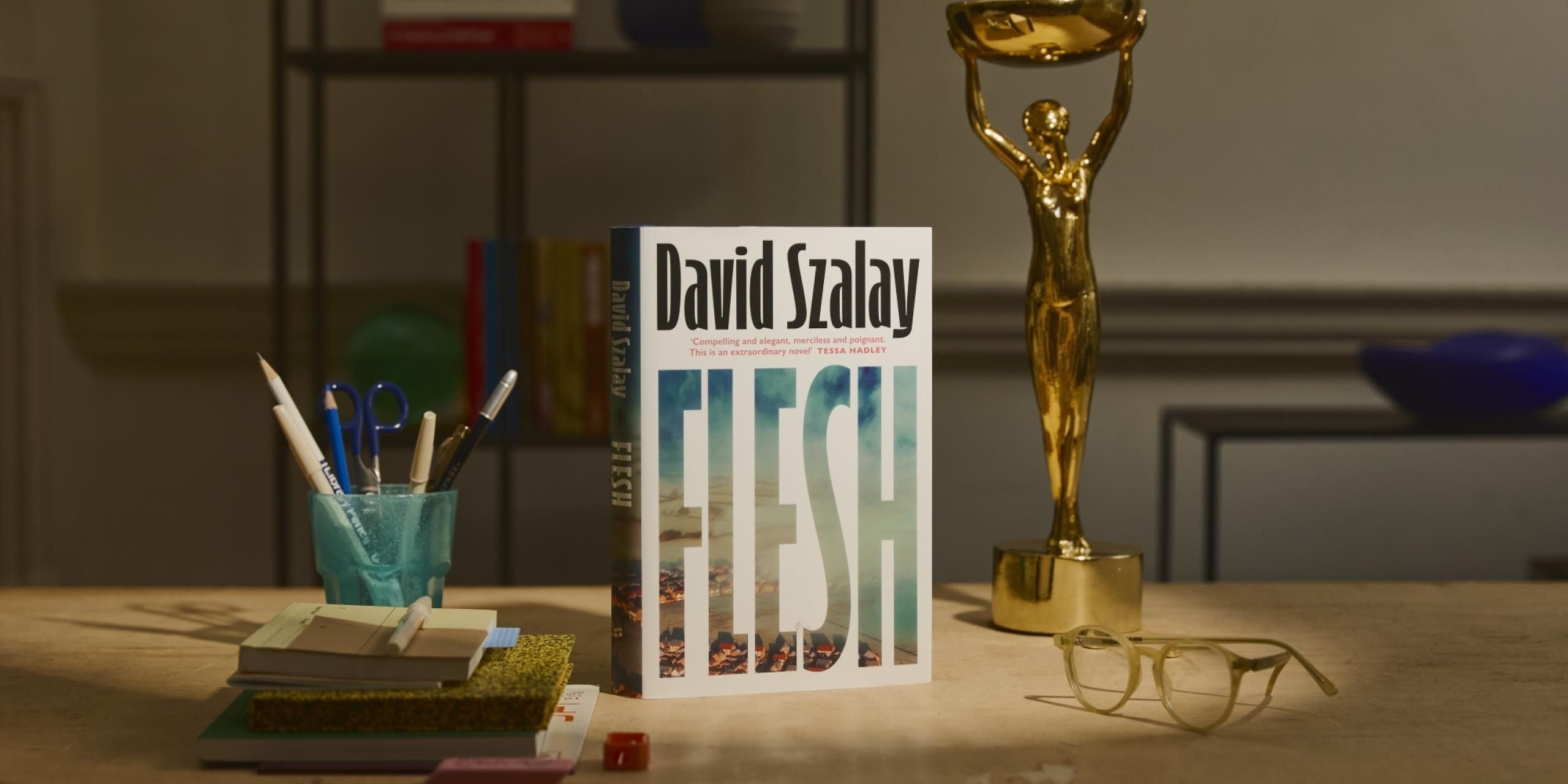
Flesh by David Szalay wins the Booker Prize 2025
- Published
Flesh by David Szalay is tonight, Monday, 10 November, named the winner of the Booker Prize 2025
- Chair of the judges Roddy Doyle describes Flesh as ‘an extraordinary, singular novel’: ‘a dark book that is a joy to read’
- David Szalay, who was previously shortlisted in 2016, is the first Hungarian-British author to win the Booker Prize
- Szalay said of writing Flesh: ‘I wanted to write about life as a physical experience, about what it’s like to be a living body in the world’
- An extract from Flesh, performed by multi-award-winning musician Stormzy for the Booker Prize 2025 shortlist films, was screened at the ceremony
- Following the recent announcement of the Children’s Booker Prize, this year’s keynote speech was delivered by Penelope Lively, the only author to have won both the Carnegie Medal for children’s fiction and the Booker Prize

Flesh by David Szalay
© Yuki Sugiura for Booker Prize Foundation
Flesh by David Szalay is tonight, Monday, 10 November, named the winner of the Booker Prize 2025. Szalay receives £50,000 and a trophy, presented to him by last year’s winner Samantha Harvey, at a ceremony held at Old Billingsgate in London. The event was broadcast live as a special episode of BBC Radio 4’s Front Row, hosted by Samira Ahmed. It was also livestreamed on the Booker Prizes’ YouTube and Instagram channels, with additional red-carpet coverage – hosted by comedian, broadcaster and author Shabaz Ali – posted on the Booker Prizes’ Instagram and TikTok accounts. Watch the livestream here.
The Booker Prize is the world’s most significant award for a single work of fiction. The prize is open to authors from anywhere in the world, writing in English, and published in the UK and/or Ireland. It has rewarded and celebrated world-class talent for over 55 years, helping shape the canon of 20th and 21st century literature. Previous winners of the prize include Salman Rushdie, J.M. Coetzee, Kazuo Ishiguro, Margaret Atwood, Hilary Mantel, Marlon James, Bernardine Evaristo and Douglas Stuart.
Flesh was selected as the winning book by the 2025 judging panel, who all attended the ceremony. The panel was chaired by critically acclaimed writer and 1993 Booker Prize winner Roddy Doyle, the first Booker Prize winner to chair a Booker judging panel. He was joined by fellow judges Booker Prize-longlisted novelist Ayọ̀bámi Adébáyọ̀; award-winning actor, producer and publisher Sarah Jessica Parker; writer, broadcaster and literary critic Chris Power; and New York Times bestselling and Booker Prize-longlisted author Kiley Reid. They considered 153 books and were looking for the best work of long-form fiction by writers of any nationality, written in English and published in the UK and/or Ireland between 1 October 2024 and 30 September 2025.
Written in spare prose, Flesh – Szalay’s sixth work of fiction – is a propulsive novel about a man who is unravelled by a series of events beyond his grasp. Spanning decades, it charts István’s rise from a housing estate in Hungary to the mansions of London’s super-rich. A meditation on class, power, intimacy, migration and masculinity, Flesh is a compelling portrait of one man, and the formative experiences that can reverberate across a lifetime.

The Booker Prize 2025 judges (l-r): Chris Power, Kiley Reid, Roddy Doyle, Sarah Jessica Parker and Ayọ̀bámi Adébáyọ̀, photographed on stage at the Royal Festival Hall, London
© David Parry for Booker Prize Foundation
Roddy Doyle, Chair of the Booker Prize 2025 judges, says:
‘The judges discussed the six books on the shortlist for more than five hours. The book we kept coming back to, the one that stood out from the other great novels, was Flesh – because of its singularity. We had never read anything quite like it. It is, in many ways, a dark book but it is a joy to read.
‘At the end of the novel, we don’t know what the protagonist, István, looks like but this never feels like a lack; quite the opposite. Somehow, it’s the absence of words – or the absence of István’s words – that allow us to know István. Early in the book, we know that he cries because the person he’s with tells him not to; later in life, we know he’s balding because he envies another man’s hair; we know he grieves because, for several pages, there are no words at all.
‘I don’t think I’ve read a novel that uses the white space on the page so well. It’s as if the author, David Szalay, is inviting the reader to fill the space, to observe – almost to create – the character with him. The writing is spare and that is its great strength. Every word matters; the spaces between the words matter. The book is about living, and the strangeness of living and, as we read, as we turn the pages, we’re glad we’re alive and reading – experiencing – this extraordinary, singular novel.’

Roddy Doyle, Booker Prize 2025 judge
© Anthony Woods
Gaby Wood, Chief Executive of the Booker Prize Foundation, adds:
‘When the five judges took their places at the winner meeting, in the same room in Fortnum & Mason where they had first met in early February, they sat in the same seats. And they reflected, not only on the circularity of that moment after nine months of reading together, but on the curious fact that they had discussed half of the books that ended up on their shortlist that very first day. Those set a high standard, and by the end of the process the judges were so loath to part company with any of the six that they kept talking for five hours.
‘Flesh was among the books they had discussed on day one. The judges returned to it, again and again, and felt more invested in it every time. After a third reading, they struggled to think of another writer whose work they could compare it to. They found it spare, disciplined, urgent, honest and heartbreaking. With Flesh, they all agreed, David Szalay breaks new ground.
‘I share the judges’ excitement over the work of an author who has been writing with ferocious and stark commitment for many years.
‘As for the judges themselves: I will miss them hugely. Their acute attentiveness to the books submitted, their kindness towards each other, their articulacy and their energy have made this past year a pleasure.’
This year’s Booker Prize campaign, ‘Fiction worth talking about’, is a celebration of the act of reading and discussing great books together. The campaign is designed to encourage readers to explore the nominated books, share their thoughts, and connect with others from around the world over their love of great fiction. Videos featuring the judges and readers from around the world can be viewed on the Booker Prizes Instagram channel.
Fortnum & Mason, ‘the world’s most famous cornershop’, has generously hosted this year’s judging panel at its flagship London Piccadilly store for the key judging meetings. The judges met in the Boardroom on the fifth floor to choose their winner.

Gaby Wood, Chief Executive of the Booker Prize Foundation
© Neo Gilder for the Booker Prize Foundation
David Szalay is the first Hungarian-British writer to win the Booker Prize. Born in Canada, Szalay has lived in Lebanon, the UK, Hungary, and now Vienna. He worked as a financial advertising sales executive in the City of London before embarking on his writing career. In addition to writing novels, Szalay is as an accomplished writer of BBC radio dramas and short stories; in 2019 he won the Edge Hill Prize for his short story collection Turbulence. This year’s prize marked his second Booker shortlisting – his first was in 2016 for All That Man Is, which was also awarded the Gordon Burn Prize and George Plimpton Prize for Fiction. Szalay won the Betty Trask and Geoffrey Faber Memorial prizes in 2008 for his first novel, London and the South-East.
Szalay has received critical acclaim throughout his career. He was included in the Daily Telegraph’s 2010 list of the top 20 British writers under 40 and was a Granta Best of Young British Novelists 2013. Flesh was selected by the Guardian and the Daily Telegraph as one of the best books to read in 2025, in the Guardian, the Irish Times and the Sunday Times summer holiday reads, and was singer-songwriter Dua Lipa’s Service95 Monthly Read for October 2025. Booker Prize-shortlisted author Zadie Smith named Flesh as a book that should win a major literary prize in her interview for Elle.com ‘Shelf Life’, and selected it as her pick for BBC Radio 4’s A Good Read, adding: ‘It is astonishing. When I read, one of the things I’m looking for is ‘how has this person made the novel new?’ For me, this novel was new’.
Flesh was the bookmaker William Hill’s third favourite to win at 4/1. Lee Phelps, spokesperson for William Hill, said in a statement on the William Hill website ahead of today’s prize announcement: ‘This year’s shortlist is looking remarkably tight, with little to split the six contenders.’
Szalay is not the only writer of Hungarian heritage to have won the Booker or International Booker Prize: László Krasznahorkai, who won this year’s Nobel Prize in Literature, won the International Booker Prize in 2015. He became the fifth International Booker Prize-nominated author – along with Han Kang, Jon Fosse, Annie Ernaux and Olga Tokarczuk – to go on to win the Nobel.
Flesh’s publisher, Jonathan Cape, has published the most Booker Prize winners in the history of the prize, with nine previous Booker winners: in 1974 (The Conservationist), 1976 (Saville), 1981 (Midnight’s Children), 1984 (Hotel du Lac), 1991 (The Famished Road), 1998 (Amsterdam), 2007 (The Gathering), 2011 (The Sense of an Ending) and 2024 (Orbital).

David Szalay, author of Flesh, attends the Booker Prize 2025 shortlist readings event at Southbank Centre in London
© David Parry for Booker Prize Foundation
David Szalay’s comments on his Booker Prize-winning book
Speaking to the Booker Prizes website about the inspiration for Flesh, Szalay said: ‘I knew I wanted to write a book with a Hungarian end and an English end, since I was living very much between the two countries at the time. It would be, to some extent, a novel about contemporary Europe, and about the cultural and economic divides that characterise it. I also wanted to write about life as a physical experience, about what it’s like to be a living body in the world – whatever divides us, we all share that.’
In an interview with BBC Radio 4’s Front Row programme, Szalay added: ‘Even though my father is Hungarian, I never felt entirely at home in Hungary. I suppose, I’m always a bit of an outsider there and living away from the UK and London for so many years I also had a similar feeling about London. So I really wanted to write a book that stretched between Hungary and London and involved a character who was not quite at home in either place.’
Speaking about the stripped back nature of the dialogue in Flesh in an interview with Dua Lipa – who described Flesh as ‘one of the most astonishing books I have ever read’ – for Service95 book club live in the New York Public library, Szalay said: ‘I wanted to write dialogue which reflected the way that people actually speak. It contributes to the sense of realism, which I think is absolutely key to the way the book works, which is of course what then generates emotional engagement.’
On a structural aspect of the book, Szalay told the Bookseller that Flesh is ‘a story collection hiding inside a novel’. Expanding on the topic in his interview with Lipa for the Service95 book club, he said: ‘Quite often the agency that he [István] shows happens between the chapters. Each chapter jumps forward by some years in his life. And often it’s in that gap between the chapters that his acts of agency takes place’, adding ‘when I was writing the book I thought of each chapter as a self-sufficient unit.’
On missing out on the Booker Prize in 2016, Szalay told the Guardian: ‘Just being shortlisted transformed my career – I sold far more books than I did before – but it was very disappointing at the time. If I’d won, maybe I’d have become lazy. It feels like some big peak to come back from; more prosaically, you probably get enough sales generated that you don’t have to publish for some years. Either way I’ve managed to convince myself that not winning was a good thing.’

David Szalay
© Jonas Matyassy
Reaction to Flesh in the media

Buy the book
Luke Brown, the Financial Times: ‘Such novels are now rare, as male writers seem increasingly frightened to describe and reckon with the potentially destructive aspects of their character. In this context Flesh feels especially refreshing, illuminating and true. More than that, it is a moving work of art with a plot that compels and surprises and devastates.’
Johanna Thomas-Corr, The Sunday Times: ‘Once or twice a year, I discover a novelist who is so exciting to read I want to share their work with everyone I know – the kind of writer who makes me want to write fiction… It’s rare to find prose this spare that doesn’t feel affected, but Szalay handles surface and depth with skill, as only great novelists can. Flesh is a revelatory novel that will make you look afresh at every eastern European doorman or bouncer you encounter.’
Keiran Goddard, The Guardian: ‘There will be a temptation to pigeonhole Flesh as a novel about masculinity; its silences and its contortions, its frustrations and its codes. But while that is clearly a central concern, Szalay is also grappling with broader, knottier, more metaphysical issues. Because, at its heart, Flesh is about more than just the things that go unsaid: it is also about what is fundamentally unsayable, the ineffable things that sit at the centre of every life, hovering beyond the reach of language.’
Claire Allfree in the Daily Mail: ‘A superb, surprisingly propulsive novel, one of the best of the year so far, that allows us to know a character on a deeply intimate level with that character barely saying a word and which, through its flat, airless, colourless prose captures something of the alienated despairing fatalism at the heart of modern life.’
The Booker effect
As the winner, Szalay can expect instant international recognition, a dramatic increase in global sales and a career transformed overnight. The winner of the Booker Prize 2024, Orbital by Samantha Harvey, was the fastest-selling winner of the prize since records began, selling over 20,000 print copies in the UK in the week following its win. It remained top of the mass market fiction chart for eight consecutive weeks. Total all-time sales of Penguin Random House’s editions of the book in all territories are now over 760,000, an increase of 3,700% on pre-longlist sales figures, while translation rights deals have increased from eight before the book’s longlisting to a current total of 45 territories.
Read an interview on the thebookerprizes.com with Harvey, in which she speaks about her year as a Booker Prize winner here.

Samantha Harvey, winner of the Booker Prize 2024
© David Parry for the Booker Prize Foundation
The ceremony
During the ceremony, Harvey described her win as a ‘magnificent ambush’ and said:
‘When I was young, writers were my gods and this prize was my pantheon. To have received it, to be standing here, (is) to have had such outrageous good fortune.
‘This prize has brought more than I can possibly say, but above all it’s brought me readers, and the understanding of how readers gather – increasingly I think – around books, in groups, in communities, as if gathering around fires, finding solace and shared experience and cause for hope and warmth and pleasure. The Booker Prize helps books become little movements.’
The keynote speech was delivered by much-loved author Penelope Lively, the only recipient of both the Booker Prize (for Moon Tiger, 1987) and the Carnegie Medal, the UK’s longest-running children’s book award (for The Ghost of Thomas Kempe, 1973).
Speaking in response to the recent announcement by the Booker Prize Foundation of the Children’s Booker Prize supported by AKO Foundation, which from 2026 will celebrate the best fiction for children aged eight to 12 years old, Lively shared the reasons she thinks children’s literature should be celebrated:
‘Children’s literature is not tethered to time. It floats free, whether written yesterday or a hundred years ago. The author of an adult novel is of their time. The issues of the day tend to creep around the narrative – issues, attitudes, assumptions. Harder to float free, and in a sense not required. We are writing now, we reflect our time, we need to.
‘The writer of a children’s book has license to abandon time and place, to create, to propose alternatives. It is an indulgence, and a hazard. The writer must find a language, a universe, that will persuade all, the literary innocent that is the child, the sophisticated adult reader. And that is what the great children’s books have done. And will continue to do. Encouraged now by this new Booker Prize.’
The Booker Prize trophy, presented to Szalay, was originally designed by the beloved children’s author and illustrator Jan Pieńkowski in 1969, and was reinstated in 2022. In 2023 it was named Iris in a public vote, in honour of Iris Murdoch, who won the Booker Prize in 1978. This year’s trophy was made by South London Foundry.
Each of the shortlisted authors for the Booker Prize 2025 receives £2,500 and a unique, hand-bound edition of their book designed by six Fellows of the Designer Bookbinders society, which were on display at the ceremony. The winner’s binding was created by Stuart Brockman. Find out more about the bound books here.
Films directed by award-winning writer-director Sasha Nathwani, featuring actors and artists performing extracts from the shortlisted books, were also screened. The films starred Gabrielle Creevy, Rory Kinnear, Shazad Latif, Katherine Parkinson and Arlo Parks, with an extract from the winning book read by Stormzy. The films, which have been viewed more than 50 million times, can be found on the Booker Prizes website and YouTube channel.

Stormzy performing an extract from Flesh by David Szalay in the 2025 shortlist films
© Neo Gilder for the Booker Prize Foundation
Booker Prize week
The celebrations for the Booker Prize 2025 began on the evening before the ceremony, Sunday, 9 November, with the annual Booker Prize shortlist readings, which took place in the Southbank Centre’s Royal Festival Hall, in London, chaired by award-winning author, literary critic, screenwriter, broadcaster, podcaster and Booker Prize 2024 judge Sara Collins.
Tomorrow, Tuesday, 11 November, Her Majesty The Queen will host an afternoon reception at Clarence House to celebrate the Booker Prize 2025, and the newly announced Children’s Booker Prize.
Szalay’s first public event as the winner of the Booker Prize 2025 will take place at Tyneside Cinema in Newcastle on Thursday, 13 November and will be run in partnership with New Writing North. The event – which is sold out – will feature the winner in conversation with the founder and Chief Executive of New Writing North, Claire Malcolm. Forum bookshop will be selling books at the venue, giving audience members the chance to get a signed copy of the winning book after the event.
The Booker Prize Foundation is a charity partner of ethical online bookshop BookKind and for November is its featured charity. From Tuesday, 11 November until the end of the year, BookKind is offering customers 10% off Booker Prize-winning title Flesh. Purchases on BookKind, which donates 10% of every sale to charity, will support the Foundation directly, helping fund its work to ensure that literature is a vital and inclusive part of the cultural landscape. Book buyers can shop the Booker Prize 2025 books on BookKind here.
Media enquiries
Please contact the Booker Prizes PR team at Premier: [email protected] / [email protected] / +44 7780 705 086
Flesh
Winner of The Booker Prize 2025
- By
- David Szalay
- Published by
- Jonathan Cape