
Join the judges of the Booker Prize 2025, Chair Roddy Doyle and his fellow panellists Ayọ̀bámi Adébáyọ̀, Sarah Jessica Parker, Chris Power and Kiley Reid, as they announce the shortlist for this year’s prize live on stage at the Southbank Centre’s Royal Festival Hall in London.
This unique evening, which marks the first announcement of the shortlist at a public event, also features actors Louise Brealey and Alfred Enoch reading unpublished judges’ correspondence from the Booker Prize archives, as well as excerpts from the six shortlisted books.
Everything you need to know about the Booker Prize 2025 longlist
Everything you need to know about the Booker Prize 2025 longlist
- Written by
- Paul Davies
- Published
From a vast range of global experiences to books brimming with long-held secrets, from fresh voices to Booker Prize alumni, here’s the lowdown on this year’s longlist
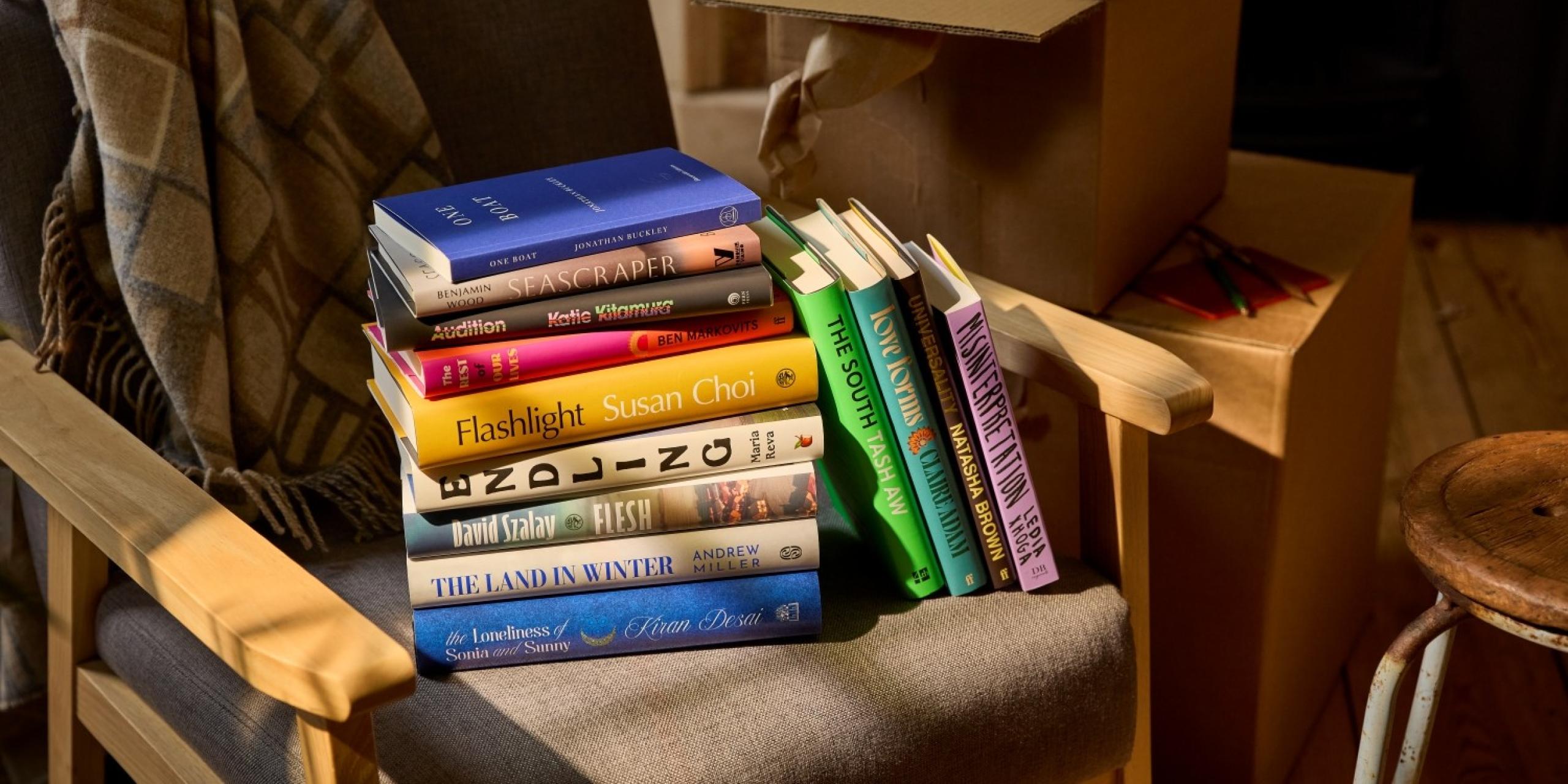
The Booker Prize 2025 longlist has now been announced – a selection of 13 superb works of long-form fiction, chosen from over 150 titles written in English and published in the UK and/or Ireland between 1 October 2024 and 30 September 2025.
As Roddy Doyle, Chair of judges, says: ‘There are short novels and some very long ones. There are novels that experiment with form and others that do so less obviously. Some of them examine the past and others poke at our shaky present. They are all alive with great characters and narrative surprises. All, somehow, examine identity, individual or national, and all, I think, are gripping and excellent.’
The 13 nominated books are:
- Love Forms by Claire Adam (Faber)
- The South by Tash Aw (4th Estate)
- Universality by Natasha Brown (Faber)
- One Boat by Jonathan Buckley (Fitzcarraldo Editions)
- Flashlight by Susan Choi (Jonathan Cape)
- The Loneliness of Sonia and Sunny by Kiran Desai (Hamish Hamilton)
- Audition by Katie Kitamura (Fern Press)
- The Rest of Our Lives by Ben Markovits (Faber)
- The Land in Winter by Andrew Miller (Sceptre)
- Endling by Maria Reva (Virago)
- Flesh by David Szalay (Jonathan Cape)
- Seascraper by Benjamin Wood (Viking)
- Misinterpretation by Ledia Xhoga (Daunt Books Originals)
The longlist features authors representing four continents and nine countries: Albania, Canada, Hungary, India, Malaysia, Trinidad and Tobago, Ukraine, the UK and USA.
It features two debut novels – Ledia Xhoga’s Misinterpretation and Maria Reva’s Endling. Six debut novels have won the Booker in its 56-year history, the most recent being Douglas Stuart’s Shuggie Bain.
The longest book on the list is Kiran Desai’s The Loneliness of Sonia and Sunny, weighing in at over 650 pages, while the shortest is Universality by Natasha Brown – a small but mighty 156 pages, and one of four books on this year’s list that are under 200 pages long.

The Booker Prize 2025 longlist
© Yuki Sugiura for Booker Prize Foundation
Around the world in 13 novels
The list, which features seven women and six men, includes five authors who identify as British or joint British (including one who identifies as Hungarian-British) and four who identify as American or joint American (including one who identifies as Albanian-American). Last year’s longlist featured six Americans and three Brits. Two Americans have won the Booker since the prize was opened up to authors of all nationalities in 2014.
Claire Adam has an opportunity to become the second Trinidad-born winner, after V.S. Naipaul won in 1971. Ledia Xhoga wouldn’t be the first Albania-born author to win a Booker Prize – Ismail Kadare won the inaugural Man Booker International Prize in 2005. David Szalay, who identifies as Hungarian-British, follows in the Booker footsteps of Hungarian author László Krasznahorkai, who won the Man Booker International Prize in 2015.
So what are the books about?
The nominated novels encapsulate a vast range of international experiences. Arguably more than any other year in the prize’s history, this year’s longlist boasts a truly global outlook.
The longlisted books transport readers to a farm in southern Malaysia, a Hungarian housing estate and a small coastal town in Greece. They shine a light on the lives of Koreans in postcolonial Japan, a homesick Indian in snowy Vermont, a Kosovar torture survivor living in New York, a shrimp fisherman in the north of England, a mother whose child was given up for adoption in Venezuela and even endangered snails in contemporary Ukraine. They reimagine the great American road trip as a slow-burning mid-life crisis, and take us into the heart of the UK’s coldest winter.
There’s a novel that began life as a short story in the New Yorker, one that was almost 20 years in the making and another that’s the first book in a proposed quartet. There are books that explore modern masculinity in its many forms, the intense bonds between mothers and children, and the multiple ways in which country, class, race and history shape people’s lives.
There are books here that are playful and expansive, sweeping and intimate; that stir up long-held secrets, painful memories and unsolved mysteries; that present us with characters on a journey to escape or confront their pasts, or performing roles they have created or that have been foisted upon them. There are books that are quietly devastating and darkly comic; that provide powerful meditations on love, guilt and responsibility; and that cast a satirical eye on the media and identity politics.

The Booker Prize 2025 longlist
© Yuki Sugiura for Booker Prize Foundation
Writers with prize pedigree…
Kiran Desai is the only previous Booker winner on this year’s longlist, following her 2006 triumph with The Inheritance of Loss. The Loneliness of Sonia and Sunny is Desai’s first novel since her Booker win 19 years ago. Should she win this year, she would become only the fifth double winner in the prize’s 56-year history. Her mother, Anita Desai, was shortlisted for the Booker three times.
Tash Aw, who joins a select group of 24 writers who have been nominated for the Booker three times (he was also longlisted in 2005 and 2013), is bidding to become the prize’s first Malaysian winner. He is one of two Malaysian novelists to be nominated for the Booker Prize in its history, the other being Tan Twan Eng (another three-time nominee).
Two other writers on this year’s list have been nominated for the Booker before (making four in total): Andrew Miller was shortlisted in 2001 for Oxygen, while David Szalay was shortlisted in 2016 for All That Man Is.
Nine of the authors (Claire Adam, Natasha Brown, Jonathan Buckley, Susan Choi, Katie Kitamura, Ben Markovits, Maria Reva, Benjamin Wood and Ledia Xhoga) are longlisted for the Booker for the first time, but all 13 longlistees have literary awards to their names:
- Claire Adam won The Desmond Elliott Prize in 2019 for her debut novel Golden Child
- Tash Aw won the 2005 Whitbread Book Awards First Novel Award for The Harmony Silk Factory
- Natasha Brown won a Betty Trask Award in 2022 for her debut novel Assembly
- Jonathan Buckley won the Novel Prize in 2022 for Tell
- Susan Choi’s 1998 novel The Foreign Student won the Asian American Literary Award for Fiction
- Katie Kitamura’s Intimacies won France’s Prix Litteraire Lucien Barriere in 2023
- Ben Markovits won the James Tait Black Prize for Fiction in 2016 for You Don’t Have To Live Like This
- Andrew Miller also won the James Tait Black Prize for Fiction, in 1997, for Ingenious Pain
- Maria Reva was the 2022 Recipient of the Kobzar Literary Award for Good Citizens Need Not Fear
- David Szalay won the Betty Trask Award in 2008 for his first novel, London and the South-East
- Benjamin Wood won France’s prix du roman Fnac in 2014 for The Bellwether Revivals
- Ledia Xhoga won the 2024 New York City Book Award for outstanding debut author for Misinterpretation
In the year that a former winner (Roddy Doyle) chairs the judging panel, Natasha Brown is nominated while chairing the judging panel for the Booker’s sister prize, the International Booker Prize 2026, which opened for submissions in June.

The Booker Prize 2025 judges: Ayọ̀bámi Adébáyọ̀, Chris Power, Kiley Reid, Roddy Doyle and Sarah Jessica Parker, photographed at Fortnum & Mason in London
© Tom Pilston for Booker Prize Foundation
…And publishers, too
Once again, some of Britain’s best-known publishers are well-represented this year, especially Penguin Random House, with five books nominated across four of its imprints: Viking, Hamish Hamilton, Fern Press (nominated for the first time) and Jonathan Cape. The latter boasts two nominees in 2025 – David Szalay’s Flesh and Susan Choi’s Flashlight. Cape has published nine previous Booker winners, including 2024’s winner, Orbital by Samantha Harvey.
Five books on the list are published by indies, including three published by Faber – Claire Adam’s Love Forms, Natasha Brown’s Universality and Ben Markovits’s The Rest of Our Lives. Faber has published six previous Booker winners, most recently Anna Burns’ Milkman, in 2018.
Daunt Books Originals (publishers of Ledia Xhoga’s Misinterpretation) is longlisted for the second year running, while Fitzcarraldo Editions (publishers of One Boat by Jonathan Buckley) is longlisted for the Booker for the first time, having been longlisted for the International Booker Prize 16 times in the past decade.
But it’s not all about books – many of the longlistees have careers and interests far beyond novel-writing. Katie Kitamura trained as a ballerina and also works as an art critic, while Natasha Brown spent a decade working in financial services, after studying mathematics at the University of Cambridge. Maria Reva is also an opera librettist, Jonathan Buckley is the author of a series of travel guides to Italy, while Ledia Xhoga has achieved success as a playwright. Tash Aw has worked as an auction-house porter, a paralegal and a Chinese language tutor, while Andrew Miller has a black belt in aikido, is a keen sailor and plays the mandolin in a folk band. After college, Ben Markovitz was a professional basketball player in Landshut, Germany.

The Booker Prize 2025 longlist
© Yuki Sugiura for Booker Prize Foundation


Features

- Book recommendations
South Asian Heritage Month: 12 books to read from the Booker Library

- Book recommendations
10 Booker Prize-nominated books that explore mid-life crises

- Book recommendations
Eight Booker Prize-nominated books that celebrate ‘spinster lit’

- Book recommendations
Eight Booker-nominated books for fans of Wuthering Heights

- Book recommendations
11 of the best debut novels that were nominated for the Booker Prize

- Book recommendations
The Booker Prize 2025 longlisted authors on the books they reread again and again

- Book recommendations
The best Booker audiobooks to curl up with this winter, chosen by you

- Book recommendations
The best children’s books for Christmas written by Booker Prize authors

- Book recommendations
11 Booker-nominated books with the most memorable endings

- Book recommendations