Love Forms
by Claire Adam
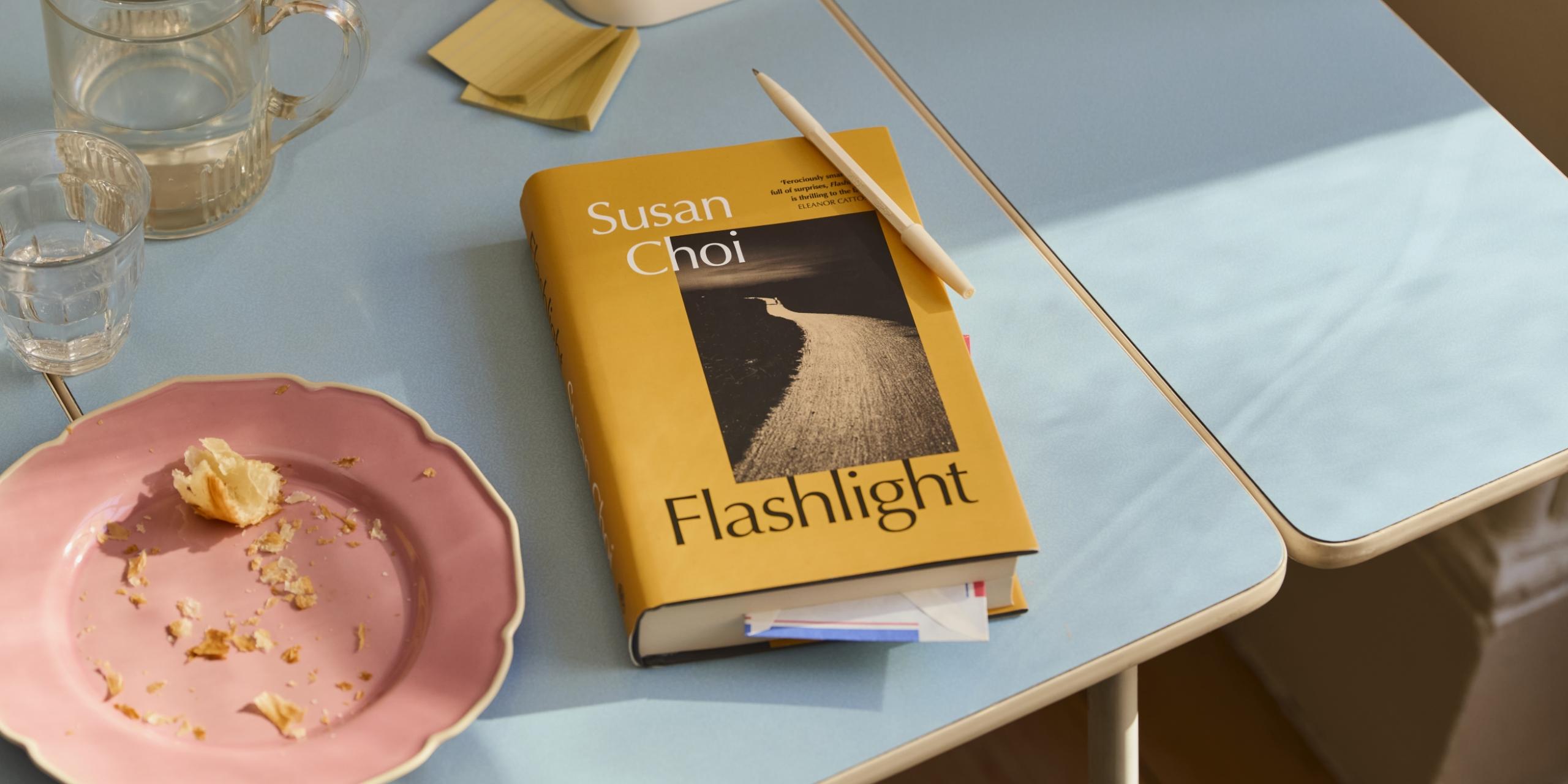
Thrilling and moving, Flashlight mines questions of memory, language and identity through the astonishing story of a family swept up in the tides of 20th-century history
Whether you’re new to Flashlight or have read it and would like to explore it more deeply, here is our comprehensive guide, featuring insights from critics, our judges and the book’s author, as well as discussion points and suggestions for further reading.
One evening, 10-year-old Louisa and her father take a walk out on the breakwater. They are spending the summer in a coastal Japanese town while her father Serk, a Korean émigré, completes an academic secondment from his American university. When Louisa wakes hours later, she has washed up on the beach and her father is missing, probably drowned.
The disappearance of Louisa’s father shatters their small family unit. As Louisa and her American mother, Anne, return to the US, this traumatic event reverberates across time and space, and the mystery of what really happened to Serk slowly unravels.
Flashlight moves between the post-war Korean immigrant community in Japan to suburban America, and the North Korean regime. It was shortlisted for the Booker Prize 2025.
Serk (also known as Seok / Hiroshi / The Crab)
We first meet Serk as a schoolboy in 1940s Japan. He is one of four children, born in Japan to Korean parents. Struggling to find work after graduating, Serk immigrates to the US to take a job at a university, where he meets and marries Anne. Together they have a child, Louisa. Nine years later, Serk embarks on a year-long secondment in Japan, taking his wife and daughter with him. The mystery of his disappearance on this trip is at the heart of the novel.
Anne
Before meeting Serk and having Louisa, 19-year-old Anne has baby – in secret – who she’s forced to give up. Her marriage to Serk is an unhappy one and her relationship with her daughter is strained. Anne’s health deteriorates while the family is Japan, and she becomes increasingly isolated. After she and Louisa return to the US, Anne finds life tough as a disabled widow with little money.
Louisa
The daughter of Anne and Serk, Louisa has a frustrating and difficult relationship with her mother and knows little about her secretive father. She struggles to remember the details of his disappearance although it reverberates through her life. Louisa eventually becomes a mother herself.
Tobias
We first encounter Tobias – the son Anne gave up for adoption – when he is 13 and then again as a young adult. He becomes something of a nomad and a Japanophile, drifting around Japan and the US with very little money and few possessions. Tobias gradually becomes a bigger part of Anne and Louisa’s lives.
Born in South Bend, Indiana, Susan Choi is the author of six novels. Her first, The Foreign Student, won the Asian-American Literary Award for Fiction. Her second, American Woman, was a finalist for the 2004 Pulitzer Prize. Her third, A Person of Interest, was a finalist for the 2009 PEN/Faulkner Award for Fiction.
In 2010 Choi was named the inaugural recipient of the PEN/W.G. Sebald Award. Her fourth novel, My Education, received a 2014 Lambda Literary Award. Her fifth novel, Trust Exercise, won the 2019 National Book Award for Fiction – and was a US bestseller.
Choi’s sixth novel, Flashlight began as a short story in the New Yorker in 2020, and won the Sunday Times Audible Short Story Award in 2021. She serves as a trustee of PEN America, teaches in the Writing Seminars at Johns Hopkins University, and lives in New York.
Susan Choi
© Laura Bianchi
‘Why choose between globetrotting adventure, family drama, academic satire, a bildungsroman, a geopolitical thriller, or fascinating episodes from history, when you can read a novel that’s all those things at once?
‘For all its capital T themes of war, migration and realpolitik, Flashlight is very much about the pain and misunderstanding that can drive families apart, and the love that can bind them. Timeless subjects, rather than fleeting concerns of the moment.’
Beejay Silcox, Guardian
‘Choi is one of contemporary literature’s great demolition artists, and her emotional foundations hold. She can build as well as she detonates. Choi gives her cast the room they need to live; to be more than vessels for political wrangling… Like the best of those early-00s novels, Flashlight is all kinds of big: capacious of intent and scope and language and swagger.’
Catherine Taylor, Financial Times
‘Susan Choi’s sixth novel takes a little-known and appalling aspect of Japanese-Korean history and fashions it into a rich generational saga that teems with intelligence, curiosity and, in terms of reading, sheer pleasure.’
Ron Charles, Washington Post
‘Flashlight is severely allergic to summary, so watch what you read about it. Even categorizing this story as a mystery risks prematurely exposing the novel’s intricate structure to too much light. It’s catholic in its genre, shifting deftly from domestic drama to international thriller, from academic satire to bildungsroman. But what can be safely revealed is that Choi is writing about people who struggle and fail to find a stable sense of identity in a shifting world conspiring against them.’
Flashlight by Susan Choi
© Yuki Sugiura for Booker Prize Foundation
On what inspired Flashlight:
‘It was a combination of being haunted by childhood memories of a trip to Japan – that was not catastrophic but was still very disruptive – and by stories about the unexplained disappearances, in the late 1970s, of ordinary Japanese people, including a schoolgirl not much older than me. As for telling the story now – it wasn’t that I chose this moment, so much as that I finally managed to finish the book! But I feel lucky, in that this moment does turn out to be a very receptive one for a story about ordinary people facing extraordinary, often malevolent forces.’
Flashlight started out as a short story published in the New Yorker, about a father lost at sea while in Japan and a subsequent exchange between a 10-year-old girl and a psychiatrist in 1970s Los Angeles. The novel begins here, too. What did you think of the book’s striking first few pages and how they set the scene for the family epic to come?
Susan Choi has described Flashlight as ‘a story about ordinary people facing extraordinary, often malevolent forces’, while Beejay Wilcox in the Guardian described Flashlight as ‘domestically sprawling, geopolitically bold’, reckoning with ‘the lies that undo families and underpin empires’. What did you think of the way the novel blends the domestic and the geopolitical?
Choi has said one of her inspirations for the novel were ‘stories about the unexplained disappearances, in the late 1970s, of ordinary Japanese people’. Was this a piece of history you were familiar with? What did you find most shocking about Serk’s fate?
Serk is ethnically Korean but was born and raised in Japan. He then immigrates to the US, before being seconded back to Japan by the university where he works. His status in all three places is tenuous, and he struggles to feel a sense of belonging anywhere. What does the book bring to light about the challenges of being an immigrant?
The difficulties in Anne and Serk’s marriage are laid bare. Both are dissatisfied and disappointed, unable to communicate and nursing secrets. What did you make of the couple’s relationship? What prevents them from being able to be open with each other?
Anne becomes unwell but struggles to make herself understood or to be believed. What do Anne’s experiences in both Japan and the US reveal about everyday ableism and sexism?
Flashlight explores the bond between parents and children (father-daughter, mother-daughter, mother-son) and how it can evolve over time and be shaped by tragedy. What did you think of the different parent-child relationships on display in the book? How did they compare with each other? In what ways do you think Louisa’s childhood shapes the mother she becomes?
The novel sweeps across decades and places – from the 1940s to the 2000s, set in Japan, Korea and the United States – alternating between the viewpoints of Serk, Anne, Louisa and, occasionally, Tobias. Did any chapters especially stand out for you? Which characters and countries did you find most interesting and why?
Anson Tong in the Chicago Review of Books said we, as readers, are ‘only holding a flashlight, perceiving what is revealed by a single beam of light’, that the form of the novel ‘evokes how memory can linger in vivid detail for a few specific moments and then zip through multiple years’. Tong says time, in Flashlight, ‘unspools in irregular ways’. What did you think of the novel’s length, structure and pace? Did you find the final chapter satisfying?
Vogue: Susan Choi on the Sprawling Stories Behind Her New Novel, Flashlight
New York Times: Susan Choi: ‘I Feel I’ve Read Nothing but Great Books Recently’
Lit Hub: Susan Choi on Writing a Cross-Cultural Story of Mystery and Tragedy
Book Forum: The Past Is a Foreign Country, Susan Choi on her new novel, family history, and Japan’s occupation of Korea