- Book recommendations
An extract from Flashlight by Susan Choi
An extract from Flashlight by Susan Choi
- Written by
- Susan Choi
- Published
Flashlight is shortlisted for the Booker Prize 2025. Read an extract here
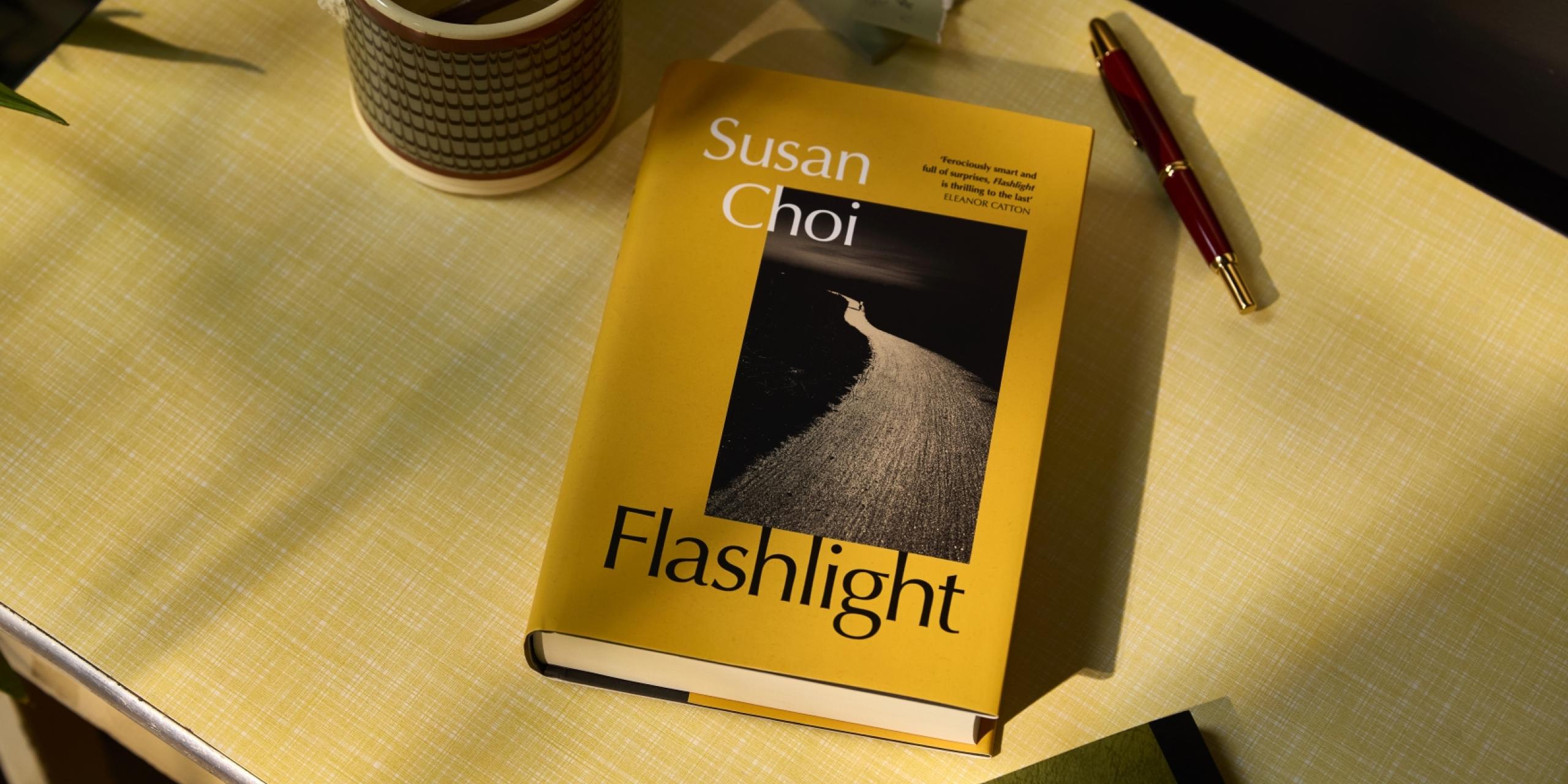
One evening, 10-year-old Louisa and her father take a walk out on the breakwater. They are spending the summer in a coastal Japanese town while her father Serk, a Korean émigré, completes an academic secondment from his American university. When Louisa wakes hours later, she has washed up on the beach and her father is missing, probably drowned.
The disappearance of Louisa’s father shatters their small family unit. As Louisa and her American mother Anne return to the US, this traumatic event reverberates across time and space, and the mystery of what really happened to Serk slowly unravels.
Flashlight moves between the post-war Korean immigrant community in Japan, to suburban America, and the North Korean regime, to tell the astonishing story of one family swept up in the tides of 20th-century history.
Flashlight is published in the UK by Jonathan Cape. This extract is taken from the novel’s opening chapter.
Buy the book
Louisa and her father are making their way down the breakwater, each careful step on the heaved granite blocks one step farther from shore. Her mother is not even on the shore, for example seated smiling on the sand. Her mother is shut inside the small almost-waterfront house they are renting, most likely in bed. All summer Louisa has played in the waves by herself because her mother isn’t well and her father is unvaryingly dressed in a jacket and slacks. But tonight he has finally agreed to walk the breakwater with her. She has asked every day since they first arrived. Spray from the waves sometimes lands on the rocks and so he has carefully rolled up the cuffs of his slacks. He still wears his hard polished shoes. In one hand he holds a flashlight which is not necessary, in the other hand he holds Louisa’s hand which is also not necessary. She tolerates this out of kindness.
“One thing I will always owe your mother is she taught you to swim. Because swimming is important to know how to do, for your safety. But when she gave you lessons, I thought it was too dangerous. I was very unfair.”
“I hate swimming.”
They both know the opposite is true. Perhaps her father recognizes her comment for what it partly is, a declaration of loyalty to him, as well as for what it mostly is, a declaration by a ten-year-old child who is contentious by reflex. Far over the water, far beyond where the breakwater joins with a thin spit of sand, the sunset has lost all its warmth and is only a paleness against the horizon. They’ll turn back soon.
“I never learned to swim,” her father reveals.
“I don’t believe you,” she scoffs. Everybody can swim. Though it’s true he always makes a big deal when she wants to get in or even get near the water.
“It’s true. I grew up a poor boy. I had no YMCA.”
“The YMCA is disgusting. I hate going there.”
“Someday, you’ll feel thankful to your mother. But I want you to act thankful now.”
These are the last words he ever says to her.
(Or are they the last words that she can remember? Did he say something more? There is no one to ask.)
Meanwhile the dark slid itself onto her chest like a snake, organizing its weight into neatly stacked coils that might go on forever and bury her, crush her, if she didn’t leap out of bed just in time and, with deft skill, reopen the door
***
Louisa lay awake staring into the dark. The ceiling showed itself in a narrow stripe of light, first sharp like a blade and then more and more soft, that crossed the ceiling from the doorframe. The door was very slightly cracked open because Louisa was afraid of the dark. This didn’t use to be the case. Every night with maddening slowness her mother would retreat from the room, clumsily bumping her wheels, to a point that Louisa would want to scream at her. When her mother was finally out in the hall, she hesitated, one hand on the doorknob, the door almost but not fully shut.
“Close it all the way, please,” Louisa would say in a sharp, grown-up tone.
The first time she’d said this, it was because she couldn’t stand another second of her mother being there, peering in through the crack. Then she said it every subsequent night the same way, having realized that it was, without being a wrong thing to say, satisfyingly hurtful. There would be another brief hesitation, which Louisa didn’t mind, because it showed that her mother was indeed satisfyingly hurt. Apparently her mother would have liked for Louisa to ask for a story, or a kiss, as if Louisa were still five years old. Her mother never expressed this desire but it was nakedly clear. Such naked wanting to be wanted made Louisa’s mother even more repellent. The door would click into its frame heavily; it was that kind of American door that Louisa had almost forgotten existed in the year she had lived someplace else. A door meant for closing. Louisa would lie in the dark, her unsparing mind tracking her mother’s wheelchair down the hall and imagining hidden trapdoors hinging open beneath it. Meanwhile the dark slid itself onto her chest like a snake, organizing its weight into neatly stacked coils that might go on forever and bury her, crush her, if she didn’t leap out of bed just in time and, with deft skill, reopen the door. Louisa was a master at handling the knob. She wasn’t clumsy, like her mother, or thoughtless, like her aunt. No sound escaped as the light was let back in, the darkness destroyed. Back to bed, to gaze up at the stripe.
Tonight sound was coming in also. She couldn’t make out the words but she knew they were talking about her. This morning, instead of going to school on time, she’d been taken by her aunt to a building downtown to be examined by a child psychologist. No one had used these words, “child psychologist.” They had called it an appointment about her grade level, which at least at the start she believed. She had been halfway through the fourth grade when she and her parents had left the US for Japan, and during their year in Japan she had finished the fourth grade, all the workbooks and readings and tests they had brought, and she’d finished the Japanese fourth grade as well—she had done fourth grade twice, in two countries, but was being made to do it over again, had been put back as if she had failed.
The appointment had been in a brick office building with a half flight of stairs at the entrance, and as they climbed her aunt had said, “This is why your mom couldn’t come with us, because of these stairs. I called ahead to ask if there were stairs at the entrance and sure enough they told me there were. Your poor mama.”
“She’s not sick,” Louisa said.
“What’s that, honey?”
Louisa was silent.
“I didn’t hear you, honey.”
Now Louisa could pretend she hadn’t heard. This was effective. No one was ever listening closely—even the people who especially claimed to be listening were not really listening.

Flashlight by Susan Choi
© Yuki Sugiura for Booker Prize Foundation
Flashlight
- By
- Susan Choi
- Published by
- Jonathan Cape
A thrilling, globe-spanning novel that mines questions of memory, language, identity and family
Features

- Book recommendations
The best Booker audiobooks to curl up with this winter, chosen by you

- Book recommendations
The best children’s books for Christmas written by Booker Prize authors

- Book recommendations