
‘When my daughters turned twelve I initiated them into the mysterious powers. Mysterious not so much in that they didn’t know those powers existed, or in that I’d kept them secret (I hid nothing from my daughters, since we were of the same sex)’
- Published
The International Booker Prize 2026 nominated author and translator on everyday family life as inspiration, and how to mix the banal with the magical
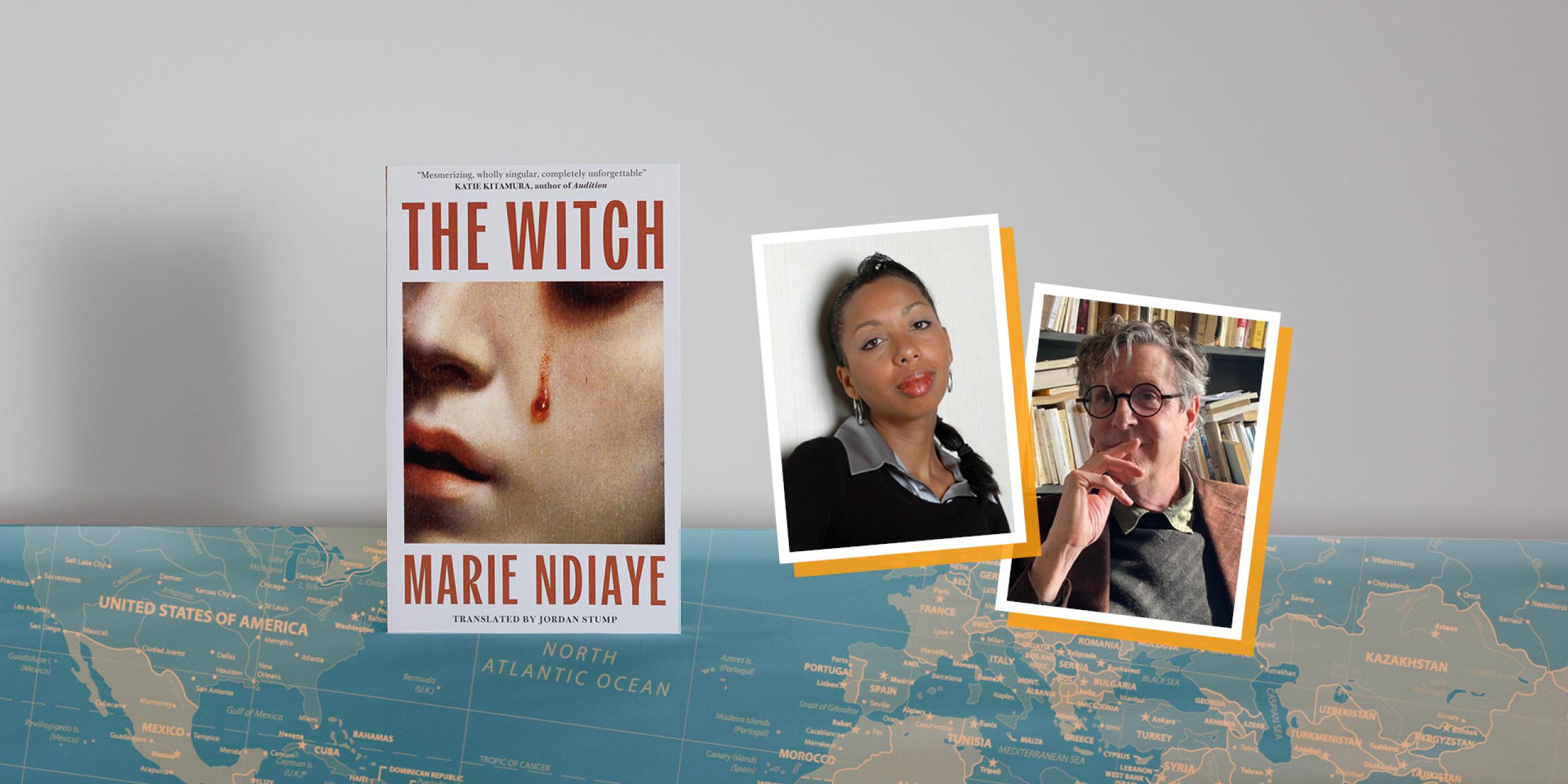
Marie NDiaye
Could you tell us about the inspirations behind The Witch?
When I wrote this book, years ago, people rarely talked about ‘witches’: that idea was nothing more than a vague memory of the fairy tales that might have been read to us when we were children. I wanted to make my character a contemporary witch: not very confident in her gift, even a little ashamed of it, and not particularly successful in passing it down to her daughters, who, modern teenagers that they are, don’t believe in it. In a way, it’s the story of a poor witch who struggles with that power she never asked for, who has to come to terms with the life fate has given her.
How did you go about writing the novel?
I wrote this book in the same way as all my other novels, over about two years. One year of thinking and one year of writing. I was still living in Normandy at the time. My three children were very small. Their presence was a great inspiration for the description of the average-family sort of life you find in the book. I was living that kind of life myself.
The theme of this year’s International Booker Prize campaign is ‘Fiction beyond borders’ – how do you think translated fiction helps readers see beyond geographical boundaries, and why is that important?
I feel an infinite gratitude toward translators – and most particularly toward Jordan Stump, who’s been translating me for a long time now, with a steadfastness and a soundness that have earned him my very deep admiration. I who can only really read French, I know well that my experience as a reader would be horribly limited without the patient, enthusiastic work of translators, just as, without them, the audience for my books would be reduced to the French-speaking world.
The International Booker Prize is celebrating its 10th birthday in its current form this year – how do you think the award has changed the perception of translated fiction over the last decade?
I suppose that its principal merit is that it grants the author and the translator the same degree of importance, and even of necessity. The reputation of this prize opens ‘the doors of our perception’ by giving us access to foreign worlds, to cultures we would, could never have known without all these fictions that speak of them.

Marie Ndiaye
© Hélie Gallimard
My experience as a reader would be horribly limited without the patient, enthusiastic work of translators
Marie NDiaye
Could you tell us about a book that made you fall in love with reading?
Blonde, by Joyce Carol Oates, was one of my major reading experiences of the past 20 years. I took that book with me everywhere I went, I opened it as soon as I had even a few free minutes – I couldn’t tear myself away. There is such mastery, such virtuosity in Oates’s narrative technique, and the reader never consciously notices it: those fundamental writerly qualities act on us without our knowing it. They govern our minds and our feelings to the point that we forget who we are, or where, or when – quite simply, we become the characters, who are more real, more true than ourselves in that moment.
And could you tell us about a book that made you want to become a writer?
The book that showed me what literature could be is one I read when I was 11 years old: Do What They Say or Else by Annie Ernaux, who was awarded the Nobel Prize in 2022. Before that I read books for children, which I liked very much of course, they shaped my ability to imagine. But that first contact with a more complicated work, in which the style mattered as much as the story, made me realise that a novel could be an artistic work. And so I told myself : someday I’m going to create something like that myself.
Is there a book that changed the way you think about the world?
In Search of Lost Time by Marcel Proust. I think every reader of that book comes to see that our awareness of time is above all an inner experience, just as our memory is not a faithful reproduction of what’s happened to us but a very personal alchemy that reveals itself through sensations (like the famous episode of the madeleine). Discovering that immense work is a foundational experience.
Which book written in French should everyone read?
Again, In Search of Lost Time, which is, I think, the greatest work written in French in the 20th century.
And, finally, which International Booker-nominated writer do you think everyone should read?
Jordan Stump
Could you tell us what it was about The Witch that made you want to translate it?
Sometimes I come across a book so moving to me that simply reading it doesn’t seem enough; those are the books I translate. In the case of The Witch, it was Lucie’s patient voice, her quiet exasperation faced with minor annoyances and devastating losses; also, more broadly, the novel’s casual mix of the banal and the magical, the gently comic and the understatedly tragic.
How did you go about translating the novel?
Getting the voice right is always paramount in translation, particularly with NDiaye, whose voice is wonderfully hard to pin down even as it is very adamantly itself. Starting from a very bad rough draft, I revise endlessly, always asking myself, ‘Does this word, this phrase, this ambiguity sound like NDiaye?’ – a hard question, particularly given the difficulty of knowing what the meaning of ‘sound like’ is, not to mention that, since it’s in English, none of it will ever sound just like NDiaye.
Eventually, after more revisions than I can count, I read through a draft and find a voice emerging that’s not mine, nor exactly NDiaye’s, but that sounds like the voice of this novel. That’s a most exhilarating feeling.
The theme of this year’s International Booker Prize campaign is ‘Fiction beyond borders’ – how do you think translated fiction helps readers see beyond geographical boundaries, and why is that important?
As an American, I find it impossible not to see the present moment in catastrophic terms: thus (among other things), although insularity and xenophobia have long hovered in the background of American life, the systematic, unthinking dehumanisation of non-anglophone non-whiteness feels new, and it sickens me. Translation is one way of fighting that; alas, the people who need to have their minds opened are probably not enthusiastic readers of translation, but one stubbornly persists in offering them that possibility – what else is there to do?
The International Booker Prize is celebrating its 10th birthday in its current form this year – how do you think the award has changed the perception of translated fiction over the last decade?
There’s absolutely no question that the International Booker Prize has given translation a visibility and an identity far greater than it had when I first began translating, in the early 1990s. The idea of an award that recognises works not written in English on the same sort of level as works from the anglosphere is a sort of revolutionary act: I think that for a long time it’s been possible for English speakers to think that the only ‘real’ (contemporary) literature is written in their language and comes from their culture, and the Booker is a powerful antidote to that way of thinking.

Jordan Stump
– author photo supplied by MacLehose Press
Sometimes I come across a book so moving to me that simply reading it doesn’t seem enough; those are the books I translate
Jordan Stump
Could you tell us about a book that made you fall in love with reading as a child?
James Thurber’s The Thirteen Clocks. Wonderful language, images that immediately imprinted themselves on my mind – the bad guy with a monocle in one eye and a patch over the other, the tears that turn to diamonds and then back to tears after two weeks, and above all the terrifying monster known as the Todal: ‘It’s made of lip. It feels as if it has been dead at least a dozen days, but it moves about like monkeys and like shadows.’ That sentence still makes me shiver with delight.
And could you tell us about a book that made you want to become a translator?
I became a translator because of Marie Redonnet’s ‘triptych’ Splendid Hôtel, Forever Valley, and Rose Mélie Rose. I found them at my university library as a very young professor, and was utterly transfixed by their remarkable voice, the strange but nightmarishly familiar world they depicted, the struggle against entropy that they recount.
I wasn’t planning to be a translator – professors are supposed to have better things to do – but when a friend in publishing suggested I have a go at translating the first few pages, I was excited in a way I’d never been before. I haven’t stopped translating since.
Is there a translator whose work you always look out for?
There are several, and what they have in common is a penchant for taking on unusual or unexpected projects.
Is there a work of fiction originally written in French that you’d recommend to English-language readers?
I would very much like the entire world to love Raymond Queneau’s Le chiendent as much as I do (translated by Barbara Wright as The Bark Tree, later reissued as Witch Grass). I’ve just been teaching it in a 20th-century French novel class, and I am once again, after who knows how many readings, agog at its inventiveness, at the idealism behind its cynicism, at its gloriously perverse manipulation of the novel and the reader alike.
And, finally, which International Booker-nominated book do you think everyone should read?
Going back a few years: David Diop’s At Night All Blood Is Black.