
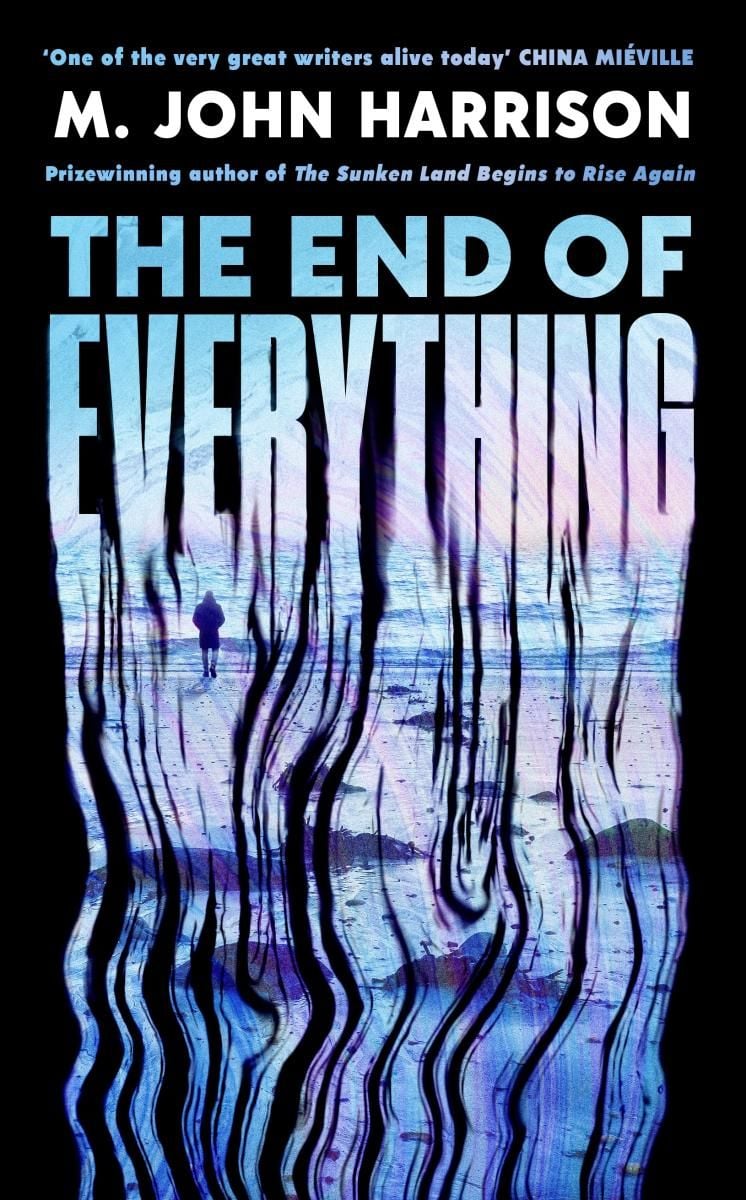

A slyly satirical and unsettling post-apocalyptic adventure into the limits of human understanding from the acknowledged master of science fiction
- Published
The author of The End of Everything, shortlisted for the Booker Prize 2026, on his favourite stationery, finding inspiration in coastal towns, and the books that shaped his writing
Buy the book
The inspiration behind my Booker-longlisted book
The art towns of the UK’s East Coast provided the setting. I love that coast, all the way round from Hastings to the Thames – even up into Suffolk. Current affairs provided the themes and the satire: what happens when all of our expectations and explanations of the world become an ongoing disaster, but we still have to make a life?
The book that made me fall in love with reading
I read almost frantically from an early age. Upstairs in my house we had a big cupboard full of books. You could actually climb into it and sit among all the dusty piles of paperbacks of someone else’s library, going back 30 years. All my heroes were in there, Leslie Charteris and the Saint; Mickey Spillane and Mike Hammer; Alfred Bester and the ferocious revenger Gully Foyle: all pulp, all trash; all walking, talking thrillers and sci-fi. A real education. My mother disowned it, and I never knew whose reading history it represented. Downstairs in the front room we displayed three shelves of more respectable volumes.
The book that made me want to become a writer
I was offered Autobiography of a Super-Tramp by W.H. Davies as a secondary school text. Hobo life. Riding the rails. Dirt, hunger, weather, adventure, amputated limbs. At 13, what more can you ask? A perfect entry to what would become an obsession with dirtbag rock-climbing and led to the sad, domesticated, UK version of that experience I presented in Climbers. (And see also ‘The Water Rat’s Tale’ in The Wind in the Willows.)
The book I read again and again
There are so many. At 16 or so I started reading The Lord of the Rings. I read it at least once a year for a decade, then suddenly experienced a kind of revulsion. I never wanted to read, see or hear about it again. Obsessive books are like old lovers. You meet them after a year or two and wonder why on earth you liked them in the first place. I’ve read thousands of books. All of them have had something to say for themselves, and I’ve been more or less overwhelmed when I understood what it was.
The book that changed the way I see the world
To be fair to the process of influence, that would have to be a list as long as my arm. Focus on a single volume would be such an oversimplification. But at around 16, just as an example, The Go-Between by L.P. Hartley opened my eyes to adult life; then, not long later, Alain Robbe Grillet’s The Erasers shocked me with its flatness of presentation, and I began to wonder immediately if you could render Hartley’s confusion of secrets and passions from Robbe Grillet’s eroded point of view. Sixteen years old, you have a lot to learn.
Obsessive books are like old lovers. You meet them after a year or two and wonder why on earth you liked them in the first place
The book that made me change the way I think about the novel
I’m always having the way I think about the novel changed, often by theory. I see theory as a kind of toolbox, full of shiny new spanners for taking apart and rebuilding what you’re working on; or of finding a way out of whatever trap the work’s got itself into over the previous few years. The best theory’s also a kind of uncanny poetry. Possibly the biggest change in the way I saw writing came via Gerard Genette’s Narrative Discourse, which takes apart time in fiction by looking at narrative as the management of time.
Recently I read in quick succession A.V. Marraccini’s We the Parasites and Christina Tudor-Sideri’s Under the Sign of the Labyrinth: both gorgeous concoctions of art and literature, theory and biography, events and their signs, the pictures and its ekphrasis. I love technique, but, writing or reading, my overall relationship with a book is always romantic.
The book I’m reading right now
Speaking of theory, I’m re-reading Funny Weather, Olivia Laing’s essays collected from the art magazine Frieze and elsewhere. They settle easily under that title. They cover more than art; even when they cover only art, they cover more than art. Laing looks for art’s reparative relationship with the world’s emergencies.
From a writer’s point of view, what leaves me as delighted and bemused as ever is their ability to make imagery and argument at the same time, entangling the two so that they wind one through the other like seams of ore. This is the best of contemporary non-fiction – the art of intertwining science and poetry, the personal and the political, the literal and the metaphorical – and I wish I knew how to do it as well as they do.
Where I most like to read
For a time I lived in Barnes, one of London’s money villages. Most afternoons I took a book and the cat up to my room, and he slept while I read. Yes this was an idyll, although like most idylls it was transitory and I didn’t recognise that until it was over. Jane Anne Phillips, Black Tickets; Joan Didion, Play It As It Lays, and Denis Johnson, Resuscitation of a Hanged Man, made strange contrasts with the landlady’s English roses. A squirrel would drop by and rummage about on the balcony until the cat woke up, then sneer at him through the window. I like to read on trains.
Where and when I most like to write, and the tools I need
I keep notebooks, favouring the smaller Moleskines, always black and with squared paper. Muji 0.5 pens in the red and the black. The notes are transcribed into computer files and revised on the way. A lot of actual writing is done during that process: what starts as a note is already becoming fiction. I used to pride myself on being able to write anywhere. Now I sit anxiously with the laptop, and need quiet or I lose concentration.
The Booker-nominated book everyone should read
Penelope Fitzgerald’s 1979 winner Offshore, about a group of precarious outsiders living in houseboats on the Thames at Battersea Reach, is chokingly funny and seriously moving at the same time, written in her wry, light, utterly crafted, utterly readable manner. That kind of writing is genuinely inimitable.
The End of Everything
- Published by
- Serpent's Tail
A slyly satirical and unsettling post-apocalyptic adventure into the limits of human understanding from the acknowledged master of science fiction


Features


- Reading guides
Reading guide: The End of Everything by M. John Harrison


- Book recommendations
The Booker Prize 2026 shortlist: what our judges said

- Book recommendations