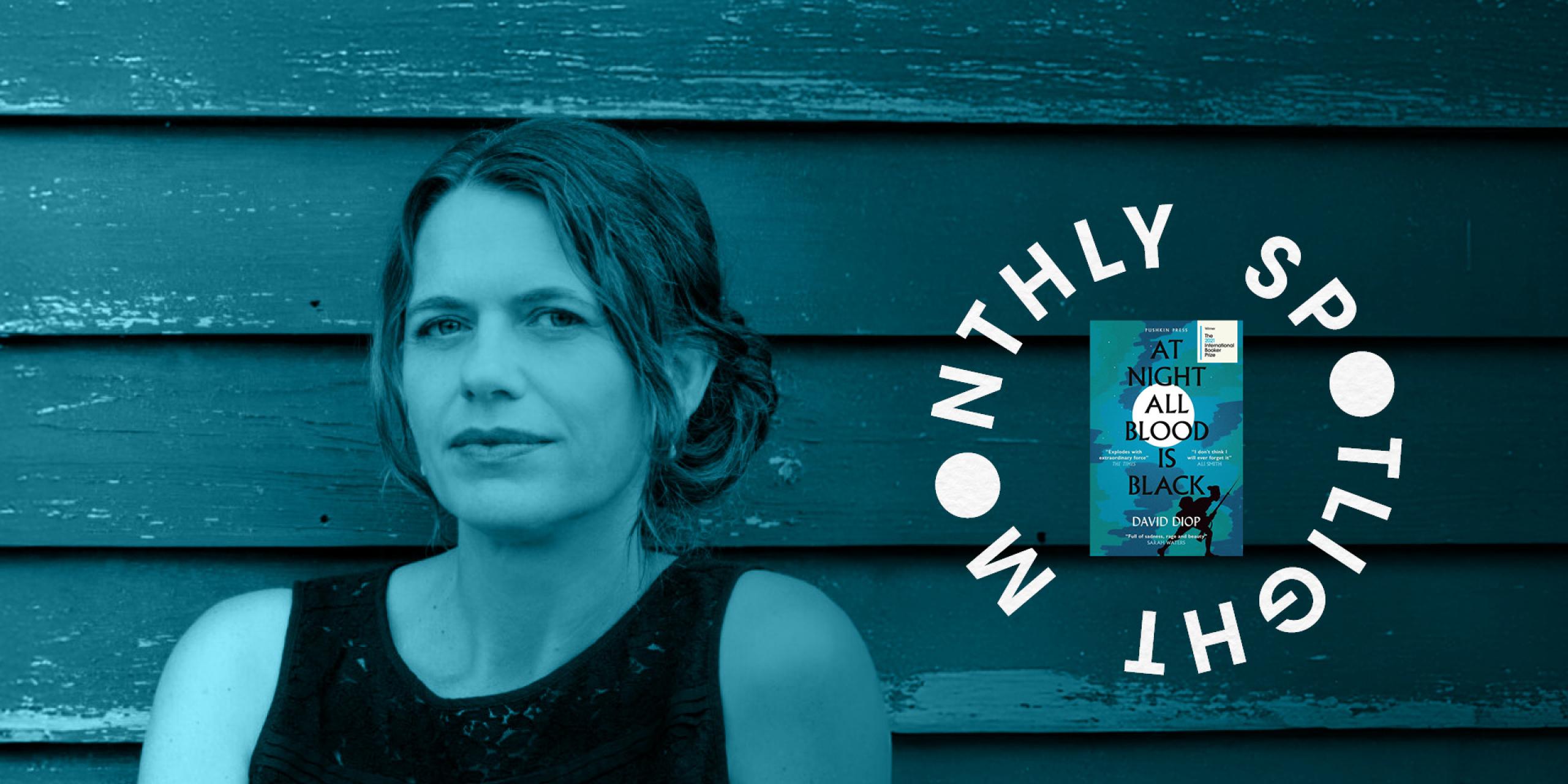

Five years after At Night All Blood is Black was awarded the International Booker Prize, David Diop reflects on the intentions behind his novel, and the impact winning has had on his career
- Published
Five years after At Night All Blood is Black was awarded the International Booker Prize, translator Anna Moschovakis reflects on the conversations the novel has started and how the characters still haunt her dreams
Buy the book
Thinking back five years to the evening you and David Diop won the International Booker Prize for At Night All Blood is Black – could you describe how it felt to win in that moment?
I was immediately thrilled on behalf of David and of this book, a singular work of fiction I deeply admire and believe should be read. Of course the process, from being informed about the longlist to the day of the award, unfolded amidst the Covid-19 pandemic and the many upheavals it sparked.
Looking back, I remember how much this timing affected my experience – not only because there was no in-person award ceremony (David and I have yet to meet in-person to this day), but also because of the particularities of that moment of focus, when our individual and collective values seemed to be under such simultaneous pressure. So while the news was joyful, there was something unsettling about it, too, and about trying to cast back to that experience now.
What impact do you think winning the International Booker has had on the wider perception of the book and on your career?
I have been delighted to see so many translations of the book roll out, and to continue to field questions from libraries, reading groups, and students writing papers and dissertations. This ongoing exposure surely has much to owe to the prize, which I hope has also directed readers to David’s subsequent, very different but equally wonderful, novels.
For my own career, I don’t have much of an answer. Translation is one of the things I do, alongside writing, teaching, and other culture and community work. The award hasn’t altered my sense of hovering at the edges of the literary translation world, though it has created many happy opportunities for me to discuss At Night All Blood is Black with strangers in various circumstances, after they have seen or read my name and made the connection.
How have your feelings about more-than-brothers Alfa and Mademba changed over the years since you finished translating the book?
I have not stopped thinking about Alfa and Mademba; they still sometimes appear in my dreams. One of my research interests is psychoanalysis, and I have often found that when I’m reading or talking about a concept from that domain – projective identification is a recent example, but there are others – the more-than-brothers come to mind. As the years have passed, these characters – and the whole novel, really – have become internalised points of reference, like locations on the map of my consciousness where important questions or puzzles can be thought.
‘To translate is never simple. To translate is to betray at the borders, it’s to cheat, it’s to trade one sentence for another’, to quote from the end of the novel. What are some of the hardest decisions you’ve had to make as a translator, and with David Diop’s book specifically?
This is a difficult question to answer, because the answer is essentially ‘every decision is hard or no decision is hard’. I don’t think I experience translation as a series of decisions – there are, of course, countless decisions, but that is true about all human experience. How do we interpret what we take in through our senses? How do we relate to others?
I love this passage from the book so much, because it can so easily be read as describing much more than translation from one language to another. Do I tolerate the anxiety of translation – there being no ‘right’ decision, there being only cheating and betrayal – the way I tolerate (and enjoy) living with others, by continually re-framing the anxious thought? Maybe every border is a betrayal, and that’s why we can’t seem to leave them alone.
It’s a slim novel that tackles some huge subjects and themes – war, racism, colonialism, torture, rape, mental illness. Did you ever feel daunted by the project? What kept you motivated while you were working on this translation?
I can say that I was, at times, daunted when I thought about the book’s future reception, but not during the process of translation itself, which I experienced as a kind of merging with the material – that may sound mystical, but only because it’s a hard experience to put into words. I do recall times when, after translating one of the more overtly brutal passages, I would go out and talk with friends, and it was only as I began to describe to them what I’d just spent my morning translating that the visceral effect of the scene would hit me.
Translation is for me a space of suspension, not unlike that experienced in a moment of performance. You must protect yourself from the full experience of the material because to feel it fully while performing (/translating) it would make your task impossible. There is a lot of provisional displacement that necessarily happens in all artmaking, and translation is no exception.
Translation is for me a space of suspension, not unlike that experienced in a moment of performance. You must protect yourself from the full experience of the material because to feel it fully… would make your task impossible
Who do you hold closest in mind when you’re translating a piece of fiction – the author or the future reader? Is there a balance to strike between what the author needs and what the audience needs?
Very hard to say! I think my first allegiance is to the text itself. Thoughts of readers (other than myself) come up later, after there’s a draft. I’ve mostly translated writers who are no longer living, so the question of the author is both abstract and unresolvable. With David, it was crucial to receive his response to my sample, and to have an initial discussion about approach (we spoke primarily about rhythm and about the embedded traces of Wolof in the narrator’s French). It helped that this was such a distilled, poetic novel, which meant that though there was certainly context that would not be familiar to many readers, the work of embedding it into the sentences had already been done. There are other kinds of novels where these questions take on a different valence and require a different approach, but again, it is unique each time so I hesitate to generalise.
How does your translation work shape your own writing, and vice versa?
Each book I take on becomes an obsession of sorts, one that bleeds into my life and, naturally, my writing. When I was about to turn in my last book, An Earthquake Is a Shaking of the Surface of the Earth, to the publishers, I had the sudden realisation that a key dynamic in it was (unconsciously) influenced by At Night All Blood is Black. I considered what if anything to do about this, and chose to include a note about this realisation in my acknowledgments. Many of my poems also include references, explicit or implicit, to whatever I was translating when I wrote them.
As for the reverse, translating is writing, so the two are in some sense inseparable. I often reach for metaphors from acting or vocal performance: I have a certain range, and I enjoy working at the edges of my range as much as I enjoy working in the more ‘natural’ centre of it. But I have said no to many translations not because the texts weren’t of interest but because they struck me as being out of my range (which may in fact be a way of saying that if I were to try to translate them, my ‘own writing’ would get too much in the way!)
What are you working on at the moment?
I am putting together a new poetry manuscript – my first in 10 years – that I’m calling Decade. And I am also immersed in a research-heavy, modular novel that turns on facts from my two grandmothers’ lives and looks at intersections between mineral extraction, migration, and the transgenerational, gendered effects of war. I also wound up with stacked translation assignments that have had me struggling to keep up for the last couple of years: I recently published a co-translation with Mihret Kebede of her Evolutionary Poems; my translation of Helen Giannecchi’s An Army of Lovers Cannot Fail is at the printers; and I’m just completing a translation of Maria Borrély’s novel from 1930, Sous le vent. One more on the dock – a graphic novel, a first for me – and then I can think about what’s next.
Where and when do you most like to work, and what tools do you need to translate? (Tools could be a laptop, coffee, peace and quiet!)
I essentially have two work modes: in a notebook/out of a bag (which can happen anywhere, including in noisy cafés and on modes of transport) and on a keyboard with all the reference materials I need (dictionaries, any book-specific research, the internet, etc.) near to hand. I guess I toggle between these modes, both out of necessity and because each serves its own purpose.
A typical flow would be: sketch out a ‘bad’ first draft by hand while out in the world; type it into the computer at a desk, researching and editing as I go; print out this draft, put it in my bag, and edit it as I have time during the day (on the subway, on a park bench, at a café or library or bar). I think this last step helps me to step into the role of potential reader, since these are the places where I tend to read books. Then, with this new marked-up copy, the process repeats.
Coffee: yes, lots.
Is there a book from your childhood that made you fall in love with reading?
So many! But one that comes to mind instantly is The Phantom Tollbooth by Norman Juster, a book I read innumerable times and which led to many daydreams and obsessions. I think it’s the story’s twinning of geographical exploration with philosophical exploration that captured me.
I have turned out to be a person with seemingly limitless appetite both for travel and for philosophical (and political, and psychological) questioning, so who knows which came first? I know I would often return to that book to soothe an overstimulated mind, and reading a (physical) book has that effect on me to this day.
Do you have a favourite book in the Booker Library? What do you love about it?
I don’t have a favourite, but can I name two that I read years ago but still think about all the time. One is The Employees by Olga Ravn in Martin Aitken’s English translation, which I first read as a result of us being together on the longlist and shortlist, but which I’ve re-read many times, and taught to my students more than once. It was one of those books I fell for instantly because I loved the play of language, ideas, structure and story apparent from the first page, but I also really admire how these elements build literary and political power through a kind of rigour and restraint.
The other is Hurricane Season, by Fernanda Melchor, translated into English by Sophie Hughes. I was completely immersed in that book from page one, and was so struck by how the momentum of the language – those endless sentences made from mostly short words – was made so effectively to bear the weight (and hold together the instability) of the subject matter.

Anna Moschovakis.
© Heather Phelps-Lipton


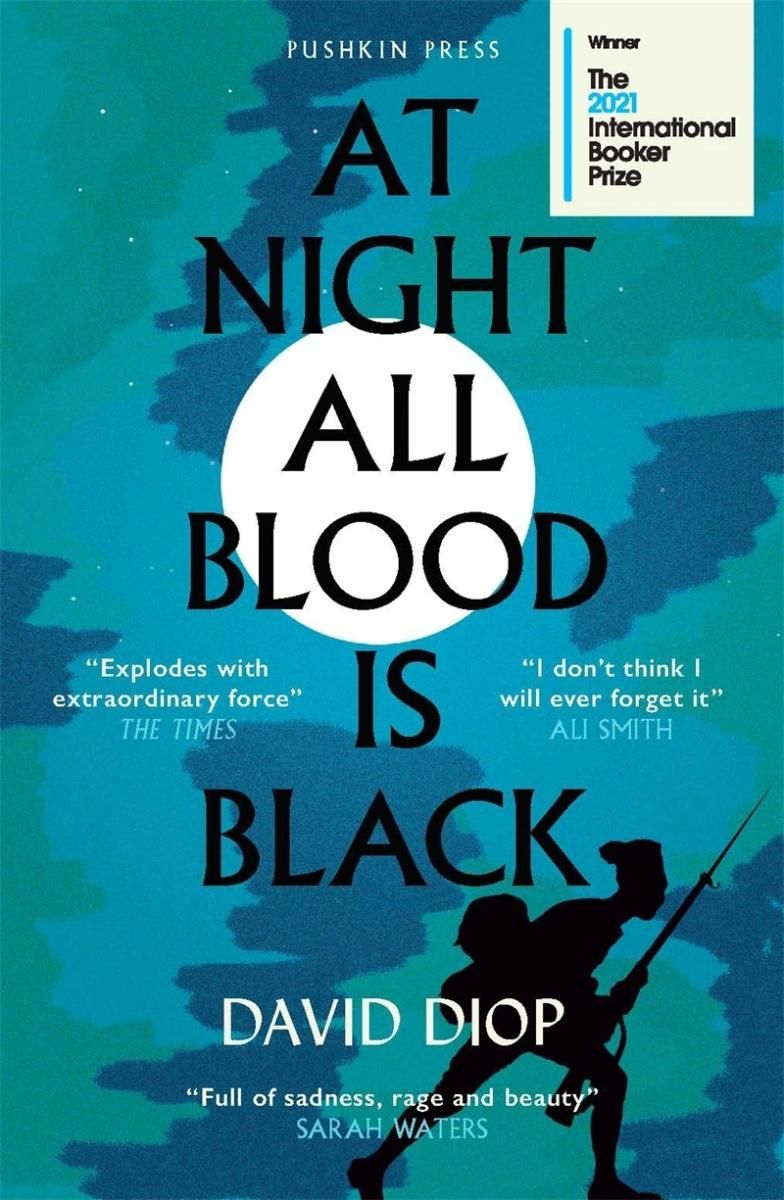
At Night All Blood is Black
Winner of The International Booker Prize 2021
- By
- David Diop
- Translated by
- Anna Moschovakis
- Published by
- Pushkin Press
Winner of the International Booker Prize 2021. A hypnotic, heartbreaking rendering of a mind hurtling towards madness, shattered by grief and the horror of war
Features


- Book recommendations
Explore the 10 winning books from a decade of the International Booker Prize


- Book recommendations
