
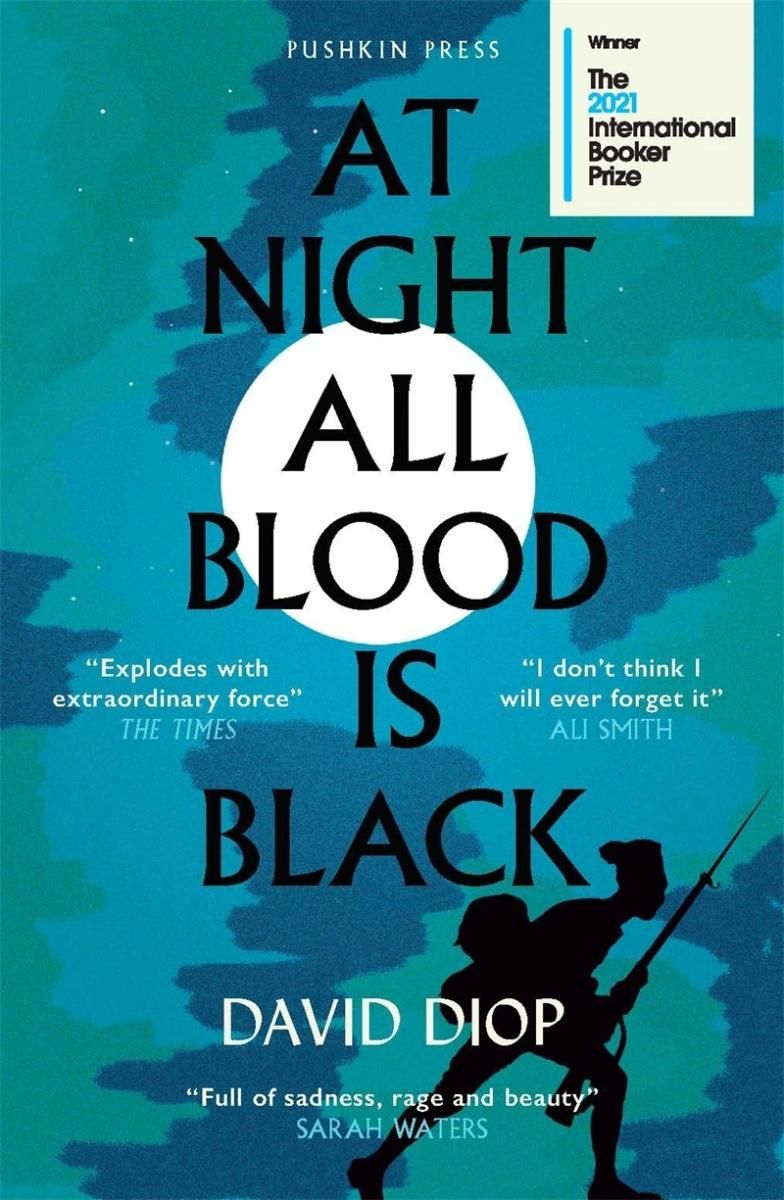

Five years after At Night All Blood is Black was awarded the International Booker Prize, translator Anna Moschovakis reflects on the conversations the novel has started and how the characters still haunt her dreams
- Published
Five years after At Night All Blood is Black was awarded the International Booker Prize, David Diop reflects on the intentions behind his novel, and the impact winning has had on his career
Buy the book
Thinking back five years to the evening you and translator Anna Moschovakis won the International Booker Prize for At Night All Blood is Black, could you describe how it felt to win in that moment?
Thinking back, yes, I can say I was very happy that Anna Moschovakis and I won this prize. Unfortunately, we weren’t able to travel to accept the award in person. We were all emerging from a period of lockdown due to Covid-19. The prize announcement was delivered online, in a broadcast filmed at Coventry Cathedral in the UK.
What impact do you think winning the International Booker has had on the wider perception of the book and on your career?
It is clear that the International Booker Prize gave At Night All Blood Is Black an aura of international visibility. For example, the English translation led to translations into Tamil, Turkish, Yoruba and Farsi that would not have come to pass without the award’s prestige. My career as a writer has also taken on new dimensions. The International Booker is an example of what Pierre Bourdieu calls a ‘legitimizing instance’ (‘Instance légitimante’), recognised the world over. As a result, I now have the good fortune of being considered a real writer, something I had for so long hesitated to claim for myself.
How was the book, and your International Booker win, received in Senegal?
The news brought immediate joy to my family, and to the Senegalese journalists who first reported it. I was invited to make a video recording that discussed the prize. My novel about the tirailleurs was even referenced by a Senegalese politician during the country’s 2023 presidential campaign.
What most inspired you to write At Night All Blood is Black? And how did you settle on the title? (The title of the French edition of the novel is Frère d’âme.)
This book was born from silence. In my French family – the maternal side – I had a great-grandfather who was in the First World War. He had been poisoned by mustard gas. My mother told me when I was still quite young how her grandfather had returned from the battlefield and never spoke about what had happened to him, what he had done and seen. Was this out of fear of reliving what he’d suffered by narrating it? Or to protect his loved ones from the visions of horror that haunted him?
At a very early age I became interested in the First World War because of this silence. I wanted to know what would have happened to him. And one day, I had the thought that he may have crossed paths with the Senegalese riflemen from my father’s family line. One of them was named Amadou Seck Ndiaye.
After that, I started to research the war experiences of African riflemen, and all I could find were impersonal letters, the benign character of which testified to the fear of the French censors who would have been surveilling their correspondence. I decided to devise a mode with which to express the terror of these West Africans who arrived from the countryside to become consumed by industrial war.
The solution I found was to narrate the state of shock by transcribing the stream of consciousness of one of them. This figure, of a man losing grip of his reason, recurs frequently in West African literature. The tirailleur driven mad by war, then sent back to Africa – we encounter him, for example, in Ahmadou Hampâté Bâ and Ahmadou Kourouma.
As for the title, it came from the text; it was taken from the final sentence of a chapter early in my novel. I had no trouble embracing it as rendered in the English translation. I had even considered it for the title of the French edition.
Do you feel distant from the characters now or do they still feel familiar or close? How have your feelings about more-than-brothers Alfa and Mademba changed over the years since the book was published?
Alfa and Mademba are characters who remain very close to me. Sometimes I find myself in this situation, where I have already imagined my characters before beginning to write them. They are like image-sources, both visual and sensorial, that precede their own transcription. For example, I had very precise images in mind of Alfa and Mademba as children, hunting game in the brush, which inspired a scene in At Night All Blood is Black. Because of this, rereading my text revives impressions and images that existed prior to their elaboration. As a consequence, my two characters live in my memory with the same ‘reality’ as do people I haven’t seen for a long time, or those who have passed on.
I have discovered that to write fiction that will satisfy me, I need to compose by hand and not on a computer keyboard. I use specific notebooks and a particular brand of pen. I wrote all of At Night All Blood Is Black by hand before typing it into the computer
The LA Review of Books commented on the novel’s ‘incantatory gore’, which describes its unique rhythm and language, as well as the grisly ground it covers. How did you find the right words to describe the physical and mental horrors of both the First World War and Alfa’s unravelling?
I wanted the character of Alfa to be in an extreme situation from the moment the book begins. That’s why I place him right away in the grips of an impossible choice: either to leave his more-than-brother in agony without helping him die, or to kill him and end his suffering. Throughout the novel, Alfa Niaye replays this primal scene, imbuing it with his regret, discovering his incapacity to get past it. The violence Alfa suffers is not only physical – from the brutalities of the war – but also psychological. My main concern was to maintain the violence of this opening throughout the book by employing a rhythm in the writing, rooted in Mademba’s terror in the face of his own death, to convey the terror that overtakes Alfa.
It’s a slim novel that tackles some huge subjects and themes – war, racism, colonialism, torture, rape, mental illness. Did you ever feel daunted by the project? What kept you motivated while you were writing and editing?
No, I was not daunted by the project because I did not have a project. My only concern was to place my characters in a context that would be faithful to the extreme violence of the First World War, at the moment when France, like other European powers, maintained a colonial empire. My preoccupation was to explore the mind of a colonial soldier thrust into what Blaise Cendrars called a ‘war factory’ (‘guerre usinière’), while thwarting the prejudices associated with the figure of the Senegalese riflemen of this period.
The fundamental subject was, for me, to show the reader that the Senegalese tirailleurs, often depicted as a homogenous group, were a collective made of individuals. Each tirailleur has a story. Alfa’s is that of a young man with an existing inner fracture, whose arrival on the battlefield only intensifies it.
The final four chapters are especially striking. Did you always know how the book would end?
No. Whereas in my most recent novel, Where the Sky Rests (forthcoming from Pushkin Press) I knew from the start how it would finish, with At Night All Blood Is Black I did not know until the last moment how it was going to end. As a result, the book’s ending is open; the narrative system is, intentionally, ambiguous. We don’t really know who is speaking. Is it Mademba, is it Alfa? This ambiguity took me by surprise when I was writing, and I decided to preserve it at all costs: ‘Now […] he is me and I am him’ are the novel’s final words.
What kinds of responses have you had from readers to At Night All Blood is Black? Have any reactions been especially pleasing or surprising?
I was quite surprised by the reading of a young woman, a high-schooler, who asked me after a presentation of the book ‘Why not imagine that it’s Mademba speaking, not Alfa, from the beginning of your novel?’ This interpretation of the text struck me as perfectly acceptable. I played so much with the duality of the ‘I’ in my tale, that in effect it is possible to think that Alfa may be the fruit of Mademba’s imagination, who may not actually have died on the battlefield, etc…. That young woman’s comment made me recognise, more than any discourse of literary criticism, the limits of intentionality for any writer.
What are you working on at the moment?
I have just published Where the Sky Rests in France, a novel that intertwines two travel narratives that follow the same route, from Egypt to Senegal. One takes place at the end of the 19th century, and the other in the third century BCE. The book engages an oral historical tradition according to which six waves of migration from Ancient Egypt populated West Africa. By telling the story of one of them, I wanted to remind people of what is so often forgotten: that Egypt is located in Africa.
Where and when do you most like to write, and what tools do you need?
I very rarely write out in the world because I require quiet. I write at home in my study, usually in the morning when my thoughts are clear and my academic obligations aren’t yet pulling me elsewhere.
Over time, I have discovered that to write fiction that will satisfy me, I need to compose by hand and not on a computer keyboard. I use specific notebooks and a particular brand of pen. I wrote all of At Night All Blood Is Black by hand before typing it into the computer.
I find that when I’m working on fiction, writing in manuscript leads to a more faithful transmission of whatever images and sensations have inspired me to write the scene at hand. I think this is because I learned, along with everyone else in my generation at least, to write my first words on paper, with a pencil or a pen. The embedded memory of this primal gesture encourages a more precise alignment between my thoughts and their expression.
Is there a book from your childhood that made you fall in love with reading?
When I was a child, I loved reading a series of books called Tales and Legends of… from the publishers Fernand Nathan. I would borrow a different volume each week from the library of the French cultural centre in Dakar. The titles ranged from Tales and Legends of Senegal to Tales and Legends of the American Indians… and of Pampa, Spain, Haiti, Britain, etc…. For me it was a way to discover the world through the myths and legends of different peoples. I was enthralled. And perhaps I still am.
Do you have a favourite book in the Booker Library? What do you love about it?
I adored Paradise, the novel by Abdulrazak Gurnah, which I read in its French translation. To read it was to be transported on a fascinating, violent, journey into the heart of Tanzania – where the book is set – and into the far reaches of the human heart.

David Diop
© Joel Saget/AFP via Getty Images


At Night All Blood is Black
Winner of The International Booker Prize 2021
- By
- David Diop
- Translated by
- Anna Moschovakis
- Published by
- Pushkin Press
Winner of the International Booker Prize 2021. A hypnotic, heartbreaking rendering of a mind hurtling towards madness, shattered by grief and the horror of war
Features


- Book recommendations
Explore the 10 winning books from a decade of the International Booker Prize


- Book recommendations
The best International Booker-nominated translated fiction, as chosen by celebrities
- Book recommendations