Longlist for Booker Prize 2026 ‘rewards risk’
Longlist for Booker Prize 2026 ‘rewards risk’
- Published
Today, Tuesday, 28 July, the 2026 longlist for the Booker Prize, the world’s most significant award for a single work of fiction, is announced
The list of 13 novels includes:
- Authors representing seven nationalities and three continents, with the majority of authors from the UK
- Past winners Marlon James and Douglas Stuart and previous shortlistee Elizabeth Strout
- Three debut novelists among 10 authors who appear on the Booker Prize longlist for the first time
- Books with humour, heartbreak, satire and surreality; books that offer fresh interpretations of dystopian sci-fi, the campus novel and the crime thriller
- Novelists who ‘brilliantly muster the power of words to take the reader to new places, to see old places from new angles, to change minds’, according to Mary Beard, Chair of the 2026 judges
- A debut novel from a 28-year-old and the 13th novel from an 81-year-old
- Writers who could become the first with Mexican or Turkish heritage to win the prize
- Authors with a range of experiences, including as a competitive trampolinist, a child actor, a fashion designer and a lawyer, as well as poets, playwrights, editors and critics
The ‘Booker Dozen’ of 13 books has been selected by the 2026 judging panel, chaired by celebrated classicist, writer and broadcaster Mary Beard. Beard is joined by award-winning poet, writer and educator Raymond Antrobus; musician, writer and broadcaster Jarvis Cocker; journalist, editor and critic Rebecca Liu; and Booker Prize-shortlisted novelist, poet and essayist Patricia Lockwood.
The prize has rewarded and celebrated world-class talent for over 55 years, shaping the canon of 20th and 21st century literature. This year’s selection, which was chosen from 163 submissions, celebrates the best works of long-form fiction by writers of any nationality, written in English and published in the UK and/or Ireland between 1 October 2025 and 30 September 2026.
The longlist transports readers from a hospital in Mexico City to the Kent seaside in a post-apocalyptic Britain to an assisted suicide clinic in Zurich, from the barren hillsides of the Outer Hebrides to the criminal badlands of West Dublin, from Kingston, Jamaica in the late 1980s to coastal Massachusetts in the run up to the 2024 US election, from an unnamed medieval court to a prison cell that defies explanation.
Tonally diverse, the books abound with humour and heartbreak, satire and surreality. There are fresh takes on dystopian sci-fi, royal history, the crime thriller and the campus novel. They are about memory, mortality, metamorphosis and murder; about old lives and new worlds; about the limits of human understanding; about reconciliation and retribution; about the lengths we go to in order to survive; and about the many ways we reckon with the past.
As well as encapsulating a variety of themes, the longlist ranges in length – from the pocket friendly to a weighty tome. Six of the books on the list are less than 250 pages long, with three under 200. The shortest is Helen of Nowhere by Makenna Goodman at just over 140 pages, whilst the longest – Marlon James’s The Disappearers – is over 600 pages long.
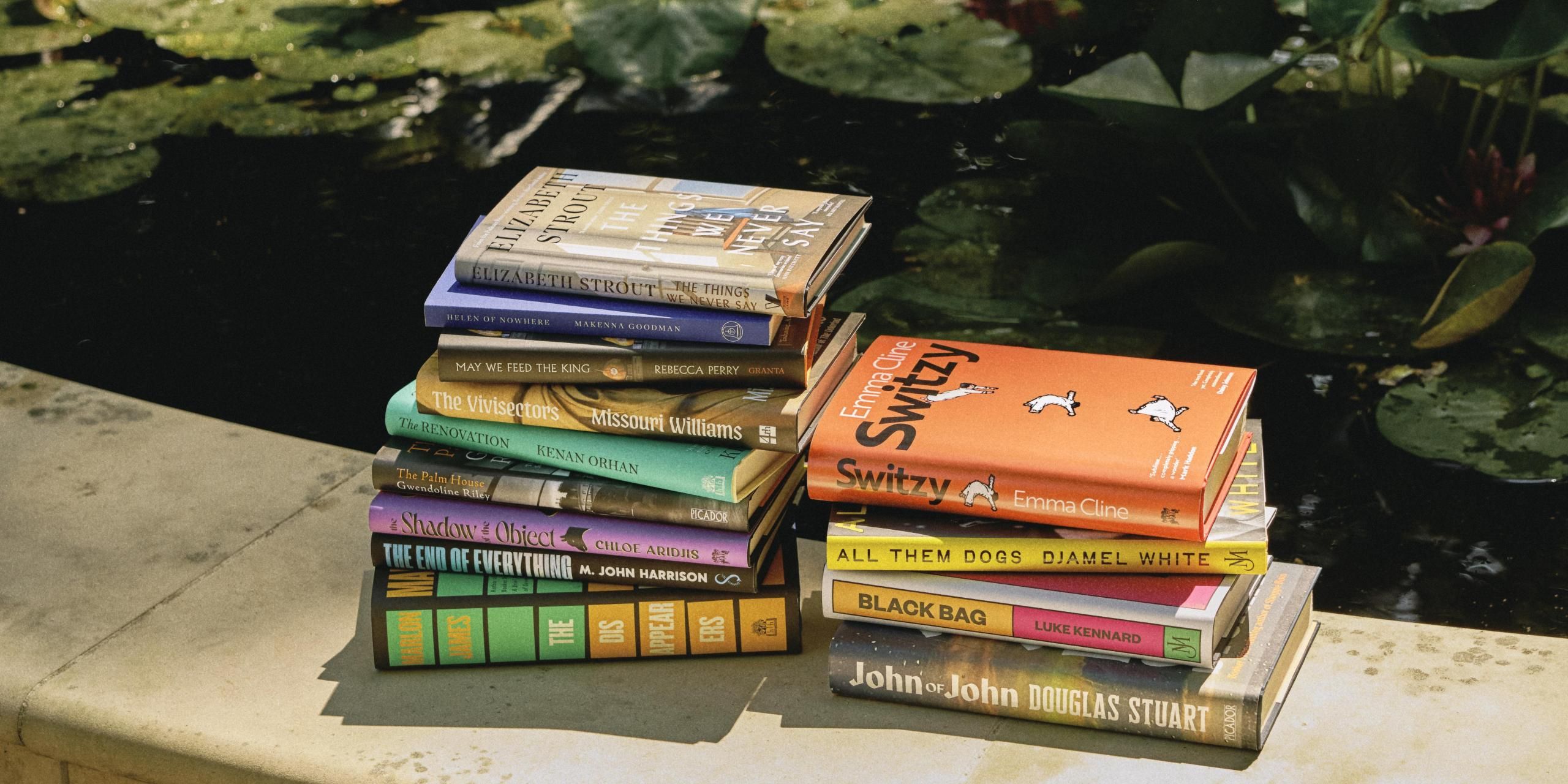
The full Booker Prize 2026 longlist is:
The Shadow of the Object by Chloe Aridjis
Switzy by Emma Cline
Helen of Nowhere by Makenna Goodman
The End of Everything by M. John Harrison
The Disappearers by Marlon James
May We Feed the King by Rebecca Perry
The Palm House by Gwendoline Riley
The Things We Never Say by Elizabeth Strout
John of John by Douglas Stuart
All Them Dogs by Djamel White

The Booker Prize 2026 longlist
© Yuki Sugiura for Booker Prize Foundation
Mary Beard, Chair of the Booker Prize 2026 judges, comments:
‘It’s been an extraordinary seven months. The five Booker judges have each read 163 books, discussed and debated them, and sometimes re-read them, to whittle them down to a longlist of just 13. I would not be telling the truth if I said that I hadn’t occasionally felt daunted, as a new box of 30 or so gleaming volumes landed on my doorstep. (Just think: if you include the re-reading and the occasional day off, you have to average a book a day to get through the total.) But what I shall most remember is the eye-opening pleasure of it all, and what I learnt about reading and the power of fiction from my fellow judges. I’ve also felt increasingly humbled by the novels and the novelists themselves. I have come away with huge admiration for anyone who can craft a work of fiction from start to finish.
‘Great books have never been written to a single formula. We are confident that our longlist of books has something for everyone. There’s the funny and the unsettling (and in some cases the funny and unsettling); there’s dystopian fantasy and domestic drama; there’s the gritty and the magically mysterious; there are some that will please and some that may shock. And they are set anywhere and everywhere: Ireland and Italy, Mexico and Massachusetts, Jamaica and the Hebrides, universities, private planes and pubs, past, present and future. But there’s one thing they all share. Every writer on our longlist brilliantly musters the power of words on the page to take the reader to new places, to see old places from new angles, to change minds.
‘Books are not mirrors: they don’t simply reflect ourselves back to us. One of the many important things about fiction is that it helps us see what it might be like not to be us, to begin to understand the perspectives of others, and to imagine what it might be like to see the world differently. Great books are not cosy. In their various ways, the novels we have chosen are (we hope) dynamite.’
Gaby Wood, Chief Executive of the Booker Prize Foundation, adds:
‘I’m delighted to have witnessed this year’s erudite, entertaining judges in action over the course of this year. Their range of tastes, openness of mind and rich discussions have resulted in a list that shows how capacious an art form the novel is. Whether working in a traditional form or stretching its possibilities, these writers can take you to the edge of a world or a thought or a feeling. There are books here that are funny, books that are pacey, books that are bold, books that will move you to tears. The 2026 longlist rewards risk: it is full of genuinely original work, and has human fingerprints all over it.’
Fortnum & Mason, ‘the world’s most famous cornershop’, is once again generously hosting this year’s judging panel at its flagship London Piccadilly store for the key judging meetings. The judges met in the Drawing Room on the fourth floor to choose their longlist.
The Booker Prize 2026 campaign is rooted in the idea of our individual reading lives – how our personal histories, interests and locations influence the role that books play in our lives and help us connect with others through great fiction. This year’s series of video shorts and photography will showcase the Booker Prize judges, books and readers out and about, with the aim of encouraging everyone to delve into this year’s selection in their favourite spot this season and share their experience with readers around the world. You can see the campaign teasers here and here.
For the second time, the Booker Prize shortlist will be announced at a public event. The prize will be returning to the Southbank Centre in London on the evening of Tuesday, 22 September 2026 for this unique event, which will feature all five judges in conversation. The announcement of the Booker Prize 2026 shortlist will be made on stage in the Queen Elizabeth Hall and will be livestreamed on the Booker Prizes website and social channels. It will also be announced via press release. The six shortlisted authors will each receive £2,500 and a specially bound edition of their book.
The announcement of the winning book for the Booker Prize 2026 will take place on Monday, 9 November 2026 at a ceremony at Old Billingsgate in London. The announcement will be livestreamed on the Booker Prizes’ channels. The winner receives £50,000 and a trophy named ‘Iris’.
Former winners, bestsellers and critically acclaimed debuts
The longlist features authors representing three continents and seven countries: England, Ireland, Scotland, Jamaica, Mexico, Turkey and America. If Chloe Aridjis, who is Mexican-British, wins she would be the first author of Mexican heritage to do so, whilst Kenan Orhan, who is Turkish-American, could be the first winner of Turkish heritage. The list includes previous Booker Prize winners Marlon James (who won in 2015 with A Brief History of Seven Killings) and Douglas Stuart (who won in 2020 with his debut novel Shuggie Bain) and three-time nominee Elizabeth Strout, who was previously longlisted in 2016 for My Name is Lucy Barton and shortlisted in 2022 for Oh William!.
Bestselling and acclaimed author James is longlisted for his sixth novel, The Disappearers, which publishes in September and has already been included in a New York Times round-up of ‘The Novels Everyone Will Be Talking About in 2026’. Stuart makes the list with his Sunday Times bestselling third novel, John of John, an Oprah Winfrey Book Club and a Telegraph ‘Best books of 2026 so far’ pick. If either were to win they would be the fifth author to have been awarded the Booker Prize twice, joining J.M. Coetzee (1983 and 1999), Peter Carey (1988 and 2001), Hilary Mantel (2009 and 2012) and Margaret Atwood (2000 and 2019). Pulitzer Prize-winner Strout receives her third nomination with The Things We Never Say, her 11th novel and a departure from her hugely popular Olive Kitteridge and Lucy Barton character series. It been described as ‘the first great novel about Trump’s America’ and is also included in the Telegraph’s ‘Best books of 2026 so far’ list.
The novelists on the longlist range in age from 28 (Djamel White) to 81 (M. John Harrison). If Harrison goes on to win he would become the oldest winner in the history of the prize (a title currently held by Margaret Atwood who was 79 when she jointly won in 2019 with The Testaments).

Mary Beard, Chair of the Booker Prize 2026 judges
© Neo Gilder for Booker Prize Foundation
The judges’ selection features 10 writers making their first appearance on a Booker Prize longlist, including three debut authors (Kenan Orhan with The Renovation, Rebecca Perry with May We Feed the King and Djamel White with All Them Dogs). Though new to the prize, many are bestsellers, award-winners, hotly tipped debut novelists and established authors deep into their writing careers and a high proportion of the longlisted novels are included in books of the year round-ups in the UK and US press:
- Chloe Aridjis won the Prix du Premier Roman Etranger in France with her debut novel, Book of Clouds, and the PEN/Faulkner Award for Fiction for her third novel, Sea Monsters. In 2014 she was awarded a Guggenheim Fellowship for her writing. The Spectator Australia called The Shadow of the Object ‘another quiet triumph for Aridjis’ and the Guardian called her ‘one of the boldest writers at work in English today’.
- Emma Cline is the author of three novels, including the Sunday Times and New York Times bestselling The Girls, which was a finalist for the Center for Fiction’s First Novel Prize, the National Book Critics Circle John Leonard Award, and the Los Angeles Times Book Prize. It was a New York Times Editors’ Choice and was the winner of the Shirley Jackson Award. She is also the author of a story collection, Daddy. Cline was selected as one of Granta’s Best Young American Novelists in 2017. Switzy was included by the BBC as one of ‘the most exciting books to look out for in 2026’.
- M. John Harrison is a literary critic and the author of 13 novels, five short-story collections and an ‘anti-memoir’. His award-winning novels including Climbers, which won the Boardman Tasker Prize for Mountain Literature in 1989; Nova Swing, which won the Arthur C. Clarke Award in 2007; and The Sunken Land Begins to Rise Again, which won the 2020 Goldsmiths Prize for innovation in fiction. The End of Everything went to number eight in the Times bestseller list when it published in June and Helen Macdonald wrote in the Observer ‘I don’t think I’ll read a better book this year’. It has been included in the Telegraph’s ‘Best books of 2026 so far’. Simon Ings writes in the Telegraph that ‘Harrison isn’t weirder than most other writers, just better’.
- Luke Kennard is the author of three novels and is an award-winning poet. In 2014 he was named one of the ‘Next Generation Poets’ by the Poetry Book Society in their once-per-decade list. He is the author of seven poetry collections, including Cain, which was shortlisted for the International Dylan Thomas Prize and described by Alan Hollinghurst as ‘the cleverest and funniest thing I’ve read this year’ and Notes on the Sonnets, which won the Forward prize for Best Poetry Collection in 2021. His debut novel, The Transition, was a BBC Radio 4 Book at Bedtime and was longlisted for the Desmond Elliott Prize. Black Bag was described by the Times as ‘a brilliant comic tour de force’ and was included in the New Statesman’s ‘The best fiction to read this year’ and the Guardian’s ‘Books to make you fall back in love with reading’ round-ups.
- London-based Rebecca Perry is an award-winning novelist and poet. Her first poetry collection, Beauty/Beauty won the Michael Murphy Memorial Prize 2017 and was shortlisted for the T.S. Eliot Prize, the Fenton Aldeburgh First Collection Prize and the Seamus Heaney Centre for Poetry Prize for First Full Collection. May We Feed the King has been awarded the 2026 Waterstones Debut Fiction Prize, with Waterstones Head of Books Bea Carvalho declaring Perry ‘an author to be seriously excited about’. She is also the author of a work of creative nonfiction, On Trampolining.
- Gwendoline Riley is the author of eight novels – many of which have been prize nominees or award-winners. My Phantoms was shortlisted for the Rathbones Folio Prize and longlisted for the Gordon Burn Prize. First Love won the Geoffrey Faber Memorial Prize and was shortlisted for the Women’s Prize for fiction, the Goldsmiths Prize, the Dylan Thomas Prize, the Gordon Burn Prize and the James Tait Black Memorial Prize. Cold Water won a Betty Trask Award and Joshua Spassky won a Somerset Maugham Award and was shortlisted for the John Llewellyn Rhys Prize. In 2018, The Times Literary Supplement named her one of the 20 best British and Irish novelists working today and earlier this year she was awarded the $175,000 Windham-Campbell prize in recognition of her life’s work. The Palm House was included in the Telegraph’s ‘Best Books of 2026 so far’ and the Sunday Times say that it establishes Riley ‘as one of our foremost fiction writers’.
- Makenna Goodman is the author of two critically-acclaimed novels. Her debut novel The Shame was named a ‘Best Book of the Year’ by The White Review and was selected as ‘New Book to read right now’ by Refinery29. The Guardian calls Helen of Nowhere ‘a perfect fairytale for our times’ and The Times says it is ‘wildly original’ and that it ‘will sharpen your attention to the world’. It has been selected by the Paris Review in its ‘Favourite Books of 2025’ feature and by Granta in its ‘A year in reading 2025’ feature.
- Kenan Orhan’s short story collection, I Am My Country, was a finalist for the PEN/Robert W. Bingham Prize and was longlisted for the Story Prize. His fiction has been published in Paris Review, Common and elsewhere, and has been anthologized in The O. Henry Prize Stories and The Best American Short Stories. The Renovation, which began life as a short story in the Atlantic in 2023, is included in the Guardian’s ‘10 debut novels to look out for in 2026’ and it was a New York Times Book Club Read pick.
- Djamel White’s debut novel All Them Dogs emerged from a short story, ‘Blue Opel’ and has been selected as a 2026 book to watch in New Statesman, Irish Times, Sunday Independent and RTE. After leaving school at 17, White volunteered in the Irish non-profit literary organisation Fighting Words – established by Roddy Doyle in 2009 – which reinforced his love of writing. At 21, he attended University College Dublin and earned a BA in English and Creative Writing, followed by an MFA in Creative Writing, and was mentored by writers including Anne Enright. He has been the recipient of a Literature Bursary Award and an Agility Award from the Arts Council of Ireland. The Guardian states that White is ‘poised as a powerful new voice in Irish literature’.
- Missouri Williams’ debut novel The Doloriad won the 2023 Republic of Consciousness Prize, was shortlisted for the VCU Cabell First Novelist Award and has been called a ‘cult hit’ by journalists. The Guardian describes Williams as writing with ‘a singular brand of Ballardian ferocity’. The Financial Times calls The Vivisectors ‘a disquieting apocalyptic fable’ that is ‘a compelling exploration of love’ and the Daily Mail says that ‘it grips you with an invigorating sense of its sheer difference from anything else out there’.
The authors have a range of experience outside of novel writing: Rebecca Perry competed internationally as a trampolinist; Djamel White has managed one of Ireland’s leading tattoo shops; Douglas Stuart was a fashion designer; Chloe Aridjis, whose second novel Asunder is set in London’s National Gallery, writes for various art journals and was a guest curator at Tate Liverpool; Makenna Goodman has been a book editor for two decades, helping other writers garner awards; Marlon James was an advertising copywriter; Elizabeth Strout briefly practised law; Emma Cline was a child actor; and though this is his first nomination, M. John Harrison has experience of the Booker Prize as a judge in 2022.
Strong showing for established publishing imprints
Big publishing houses are behind 10 of the 13 titles on the longlist, led by Penguin Random House, which has five titles across three imprints: Chatto & Windus with The Shadow of the Object and Switzy; Hamish Hamilton with The Disappearers and The Renovation; and Viking with The Things We Never Say. Picador, an imprint of Pan Macmillan, is represented twice (The Palm House and John of John) as is Hachette’s John Murray imprint (Black Bag and All Them Dogs), whilst HarperCollins’ 4th Estate makes the list with The Vivisectors.
Three independent publishers each have a book on the list: Fitzcarraldo Editions (Helen of Nowhere), Profile Books imprint Serpent’s Tail (The End of Everything) and Granta (May We Feed the King). Granta has published six previous Booker nominees, including 2013 winner The Luminaries by Eleanor Catton. Serpent’s Tail is longlisted for the fourth time, while Fitzcarraldo Editions is nominated for the Booker Prize for the second time, having been recognised by the International Booker Prize 17 times in the past decade.

The Booker Prize 2026 judges – Raymond Antrobus, Patricia Lockwood, Rebecca Liu, Jarvis Cocker and Mary Beard – with the longlisted books
© Neo Gilder for Booker Prize Foundation
What the judges said about the longlisted books
The Shadow of the Object by Chloe Aridjis
‘A mysterious and free-wheeling novel which moves between the real world and dream-states. We were charmed by its suggestion that the most meaningful truths can be found in the shadows.’
Switzy by Emma Cline
‘Cline writes vividly about all the trappings of the elite – the private jets, the heirloom watches – as well as their sad social cost in a story that feels immersive, elegiac, and very real.’
Helen of Nowhere by Makenna Goodman
‘A spellbinding novel or a play with just four characters? Philosophically, politically, and spiritually adventurous, this slim, ambitious volume has the power to transform.’
The End of Everything by M. John Harrison
‘A book not just about everything but about now. Shimmering, oblique, it holds the reader to the surface of something very grave and deep.’
The Disappearers by Marlon James
‘A book that examines territory Caribbean literature has rarely dared to occupy, as what begins as a theatrical story becomes something closer to a reckoning. James is a singular literary talent.’
Black Bag by Luke Kennard
‘This of-the-moment satire considers anonymity and disgust, online rackets, and what it means to find love in our unstable times. We admired its sharply crafted sentences and humour.’
The Renovation by Kenan Orhan
‘A hilarious fantasy which had some of the judges laughing out loud. But it also poses questions about political activism, belonging, and the different forms imprisonment can take.’
May We Feed the King by Rebecca Perry
‘A wonderfully enticing combination of themes, woven together with a delicacy of touch. You can’t read it without reflecting on the fragile boundary between the present and the past.’
The Palm House by Gwendoline Riley
‘A note-perfect portrait of rarefied London intellectual spaces, and the people who make up that impersonal thing we think of as the Establishment. Minimalist, precise, and indelible.’
The Things We Never Say by Elizabeth Strout
‘A devastating look at the dangerous cracks in family life and in the contemporary world at large. Strout’s prose is brilliantly understated and all the more powerful for that.’
John of John by Douglas Stuart
‘This excavation of family, violence and shame is woven through with beautiful imagistic detail, and – unexpectedly – shades of hope. We loved the rich, textural detail of the story.’
All Them Dogs by Djamel White
‘A ballsy, unsentimental portrait of West Dublin gangland, set well off the beaten track of the city’s usual literary landmarks. White has an ear for dialogue that is both racy and real.’
The Vivisectors by Missouri Williams
‘A bracing antidote to the cosy campus and the dark academia novel, The Vivisectors is genuinely experimental, relentlessly and rollickingly told – and in places truly menacing.’
The Booker Prize Foundation is a charity partner of ethical online bookshop BookKind, which is offering a 10% discount on all of the Booker Prize 2026 longlist titles as well as a complimentary copy of the Booker Prizes Quick Read, All Around the World: Stories by Booker Prize Writers. Readers can choose to donate 10% of every purchase to the Booker Prize Foundation, supporting our work to help readers and writers of the future.
The prize’s impact
The Booker Prize, first awarded in 1969, is the leading literary award in the English-speaking world, and has brought recognition, reward and readership to outstanding fiction for over five decades. Authors shortlisted for the prize gain global readerships and an increase in profile and sales, and the winner can expect their career to be transformed.
The winner of the 2025 prize, Flesh by David Szalay, sold over 7,900 hardback copies in the UK in the week following its win on 10 November, a 1,441% week-on-week sales increase, with combined e-book and audio book sales in the same week totalling 15,000 copies, representing a 2,508% increase. It reached number four in the Sunday Times bestsellers chart – staying in the top 10 for 10 weeks – number one in the Times, and entered the Amazon fiction Top 20 Most Sold list for the first time in the week after its win, in second place. It topped the Independent Bookshop Top 20 the following week. The hardback edition was the 11th bestselling fiction title in 2025 and the paperback, which published in spring this year and spent three weeks as Sunday Times bestseller, is in the top 15 bestselling general fiction paperbacks of the year so far. The publisher has now sold over 91,000 hardback and 60,000 paperback print copies in the UK, with combined digital sales totalling over 75,000. Rights deals increased from 12 before Flesh’s longlisting to a total of 41 territories now either sold or under offer.
The Booker Prize Foundation has created sets of short films featuring well-known actors for the Booker Prize since 2022. The films have become one of the highlights of the prize season, with the Booker Prize 2025 films viewed online 67 million times. The films are award-winners themselves: the shorts produced for the Booker Prize 2025 shortlist, directed by Sasha Nathwani, won a Webby Award in the Social – Arts and Entertainment category and a Brand Film Award for Best Use of Digital/Social Media, whilst the Booker Prize 2022 films, directed by Kevin Thomas, won the Culture category of The Drum Awards for Marketing EMEA 2023. The Booker Prize 2026 shortlist films will be released in the autumn, in the weeks after the shortlist announcement.
Booker Prize 2026 public events:
The Booker Prize 2026 shortlist announcement: 7pm BST, Tuesday, 22 September 2026, Southbank Centre, London
The judges of the Booker Prize 2026, Chair Mary Beard, Raymond Antrobus, Jarvis Cocker, Rebecca Liu and Patricia Lockwood will be in conversation with Booker Prize Foundation Chief Executive Gaby Wood, as they announce the shortlist for this year’s prize live on stage in the Southbank Centre’s Queen Elizabeth Hall, London. The event forms part of the Southbank Centre’s 75th anniversary programme.
Tickets are priced from £22 plus £4 booking fee and can be booked at southbankcentre.co.uk.
The Booker Prize 2026 shortlist at The Times and Sunday Times Cheltenham Literature Festival: 2.30pm BST, Saturday, 10 October 2026
Gaby Wood, Chief Executive of the Booker Prize Foundation will host the Cheltenham Literature festival’s annual introduction to the six shortlisted books and their authors, who will join the event both in-person and virtually.
Tickets will go on sale on Wednesday, 12 August and can be booked at cheltenhamfestivals.org
The Booker Prize 2026 shortlist readings: Southbank Centre, London, 7.30pm GMT, Sunday, 8 November 2026
The prize’s annual shortlist readings, which feature the six authors reading from and discussing their books, are returning for the 2026 prize season and will take place on Sunday, 8 November in the Southbank Centre’s Queen Elizabeth Hall, London, as part of its 75th anniversary programme. The event chair will be announced in the autumn. Tickets go on sale on 10 September and can be booked at southbankcentre.co.uk.

The Booker Prize 2026 longlist
© Yuki Sugiura for Booker Prize Foundation