
From experimental form to narrative surprises, this year’s longlisted books are definitely worth talking about
What our judges said about the Booker Prize 2025 longlist

What our judges said about the Booker Prize 2025 longlist
- Published
Wondering which of the 13 Booker Prize 2025 longlisted titles to read first? We asked our judges to summarise each novel – and say what they loved about it
Love Forms by Claire Adam
‘Claire Adam returns to Trinidad for her sophomore novel. We first meet Dawn, a pregnant 16 year-old, on a clandestine journey across the sea to Venezuela. There, she gives birth and returns home without the baby, just as her parents had prescribed. Now, at 58, Dawn is the divorced mother of two adult men, but the loss of the baby girl consumes her every move. The story, heartbreaking in its own right, comes second to its narration. Dawn’s voice haunts us still, with its beautiful and quiet urgency. Love Forms is a rare and low-pitched achievement. It reads like a hushed conversation overheard in the next room.’

Love Forms by Claire Adam
© Yuki Sugiura for Booker Prize Foundation
The South by Tash Aw
‘It’s summertime in the 1990s and rural Malaysia is hot. Teenager Jay and his family leave their home of Kuala Lumpur to work on a farm in the Johor Bahru countryside. There, Jay meets Chuan, who opens Jay up to friendship, illicit pastimes, and a deeper understanding of his sexuality. To call The South a coming-of-age novel nearly misses its expanse. This is a story about heritage, the Asian financial crisis, and the relationship between one family and the land. The South is the first instalment of a quartet, and we’re so pleased that there is more to come.’

The South by Tash Aw
© Yuki Sugiura for Booker Prize Foundation
Universality by Natasha Brown
‘Natasha Brown’s Universality is a compact yet sweeping satire. Told through a series of shifting perspectives, it reveals the contradictions of a society shaped by entrenched systems of economic, political, and media control. Brown moves the reader with cool precision from Hannah, a struggling freelancer, through to Lenny, an established columnist, unfurling through both of them an examination of the ways language and rhetoric are bound with power structures. We were particularly impressed by the book’s ability to discomfit and entertain, qualities that mark Universality as a bold and memorable achievement.’

Universality by Natasha Brown
© Yuki Sugiura for Booker Prize Foundation
One Boat by Jonathan Buckley
‘Following the death of her father, Teresa returns to the small coastal town in Greece she first visited when her mother died nearly a decade before. From this scenario, tacking between the events of the second trip and memories of the first, Buckley creates a novel of quiet brilliance and sly humour, packed with mystery and indeterminacy. The way in which the book interleaves Teresa’s relationship to her mother, her involvement in an amateur murder investigation, and an account of a love affair, raises questions about grief, obsession, personhood and human connectivity we found to be as stimulating as they are complex.’

One Boat by Jonathan Buckley
© Yuki Sugiura for Booker Prize Foundation
Flashlight by Susan Choi
’Flashlight is a sprawling novel that weaves stories of national upheavals with those of Louisa, her Korean Japanese father, Serk, and Anne, her American mother. Evolving from the uncertainties surrounding Serk’s disappearance, it is a riveting exploration of identity, hidden truths, race, and national belonging. In this ambitious book that deftly criss-crosses continents and decades, Susan Choi balances historical tensions and intimate dramas with remarkable elegance. We admired the shifts and layers of Flashlight’s narrative, which ultimately reveal a story that is intricate, surprising, and profound.’

Flashlight by Susan Choi
© Yuki Sugiura for Booker Prize Foundation
The Loneliness of Sonia and Sunny by Kiran Desai
‘This novel about a pair of young Indians in America becomes one about westernised Indians rediscovering their country, and in some ways a novel about the Indian novel’s place in the world. Vast and immersive, the book enfolds a magical realist fable within a social novel within a love story. We loved the way in which no detail, large or small, seems to escape Desai’s attention, every character (in a huge cast) feels fully realised, and the writing moves with consummate fluency between an array of modes: philosophical, comic, earnest, emotional, and uncanny.’

The Loneliness of Sonia and Sunny by Kiran Desai
© Yuki Sugiura for Booker Prize Foundation
Audition by Katie Kitamura
‘This novel begins with an actress meeting a young man in a Manhattan restaurant. A surprising, unsettling conversation unfolds, but far more radical disturbances are to come. Aside from the extraordinarily honed quality of its sentences, the remarkable thing about Audition is the way it persists in the mind after reading, like a knot that feels tantalisingly close to coming free. Denying us the resolution we instinctively crave from stories, Kitamura takes Chekhov’s dictum – that the job of the writer is to ask questions, not answer them – and runs with it, presenting a puzzle, the solution to which is undoubtedly obscure, and might not even exist at all.’

Audition by Katie Kitamura
© Yuki Sugiura for Booker Prize Foundation
The Rest of Our Lives by Ben Markovits
‘When Tom Layward’s wife cheated on him, he stayed for the children but promised to leave when his youngest turned 18. Twelve years later, Tom drops his daughter off at college, but instead of driving back to New York, he heads west. What follows is a remarkably satisfying road trip full of strangers, friends, and self-discovery. It’s clear author Ben Markovits has spent time teaching. This novel speaks like a much-loved professor, one whose classes have a terribly long waitlist. It’s matter-of-fact, effortlessly warm, and it uses the smallest parts of human behaviour to uphold bigger themes, like mortality, sickness, and love. The Rest of Our Lives is a novel of sincerity and precision. We found it difficult to put it down.’

The Rest of Our Lives by Ben Markovits
© Yuki Sugiura for Booker Prize Foundation
The Land in Winter by Andrew Miller
‘In the depths of Britain’s coldest winter, two neighbouring women forge a friendship in the countryside. It’s 1962 and they have both just become pregnant. Around them, the men are struggling: maimed by father figures, haunted by the past, hampered by the destructiveness of their own desires. As a winter storm wreaks havoc on their lives, these characters become pivotal figures in a community precariously balanced between history and future: between the damage wrought by the war and the freedom for women that lies ahead. In beautifully atmospheric prose, Andrew Miller brings suspense and mystery to this seemingly inconsequential chapter in British history.’

The Land in Winter by Andrew Miller
© Yuki Sugiura for Booker Prize Foundation
Endling by Maria Reva
’Endling shouldn’t be funny, but it is – very. Set in Ukraine just as Putin invades, it features three young women, on two different missions, in one vehicle. Structurally wild and playful, Endling is also heart-rending and angry. It examines colonialism, old and neo, the role of women, identity, power and powerlessness, and the very nature of fiction-writing. Maria Reva also tells a riveting, unique story; the shock is that this is her first novel. It’s a book about the world now, and about three unforgettable women, Yeva, Nastia and Solomiya, travelling together in a mobile lab. The endling, by the way, is a snail.’

Endling by Maria Reva
© Yuki Sugiura for Booker Prize Foundation
Flesh by David Szalay
‘David Szalay’s fifth novel follows István from his teenage years on a Hungarian housing estate to borstal, and from soldiering in Iraq to his career as personal security for London’s super-rich. In many ways István is stereotypically masculine – physical, impulsive, barely on speaking terms with his own feelings (and for much of the novel barely speaking: he must rank among the more reticent characters in literature). But somehow, using only the sparest of prose, this hypnotically tense and compelling book becomes an astonishingly moving portrait of a man’s life.’

Flesh by David Szalay
© Yuki Sugiura for Booker Prize Foundation
Seascraper by Benjamin Wood
‘Seascraper seems, at first, to be a beautifully described account of the working day of a young man, Thomas Flett, who works as a shanker in a north of England coastal town, scraping the Irish Sea shore for shrimps. And it is that: the details of the job and the physicality of the labour are wonderfully captured by Benjamin Wood. But this novel becomes much more. It’s a book about dreams, an exploration of class and family, a celebration of the power and the glory of music, a challenge to the limits of literary realism, and – stunningly – a love story.’

Seascraper by Benjamin Wood
© Yuki Sugiura for Booker Prize Foundation
Misinterpretation by Ledia Xhoga
‘A Kosovan torture survivor requests translation assistance at his therapy sessions. Our narrator, a nameless translator, reluctantly agrees. But Alfred’s account of his experiences conjures hidden memories that seep into her psyche, forcing her to question her marriage and her place in the world. This is a story of a woman saddled between her Albanian past and her New York present. It explores the way that language is kept in our bodies, how it can reveal truths we aren’t ready to hear. Misinterpretation subtly blurs the distinction between help and harm. We found it propulsive, unsettling, and strangely human.’

Misinterpretation by Ledia Xhoga
© Yuki Sugiura for Booker Prize Foundation


Features


- Book recommendations
South Asian Heritage Month: 12 books to read from the Booker Library

- Book recommendations
10 Booker Prize-nominated books that explore mid-life crises

- Book recommendations
Eight Booker Prize-nominated books that celebrate ‘spinster lit’
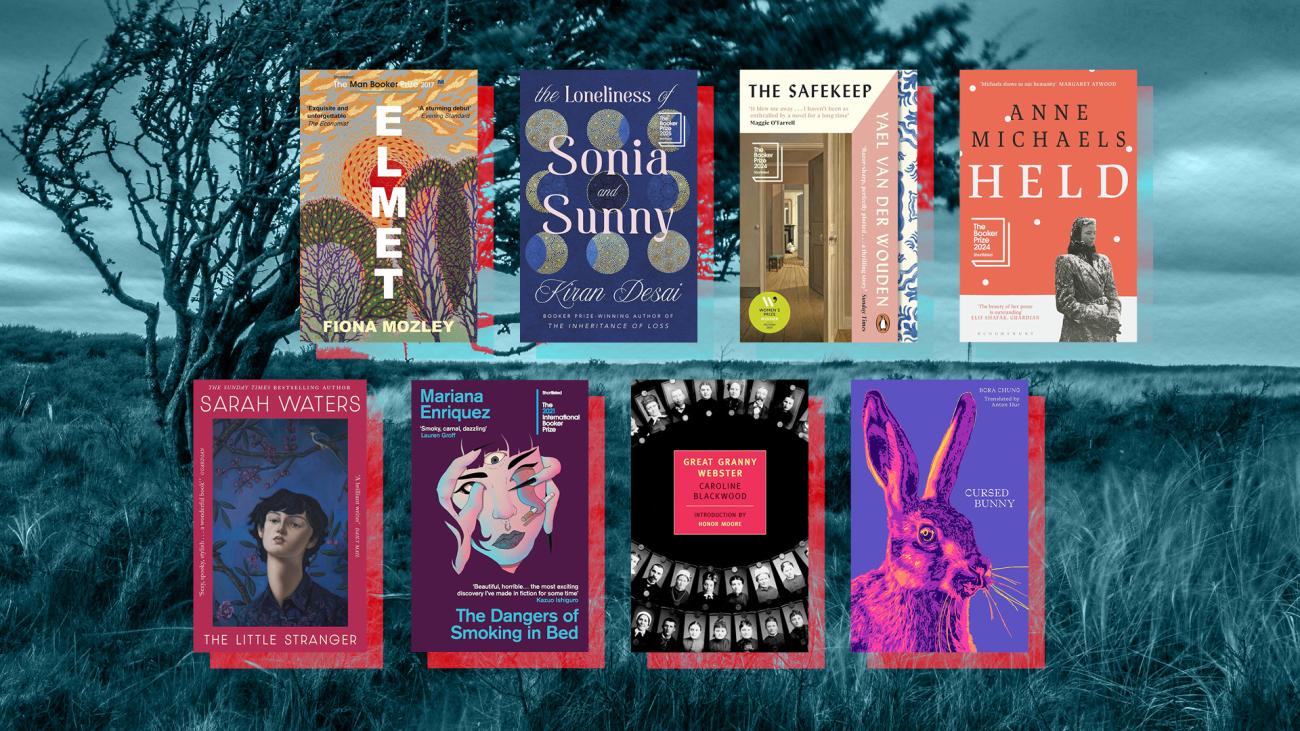
- Book recommendations
Eight Booker-nominated books for fans of Wuthering Heights

- Book recommendations
11 of the best debut novels that were nominated for the Booker Prize

- Book recommendations
The Booker Prize 2025 longlisted authors on the books they reread again and again

- Book recommendations
The best Booker audiobooks to curl up with this winter, chosen by you

- Book recommendations
The best children’s books for Christmas written by Booker Prize authors

- Book recommendations