
‘It was then that I heard a knocking on the windowpane. And there, behind the glass, stood Nelso Tabiòna. He was looking at me in silence, in keeping with his most personal principle of discretion. As a matter of fact, he deems it proper to announce himself in this manner.’
- Published
The International Booker Prize 2026 nominated author and translator on writing about life on the margins, and how the hyperlocal can allow us to think global
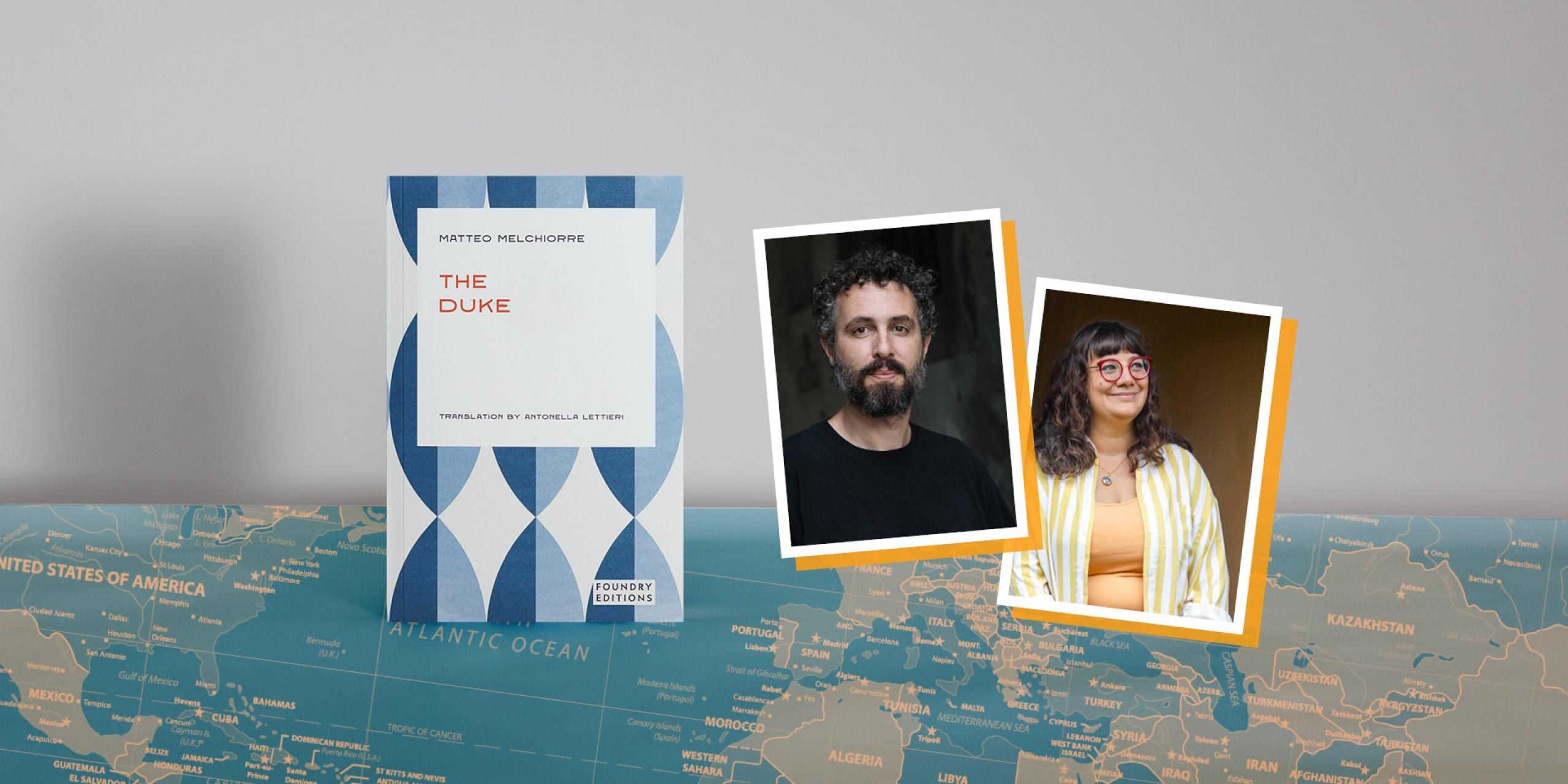
Matteo Melchiorre
Could you tell us about the inspirations behind The Duke?
I had many sources of inspiration. Generally speaking, I’d say that The Duke was born from the scene that now opens it. On a day in autumn, I saw a crow attack a buzzard, and the buzzard caught the crow in mid-air and hurled it to the ground. That rare occurrence felt to me like a sort of metaphor – a rebellion that went against all the usual interactions that take place between buzzards and crows.
That episode set ablaze my desire to tell about the world as I witness it every day, the mountain of mid altitude, the margins. But I also had other inspirations, especially an ancient manor house, now no longer lived in, that always moved me deeply.
How did you go about writing the novel?
I began with a vast map of the places and events I was imagining. My early drafts were mostly written longhand, on notebooks. The Duke took me six years to write, from 2017 to 2022. During those years, the book and the universe it contained were another world I inhabited alongside the real world.
I was moving around a fair bit around that time, and the novel followed me wherever I went: I wrote it in my office in the village where I was born, Tomo; in a small rental room in the centre of Feltre, where I had moved in the meantime; and on the train, during my daily commute from the mountains to the lowlands, to Castelfranco, where I work as the director of the Casa di Giorgione Museum, the library and the archive.
The theme of this year’s International Booker Prize campaign is ‘Fiction beyond borders’ – how do you think translated fiction helps readers see beyond geographical boundaries, and why is that important?
Borders. Frontiers. These are issues that resonate with me so much. I even edited an academic volume and curated a series of seminars on the plurality of borders at one point. I am convinced that borders are of paramount importance to understand the present and will be the deciding issue for our future.
Borders are disputed. On borders, blood is endlessly spilled. Borders, including linguistic borders, narrow our vision and our outlook, which is why I am firmly convinced that literary translation, dealing as it does with the lyrical, is the key to unlocking entirely new forms of imagination, entirely new worlds, even right at the heart of places that we think we know all too well, like in the case of The Duke.
Indeed, when thinking about Italy from abroad, who could actually imagine that places like Vallorgàna really exist, in this day and age? But thanks to translation, another border is crossed, and we can step into an entirely new world.

Matteo Melchiorre
© Alberto Bogo
Literary translation is the key to unlocking entirely new forms of imagination, entirely new worlds
Matteo Melchiorre
Could you tell us about a book that made you fall in love with reading as a child?
When I was little, I loved reading, and now I couldn’t be more grateful to my parents for introducing me to books so early on. However, there is one book that was a real epiphany for me, an experience that no other could ever match: Tolkien’s The Lord of the Rings. I was 10.
Grown-ups kept telling me that I wouldn’t make it through, that I was too young for such a big, complex trilogy. And yet, despite being only 10, I plunged into it and had one of the most exciting adventures of my entire life. What is so special about The Lord of the Rings is that it takes the reader to a fictional world that is yet incredibly rich and alive, and as contradictory as the real world, and tells about people’s most basic, most fundamental passions with no frills, a bit like I tried to do with The Duke.
And could you tell us about a book that made you want to become a writer?
There’s no doubt in my mind. In this case, too, it was a book I read when I was young (probably 13): Stevenson’s Treasure Island, and Stevenson is still one of my favourite authors. That book instilled in me a sense of adventure, kept me on tenterhooks, and took me to the most disparate places. But unlike Tolkien, it was set in the real world – a world from the past, to be sure, but real nonetheless.
It thrilled me to think that a place as marginal as Jim’s world is before the narrative is set into motion could suddenly be ignited by an extraordinary adventure, and it made me want to write something similar. Which I did, of course, filling a whole notebook that must still exist somewhere.
Is there a book that changed the way you think about the world?
My answer has to be Luigi Meneghello’s Deliver Us. No book in the world stands comparison to it, at least for me. It’s a tale about a village in the Veneto region set in the aftermath of the Second World War, but with frequent flashbacks to the final years of the Fascist era. It’s an extraordinary novel, written in the first person. Or is it an extraordinary essay? Hard to say.
It completely changed my worldview because it taught me to use the microscopic as a lens for looking at the world. Meneghello, who left Italy to teach in the UK, in Reading, showed me how to look around, dig deep, treasure details, think critically, and always cherish irony as an existential tool. Deliver Us – what an extraordinary book! I re-read it every year, almost as if it were a Bible.
Which book written in Italian should everyone read?
At the risk of sounding repetitive, the answer is still Meneghello’s Deliver Us. The reason is simple: Meneghello uses an extremely refined, deliberate, and even curated language that is yet utterly steeped in the turns of phrase, the syntax, the logic, and, at times, even the stories of the dialect from Veneto.
His writing is the perfect demonstration of how language, and therefore literature, finds its nourishment deep down, in the most profound layers and stratifications of the land where it’s originally conceived, fashioned, and spoken. This is why reading Meneghello truly means entering into a different world.
And, finally, which International Booker-nominated book do you think everyone should read?
Definitely Flights by Olga Tokarczuk, as it deals – from a perspective that is almost opposite to mine, as it happens – with issues such as uprootedness and travelling that are a fundamental condition for human beings.
Antonella Lettieri
What it was about The Duke that made you want to translate it?
When I first read The Duke, I felt right away that it was exactly the book I was craving as a reader – I just hadn’t realised it before. It’s a wonderfully sweeping novel that reads like a great 19th-century classic but addresses very contemporary issues.
For me, falling in love with a book as a reader is always the first step towards translation, and as soon as I catch myself translating a book into English in my head as I read along, I know I’m hooked – and it’s the best feeling in the world.
How did you go about translating the book?
The development of The Duke’s voice in English took several months, or perhaps closer to a year. My editor Richard Village and I were clear from the very beginning that the novel’s unique voice was almost a character in its own right, and that it had to be pitch-perfect.
In Italian, the voice has several ‘quirks’ that couldn’t necessarily be reproduced in English literally, as the two languages don’t quite work the same way; for example, the use of more antiquated words and expressions, or the occasional regionalism.
So I had to invent new quirks for The Duke in English, similar in effect but different in nature. I started paying a lot of attention to other people’s preferred turns of phrase, and to my own – to all those unconscious choices we make all the time that aren’t more correct than others, yet we tend to prefer nonetheless – and so, little by little, The Duke’s voice was born.
The theme of this year’s International Booker Prize campaign is ‘Fiction beyond borders’ – how do you think translated fiction helps readers see beyond geographical boundaries, and why is that important?
The story told in The Duke is hyperlocal, but it addresses global issues such as the relationship between humans and nature, climate change, and the burden of a shared past on our present. This is exactly what literature in translation does best, presenting the hyperlocal to help the reader think about the global.
Though it could be argued that this is what all prose does, literature in translation compels the reader to summon in themselves an ‘excess of compassion’, a sympathy that goes beyond what is well known and understood to take in and accept what at first might be unknown, and perhaps even unintelligible. And it is this excess of compassion that we desperately need today, in a world that often dehumanises and brutalises all that is different.
The International Booker Prize is celebrating its 10th birthday in its current form this year – how do you think the award has changed the perception of translated fiction over the last decade?
The International Booker Prize has played a crucial role in bringing literature in translation to wider audiences, and as a translator, I am extremely grateful for all the work it has done and continues to do. The prestige that readers attach to anything that comes with the ‘Booker seal of approval’ helps persuade more hesitant readers to pick up a book they might not otherwise have chosen.
But I think that the ‘International Booker effect’ goes much deeper than that: over the last 10 years, the prize has not only amplified and promoted excellent literature in translation but, with its bold choices and diverse voices, has also helped shape the landscape of literature in translation in the anglophone world, demonstrating to the publishing industry at large, and in no uncertain terms, that there is much space, and hunger, for literature that only a few years ago would have been considered ‘untranslatable’ or ‘unsellable’.

Antonella Lettieri
© Megan Taylor
Falling in love with a book as a reader is always the first step towards translation
Antonella Lettieri
Could you tell us about a book that made you fall in love with reading as a child?
I was a voracious reader as a child, and still am! Growing up in Italy, so much of what I read would have been in translation, though I’m not sure I necessarily realised it then. I have a very distinct, very cherished memory of being taken by my mum to the town library for the first time when I was seven or eight, and of my sheer delight and amazement at discovering that I could really read all those books for free!
It’s hard to pinpoint the one book among the many that made me fall in love with reading, but a novel I will always feel fondly for is Louisa May Alcott’s Little Women. Like Jo, I loved reading stories and aspired to write my own one day.
And could you tell us about a book that made you want to become a translator?
For me, growing up in Italy and being exposed to literature in translation from a much younger age than perhaps anglophone children are, my desire to become a translator came hand in hand with the gradual realisation that so much of the literature I admired was accessible to me only because someone had translated it in the first place.
For example, I loved Russian literature as a teenager, especially Dostoevsky – the snowy coldness of the landscapes, those characters so different from me who yet felt exactly as I did – and the idea that I would never have read those books were it not for their translators filled me with gratitude and respect for the profession from an early age.
Is there a translator whose work you always look out for?
So many excellent translators have been doing so much for the profession and its visibility over the last few decades that it’s hard to know where to start. Some names that immediately come to mind are Anton Hur, Daniel Hahn, Julia Sanches, Polly Barton, Frank Wynne, and Rosalind Harvey, but I’m sure I’m forgetting so many more key influences for me, and I hope that, over my career, I’ll be able to contribute to the betterment of the profession as much as they have.
A translator I always follow with great interest – and, I must confess, actually know better for her work as a writer than as a translator – is Jen Calleja. I love how her creative writing and translation work seem to exist on a continuum, which is something I think many translators aspire to.
Is there a work of fiction originally written in Italian that you’d recommend to English-language readers?
If it is fair to assume that everyone in the world has already read Elena Ferrante’s Neapolitan novels, translated by Ann Goldstein, as well as Vincenzo Latronico’s excellent Perfection, translated by Sophie Hughes, then I’d say Claudia Durastanti’s Strangers I Know, translated by Elizabeth Harris.
Strangers I Know is one of the recent Italian books that has made the strongest impression on me over the past few years. I love its dual perspective, from a small village in southern Italy to NYC and back, and find it very relatable to my own experience. But Durastanti’s greatest achievement in that book is the razor-sharp yet wholly compassionate gaze she aims at family mythologies and relationships – it’s a must-read!
And, finally, which International Booker-nominated book do you think everyone should read?
Tomb of Sand by Geetanjali Shree, translated by Daisy Rockwell, is an exuberantly funny and experimental exploration of very serious themes (such as the impact of borders on people’s lives) that will linger with the reader long after the last page is turned. But really, all of them! There’s so much excellent literature just waiting to be discovered in the International Booker lists.


