

From witchcraft to warfare, trauma to transformation, resilience to cruelty, this year’s longlist shines a light on a vast range of experiences
An extract from The Duke by Matteo Melchiorre, translated by Antonella Lettieri
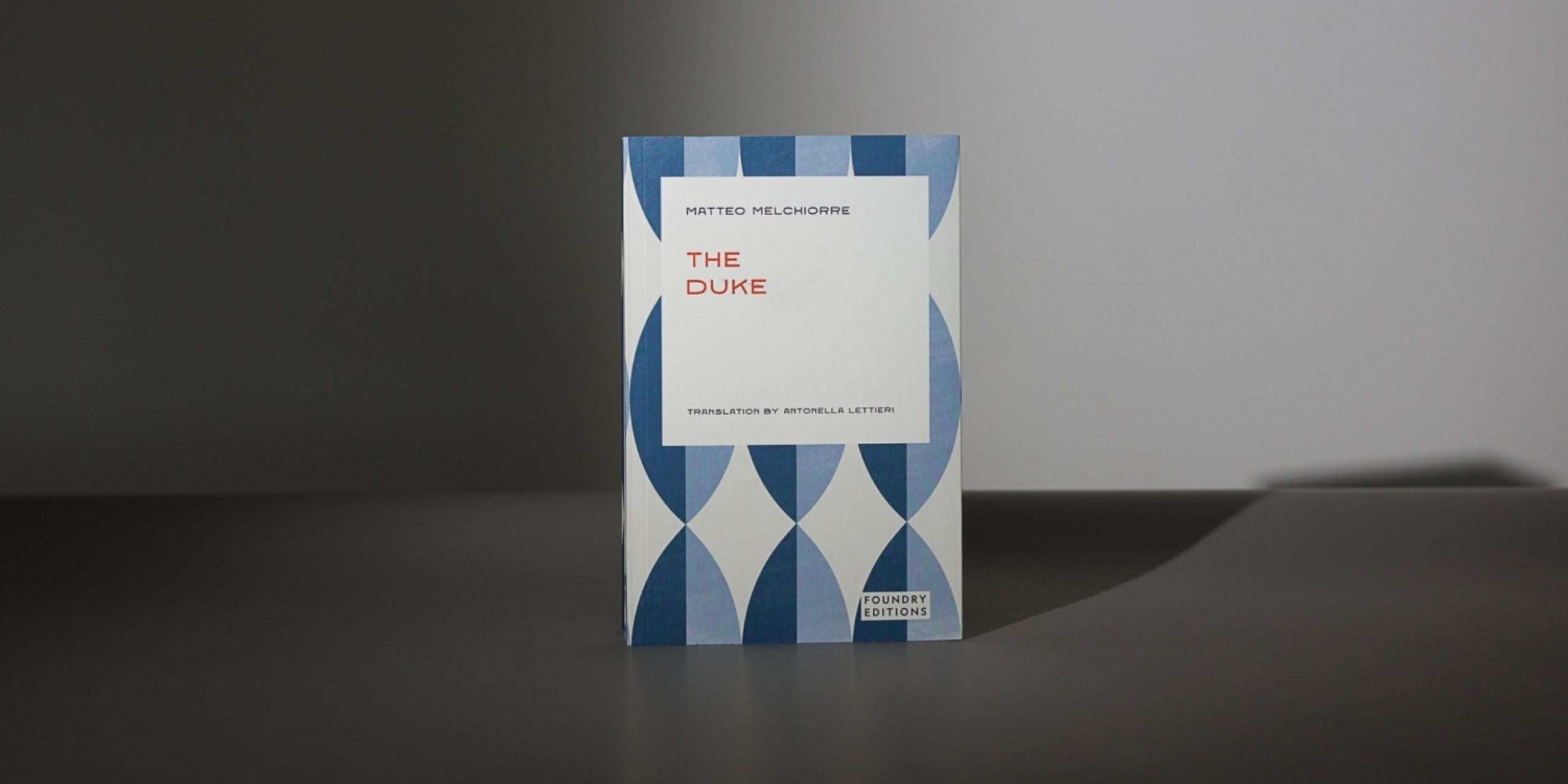
An extract from The Duke by Matteo Melchiorre, translated by Antonella Lettieri
- Published
The Duke is longlisted for the International Booker Prize 2026. Read an extract here
The Duke is a character study of both its protagonists and of life in a tiny mountain village governed by nature, presenting a new vision of Italy.
Outside Vallorgàna, a tiny, isolated village high in the foothills of the Dolomites, the ‘Duke’ lives in the villa of his aristocratic ancestors. The last of the Cimamonte family, he spends his days on his land and absorbed in his archive, tolerated, if gently ridiculed by his neighbours.
When the Duke finds out that the village big man is taking timber from his land, he has a decision to make. Will he stay in his glorious isolation, or will he honour his ancestral blood and take action against this affront?
Matteo Melchiorre creates a sweeping portrait of the idiosyncratic character of the Duke and the world of Vallorgàna. With the pace, panorama and plot twists of a 19th-century classic, the breathless story of the Duke’s ensuing feud unfolds, asking 21st-century questions about our relationships with privilege, the past, the natural world and each other.
The Duke is published in the UK by Foundry Editions. This extract is taken from the novel’s first chapter.
Buy the book
It was then that I heard a knocking on the windowpane. And there, behind the glass, stood Nelso Tabiòna. He was looking at me in silence, in keeping with his most personal principle of discretion. As a matter of fact, he deems it proper to announce himself in this manner. He arrives in the courtyard, methodically peeps through each window of the ground floor, and, when he finally sees me, stops there and waits in silence. If I notice him, fine. Otherwise, he actually raps his knuckles on the glass. Once, with all due respect, I told Nelso that this behaviour of his was perhaps a touch questionable. He took offence: according to him, it most certainly was not an impertinence but rather showed commendable consideration, a most distinguished discretion.
Nelso is not the kind of man to countenance the possibility of being wrong or to second-guess himself, his own thoughts, or his own actions, and here in Vallorgàna local wisdom has it that this is the natural inclination of a Tabiòna. Therefore, he is prone both to carrying out great feats and to telling sensational tales about said feats; and this too, in the village, is ascribed to the instinctive, hereditary character of the Tabiònas. Nelso might tell the story of how he spotted a deer, but this deer will have the grandest antlers one ever did see. He might have felled a tree, but this tree will be so enormous that no one else but he, who is the prince of woodcutters, would have ever dreamt of notching it. Nelso might have driven up the Mountain in his four-by-four with no need for chains despite the heavy snowfall. He might have manoeuvred his trailer overloaded with logs in a space where not even a wheelbarrow could turn around.
Faced with a man like this – who is, by the way, the person to whom I am closest in the village and who has on his side not only his aptitude for great feats but also such an age that, as he loves to repeat, he might be my father – faced with a man like this, as I was saying, one can only prepare oneself to listen and to admit to one’s own insignificance. This is certainly true, but at the same time one must give him demonstrations of resoluteness, decisiveness, and practicality, since a man who is not resolute, decisive, or practical is regarded by Nelso’s system of ethics as beyond shameful.
Therefore, on that day, after Nelso knocked upon the glass, I motioned to him to come inside, showing a certain imperious resolve. He pointed to his muddy boots, his woolly hat, his army jacket, the cigarette in his hand. He shook his head. “Get in!” I said. So he extinguished the cigarette on the sole of his boot, put the stub into his breast pocket, and came in.
In his eyes was a certain surliness and irritation. He was clearly expecting me to ask, all meek and fearful, whatever might be bothering him. But I chose to defy him. As soon as he sat at the table, I told him that I, and no one else but I, however unworthy I might be to stand in his presence, had just that minute seen something which he, perhaps, had not only never seen before but also never even imagined. Since this kind of provocation makes Nelso’s blood boil like nothing else in the world, he closed his eyes, shook his head, and said, “Come off it!”
I told him about the tangle of crows up in the sky, how a buzzard and a crow had come out of that jumble grappling; and then how the buzzard had hurled the crow down into the courtyard, I had thrown a handful of gravel, and the buzzard had flown away pulling the crow aloft.
Could Nelso Tabiòna let me have even the smallest of satisfactions? Of course not. He said that it was impossible: with ten crows against a single buzzard, the crows have it; and even if, by some sort of fluke, the buzzard has it for once, it is impossible for a buzzard, though it is a strong bird, to pull up a crow, which is, after all, a heavy bird, and carry it off as if it were a mouse.
But I insisted, saying to Nelso that I was certain that I had seen what I had seen, and adding my explanation: the buzzard had rightfully rebelled against the crows tyrannising our skies.
Nelso then said, surprising me, that if there is one type of bird around here which could rebel against the crows, it must be the buzzard, and he admitted also that I was not wrong when I said that the crows were tyrants, since the increase in their numbers was most evident. And this was, according to Nelso, a recent development of the last few years, one of the many consequences, of course all known to him in great detail, of the ghastly times in which we live. “Even you must have noticed,” he said, “that Vallorgàna has become one long funeral. We’re on our way out. The crows move in. That’s about the gist of it.”
He added that, in these ghastly times, we also have to deal with crows which, on top of it all, are quite different from the crows of yore. Our crows are braver, shrewder, bolder: their black eyes sparkle with the blaze of arrogant intelligence and their flitting about radiates a new malice. This is why, according to Nelso, we should do as “our grandfathers” used to do.
So I asked him what it was that our grandfathers used to do. “They’d keep well hidden with their rifles,” he said, “and then, when the moment came, they’d blast any old crow out of the sky, or they’d catch one using some traps of theirs, cages with a decoy pigeon inside.” Nelso’s account of the subject was extremely detailed. He explained that, after they had eventually killed it, these grandfathers of ours would take the crow and hang it from a noose or, more often, crucify it, wings open. Then they would raise these banners of death upon branches or poles, in the middle of the fields or amongst the vines. So, these crows were crucified like thieves and adorned with scrolls made of tinfoil which wavered in the wind, reflecting the sunlight.
When I said to him that these were intolerable atrocities, abominations, brutalities, Nelso commented that, on the one hand, they at least kept the crows away from the fields and the vines and that, on the other, to survive in a world like the world used to be, one needed to have a strong stomach or else starve.
Having pronounced this statement, Nelso looked at his watch and threw his hat onto the table. “You have me here talking rubbish,” he said, “when I have something serious to tell you instead. Let’s get to the point. You’ve been had, Duke. Up in the Mountain, in your woods. You’ve been had.”

The Duke
© India Hobson for Booker Prize Foundation
The Duke
- Translated by
- Antonella Lettieri
- Published by
- Foundry Editions
A character study of both its protagonists and of life in a tiny mountain village governed by nature, The Duke presents a new vision of Italy


