‘Shocking, understated, discomfiting, hilarious’: shortlist for Booker Prize 2026 announced
‘Shocking, understated, discomfiting, hilarious’: shortlist for Booker Prize 2026 announced
- Published
The 2026 shortlist for the Booker Prize, the world’s most significant award for a single work of fiction, is announced
The list of six novels includes:
- Past winners Marlon James and Douglas Stuart and returning shortlistee Elizabeth Strout
- Four authors from the UK
- Historical fiction from a debut novelist, a comic novel and a work of speculative fiction – all by authors shortlisted for the first time
- Books by authors whose ages span 40 years, including an 81 year-old who could go on to become the oldest winner in the prize’s history
- Characters that include a reluctant monarch, an actor paid by a psychology professor to wear a black leather bag, and a survivor set on retribution after a murderous homophobic attack
- Books from a former competitive trampolinist, a fashion designer, a lawyer and two award-winning poets
- Narratives that range from ‘the hilarious to the discomfiting, from the powerfully shocking to the intriguingly understated’, which represent ‘writing at its best’, according to Mary Beard, Chair of the 2026 judges
The shortlist of six books has been selected by the 2026 judging panel, chaired by celebrated classicist, writer and broadcaster Mary Beard. Beard is joined by award-winning poet, writer and educator Raymond Antrobus; musician, writer and broadcaster Jarvis Cocker; journalist, editor and critic Rebecca Liu; and Booker Prize-shortlisted novelist, poet and essayist Patricia Lockwood.
The prize has rewarded and celebrated world-class talent for over 55 years, shaping the canon of 20th and 21st century literature. This year’s selection, which was chosen from ‘the Booker Dozen’ of 13 titles, selected from 163 submissions, celebrates the best works of long-form fiction by writers of any nationality, written in English and published in the UK and/or Ireland between 1 October 2025 and 30 September 2026.
Spanning a range of genres – from dystopian fiction to contemporary realism, from campus satire to historical fiction – the shortlisted books explore what it means to be human in an ever-changing world and the communities and events that shape us. Both intimate and epic, personal and political, they provide meditations on familial bonds, identity, shame, love, loneliness, survival and the ultimate unknowability of others. They are moving, pacey, funny, violent, intriguing, horrifying and hopeful.
The interior lives of a rich cast of characters are vividly depicted by the shortlisted authors, from a beachcomber eking out an existence on the coast of Kent to an out-of-work actor paid to attend university lectures zipped inside a black leather bag for a psychology experiment; from a reluctant monarch in a medieval court under threat by scheming courtiers to a son returning home to his repressive father in a traditional Calvinist island community in the Outer Hebrides; from a teacher with a seemingly comfortable life in coastal Massachusetts who is harbouring a secret, to a survivor of a murderous homophobic attack in 1980s Kingston, Jamaica, set on retribution.
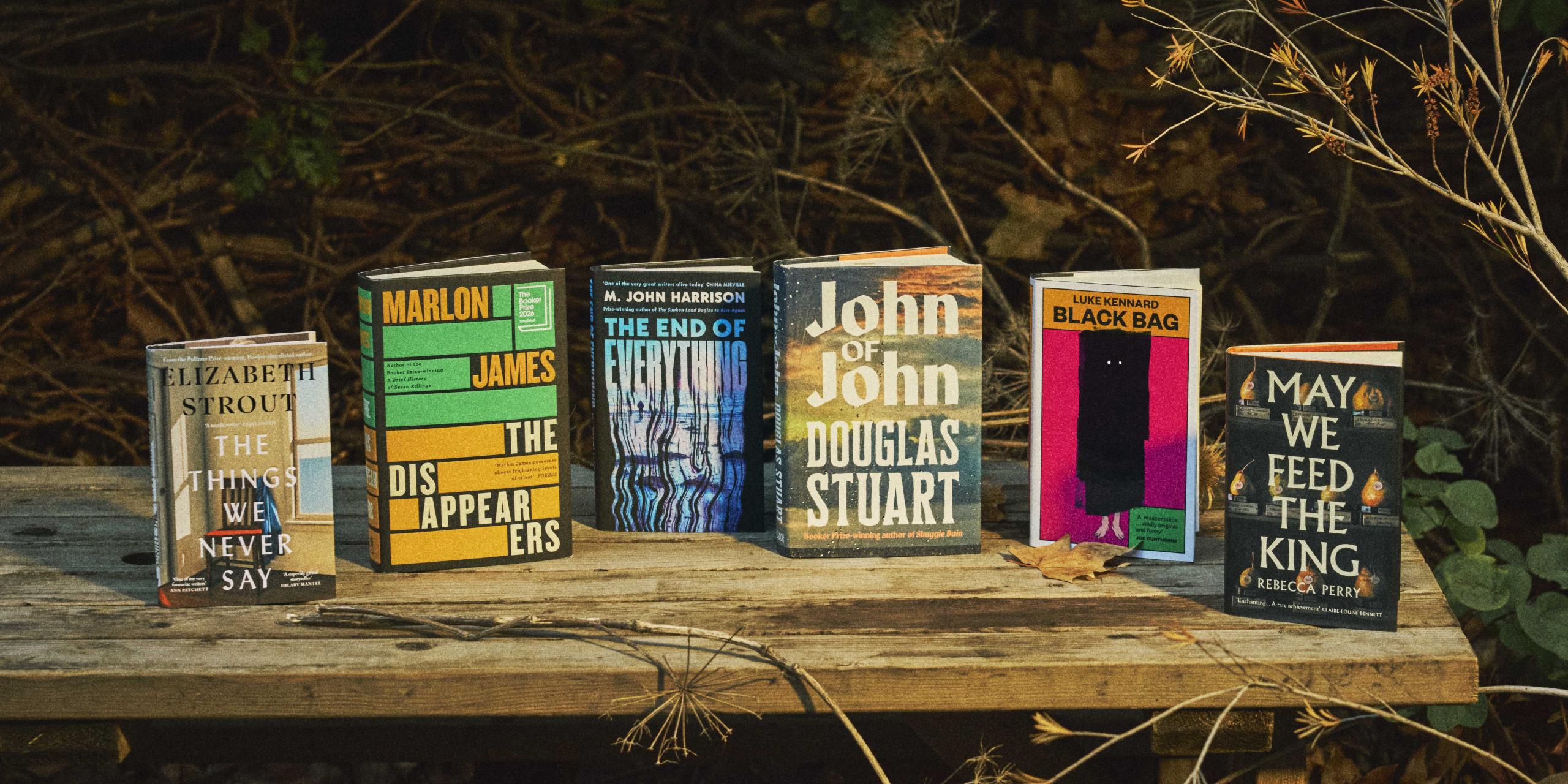
The full Booker Prize 2026 shortlist is:
The End of Everything by M. John Harrison; published by Serpent’s Tail (Profile Books)
The Disappearers by Marlon James; published by Hamish Hamilton (Penguin Random House)
Black Bag by Luke Kennard; published by John Murray (Hachette)
May We Feed the King by Rebecca Perry; published by Granta
The Things We Never Say by Elizabeth Strout; published by Viking Fiction (Penguin Random House)
John of John by Douglas Stuart; published by Picador (Pan Macmillan)

The Booker Prize 2026 shortlist
© Yuki Sugiura for Booker Prize Foundation
Mary Beard, Chair of the Booker Prize 2026 judges, comments:
‘It was a meeting none of the judges is likely to forget – getting together to whittle down the 13 extraordinary novels on the longlist to just six. It was fun. Most of these books were beginning to feel like old friends after at least two readings. And it was painful to have to let some of them go, with their now bent spines and dog-eared pages, their brilliant capacity to make us think, argue and sometimes disagree.
‘We did not start out with a checklist of the different types of book we wanted to see represented in the final six, or the kinds of authors or subject matter. But when we looked at the lineup of our shortlist, neatly propped up against one another, almost glowing, we were happy that we had showcased many of the strengths of contemporary English language fiction. These novels range from the hilarious to the discomfiting, from the frighteningly strange to the alarmingly domestic, from the powerfully shocking to the intriguingly understated. In them, we meet characters from different countries and different centuries, created by authors 40 years apart, new talent and well-known favourites.
‘This is writing at its best. There’s plenty to enjoy, some blissful escapism and prose to die for (‘I just wish I could have written that’ kept going through my mind). But there is also plenty here to change the way we see the world, to surprise us and to challenge our certainties.
‘We hope that you get as much out of the books on our shortlist as we have.’

Mary Beard, Chair of the Booker Prize 2026 judges
© Neo Gilder for Booker Prize Foundation
Gaby Wood, Chief Executive of the Booker Prize Foundation, adds:
‘I knew it would be almost impossible for the judges to reduce their phenomenal longlist to just six books, and it was. But the prize rules demand a shortlist! These six, which struck the judges strongly the first time they read them and deepened when read again, speak to each other in unexpected ways by virtue of being placed side by side.
‘Despite the great range in their styles and subjects, in all of these novels we find forms of isolation: relationships breaking down or withheld, people harbouring secrets or pain, characters closing themselves off from others or attempting to reach beyond their solitude towards them. As a collection, this shortlist asks: What can we know of each other, what do we infer or assume, what are we prepared to see?
‘Sentence by sentence, the writing in every one of them is exceptional. I would recommend this list to any reader: each book, perhaps, for a different state of mind.’

Gaby Wood, Chief Executive of the Booker Prize Foundation
© Clara Molden
Former winners, bestsellers and a critically acclaimed debut
The shortlist features authors representing four countries: England, Scotland, Jamaica and the USA. This year marks the second time in the last 10 years that more male than female authors feature on the shortlist – the other occurrence was in 2023 when there were also four men to two women. In 2018, 2019 and 2020 four out of the six shortlistees were women and in 2024 five out of the six were.
The list includes previous Booker Prize winners Marlon James (who won in 2015 with A Brief History of Seven Killings) and Douglas Stuart (who won in 2020 with his debut novel Shuggie Bain) and three-time nominee Elizabeth Strout, who was previously longlisted in 2016 for My Name is Lucy Barton and shortlisted in 2022 for Oh William!.
Bestselling and acclaimed author James is shortlisted for his fifth novel, The Disappearers, which was published in the UK this month (September 2026) and has been receiving high praise from critics, with the New York Times calling it a ‘masterpiece’ that ‘is the novel of the decade, if not the century’ and is longlisted for the National Book Award 2026. In addition to his Booker win, James is the recipient of the American Book Award, the Los Angeles Times’ Ray Bradbury Prize for Science Fiction, the Anisfield-Wolf Book Award and the Dayton Literary Peace Prize.
Stuart makes the list with his Sunday Times bestselling third novel, John of John, which was shortlisted for the Orwell Prize for Political Fiction 2026 and was a Oprah Winfrey Book Club and a Telegraph ‘Best books of 2026 so far’ pick. Like James, Stuart has received a multitude of accolades for his previous works of fiction, including winning Debut of the Year and Book of the Year at the British Book Awards and being shortlisted for the National Book Award.
If either James or Stuart were to win, they would be the fifth author to have been awarded the Booker Prize twice, joining J.M. Coetzee (1983 and 1999), Peter Carey (1988 and 2001), Hilary Mantel (2009 and 2012) and Margaret Atwood (2000 and 2019). If Stuart triumphs, he would be the second fastest returning winner after Mantel.
Pulitzer Prize-winner and New York Times bestseller Strout receives her second Booker Prize shortlisting with The Things We Never Say, her 11th novel and a departure from her hugely popular Olive Kitteridge and Lucy Barton character series. Her books have won the Premio Bancarella Prize and been finalists in National Book Critics Circle Award Finalist and the Orange / Women’s Prize for fiction and have twice been selected as an Oprah Book Club pick. The Things We Never Say has been described by The Times as ‘the first great novel about Trump’s America’ and is also included in the Telegraph’s ‘Best books of 2026 so far’ list. Writing in The Atlantic, Adam Begley says ‘Elizabeth Strout does more with less than any writer I can think of.’
The novelists on the shortlist range in age from 40 (Rebecca Perry) to 81 (M. John Harrison). If Harrison goes on to win he would become the oldest winner in the history of the prize (a title currently held by Margaret Atwood who was 79 when she jointly won in 2019 with The Testaments). If Perry wins, she would be the seventh debut novelist winner in the prize’s 57-year history, and the first since Stuart’s win in 2020.
Half of the judges’ selection features writers making their inaugural appearance on a Booker Prize shortlist, including Perry with May We Feed the King. Though new to the prize, they are critically acclaimed fiction and poetry award-winners:
- Harrison is a literary critic and the author of 13 novels, five short story collections and an ‘anti-memoir’ and is referred to by the Guardian as ‘an SF master’. His award-winning novels include Climbers, which won the Boardman Tasker Prize for Mountain Literature in 1989; Nova Swing, which won the Arthur C. Clarke Award in 2007; and The Sunken Land Begins to Rise Again, which won the 2020 Goldsmiths Prize for innovation in fiction. The End of Everything went to number eight in the Times bestseller list when it was published in June and Helen Macdonald wrote in the Observer ‘I don’t think I’ll read a better book this year’. It has been included in the Telegraph’s ‘Best books of 2026 so far’. Simon Ings writes in the Telegraph that ‘Harrison isn’t weirder than most other writers, just better’.
- Luke Kennard is the author of three novels and is an award-winning poet. In 2014 he was named one of the ‘Next Generation Poets’ by the Poetry Book Society in their once-per-decade list. He is the author of seven poetry collections, including Cain, which was shortlisted for the International Dylan Thomas Prize and described by Alan Hollinghurst as ‘the cleverest and funniest thing I’ve read this year’ and Notes on the Sonnets, which won the Forward prize for Best Poetry Collection in 2021. His debut novel, The Transition, was a BBC Radio 4 Book at Bedtime and was longlisted for the Desmond Elliott Prize. Black Bag was described by the Times as ‘a brilliant comic tour de force’ and was included in the New Statesman’s ‘The best fiction to read this year’ and the Guardian’s ‘Books to make you fall back in love with reading’ round-ups.
- London-based Rebecca Perry is an award-winning novelist and poet. Her first poetry collection, Beauty/Beauty won the Michael Murphy Memorial Prize 2017 and was shortlisted for the T.S. Eliot Prize, the Fenton Aldeburgh First Collection Prize and the Seamus Heaney Centre for Poetry Prize for First Full Collection. May We Feed the King has been awarded the 2026 Waterstones Debut Fiction Prize, with Waterstones Head of Books Bea Carvalho declaring Perry ‘an author to be seriously excited about’ and the Observer naming her in their cohort of eight ‘best debut novelists of 2026’. The Irish Times said May We Feed the King ‘marks the beginning of an eminent novel-writing career’, whilst the Guardian calls it ‘an ingenious novel that asks how much we can really know about history’. Perry is also the author of a work of creative nonfiction, On Trampolining.
The authors also have a range of experience outside of novel writing: Perry competed internationally as a world-class trampolinist; James was an advertising copywriter; Strout briefly practised law; Kennard is a Professor of Creative Writing at Birmingham University in the UK; and though this is his first nomination, Harrison judged the Booker Prize in 2022.
Several of the novels were inspired by real events or people: James based The Disappearers on a violent incident in Jamaica that was rumoured to have happened; Kennard took inspiration for Black Bag from a real social psychology experiment undertaken at Oregon State University in the 1960s; and Strout realised the character of Artie Dam after reading an obituary of a man with (almost) the same name in a decades-old newspaper clipping.
Six different imprints on the shortlist
Two independent publishers have a book each on the shortlist: Profile Books imprint Serpent’s Tail with The End of Everything and Granta with May We Feed the King. Granta has published six previous Booker shortlistees, including 2013 winner The Luminaries by Eleanor Catton, while Serpent’s Tail is shortlisted for the fourth time.
Big publishing houses represent four out of the six titles on the shortlist, led by Penguin Random House, which has two titles across two imprints: Hamish Hamilton with The Disappearers and Viking with The Things We Never Say. Picador, an imprint of Pan Macmillan, makes the list with John of John, while Hachette’s John Murray imprint does so with Black Bag.
What the judges said and the authors’ inspiration behind their shortlisted books
The End of Everything by M. John Harrison
Harrison said: ‘The art towns of the UK’s East Coast provided the setting. I love that coast, all the way round from Hastings to the Thames – even up into Suffolk. Current affairs provided the themes and the satire: what happens when all of our expectations and explanations of the world become an ongoing disaster, but we still have to make a life?’
The judges said: ‘The End of Everything can be read as a thriller, a mystery, a satire, a dystopia, a road novel, a work of realism. The landscape may be bleak, the catastrophe may be immersive, yet there still were moments we found ourselves laughing aloud’
The Disappearers by Marlon James
James said: ‘The Disappearers is based on a violent incident that was rumoured to have happened but was never proven, at least not up to the point when I began writing. But in Jamaica we trust rumours more than facts, so the fact that people kept whispering about it meant it was true. But I’m more concerned with an incident’s aftermath than the thing itself, and fiction is ideally placed to bring what might be a closed-off chapter right into the open.’
The judges said: ‘A Jamaican epic from one of the most impactful Caribbean novelists today; readers will love the shifting register of the dialogue and poetic phrasings, often pierced through with sharp, double-edged humour’.
Kennard said: ‘I came across the original 1960s black bag experiment by accident when I was researching something else. It caught my attention, but I was more interested in the person playing black bag than the results of the study. My narrator is a struggling actor, but I think it’s about trying to be an artist of any kind in the current moment, when arts and culture are so systematically undervalued, when the doubts seem to loom larger than the possibilities. It really tests your hubristic self-belief, and leaves you with a kind of all-pervading shame, which is always a good subject matter for fiction.’
The judges said: ‘In a wonderfully quirky campus novel, Kennard combines an absurd experiment with a moving story about human frailty, passion, confusion and identity. There’s something for everyone here’.
May We Feed the King by Rebecca Perry
Perry said: ‘Two characters – a woman using replica food scenes to conjure spirits in her home and a young attendant to a dying King – came to me separately, and I was writing them in two short stories. At a certain point I realised their world, in a way, was the same one and I embarked on the novel.
‘I knew I wanted to write historical fiction somewhat outside of the genre and, as the book developed, I became preoccupied by questions of memory, agency and imagination. Concurrently, horrifying global events unfolding on the orders of cruel, tyrannical men began feeding into questions the book had about power and responsibility.’
The judges said: ‘An affecting and lush jewel of a novel that moves between our present-day world to a medieval court and unsettles the idea that there’s ever one universal historical truth’.
The Things We Never Say by Elizabeth Strout
Strout said: ‘My inspiration for The Things We Never Say came from two rather odd places. The first was an old obituary I saw from decades ago. My friend in upstate New York sent me a page of them, and there was one man who had the last name Damm. The man in the obituary haunted me because he looked so entirely ordinary and pleasant. He wore big wire-framed glasses and just had an exceptionally kind look to his face.
‘The second part of the inspiration came from a brief conversation with a man I know in Maine who told me that one day he and his father were riding in a boat off the coast of Massachusetts, and they saw a man’s head in the water. They rode up to him and pulled him out and the fellow telling me the story said that a few nights later his father had called the man and taken him for a drink. From these two images sprang forth the story of Artie Dam.’
The judges said: ‘A novel that engages with the deeply divisive politics of present-day America, without itself becoming divisive. This is the kind of book we need now: a calm antidote to contemporary events’.
John of John by Douglas Stuart
Stuart said: ‘I set out to write about the bond between a father and son despite the deep silence between them. I was drawn to the Outer Hebrides because when we talk about class or sexuality or social upheaval our rural places are so often overlooked. On Harris I found a rich, inspiring culture; a culture shaped by community, with a history of crofting and weaving, in a place that is the stronghold of the Gaelic language and a very devout form of Presbyterianism. There was such richness that I couldn’t help but be inspired. It’s not that I wanted to tell this story now – although the world is as divided as it ever was, and queer people are under increasing attack – but it’s more that this is the story I had to write, and there was nothing that I could do but to write it.’
The judges said: ‘A rich and moving novel about a father and son who live on a remote Scottish island in the 1990s, where small-town secrets and buried shame reverberate to surprising, devastating and even joyous effect’.
Further reading on the Booker Prize 2026 judges
- The full judges’ comments on the shortlisted books can be viewed before the announcement here, and will be on the Booker Prizes website here
- The full shortlisted author interviews can be viewed here and will be on the Booker Prizes website here
- Get to know the Booker Prize 2026 judges
The Booker Prize Foundation is a charity partner of ethical online bookshop BookKind, where you can buy all six Booker Prize shortlisted books for £79 saving over £30. BookKind donates 10% of every order to the charity, supporting readers and writers of the future. The shortlist bundle can be purchased after the embargo lifts here.

The Booker Prize 2026 judges: Raymond Antrobus, Patricia Lockwood, Rebecca Liu, Jarvis Cocker; and Mary Beard
© Neo Gilder for Booker Prize Foundation
Forthcoming Booker Prize 2026 public events
The Booker Prize 2026 shortlist at The Times and Sunday Times Cheltenham Literature Festival: 2.30pm BST, Saturday, 10 October 2026
Gaby Wood, Chief Executive of the Booker Prize Foundation will host the Cheltenham Literature Festival’s annual introduction to the six shortlisted books and their authors, who will join the event both in-person and virtually. Tickets can be booked at cheltenhamfestivals.org
The Booker Prize 2026 shortlist readings: Southbank Centre, 7.30pm GMT, Sunday, 8 November 2026
The prize’s annual shortlist readings, which feature the nominated authors reading from and discussing their books, are returning for the 2026 prize season, chaired by award-winning novelist and former Booker Prize judge Sara Collins. The event will take place in the Southbank Centre’s Queen Elizabeth Hall, London, as part of its 75th anniversary programme. Tickets can be booked at southbankcentre.co.uk. There will be limited press tickets – please contact Premier PR to register interest.
Meet the Booker Prize 2026 winner: Newcastle, Thursday, 12 November 2026
The newly crowned winner of the Booker Prize 2026 will be appearing at an event in Newcastle for their first and only public event in the week following their win, run in partnership with New Writing North. Venue and event details to be announced.
Details of all Booker Prize events can be found here.