

Julian Barnes, winner of the 2011 Booker Prize, is known for funny, experimental works that often explore the slippery nature of memory and truth. But which of his books should you read first?
Where to start with Anita Brookner: a guide to her best books
Where to start with Anita Brookner: a guide to her best books
- Written by
- John Self
- Published
Anita Brookner was a prolific writer and a master of both comedy and tragedy. Over the course of 28 years, she wrote 24 novels. But where should you begin?
When Anita Brookner won the Booker Prize in 1984 with Hotel du Lac, the result was, according to TV presenter Melvyn Bragg – who was hosting the TV coverage of the award – ‘a great surprise’ and ‘an unexpected choice’. There was widespread criticism in the press (see below), as well as suggestions that Brookner’s win ‘caused widespread disappointment’ among booksellers. But the book’s continued success in the last 40 years has proved otherwise, and shown that chair of the judges Richard Cobb had it right when he said they wanted to choose books that would ‘appeal to the general public’.
Now, ten years after her death, Brookner is the subject of a major biography. ‘I have no private papers,’ Brookner said in an interview in 1995. ‘I shall leave no trace.’ But she leaves a legacy of 24 novels – a dizzying number. Both her friend Julian Barnes and her biographer Hermione Lee agree that Brookner would have been more highly regarded had she written fewer books – so the question remains, which ones to choose? Here is our selection of her very best.
If you want to begin at the beginning
Brookner’s first novel was an astonishingly assured performance for a debut. ‘She seemed to have arrived fully formed,’ said Hilary Mantel, ‘as if she had hatched from a marble egg.’ This may be because Brookner’s first novel was not her first book: she had by then published several works of art criticism, and knew how to communicate with the general reader. The debut, A Start in Life (1981), was published when Brookner was 52 years old (sort of: see below).
Its confidence and aplomb is there from the very first line: ‘Dr Weiss, at forty, knew that her life had been ruined by literature.’ Ruth Weiss is an academic whose journey from innocence to experience has not been the adventure she wanted. We go through her childhood, and back to the lives of her parents George and Helen, and their own disappointments. When Ruth goes to Paris – for many Brookner protagonists, a place of intellectual escape – she is torn between duty to her ailing parents and her own ambitions for work and love. ‘It would soon be her turn to be happy,’ she ruefully observes at one point.
A Start in Life fits the expectation of a Brookner novel in that it concerns a frustrated solitary figure – Brookner would mock her own stereotype by telling Julian Barnes she had written a new novel: ‘It’s about … a lonely woman’ – but what’s surprising to the newcomer is how funny it is. The first page alone contains a handful of good jokes. These are restrained jokes, certainly – ‘students wrinkled their brows as if in pain when asked to consider any writer less alienated than Camus’, goes one – but they set the pace for a book which on publication was rightly received as ‘witty’, ‘amusing’ and ‘very funny’. There are one-liners – Ruth’s mother, an actress, is described as having ‘teeth [that] were not good enough for television’ – and grotesque slapstick, as when one character ‘turned a different colour, faltered, and collapsed untidily onto the floor’. (‘Untidily’ is the perfect word.) For an art historian turned brilliant novelist, A Start in Life was a stellar start for Brookner’s second life.

A Start in Life by Anita Brookner
If you want to read a love story
Brookner, who wrote with Jamesian elegance, used dry language to conceal overheated, uncontrollable emotions. Her first four books were about women struggling between solitude and love, and her second novel Providence (1982) is a perfect love story – provided you’re not hung up on a happy ending. The heroine this time is Kitty Maule, a university lecturer who loves her job but is frustrated by everything surrounding it. ‘When I get to hell I expect to find a perpetual staff meeting in progress.’
Softening the workplace pain is her married colleague Maurice, a popular lecturer (‘charismatic shit’, another colleague has it) with whom Kitty is pursuing an affair. Kitty’s subject as a teacher – Romanticism – is a hopeless guide for her. ‘Real life seems to impose such insuperable problems.’ Kitty’s struggle to forge a future with Maurice leads to desperation: first consulting a clairvoyant, then following him – where else? – to Paris. She seems to have broken free of Brooknerian stasis: ‘My mother was a widow at 18. My father was a corpse at 21. I am wasting time. I shall waste no more.’ But fate – and her author – have a delicious surprise or two in store.
‘I am not built for leisure,’ observes Kitty, which might have come from the lips of many Brookner characters. You might think it also applies to the author herself, who produced a novel a year for more than two decades. But Brookner didn’t struggle with her books. She wrote each one in three months, according to Hermione Lee. ‘She mapped out the book in her head while walking, as though it had been “encoded in the unconscious”.’ And she knew the ending before she began, which is particularly fitting for Providence, the conclusion of which is one of Brookner’s strongest.

Providence by Anita Brookner
Buy the book
If you want to see why she won the Booker Prize
For the Booker Prize 1984, Brookner was up against a strong group: J.G. Ballard, Julian Barnes, Anita Desai, Penelope Lively and David Lodge. The fact that she won – by three votes to two over Lodge’s Small World – seemed to irk some commentators. Hotel du Lac was dismissed as a work of ‘wispy fineness’ by John Sutherland, and Germaine Greer derided it as being in ‘a tradition of very sensitive books about lonely ladies’. J.G. Ballard, apparently unaware that he was never seriously in the running, told Brookner, ‘You stole my Booker Prize’.
But reading Hotel du Lac reveals it to be not wispy or sensitive at all. It is a cool, sharp, even hard-edged book, full of angst and black comedy, that seems closer to the tradition of European modernism than much English literary fiction. It perfects many of the elements of the earlier novels: a woman on holiday, frustrated by her married lover, trying to take her life back but not knowing how. Edith Hope, a romantic novelist under the ‘more thrusting’ name of Vanessa Wilde, stays at a hotel in Switzerland to recover from a scandal we find out about only later. There she meets another traveller, Mr Neville, and Brookner builds the emotional impact of the story beautifully to great moments of detonation and revelation. Hotel du Lac is a supreme example of the art of fiction – fiction being, as Edith points out, ‘the time-honoured resource of the ill-at-ease’.
When Brookner won the Booker Prize, she became a public figure, which led to one uncomfortable experience. Before publishing her debut three years earlier, Brookner had altered her date of birth in the directory Who’s Who from 1928 to 1938. After her Booker win, an eagle-eyed observer spotted the change and informed the press. Private Eye (which referred to her winning novel as A Stroke du Luck) observed that ‘nothing, it seems, can be more rejuvenating than winning the Booker Prize’. When the story was also covered in the Times, Brookner put pen to paper. ‘Allow me to put the record straight,’ she wrote to their letters page. ‘I am 46, and have been for some years past.’

Hotel du Laq by Anita Brookner
If you want to read an epic (Brookner-style)
Time slows down in Anita Brookner novels, because life has slowed down for her characters. Lewis Percy (1989) showed that she could write about men as well as she could about women – provided they were Brooknerian men. And so Lewis Percy is: he’s a young man, the only son of a widowed mother (who lives in London, ‘a bus ride from the centre of things’) who experiences life vicariously through art and harks back to the time he lived in Paris. ‘The future was there, after all; it simply had to be filled in.’
This novel is unlike Brookner’s others in that it covers two decades in Lewis’s life, from the 1950s to the 1970s: a virtual epic, by her standards. When Lewis’s mother dies (‘It was her heart’ – of course it was!), it frees him financially, and leads him to marriage, flirtation with infidelity, and all the things of life he’s only previously read about. The action is both internal and external, and the book is full of rewarding details, from the character of Lewis’s monstrous mother-in-law, to a plot that doesn’t end until the very last line of the very last page. ‘It was all easier in books,’ Lewis thinks at one point, ‘especially books written by women.’ Well, up to a point.
As always with Brookner’s novels, Lewis Percy had a mixed reception in the press. On the anti side was Peter Kemp in the Sunday Times, who dismissed not just the book, but Brookner’s fictional project in toto: ‘They come around once a year, like genteel canvassers for some antiquated charity, say, The Distressed Gentlefolks’ Aid Association…’ Hard to imagine that this was the book described by Bevis Hillier in the Spectator as follows. ‘She rides through the thickets and scrublands of modern fiction like an empress on a palanquin … makes one almost cry out with delight … No one since Evelyn Waugh has had such an unerring bead on the mot juste.’ We know which one we agree with.

Lewis Percy by Anita Brookner
If you want to read a story of sexual desire
For the great Francophile Brookner, the greatest compliment a reader ever paid her was ‘You write French novels, don’t you?’ Her most French novel of all, as the title suggests, is Incidents in the Rue Laugier (1995). It’s also her sexiest book. The story is set in provincial Dijon and in Paris, and takes us into the minds of three characters. A young French woman, Maud, finds herself drawn to the beautiful David Tyler – no surprise, since everyone, male or female, seems to be drawn to this ‘perfect lover, the archetypal man’. Tyler treats her horribly, as he treats everyone horribly, while their English friend Edward – the classic mousy Brooknerian protagonist here, chained to familial obligation – looks on as a gooseberry.
When Tyler gets Maud pregnant – ‘You have got your appetite back, I see,’ says her mother. ‘Mind you don’t put on weight’ – and abandons her, Edward steps in and offers to marry her – and Maud makes do: ‘She supposed she must live there, with him, and call it her home.’ The ghost of Tyler continues to haunt the relationship. ‘Arrogance excites a certain respect,’ thinks Maud, ‘while modesty brings few rewards.’ It’s a chewy, satisfying story of what happens when passion is misdirected, and all cleverly contained within a framing device of Maud’s daughter reconstructing her mother’s experiences and thoughts from her notebooks, so we never quite know what’s true and what isn’t.
Brookner’s wit extended outside the texts of the novels themselves. When Incidents in the Rue Laugier was first published in paperback, the author description ended by saying that Brookner, having retired from academia, ‘now reads and writes for her own amusement’. An earlier version had read that Brookner ‘abandoned […] the University of London for the anonymity of a small flat in Chelsea and the cultivation of certain fictional characters who may one day appear in future novels’.

Incidents in the Rue Laugier by Anita Brookner
If you fancy a family story
With Latecomers (1988), Brookner expanded her range not only to men, but to every member of two intertwined families. The central characters are friends and business partners (they made their money in printing works and sentimental greetings cards) named Hartmann and Fibich, both exiles in childhood from Nazi Germany. Hartmann is ‘a voluptuary’, a sensualist who aspires to the sublime (which, we’re reminded, includes terror as well as beauty), who is ‘ruthless in dispensing with the past, since every minute of the present must be valued’. Fibich, by contrast, lives in gloom, with fear of the future and cloudy memories of hunger. ‘The analyst had been very keen on that episode.’
The joy of Latecomers is how it blends the serious business of the men’s memories, and the miracle of their survival, with full portraits of their wives and children. Hartmann’s ‘frivolous’ wife Yvette is obsessed with the perfection of her own body (when pregnant, ‘her worries were not so much for her condition as for her silhouette’). Fibich’s wife Christine recalls the death of her father, in a brilliant comic scene, as she sits by him in his final moments. ‘“Father,” she said, leaning forward in a thrill of dedication. “Father. Tell me what to do.” […] “Father. Tell me.” After an immense effort Mr Hardy turned his head in her direction. “Don’t sell Glaxo,” he said, and fell back, dead.’ And we get their children too. Latecomers is one of Brookner’s very finest novels, as dark and funny as can be.
Latecomers was one of Julian Barnes’s favourite books of Brookner’s. The two struck up a friendship after both were shortlisted in 1984. They met for lunch annually (which never lasted more than 75 minutes), sympathised with one another’s bad reviews (‘the envy of your reviewers is apparent to the meanest intelligence,’ she told him), and basked in mutual Francophilia. Brookner sent Barnes her 1992 novel Fraud: ‘You will hate this, as everyone else seems to have done – but it comes with my love, as always.’ Following her death, Barnes paid tribute to Brookner by basing the title character in his novel Elizabeth Finch on her. Brookner and Barnes were, wrote her biographer Hermione Lee, ‘just each other’s cup of tea’.

Latecomers by Anita Brookner
Buy the book
If you want to read a late masterpiece
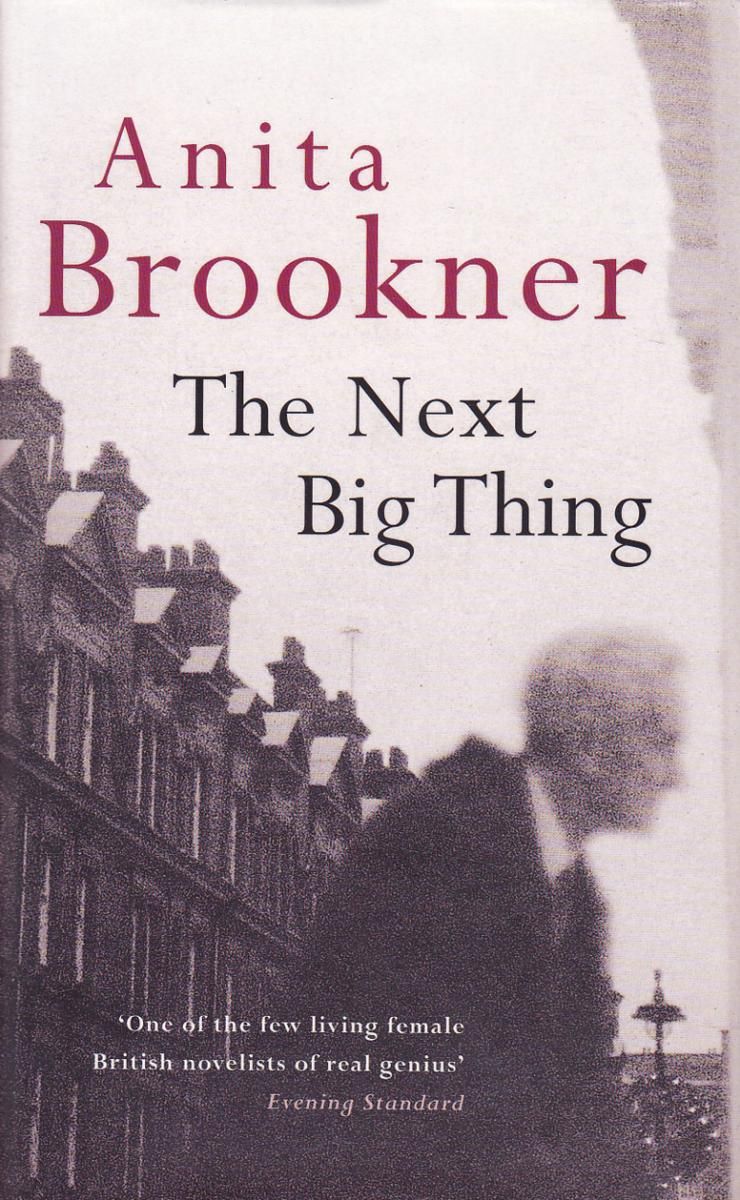
Apart from her Booker-winner Hotel du Lac, Brookner was nominated for the prize only once more: in 2002, when her novel The Next Big Thing was longlisted. The title is a typical example of Brookner’s black sense of humour: ‘the next big thing’ is death, and the one facing it is Julius Herz. Like Hartmann and Fibich in Latecomers, Herz is a Jewish emigrant in London, wondering what to do in the long years between retirement and the end. ‘So much time! How on earth was it to be filled?’ Well, there’s art: ‘surely the key to a better world,’ he thinks. Or books: he likes Thomas Mann: ‘old fashioned stuff but that was what he preferred these days’. (Surely a sly reference to how some viewed Brookner’s own books.)
But there is also love, or something like it, and Herz becomes unreasonably interested in a new young neighbour, which leads him to an embarrassing act. ‘He was paying the price for being an anomaly: an old man in love.’ But is there another option? His cousin Fanny, whom he adored as a child in Berlin, has got in touch with him again. This makes The Next Big Thing a tense story of how the past might direct an increasingly short future, and whether it’s ever too late to change your life. It also contains one of her finest endings, up against some stiff competition. Brookner always resisted the common assumption that her female protagonists were avatars of the author, but she was less guarded when talking about her male characters, acknowledging to one interviewer that Julius Herz was ‘me, really’.

The Next Big Thing by Anita Brookner
If you want to find out how it ended
Brookner’s last full-length novel, Strangers (2009), opens with just as much unmistakable Brooknerian style as her debut. ‘Sturgis had always known it was his destiny to die among strangers.’ He is retired and lonely, feeling the pinch from the absence of work. ‘If he cried out (but he would never do such a thing) no one would hear him.’ Aside from an even more elderly relative, Sturgis has only one resource: contact with strangers. ‘Fortunately there was no shortage of them: everyone was a stranger.’
Sturgis thinks he knows what his trouble is: he doesn’t have children. Brookner often expressed a similar sentiment in interviews. ‘If I were happy, married with six children, I wouldn’t be writing,’ she told the Paris Review in 1987. But Sturgis has had lovers, though one of them, Sarah, considered him too ‘good’. ‘Goodness,’ he concedes now, ‘was not an evolutionary goal.’ In Brookner’s world, just as the tortoise loses to the hare, the good do not necessarily thrive. Strangers, like other Brookner novels, is a book that casts moral questions for the reader. She disapproved of traditional romance fiction: ‘What I can’t understand is the radical inauthenticity of some women’s novels that are written to a formula: from the peatbogs of Killarney to the penthouses of Manhattan, orgasms all the way!’ To remain ‘pure’, she said, ‘a novel has to cast a moral puzzle’.
It is this purity that gives Strangers, and Brookner’s other books, a chill around the edges, even as they are filled with beautiful writing and rich storylines. She was dedicated to her vision, and pursued it to the end. In her Paris Review interview, she was asked if she would go on writing about love. ‘What else is there?’ Brookner replied. ‘The rest is mere literature!’

Strangers by Anita Brookner


Features

- Book recommendations
Eight novels to read in autumn, nominated for the Booker Prizes

- Book recommendations
Fashion in fiction: how clothes shape the story in Booker Prize novels

- Book recommendations
Eight Booker Prize-nominated books that celebrate ‘spinster lit’

- Book recommendations
The Booker Prize in the noughties: 10 novels that are well worth revisiting

- Book recommendations
Nine Booker Prize-nominated books for fans of The White Lotus

- Book recommendations
10 Booker-nominated novels that are perfect for book clubs


- Book recommendations
70 classic Booker Prize-nominated novels, recommended by our readers

- Book recommendations
