Full of backstage scandal and romantic intrigue, this darkly comic novel is about class, the long shadow of war, and unrequited first love
Where to start with Beryl Bainbridge: a guide to her best books
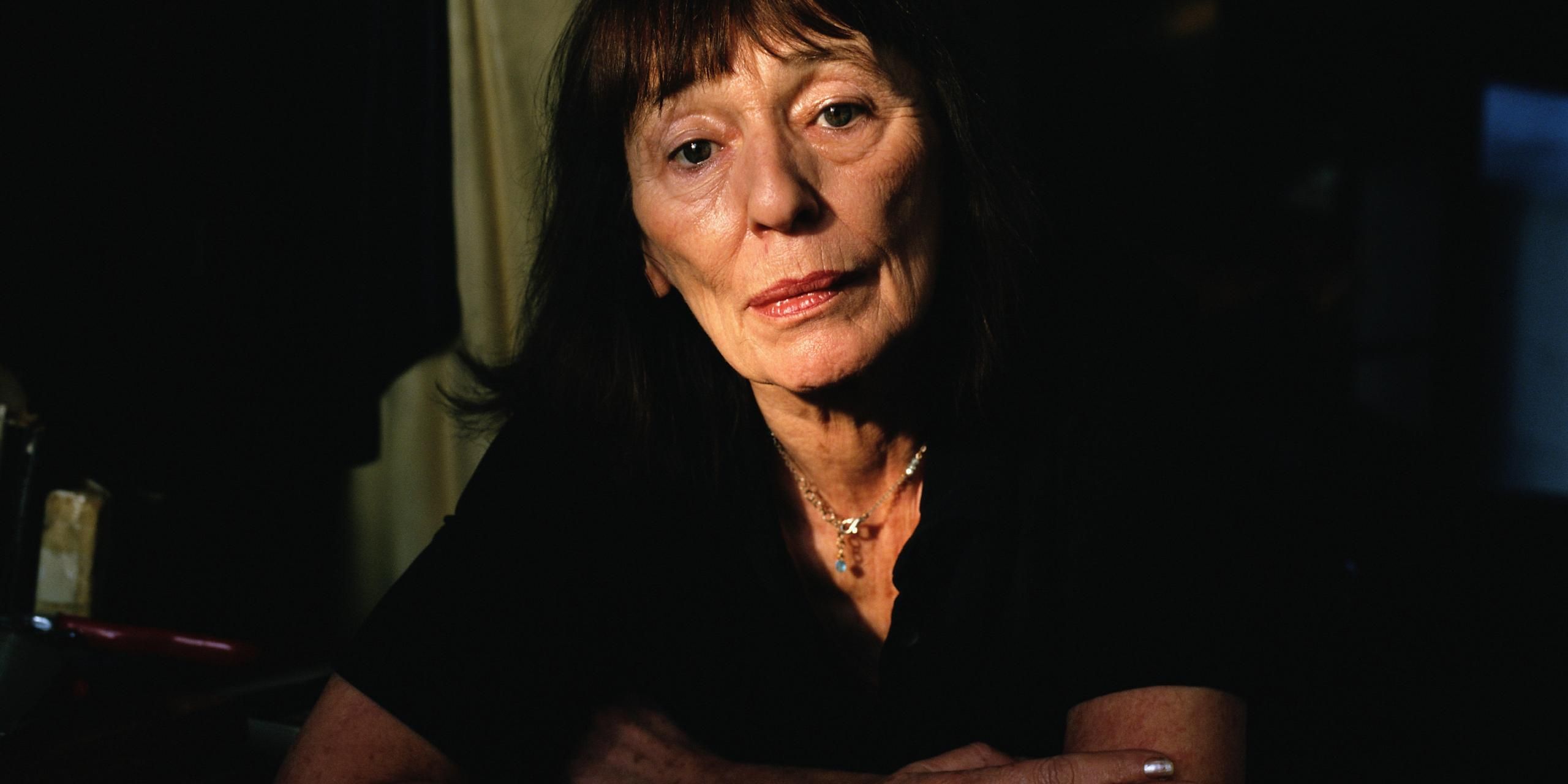
Where to start with Beryl Bainbridge: a guide to her best books
- Written by
- Lucy Scholes
- Published
Beryl Bainbridge is known for writing idiosyncratic, macabre, psychologically astute, often hilarious novels. She was shortlisted for the Booker Prize five times – but which of her many books should you read first?
Beryl Bainbridge was rarely found without a cigarette in one hand and a glass of whisky in the other, and famously declared she didn’t really see the point of eating since it blunted the effects of alcohol. Fellow Booker-nominated Liverpudlian Linda Grant first encountered Bainbridge in the flesh on a day organised for library members to meet authors in Essex in 2002. At the lunch for which, Grant later recalled, ‘Beryl ate a few salad leaves and drank a third of a bottle of Scotch, which did not appear to impair her in any way.’ Grant knew, without a doubt, that she was ‘in the presence of greatness’.
Born in Liverpool in 1932, Bainbridge returned again and again to the landscape, emotions, people and experiences of her childhood, though not in an obviously autobiographical vein. Instead, she mixed fact and fiction to potent effect, never losing sight of the importance of telling a good story.
She spent most of her adult life in Camden Town in London, in a house crammed with Victoriana – piles of religious iconography, a life-sized mannequin of Neville Chamberlain, and plenty of taxidermy, including a stuffed water buffalo she named Eric. This only added to her reputation as an eccentric, but as her friend Paul Bailey told the Guardian after her death in 2010, at the age of 77, she was someone who simply ‘refused to believe that life is ordinary, and her books reflected that belief’.

Beryl Bainbridge at home in Camden Town, London,1998
© David Levenson / Getty Images
If you read just one of her books – An Awfully Big Adventure (1989)
Published in 1989, An Awfully Big Adventure is one of Bainbridge’s best known and beloved novels. Her friend and fellow writer A.N. Wilson – a Booker judge in 1996 – called it her ‘masterpiece’, and he isn’t the only one to feel this way. Set against the grimy, grey backdrop of 1950s Liverpool, it’s about the secrets, sex and violence that lurk behind the scenes of a repertory theatre’s production of Peter Pan, as seen through the eyes of teenage Stella Bradshaw, an ingénue with a cold hard streak of naked ambition.
The book is bitingly funny in one scene, despairingly tragic the next, and Bainbridge’s thespians are a deliciously rum lot, their antics peppering what’s also a moving coming-of-age story. As Yiyun Li astutely observes, a ‘recurrent subject’ for Bainbridge ‘is how much fuller and more intensely children live in the world created in their own minds. Children in Bainbridge-land, having not learned to mask or moderate, and seeing through the façade put up by adults with their indifference, cowardice, neediness, and cynicism, live with a higher, purer, and more irrefutable passion.’ Li has written the foreword to new editions of the novel just published in both the UK (Daunt Books) and the US (McNally Editions).
As is the case with many of her novels – particularly those written in the first half of her career, from the late 60s through the late 80s – much of the detail herein is drawn from Bainbridge’s own life. In this instance, her own youthful experiences as an actor. Like her fictional alter ego Stella, Bainbridge joined the Liverpool rep when she was only 16, and to date, is the only Booker nominated author to have appeared on Coronation Street!
The novel was also adapted into a rather wonderful 1995 film starring, amongst others, Alan Rickman and Hugh Grant (the director, Mike Newell, having clocked the latter’s talent for playing rogues decades before the rest of the industry caught on), which might help account for its popularity.

The new McNally Editions cover for An Awfully Big Adventure by Beryl Bainbridge
If you want to see where it all began – Filthy Lucre (1986)
Despite her early experiences on the stage, writing was always where Bainbridge’s true creativity lay. In an interview with the Paris Review published when she was 68, she said that she’d known that she’d wanted to be a writer since she was eight years old, and indeed, she wrote her first novel, Filthy Lucre, not three years later, when she was only 11. From the foggy streets of Victorian London to the plantations of Virginia, it’s a tale of lost inheritances, the Chinese Opium Wars, and adventures on the high seas. Think Oliver Twist-meets-Treasure Island, to name two references from Bainbridge’s childhood bookshelves.
Published in 1986, four decades after it was written, it appeared as something of a novelty, offering up an endearing portrait of a now established writer as a young girl. But as the Sunday Telegraph’s critic pointed out, ‘If this novel is to set a fashion for authors to rummage in their trunks for early works, they had better beware: Beryl Bainbridge has set a very high standard.’ Adding to its charms are the black and white drawings that the author produced to illustrate the text. Also a talented artist, Bainbridge painted and drew throughout her life, preferring to produce images that told some kind of narrative. ‘I like making things,’ she told Michael Parkinson when he interviewed her on Desert Island Discs in 1986 – novels, pictures, models, stories. As a rule, after she’d finished writing each of her novels, she’d paint a picture from it.

Collected Stories by Beryl Bainbridge, including the novella Filthy Lucre and the short story ‘Mum and Mr Armitage’
If dark comedy is your thing – The Bottle Factory Outing (1974)
As her novels demonstrate, Bainbridge had an impish, gimlet eye for comic detail, and she treated her characters ruthlessly – as, indeed, so often does real life. The Bottle Factory Outing (1974) is one of the best examples of her talent for black comedy (a new edition of which is also published this month by Daunt Books in the UK, with a foreword by A. K. Blakemore).
A novel about a work day out gone hilariously, tragically awry, it was described by Graham Greene as ‘outrageously funny and horrifying’. Again, it was based in part on her own life: the part-time job she had in 1970, putting labels on the bottles in an Italian wine factory just round the corner from her house in Camden Town. She was a young single mother at the time, had published her first two novels, but they hadn’t made her enough money to live off. Free drink was par for the course, and as she later told the New York Times, the factory was so cold that everybody ‘guzzled’ as much as they could, herself included: so much so that she had to be ‘wheeled home every afternoon on a trolley’. Needless to say, the job was short-lived, but her taste for booze remained.

The Bottle Factory Outing by Beryl Bainbridge
If you like thrillers – Harriet Said (1972)
Although published as her third novel, Harriet Said… (1972) is technically Bainbridge’s debut, written back in 1961. She sent it to various publishers at the time, but it was roundly rejected. ‘What repulsive little creatures you have made the central characters, repulsive beyond belief!’ she later recalled one telling her. These ‘repulsive creatures’ are two Merseyside schoolgirls, whom, we know from the opening page, have been involved in something terrible. What exactly happened, and whether they’re the victims or the perpetrators, are the questions the novel then sets out to answer.
The germ of the idea for this shocking tale of adolescent transgression originated in newspaper reports Bainbridge had read about New Zealand’s real-life Parker-Hulme case (which also inspired Peter Jackson’s film Heavenly Creatures, starring Kate Winslet and Melanie Lynskey). ‘Pinching’ good plots from news stories was something she admitted to doing often. She’d then fill in the rest from her own life, basing her characters on people she knew, or drawing on her own experiences when it came to more minor events in the story.
Her own childhood was of endless fascination to her. ‘All I ever wanted to do was to make sense of what had happened to me,’ she expounded during her Desert Island Discs appearance, explaining that she used her fiction to ‘exorcise’ the ‘dark strains’ of her early years – in particular the turbulent relationship between her parents, between whom she often acted as a referee. This marks her writing out as different to that of many of her peers during this era. As she told the Paris Review: ‘When I started writing in the 1960s, wasn’t it the time when women were beginning to write about girls having abortions and single mothers living in Hampstead and having a dreadful time? Well, I thought, I’m not going to do that; I’m not bothering with all that rubbish.’

Harriet Said… by Beryl Bainbridge
If you like true crime – Watson’s Apology (1984)
Not that Bainbridge’s characters aren’t having a dreadful time! Quite a lot of them are, quite a lot of the time. Death abounds in her fiction, and not the quiet, sanitised, end-of-a-long-life-well-lived kind either. Instead, people are dispatched suddenly and violently – children too (which is still quite the taboo) – but the closest she comes to writing an actual murder mystery is Watson’s Apology (1984), which is perfect for fans of Kate Summerscale’s narrative non-fiction.
Bainbridge takes a real-life murder – perpetrated in 1872 by a Rev. John Selby Watson, an Anglican clergyman in Stockwell, who came home from church one Sunday morning and, seemingly without warning, bludgeoned his wife to death before attempting suicide himself two days later – and fictionalises the circumstances that lead up to the lurid incident. She thus transforms a sordid, suburban-set tale into a gripping portrait of a malignant marriage with its petty failures and flaws. Anita Brookner declared the novel a ‘remarkable’ achievement, comparing it to the works of George Gissing, and given its ambition and accomplishment, it’s often unfairly overlooked when people talk about Bainbridge’s best writing.

Watson’s Apology by Beryl Bainbridge
If you want something topical – Young Adolf (1978)
What if, in 1912, a young Adolf Hitler, then in his early 20s, went to stay with his half-brother and his wife who were living in Liverpool? This is the premise of Young Adolf (1978), Bainbridge’s first foray into the realm of historical fiction.
Bainbridge’s Adolf is a good-for-nothing layabout, a failed art student without a job – and no interest in getting one – who is paranoid about being pursued for evading military service back in Austria. He’s prone to tantrums and tempers, and likes to rant about the contamination of Europe by impure blood lines. In the context of the book, everything that comes out of the pipsqueak’s mouth deserves laughter, but the weight of history sends a shiver down the reader’s spine.
Thoroughly traumatised by his time in Liverpool, Adolf heads home nursing grudges and plotting revenge. Nevertheless, the plot resembles that of a screwball comedy. As the Observer rightly surmised, only Bainbridge could have the chutzpah to merge ‘high farce’ and ‘prophetic ironies’, not to mention the talent to pull it off.

Young Adolf by Beryl Bainbridge
If you like historical fiction – The Birthday Boys (1991), Every Man for Himself (1996), According to Queeney (2001)
Having cut her teeth with Young Adolf and Watson’s Apology, at the beginning of the 1990s, Bainbridge threw her lot in with historical fiction. The Birthday Boys (1991) took as its subject Captain Robert Scott’s ill-fated 1910-13 expedition to Antarctica; while Every Man for Himself (1996) dealt with the sinking of the Titanic.
Most consummate of them all though is her penultimate novel, According to Queeney (2001), about Samuel Johnson’s relationship with Hester Thrale, as observed by Thrale’s daughter Queeney, while the famous man of letters is staying with her family at their country house, and recuperating from a mental breakdown.

According to Queeney by Beryl Bainbridge
If you want to read the one that should have won the Booker – Master Georgie (1998)
Speaking after Bainbridge’s death, Ion Trewin told the Guardian that she was ‘the greatest novelist of her generation who didn’t win the Man Booker Prize, and quite undeservedly so’. This might seem like quite a statement for the then literary director of the Booker to make, but Bainbridge had been shortlisted five times and never triumphed. In order to remedy this, in 2011 the Booker Prize Foundation organised a special ‘Best of Beryl’ prize in which they asked the public to vote for their favourite of her Booker-nominated works, finally elevating Bainbridge from ‘Booker bridesmaid’ to bride.
The winner was Master Georgie (1998), which recounts the adventures of George Hardy, a surgeon and photographer. The first half of the novel unfolds in 19th-century Liverpool, and treats us to our hero’s back story – including how Myrtle, a young servant girl who works for George’s family, becomes much more to him than hired help; and how she and he make the acquaintance of one Pompey Jones, another central character in the story. In the book’s second half, George (and his extended family) decamps to Constantinople, hoping to put his surgeon’s skills to good use in the Crimean War.
Characteristically, Bainbridge doesn’t shy away from the horrors of the battlefield, both physical and psychological, and by the end, it’s a sobering portrait of the grim realities of war. Interesting though, despite the period context, at its core this is a novel about one peculiar family and their own peculiar domestic set-up, and in that it perhaps has more in common with its author’s early novels, such as The Dressmaker (1973) and A Quiet Life (1976), than her then more recent historically-set offerings.

Master Georgie by Beryl Bainbridge
If you only have time for something short – Mum and Mr Armitage (1985)
‘I love narrative bumps and shocks,’ Bainbridge told the New York Times in 1981. ‘Nowadays, unless a writer is superb, I don’t think it’s enough just to go waffling on.’ Indeed, her own novels are fabulously succinct, rarely exceeding 150 pages; the result of diligent honing and paring back. She preferred to write by night, often producing as many as 12 pages in a sitting, but then she’d ruthlessly strip them back, which could mean throwing out as many as 11 of those pages, then revising the remaining lines up to 14 times. Find her at her most compressed in her short story collection Mum and Mr Armitage (1985), in which I recommend the titular tale in particular; that of two jokesters meeting their match in an elderly spinster who ‘expected to be left out of things’. It’s Bainbridge at her cruel, comic, concise best.
Collected Stories by Beryl Bainbridge, including the novella Filthy Lucre and the short story ‘Mum and Mr Armitage’
If this has piqued your interest in the woman behind the writing – Something Happened Yesterday (1993)
‘What is more peculiar, more riveting, devious and horrific than real life?’ Bainbridge once asked. From her relationship, age 15, with a German POW, to the time her mother-in-law tried to shoot her (with a real gun – Bainbridge proudly left the bullet holes as evidence in the hallway of her home), her life really was as bizarre as anything she described in her novels, and vice versa.
So, for a taste of Bainbridge’s reality without a fictional veneer, read Something Happened Yesterday (1993), a collection of short, personal essay-style columns originally published in the Evening Standard (again, with added illustrations by the author). Full of self-deprecating wit and entertaining anecdote, they were aptly described by one critic as being ‘as salty and addictive as a bag of crisps’ – one of the few foodstuffs one can imagine Bainbridge herself actually consuming; a good pairing with the whisky and fags.

Something Happened Yesterday by Beryl Bainbridge




Features
- Reading guides
Reading guide: An Awfully Big Adventure by Beryl Bainbridge

- Book recommendations
Eight Booker Prize-nominated books for fans of Downton Abbey


- Book recommendations
Booker Prize books that have been adapted for film and television

- Book recommendations
Nine Booker-nominated novels to take on a road trip

- Book recommendations
11 Booker-nominated books based on real-world events

- Book recommendations
The Booker Prize in the 1990s: 10 novels that are well worth revisiting

- Book recommendations