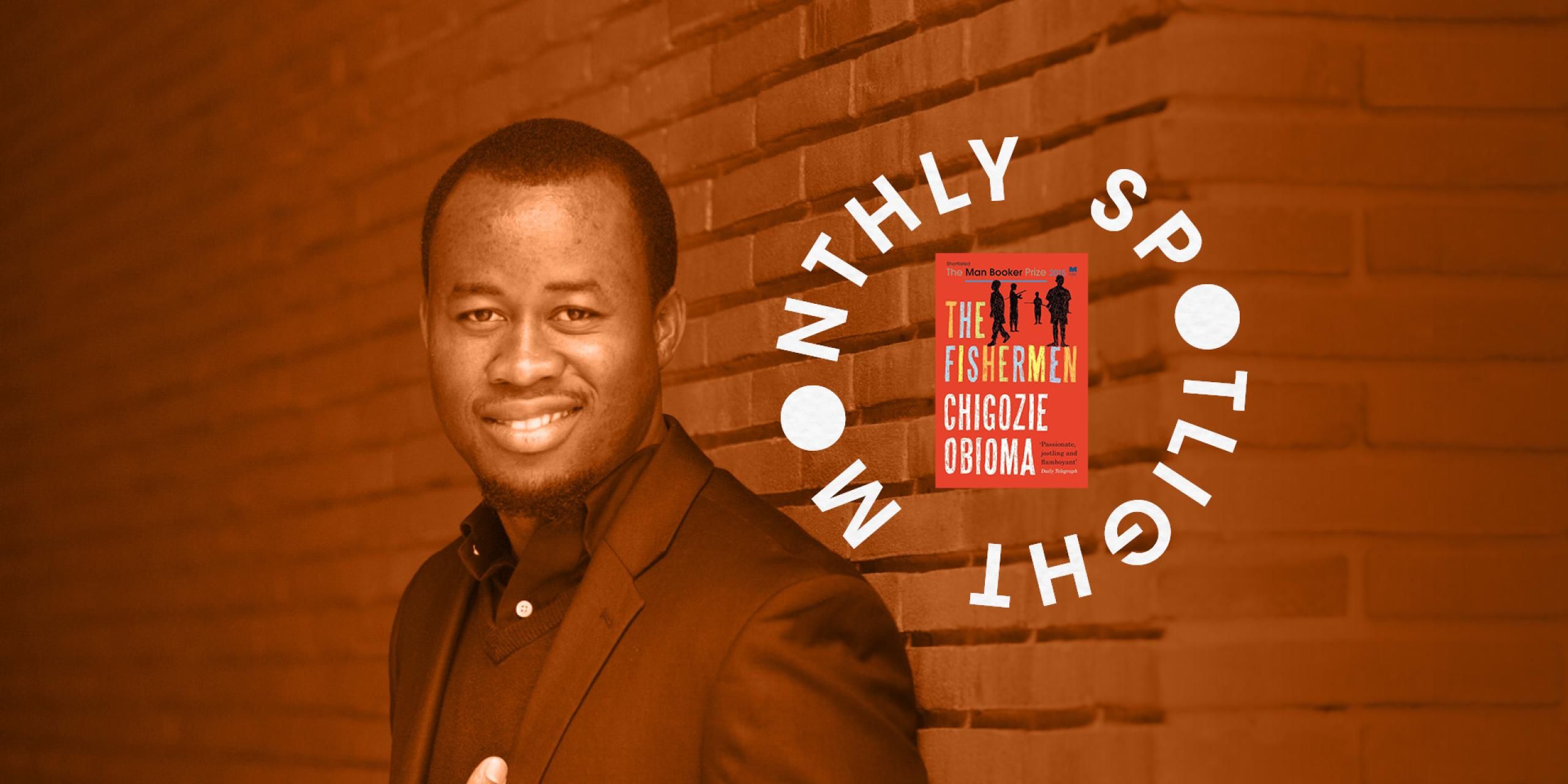
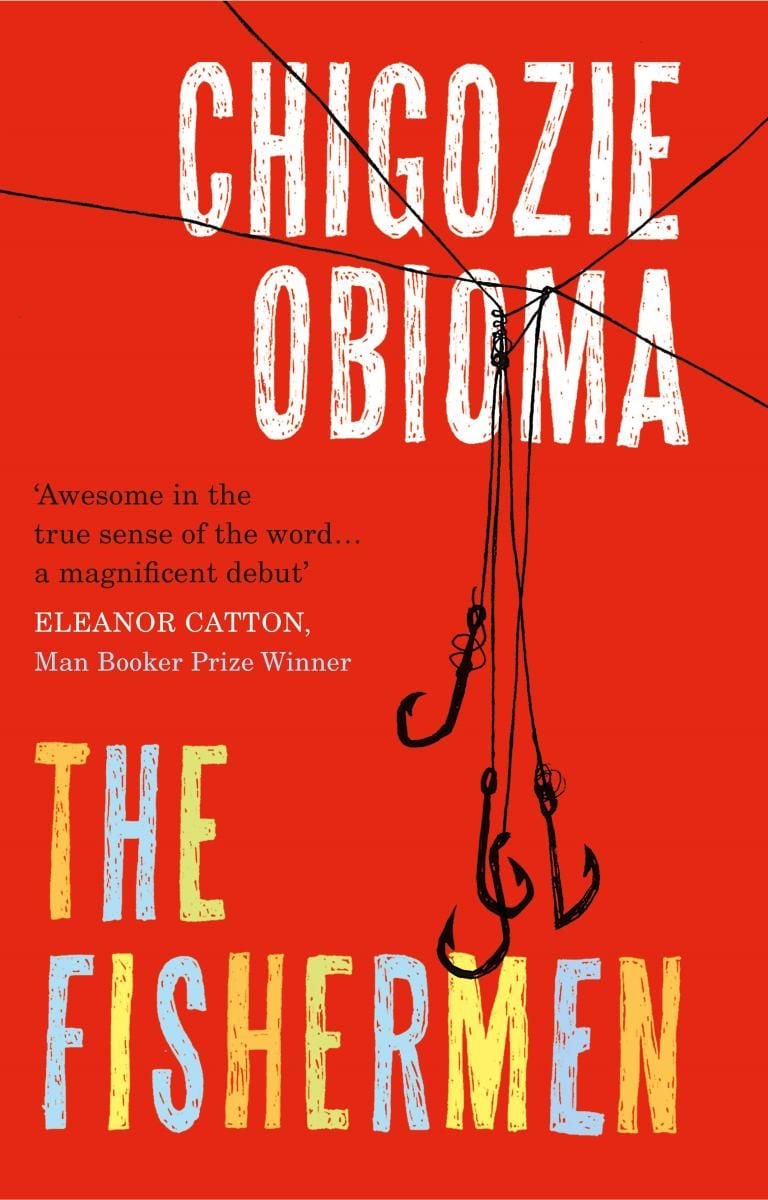

In a small town in 1990s Nigeria, four brothers’ lives are unravelled by a devastating prophecy
- Published
The author of The Fishermen – shortlisted for the Booker Prize in 2015 – on his inspirations and influences, his strong bond with the characters he creates, and how being a Booker judge made him a faster reader
Buy the book
It’s 10 years since The Fishermen was shortlisted for the Booker Prize. How did that nomination feel back then, and what impact do you think it’s had on your writing career?
Well, I got the news of the longlist almost six hours after it was announced because I was on a plane from the USA back to Nigeria. By the time the plane landed, my phone and emails had exploded. A month or so later, when the shortlist came out, my life changed even more. I believe the book had sold about a dozen translation rights over several months prior to that announcement. But by Friday of that week, we had doubled those rights deals. The nomination gave insistent life to the book – a life that continues to breathe into everything I have written ever since.
You’ve since been a Booker Prize judge yourself. Did that experience affect how you feel about your own nominations (Obioma’s novel An Orchestra of Minorities was also shortlisted for the prize, in 2019), or the Booker Prize itself in any way?
I believe that judging the prize was in many ways more rewarding than my own nominations – at least in giving me perspective and educating me on the work my contemporaries are doing. Reading all those books and seeing how difficult it is to get on the longlist, let alone on the shortlist, gave me renewed appreciation for whatever had happened to me in the past. The process also helped me become a faster reader; I was a much slower reader before that.
Do you feel distant from the characters in The Fishermen now or do they still feel familiar or close? How have your feelings about Ikenna, Boja, Obembe and Ben changed over the intervening decade?
Ha, I think that those characters often are blown far away from me by the wind of life. But somehow, they’ve never gone too far away. All the main characters – Ikenna, Benjamin, Obembe, Boja, Chinonso, Ndali, Kunle, Agnes, etc – lurk within me. I find myself filtering some conversations through their lens, speaking words that I feel may have come from their minds. This is why I call my characters ‘imaginative ghosts’. And sometimes, they insinuate themselves into my life in curious ways. Take for instance, my son’s name: Ikenna. I cannot stress enough that it was not my intention to name him after a character in The Fishermen, nor was it his mother’s. We had agreed that he would take an Igbo name, but couldn’t settle on one. So, I wrote down about two dozen names and vowed to name him the one that was first picked. Guess what that name was!
The bond between the four brothers is at the heart of the book. For our narrator, Ben, his older brothers are a shelter and an anchor. What drew you to explore sibling relationships – the intensity, the hierarchy and the unravelling – and to tell the story from the younger of the four brother’s perspective?
The novel was a product of two converging happenstances: the first was the result of an epiphany I had in which, upon departing from home for university, I realised that I had a stronger bond with my siblings than I ever imagined and a curiosity as to what could fracture that bond. The second was that I had developed an injured mind thinking about the genetic makeup of Nigeria as a nation-state, or, rather, a ‘state-nation’.
The two ideas flowed together, and I just envisioned this close-knit unit of brothers trying to exist in a world that was sharpening its many knives around them. I ultimately decided upon that narrative conceit because I wanted him to attempt to navigate the world and circumstances beyond his understanding by associating them to things he understood or was fascinated by: in this case, animals.
The ‘madman’ Abulu is held responsible for the family’s woe. Where did the idea for him come from and how did you develop him as a character?
I was looking for a catalyst for the dissolution of the brotherly bond and, for the longest time, I played with many ideas until I recalled a time many years ago when a ‘prophet’ visited my primary school. This was a character that came to me almost in its fullness. I just knew what he would look like. The most difficult part of creating him was giving him convincing speech – what would a ‘madman’ say when, and if, others engaged him? So, in the end I made his speech mostly oracular, strange, and concise.
All the main characters lurk within me. I find myself filtering some conversations through their lens, speaking words that I feel may have come from their minds
Chigozie Obioma
What most inspired you to write The Fishermen?
The main inspiration was a phone call from my dad in 2009 in which he spoke about the increasing closeness of my oldest brothers who, like Ikenna and Boja, were very close in age. I had been reading about Nigeria and writing this long-winded treatise on the foundational struggles of the country as a viable nation-state. After that phone call, I almost instantly had this image of the Agwu family as the family that would afford me the binary story I wanted to tell: one which follows the family and its unravelling at a personal story level, and the other which constructs it as a metaphor for Nigeria in which Abulu appears as the intrusive, colonial force that disrupts the equation of things.
Things Fall Apart by Chinua Achebe and ‘The Second Coming’ by William Butler Yeats are both referenced in the book. Could you explain their influence on you?
Every work of fiction ever written borrows from something that precedes it – it’s the spiritual question of evolution in previous species that lend their DNA and attributes to the succeeding ones who then, hopefully, improve on that which was before. Achebe’s book speaks to the unravelling of a civilisation because of the intrusion of an outside force – herein the Imperial colonial force from Great Britain. Yeats’s famous poem is prophetic in that its stark prediction of this thing that is ‘slouching towards Bethlehem to be born’ comes from a ‘revelation’, much like Abulu’s prophecy decided the fate of these brothers. The character of Abulu can be said to be born from this tension of revelation and occurrence: he is that force that arrives at the shore of a quiet house and tells its people, this is how your lives will be now.
The book has distinctive chapter titles and opening phrases, following a rhythmic, repeating formula. How did you come up with this framing device?
The device is supposed to mirror the mind of a child-narrator, Ben, who has to try to navigate complex questions of life and existence, such as his father leaving home for long stretches of time; his mother often struggling to manage the home; and his older brothers developing ‘strange’ emotions, like bitterness, suspicion, and even hatred towards each other.
To help him navigate these complexities, Ben has to associate difficult situations with things he already knows or is obsessed with. He has always been fascinated with the images and entries about animals in the Encyclopaedia Brittanica his family owns, so his references are drawn from that. If he knows, for instance, that eagles leave their nests to hunt for food in distant places, then he can better understand why his father does this by associating his father’s frequent travel for work to the travels of an eagle. Hence, the designation of his father as an eagle.
If you had to sum up The Fishermen in a single sentence, what would it be?
That the wrong footsteps of one man can create a stampede – that is, destroy an entire world and society.
What kinds of responses have you had from readers of The Fishermen? Have any reactions been especially pleasing or surprising?
I have to be honest and say that the novel, despite being sometimes an uncomfortable read, has a genuinely dedicated mass of fans. It’s a thing of boundless gratitude for me. I still hear, to this day, comments from people saying how much they love the book. What often surprises me though is the question they always ask me: Chigozie, is it the prophecy of Abulu that upends the Agwu family or is it simply adolescent madness? I always imagine that they already know my answer: I don’t know.

Chigozie Obioma
© Zach Mueller
The novel, despite being sometimes an uncomfortable read, has a genuinely dedicated mass of fans. It’s a thing of boundless gratitude for me
Chigozie Obioma
You’ve said that the novel is ‘a tribute to my many brothers’ – what did they think of the book?
It’s more like a tribute to my siblings, though there are more boys than girls in the family. There are obviously individual feelings, but mostly, my siblings are perplexed by the book. Some of them can see themselves in the characters of the brothers, but often those depictions are either exaggerated or highly undermined by the fictional. One exception is that, Benjamin, my second youngest brother, believes he is the Benjamin in the novel. It was he who inadvertently gave me the structure for the book. I had written it in a different way when, in 2010, I was falling asleep and I suddenly heard my brother Benjamin describing how some new neighbours had children who could run like ‘hares’ and a school spilling out like ‘ants’. I knew at once that I had found the structure I had been looking for.
You’ve also said that it is ‘a wake-up call to a dwindling nation – Nigeria’ – could you expand on this and where you think the novel sits now, culturally and politically, ten years on?
That verb was chosen at the time because I wanted an expansive verb that could say so much and yet feel somewhat opaque. In 2013 when I finished writing the novel, Nigeria was dwindling in its prospects as a nation; in the hopes that its citizenry had that it could become that great African nation; and in its treatment of its most vulnerable class. Sadly, it has continued to ‘dwindle’, even though I do recognise some improvements in, say, the electoral politics. In Nigeria these days, an incumbent president can lose an election and concede and vacate power. A candidate of the ruling power with extraordinary influence on the state he governed as governor twice, and which is largely peopled by people of his ethnic stock, could lose in his home state. These are miracles of political stabilisation. However, economically, Nigeria’s ‘dwindling’ has not been more critical; it’s disastrous.
The Fishermen is about childhood, among other things. What was the book you loved most as a child and why?
The book I loved most must have been Amos Tutuola’s The Palm-Wine Drinkard because of where it occupied in my consciousness and how it shaped my aesthetics. It is a truly strange book, but an unforgettable one as well.
Where and when do you most like to read and write, and what tools do you need?
In general, I like to write very early in the morning. Nowadays, I write early in the sunroom attached to the side of my house in Athens, Georgia. I watch the sun in its rising, and that does something to my mind. I mostly need a stack of long papers and ballpoint pens, 10-point impression. I am not sure why I need to have that specific pen, but this is what I am most comfortable with. I don’t use the laptop until I need to type out what I have written.
What books are you enjoying reading at the moment?
I am enjoying a non-fiction book called Undaunted Joy by Shemaiah Gonzalez – it’s an astonishing book about experiencing and finding joy in everyday things. I have also recently really enjoyed Audition by Katie Kitamura, which is on this year’s Booker Prize shortlist.
Do you have a favourite book in the Booker Library, and, if so, what do you love about it?
I am split between Arundhati Roy’s The God of Small Things and Kazuo Ishiguro’s The Remains of the Day. These are both wonderful novels. What I love about The Remains of the Day is that it deploys the use of an expansive irony, whereas irony as a literary device has almost entirely vanished from the modern novel. Yet, Ishiguro expands it. Like classical drama, we are light years ahead of the Butler who cannot see the miserable state of his situation. But we can. This is what crushes the reader in the end. It is a novel of raw, deceptive simplicity.


The Fishermen
- Published by
- Pushkin ONE
Chigozie Obioma combines classic African storytelling with contemporary fiction in this haunting fable suffused with supernatural power
Features

- Book recommendations
10 Booker Prize-nominated books featuring complicated sibling relationships


- Book recommendations
Booker Prize authors on the childhood books that made them fall in love with fiction

- Book extract
An extract from The Fishermen by Chigozie Obioma
- Competition
Win a copy of The Fishermen by Chigozie Obioma
- Reading guides
Reading guide: The Fishermen by Chigozie Obioma

- Book recommendations
11 Booker-nominated books that reimagine classic works and ancient texts

- Book recommendations
70 classic Booker Prize-nominated novels, recommended by our readers

- Long read
- First person
- Video