Glory
by NoViolet Bulawayo
In a small town in 1990s Nigeria, four brothers’ lives are unravelled by a devastating prophecy
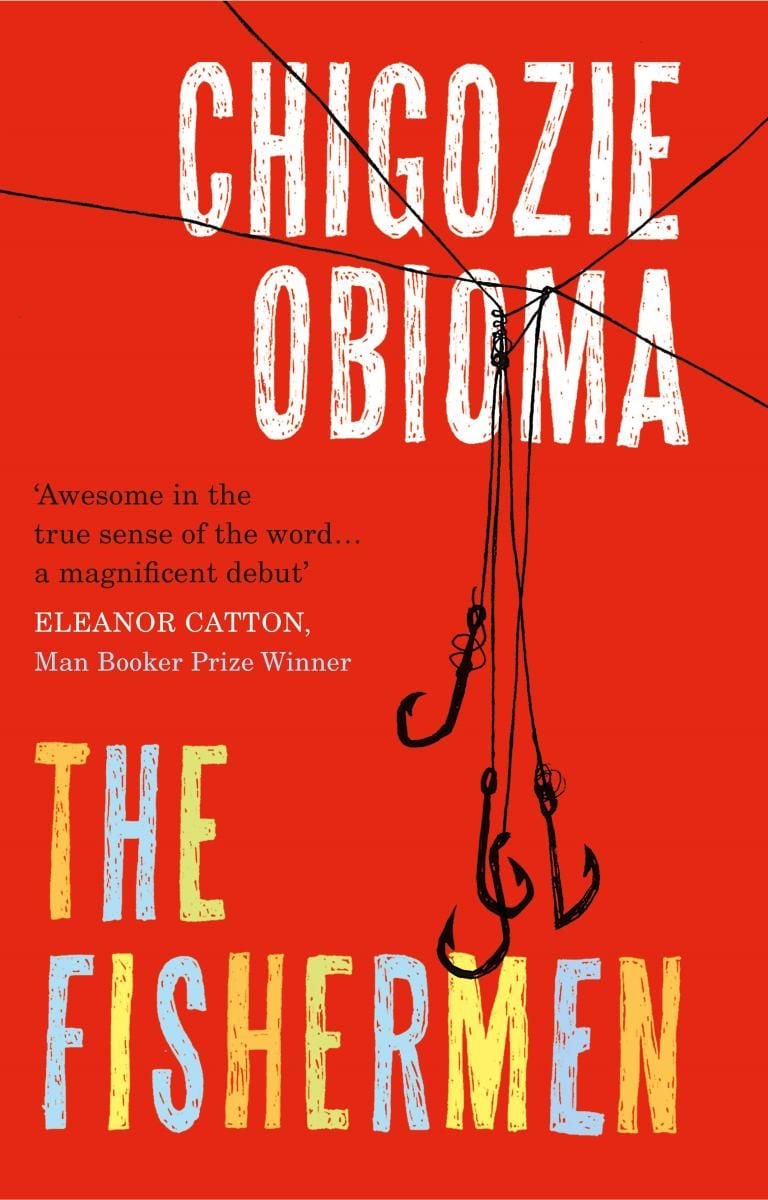
Whether you’re new to The Fishermen or have read it and would like to explore it more deeply, here is our comprehensive guide, featuring insights from critics, our judges and the book’s author, as well as discussion points and suggestions for further reading.
In a small Nigerian town in the mid-1990s, four brothers take advantage of their strict father’s absence to go fishing in a forbidden river. They encounter a dangerous local madman, Abulu, whose mystic prophecy of violence threatens the very core of their close-knit family. He predicts that one of the brothers will kill another, unleashing a tragic chain of events.
The Fishermen was shortlisted for the Booker Prize in 2015.
Ben
Ben is one of the youngest brothers in the Agwu family and is the narrator of the story. He is 39 years old, but is reflecting on the tragic events of his childhood, when he was nine. Ben looks up to his older brothers and makes sense of their characters by comparing them to animals.
Ikenna
Ikenna is the oldest sibling and, aged 15, the leader of the brothers. After learning of Abulu’s prophecy, his behaviour becomes erratic and paranoid. Ikenna stops eating and isolates himself from his family.
Boja
Boja is 14 years old and shares a bedroom with Ikenna. He is the closest to his older brother, but the prophecy changes their relationship and Boja doesn’t understand Ikenna’s hostile behaviour.
Obembe
Obembe is 11 years old and the third youngest of the four brothers. After a series of tragic events, he seeks revenge, creating plans and drawing sketches of what he wants to do to Abulu, convincing Ben to help him.
Abulu
Abulu is the madman whom the brothers encounter one day after a fishing trip. Known for his unpredictable behaviour and strange predictions, he claims that a fisherman will kill Ikenna.
Born in Akure, Nigeria, in 1986, Chigozie Obioma is the author of three novels: The Fishermen (2015), An Orchestra of Minorities (2019) and The Road to the Country (2024).
Obioma was named one of Foreign Policy magazine’s 100 Leading Global Thinkers in 2015, after the huge impact of his debut novel, The Fishermen. The book won the inaugural Financial Times/Oppenheimer Funds Emerging Voices Award for Fiction; the NAACP Image Awards for Outstanding Literary Work – Debut Author; and the Art Seidenbaum Award for First Fiction [Los Angeles Times Book Prizes]. The novel was also shortlisted for the Booker Prize in 2015, as well as for several other prizes in the UK and US.
His second novel, An Orchestra of Minorities, was shortlisted for the Booker Prize in 2019. Obioma was a Booker Prize judge two years later, in 2021. He is the Helen S. Lanier Professor of Creative Writing and English at the University of Georgia, and is one of 12 siblings – with seven brothers and four sisters.
Chigozie Obioma
© Zach Mueller
Fiammetta Rocco, The New York Times Book Review
‘The political implications of The Fishermen are obvious, though never overstated. Countries can take a wrong turn, Obioma suggests, just as people can … As things fall apart and the family’s center cannot hold, Obioma’s readers will begin to recall another work of fiction from Africa, a book that, after more than half a century, has never been out of print. In his exploration of the mysterious and the murderous, of the terrors that can take hold of the human mind, of the colors of life in Africa, with its vibrant fabrics and its trees laden with fruit, and most of all in his ability to create dramatic tension in this most human of African stories, Chigozie Obioma truly is the heir to Chinua Achebe.’
Naomi Sharp, The Atlantic
‘One of Obioma’s most powerful decisions is to assign the role of narrator to nine-year-old Benjamin, who is at once looking back as an adult and conjuring up the perspective of his childhood self. Benjamin’s loyalty to his brothers sometimes clouds his understanding, but also makes a mythic story feel human … Obioma never rules out the possibility of the supernatural, but the driving forces of the book are internal, not external—the push-pull of characters fighting for a sense of agency but believing all the while in fate.’
Helon Habila, The Guardian
‘The Fishermen mixes the traditional English novel form with the oral storytelling tradition, dramatising the conflict between the traditional and the modern. But The Fishermen is also grounded in the Aristotelian concept of tragedy … But as in all good tragedies, after the prophecies and the omens, it is character and logic and moral choices that drive the story to its conclusion.’
Tim Martin, The Telegraph
‘It’s a passionate, jostling and flamboyant piece of work, set in Nigeria during the military rule of the Nineties, which conceals a subtle state-of-the-nation allegory in its tale of a progressive family driven to disintegration by a folk prophecy … There’s a tinge of Shakespearean or Greek tragedy to such a prophetic set-up – with the fatal flaw being the father’s presumptuous ambitions for his children. There is also a succinct postcolonial allegory, as the sprouting seeds of division and dissatisfaction begin to tear the family apart.’
Lucy Scholes, The Independent
‘The plot’s initial fairytale-like simplicity mutates into something darker, similar to the ‘metamorphosis’ Ikenna himself undergoes in the aftermath of Abulu’s foretelling, as he transforms into a ‘python’ … One of the many delights of The Fishermen is how deeply multi-layered the narrative is.’
‘There is something about the cast of characters that makes them all feel like a part of me in some way. All the main characters – Ikenna, Benjamin, Obembe, Boja, Chinonso, Ndali, Kunle, Agnes, etc. – lurk within me. I find myself filtering some conversations through their lens, speaking words that I feel may have come from their minds. This is why I call my characters ‘imaginative ghosts’. And sometimes, they insinuate themselves into my life in curious ways. Take for instance, my son’s name is: Ikenna. I cannot stress enough that it was not my intention to name him after a character in The Fishermen, nor was it his mother’s. We had agreed that he would take an Igbo name, but couldn’t settle on one. So, I wrote down about two dozen names and vowed to name him the one that was first picked. Guess what that name was!’
‘The germ of the idea came from a very personal place and the emotion of being homesick. I left Nigeria and was living in a very interesting place, both paths long and unknown to me, in Cyprus. While there, I began to miss my brothers especially, and sisters; growing up in an African family, I shared a lot with my brothers and was closer to them. During a phone conversation with my dad one evening while I was in Cyprus, he told me of the growing closeness between my two oldest brothers, who while growing up had a very serious rivalry between them. I started to think about that closeness and what it means to love your brother, and also what if this time never came, what if they never came to understand this love of brother and closeness of family. That reflection brought the idea of a close-knit family that is destroyed.’
Thirty-nine-year-old Ben narrates The Fishermen as he reflects on the events of his childhood as a nine-year-old. Helon Habila, writing for the Guardian, said: ‘This well-managed balance between childhood action and adult memory gives the book a directness and guilelessness that is essential to its success. The author, when he wants to generate mystery or suspense, reverts to the child’s point of view, switching to that of an adult when he wants to create clarity and authority.’ Do you agree with Habila’s interpretation?
In an interview with the Louisiana Channel, Obioma said that the book, ‘on a primary level was intended to be Cain and Abel-like, but I think the heart of the novel is in fact the love between those brothers.’ Did you notice any similarities with the biblical story? Where were the examples of love amidst the hatred the brothers end up having for each other?
Obioma was described by the New York Times and the New Statesman as being the heir to Nigerian author Chinua Achebe, who won the Man Booker International Prize in 2007 for his entire body of work. If you’ve read Achebe’s books, what resemblances can you see between the two authors’ work?
Obioma includes lots of symbolism within the novel, especially with regard to animals. Not only is each chapter named after an animal, Ben also identifies each family member as a specific type of creature. Did you see the similarities between the chosen animals, their characteristics and each family member?
The Fishermen is set in 1990s Nigeria, amidst the coups and political upheaval that defined the decade. In an interview with the Booker Prizes, Obioma says the book is partly ‘a metaphor for Nigeria in which Abulu appears as the intrusive, colonial force that disrupts the equation of things’. Does this admission by the author change the way you perceive Abulu, and to what extent did you see it as a book about Nigeria as a whole?
The father of the brothers is determined that his children follow Western ideals of success, wanting them to become lawyers and doctors. A strict and imposing patriarch, he leaves the family home to work away, returning to a series of tragedies. What do you think would have happened if the boys’ father had stayed? Do you think events would have transpired differently?
Abulu’s prophecy ends up dramatically altering the lives of the four brothers, with horrific consequences. In an interview with the Louisiana Channel, Obioma said that in Igbo culture, it’s believed that everything we do is preordained, that there are no coincidences. Do you believe the prophecy was self-fulfilling or would the tragedy have happened regardless of whether or not Abulu had spoken it aloud? Was it fate or free will?
The eldest brother, Ikenna, readily believes the prophecy that predicts his own death. Rather than questioning it, he dismisses his brothers’ pleas, in which they declare their love for him and insist that they would never kill him. Why do you think Ikenna so easily believes Abulu?
With reference to his brother Ikenna’s belief in the prophecy, Ben says, ‘I have now come to know that what one believes often becomes permanent, and what becomes permanent can be indestructible.’ What’s your interpretation of this quote?
Towards the end of the book, Ben thinks he’s seen his brother, Obembe, in the garden of the family home. But his other family members don’t see him, so it’s unclear whether what Ben saw was imaginary or real. Do you think it really was Obembe or a figment of Ben’s imagination?
Fiction Writers Review: An Interview with Chigozie Obioma
Afreada: Chigozie Obioma In Conversation
World Literature Today: Writing, the Gambler’s Art: A Conversation with Chigozie Obioma
Times Literary Supplement: Twenty Questions with Chigozie Obioma
Louisiana Channel: Chigozie Obioma Interview: Everything We Do is Preordained
Writer’s Digest: Chigozie Obioma: The WD Interview
by NoViolet Bulawayo
by Chigozie Obioma
by Chinua Achebe
by Ben Okri (prize winner)
by Chimamanda Ngozi Adichie