

Atonement
by Ian McEwan
Set in the borderlands of English history immediately before the liberation of the Swinging Sixties, Ian McEwan’s short novel reveals how a life can be irrevocably altered by a moment’s twist of fate
Whether you’re new to On Chesil Beach or have read it and would like to explore it more deeply, here is our comprehensive guide, featuring insights from critics, our judges, and the book’s author, as well as discussion points and suggestions for further reading.
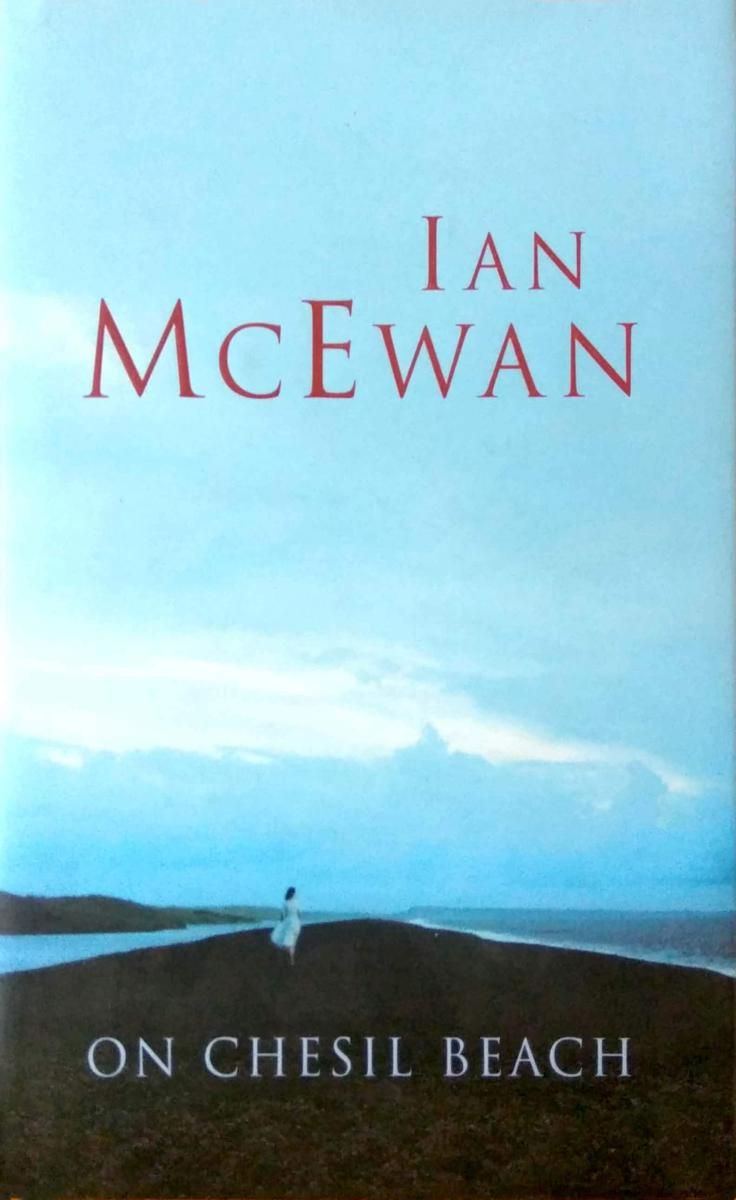
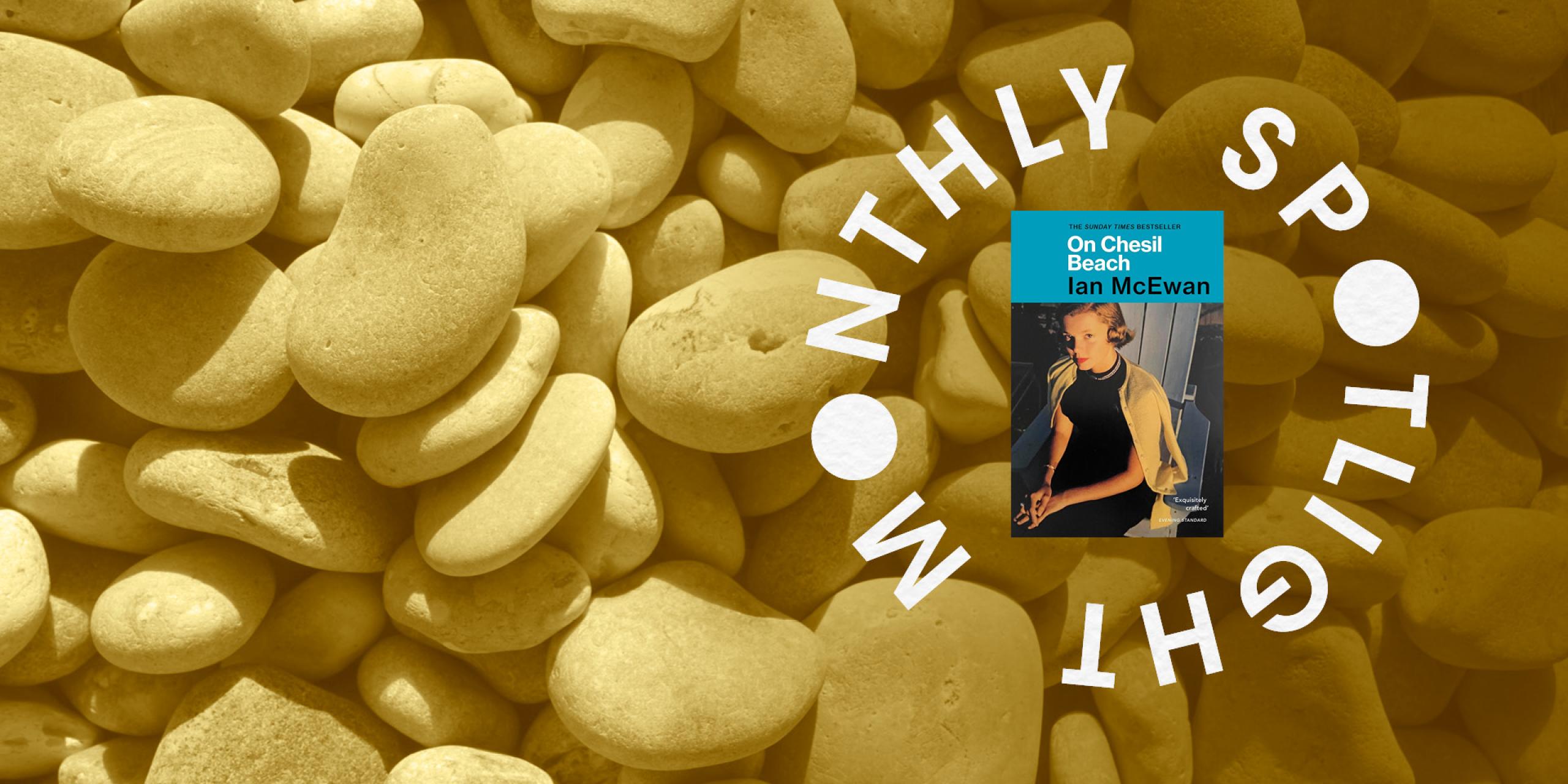
On Chesil Beach is Ian McEwan’s devastating novel about ways in which the entire course of a life can be changed by a gesture not made, or a word not spoken. It questions fears, boundaries and communication in a stifled, strict society.
It is June, 1962. In a hotel on the Dorset coast, overlooking Chesil Beach, Edward and Florence, married that morning, are sitting down to dinner in their room. Neither is entirely able to suppress anxiety about the wedding night to come…
The wedding night – the book’s main setting – is interspersed with a series of flashbacks, through which we come to understand Edward and Florence’s different backgrounds, hopes and anxieties.
On Chesil Beach was shortlisted for the Booker Prize in 2007.
Edward Mayhew
Edward Mayhew, an earnest history graduate from a modest, lower-middle class background. He is eager and impatient about the imminent physical intimacy his wedding night should bring. He is in love with Florence, admiring the ‘details’ of her, but his over-excitement, delusions and clouded judgement lead to an awkward and abruptly curtailed evening on their wedding night. In the aftermath, he reacts angrily and with embarrassment.
Florence Ponting
Florence Ponting, a talented and disciplined violinist from a wealthy family. She is fearful and repulsed by physical touch. McEwan lightly hints at elements of childhood trauma and sexual abuse in her past. Florence is overwhelmed by marriage handbooks and the expectations of others, and is disgusted at anatomical descriptions of sex. After a disastrous wedding night in the hotel, Florence desperately suggests a platonic and open marriage with Edward. He refuses, and they go their separate ways.
Saoirse Ronan and Billy Howle in the 2017 film adaptation of On Chesil Beach
© MovieStillsDB
Born in Aldershot, England, Ian McEwan is one of only five authors to have been nominated for the Booker Prize six times. He won the prize in 1998 with Amsterdam, was shortlisted for The Comfort of Strangers (1981), Black Dogs (1992), Atonement (2001) and On Chesil Beach (2007), and was longlisted for Saturday (2005). He won the Whitbread Novel of the Year Award for The Child in Time, in 1987, and the National Book Critics Circle Award for Enduring Love, in 1999. His other novels include The Cement Garden, The Innocent, Solar, Sweet Tooth, The Children Act, Nutshell and Machines Like Me. He was also shortlisted, for his entire body of work, for The Man Booker International Prize 2005 and 2007.
Many of his books have been adapted for the big screen, including On Chesil Beach, which was released in 2017 and starred Saoirse Ronan and Billy Howle.
In 2023, McEwan became a Companion of Honour after being recognised in the King’s first official birthday honours.
‘McEwan’s books have the air of thrillers even when, as in “On Chesil Beach,” he seems to have systematically replaced mortal stakes – death and its attendant horrors – with risks of embarrassment, chagrin and regret.’
Jonathan Lethem, The New York Times
‘There’s a virtuosic expanse just past the novel’s midpoint, when the newlyweds finally arise from their dinner to make their awkward way toward consummation. As McEwan details the emotional ebb and flow of desire, fear, mortification, and embarrassment of two people who barely know themselves, let alone each other, the reader realizes in retrospect that he has become spellbound by twelve pages that describe perhaps a minute and a half of foreplay. The prose slices and shimmers, though sex has rarely seemed less sexy.’
‘It is also a novel about sex and class in England, riffing gently on the work of Lawrence and Forster, suggesting that Florence’s frigidity is partly a function of her class and is shared by her parents, especially her mother, Violet.’
Colm Tóibín, ‘Dissecting the Body’, London Review of Books
‘There is a fairy-tale quality to the book, in that everything that follows seems inevitable. The minute currents of tension that change a conversation and a life are so crucial to McEwan’s method that it would be unfair to give away every last turn in his narrative. Towards the end, when fates have been sealed… Such is the deft compression of McEwan’s art here that, in his hands, such a formulation does not seem far from the truth.’
Tim Adams, The Observer
‘I’m not a religious person. I don’t believe in fate or supernatural entities moving our lives along, and I think the accidental, the random, plays a very large part in our lives.
In this story, the young couple end up out on the beach in a confrontation, which for me always was the set piece I wanted to get to. And there, concentrated into one particular moment is the whole manner in which these two fates will separate.’
Ian McEwan, NPR
Some critics and observers questioned On Chesil Beach’s inclusion on the Booker Prize 2007 shortlist. This was due to its short length, with many arguing that this should have disqualified it.
‘It is a short, taut novel and we are content that it qualifies for the prize… It is not at all slight in emotional depth… It is a very tight novel but it manages to achieve great depth of analysis.’
Howard Davies, Chair of Judges for the Booker Prize 2027, quoted in The Express
Ian McEwan
© David Levenson/Getty
On Chesil Beach is set in 1962, not long before the sexual revolution of the mid-60s. How did you feel Florence and Edward were impacted by the strict rules and imposed expectations of their gender? Had they met a decade later, might things have been different for them?
Edward and Florence’s class and upbringings are in sharp contrast with one another. Edward has a chaotic, working-to-middle-class family life, whereas Florence’s is refined, upper-middle-class (her mother dines with Iris Murdoch). Edward struggles with Florence’s family, feeling intimidated and frustrated by their views. Discuss how their different backgrounds shaped their attitudes to sex and relationships.
Edward is eager to have sex with Florence; while she is terrified and paralysed by worry. Although Edward loves Florence, how much do you think his desire is driven purely by his love for her, and how much is shaped by his own ego and societal expectations?
McEwan writes about sex and the body in On Chesil Beach in a way that is heavily anatomical and almost scientific. It contrasts with the way sex is typically portrayed in fiction: seductive, tense and euphemistic. How did you respond to McEwan’s stylistic choice, and why do you think he chose to approach intimacy in such a way?
This book is about the impact of words left unsaid. Florence and Edward both keep their true feelings – about each other, their lives, and their wedding night – secret. McEwan writes about them walking on ‘tiptoes’ around each other. Despite their relationship, do you think they really knew each other at all?
McEwan’s Chesil Beach is harsh, isolated, rough and unyielding. Yet most of the novel’s action takes place in a small, claustrophobic hotel room – a contrast to the open sea outside. How does McEwan use the contrast between the wild landscape outside and the confined space inside to reflect their relationship?
The novel ends with a tragic misunderstanding that will shape the rest of the young couple’s lives. Do you think it was inevitable, given the time in which it was set? Discuss whether you noted McEwan foreshadowing this outcome from the very beginning.
After the disaster of their wedding night, Florence proposes that the pair embark on a platonic marriage. Edward does not agree, and the couple go their separate ways. What do you think could have happened if Edward agreed to Florence’s proposal? Do you think the two just needed space and time to figure out their physical relationship and insecurities, or do you think they are completely incompatible?
The novel focuses intensely on one night in 1962 but then follows the consequences across an entire lifetime. Why do you think McEwan chose to make one brief moment, the couple’s wedding night, the defining event of Edward and Florence’s lives?
On Chesil Beach is often described as a novella, at around 170 pages in length. It was a controversial inclusion on the 2007 Booker Prize shortlist, with some observers arguing it was too short to qualify; the judges that year had to defend it. Why do you think McEwan chose such a concentrated form for this story? How did the book’s brevity and focus on one pivotal moment shape your experience as a reader?
London Review of Books: Dissecting the Body
The New York Times: Edward’s End
NPR: Ian McEwan’s ‘On Chesil Beach’
The Guardian (The Observer archive): On Chesil Beach by Ian McEwan Review
by Ian McEwan
by Alan Hollinghurst (prize winner)
by John Banville (prize winner)
by Julian Barnes (prize winner)
by Stanley Middleton (prize winner)
by Sally Rooney