

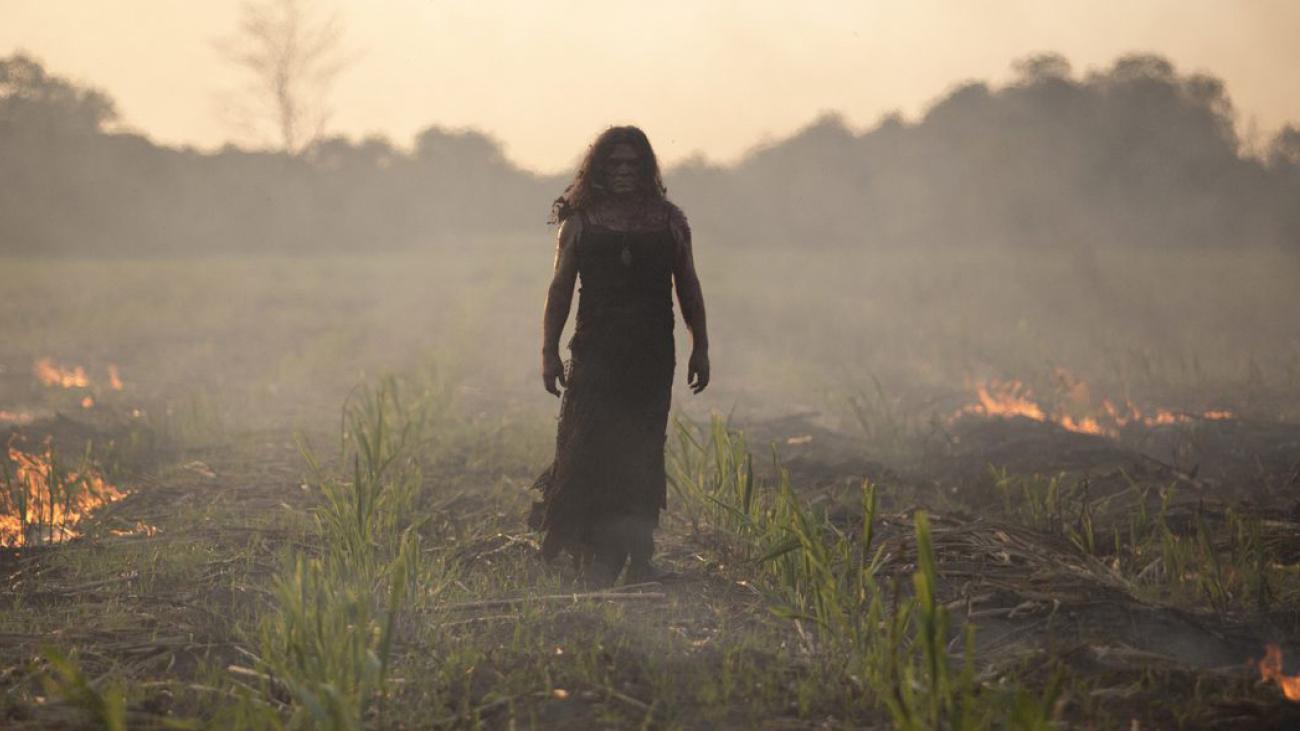
‘My beloved aunt, I am as innocent and forged in the image and likeness of God as any other, as every other, though I have been a cabin boy, shopkeeper, and soldier, and before then, long before, a small girl at your skirts.’
- Published
The International Booker Prize 2026 nominated author and translator share their inspirations and influences, and discuss how fiction can cross borders of history, culture, gender and class
Gabriela Cabezón Cámara
Could you tell us about the inspirations behind We Are Green and Trembling?
The jungle: beautiful, alive, and in danger. Fires on a geological scale. My dog Roja. El mundo alucinante, by Reynaldo Arenas. Gran Sertón: Veredas, by João Guimarães Rosa. La bestia ser, by Susana Villalba. Una ballena es un país (A Whale Is a Country, translated by Robin Myers). The children in my life: Lola, Lautaro, and Amparo. The horrific attack against life on Earth we’re all experiencing. The beautiful beings of all species that continue to resist. The works of Ailton Krenak and Davi Kopenawa. Ayvu Rapita of the Mbyá Guaraní.
How did you go about writing the novel?
It was a long process: it took me six years, including the depressive pandemic ones and their beautiful birds. All of the things I’ve mentioned above as inspirations were rattling around in my head, and I wanted to write about them somehow.
One day, while chatting with my editor, Ana Laura Pérez, she recalled my interest in the story of the Lieutenant Nun. It was like magic: it connected everything I’d been carrying around with me. The first thing that came out was Antonio’s first letter to his aunt, written in language that lovingly satirises the Spanish Golden Age.
Then I felt the need for another perspective and another linguistic register. That’s when the third person appeared – an elastic presence that can focus on other human and non-human characters – in a Spanish closer to Rioplatense time and space.
Finally, in a state of some despair, because I couldn’t stand the darkness subsuming my work-in-progress and me, I had a dream: I woke up with the phrase ‘both cruel and tender’ in my mouth. That’s when the characters of the girls and their voices appeared. They gave the novel meaning, love, and light at last.
The theme of this year’s International Booker Prize campaign is ‘Fiction beyond borders’ – how do you think translated fiction helps readers see beyond geographical boundaries, and why is that important?
Fiction can cross all borders, even those that seem impossible to cross: the borders of history, culture, ethnicity, gender, and class. So of course it can cross geographical borders, too, which are political by definition. This is important, because borders are a perverse invention: in the life of Earth, which we’re part of, migration, for instance, is a natural state. What’s more, national and religious differences, among others, often serve as a pretext for terrible wars that only benefit the most powerful. They destroy the rest of us. When we read fiction, the other is restored to what they always were: human, feeling, thinking. Kindred.
The International Booker Prize is celebrating its 10th birthday in its current form this year – how do you think the award has changed the perception of translated fiction over the last decade?
To translate is to share and expand. The Booker Prize globalises literatures and worldviews, shatters borders, builds bridges. Many of my colleagues from Latin America, for instance, have found new readers in many other languages, not just English, thanks to the Booker platform.

Gabriela Cabezón Cámara
© USAR ESTA
Fiction can cross all borders, even those that seem impossible to cross: the borders of history, culture, ethnicity, gender, and class
Gabriela Cabezón Cámara
Could you tell us about a book that made you fall in love with reading as a child?
It’s hard for me to choose just one. My first books were a collection of classics (A Thousand and One Nights, for example) abridged for children. They had large Disney-style illustrations. Through those books, I spoke with genies in lamps, I was a giant, I was tiny, I ate apples offered by evil stepmothers.
Soon after that, I met Tom Sawyer, Huckleberry Finn, and Sandokan. I went on all sorts of diminutive adventures. And I fought against empire. I loved all three and was all three.
Later still, My Sweet Orange Tree: I’d never cried so much in my life. It was always about other worlds inside the world. The ones that let me live even when it hurt, and showed me other ways to live beyond the ones imposed on me. Even ways that didn’t yet exist.
And could you tell us about a book that made you want to become a writer?
I couldn’t name only one. Ever since I learned to read, I’ve spent several hours a day inside a book. Or several books.
Is there a book that changed the way you think about the world?
Lots of them. But I’ll mention one for now: Operación Masacre. It’s a work of investigative journalism by the Argentine writer Rodolfo Walsh about the executions of pro-Perón activists perpetrated by the military, which then tried to cover up the crime. Walsh discovered the killings and followed the trail. He was a fiction writer as well, and when he published this book in 1957, he inaugurated the nonfiction novel. He changed the conception of Argentine history. And world history too, in a sense: the ways of fascism are pretty universal.
Which book written in Spanish should everyone read?
So many! One I find especially urgent is a poetry collection by Susana Villalba called La bestia ser. It interweaves dramatic monologues between a dog, a tree, and a rock. With extraordinary beauty, it manages to draw us into these beings’ possible perspectives.
And, finally, which International Booker-nominated book do you think everyone should read?
All of them. I always try to find and read every single one. I’ve never regretted it.
Robin Myers
Could you tell us what it was about We Are Green and Trembling that made you want to translate it?
The sumptuousness and range of Gabriela’s prose. ‘Do you like sentences?’ is Annie Dillard’s famous question to aspiring writers, and as I read Las niñas del naranjel before it started to become We Are Green and Trembling, I felt more in contact with the delight of the sentence than I’d been in a long time. Gabriela’s language is rich, constantly surprising, and musical in a way that never stays still (luxuriant and mellifluous; tense and staccato). I could feel myself almost physically itching to translate it as I read – to figure out how the prose works from the inside – which is how I know I’m falling in love with a book.
How did you go about translating the novel?
As I usually do, I did a very loose, messy, instinctive, going-with-the-flow sort of first draft, then grew more deliberate and meticulous with each successive one. Over multiple revisions, the most meticulous and consuming work involved Gabriela’s complex polyphony. Among the biggest challenges were finding the tone for the speech of young children; for the creatively archaic (as opposed to historically ‘accurate’) Spanish of Antonio’s letters, as well as the dialogue among the Spanish colonisers; for a character who shows up late in the book speaking contemporary Argentine Spanish. Late in the revision phase, I read a long section out loud to my partner, who helped me think through certain oral motifs for several characters.
The theme of this year’s International Booker Prize campaign is ‘Fiction beyond borders’ – how do you think translated fiction helps readers see beyond geographical boundaries, and why is that important?
Borders are geopolitical impositions. Their purpose is to demarcate, homogenise, and reduce. Translated literature (not only fiction) is all about multiplicity. It flies in the face of reduction! The practice of reading, writing, and publishing translations reminds us, and humbles us all in doing so, that every book is a collaborative and continually (re)generative creation, expansive and refractive across time and space.
The International Booker Prize is celebrating its 10th birthday in its current form this year – how do you think the award has changed the perception of translated fiction over the last decade?
It’s a powerful message that such a prestigious prize is shared equally between writer and translator. I think the visibility granted to this collaboration helps remind readers – and the publishing industry itself – that it is a collaboration, a partnership, a co-authorship in the most concrete sense.

Robin Myers
© Nuria Lagarde
Translations remind us that every book is a collaborative and continually (re)generative creation, expansive and refractive across time and space
Robin Myers
Could you tell us about a book that made you fall in love with reading as a child?
I remember being utterly shaken and riveted by Lois Lowry’s The Giver. It was the book that taught me the power of an ambiguous ending.
And could you tell us about a book that made you want to become a translator?
I remember a poem, not a book, and it was originally written in English: ‘Meditation at Lagunitas’ by Robert Hass. I think of it as a poem about living, loving, and communicating in the shadow of inevitable loss, and about wonderment as an antidote to the fear of it. I translate from Spanish into English; I always have. Still, it was this English-language poem that made me want to become a translator, because I longed to share it with a Spanish-speaking friend. A pure wish for communion.
Is there a translator whose work you always look out for?
Julia Sanches, who is a brilliant and endlessly creative translator from Spanish, Portuguese, and Catalan, as well as a stalwart advocate for translators and their labour.
Is there a work of fiction originally written in Spanish that you’d recommend to English-language readers?
Eisejuaz, by the late Argentine writer Sara Gallardo, a novel that rings with as strange and powerful a music as any I’ve ever read. It hasn’t been translated into English yet, but one of Gallardo’s other novels recently was: January, translated by Frances Riddle and Maureen Shaughnessy (Archipelago Books).
And, finally, which International Booker-nominated book do you think everyone should read?
Small Comfort by Ia Genberg, translated by Kira Josefsson, whose work I love.


Features

- Book recommendations
10 Booker Prize-nominated books that explore sapphic love


- Book recommendations
11 Booker-nominated books that reimagine classic works and ancient texts
- Book recommendations