

Waterland
by Graham Swift
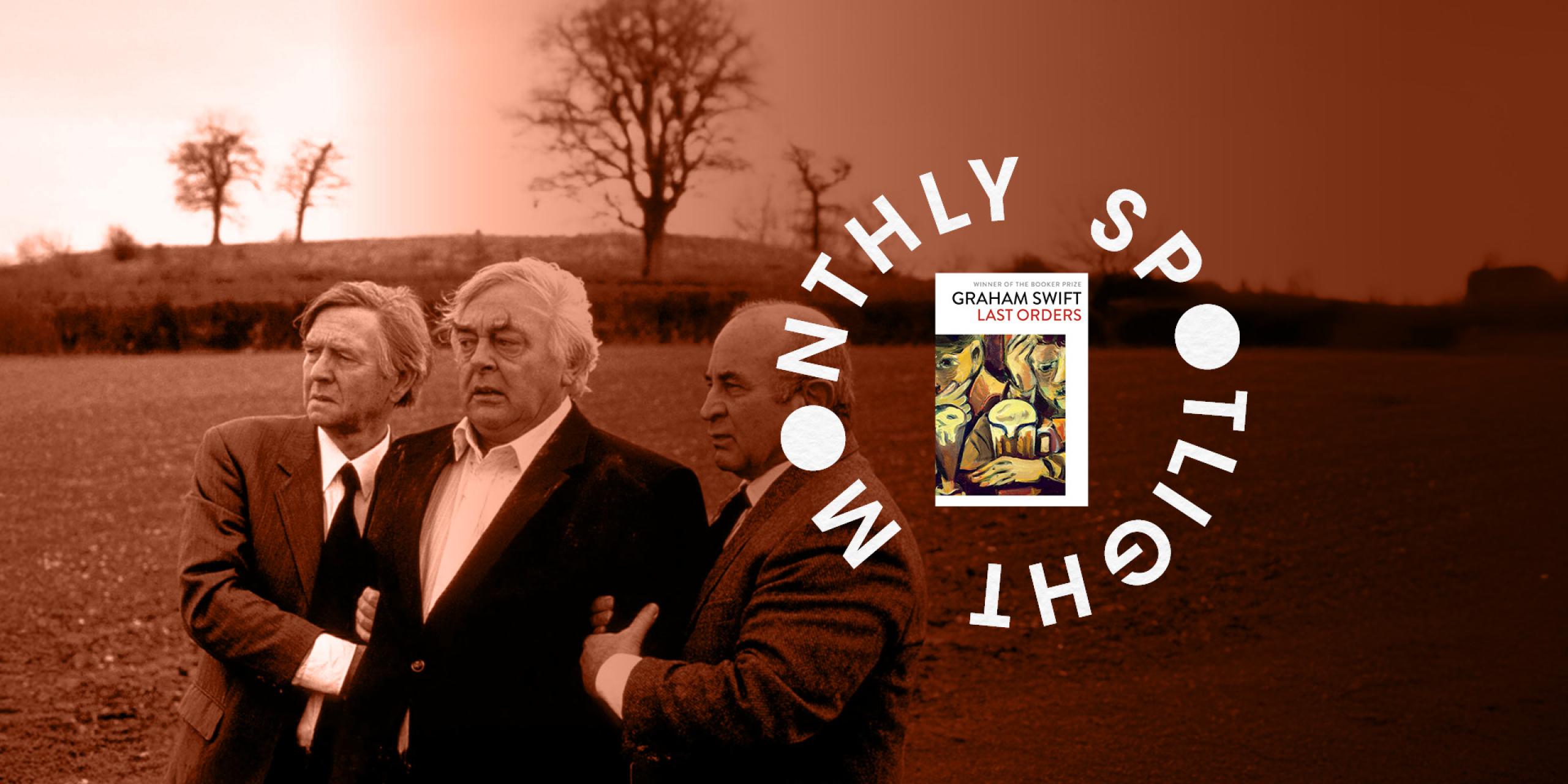
In Graham Swift’s Booker Prize-winning novel, four men reflect on their pasts as they say a final goodbye to their close friend
Whether you’re new to Last Orders or have read it and would like to explore it more deeply, here is our comprehensive guide, featuring insights from critics, the book’s author, as well as discussion points and suggestions for further reading.
Film still from Last Orders © AJ Pics / Alamy
Four men gather in a south London pub. They have met to carry out the last wishes of Jack Dodds, master butcher, which are that his ashes be scattered into the sea at Margate, on the Kent coast. For reasons she does not disclose, Jack’s widow, Amy, decides not to join them. As the men drive from Bermondsey to the seaside town, their errand becomes an extraordinary journey into their collective and individual pasts.
Last Orders won the Booker Prize in 1996.
Jack Dodds
Jack was a butcher in Bermondsey, south London, and recently died of cancer. He had a wife, Amy; a daughter, June; and an adopted son, Vince – as well as a close group of friends. Three of his friends – Ray, Lenny and Vic – along with Vince, all travel to Margate, a seaside town on the Kent coast, to fulfil Jack’s wish for his ashes to be scattered into the sea.
Ray Johnson
Nicknamed ‘Lucky’, Ray works as an insurance clerk and loves to gamble on horse racing. Ray’s wife, Carol, left him years ago, and his daughter, Susie, now lives in Australia. He is Jack’s closest and oldest friend as they fought together in the Second World War.
Lenny Tate
Nicknamed ‘Gunner’, Lenny was once a boxer but now sells fruits and vegetables for a living and is a drinking buddy of Jack’s. He has a complicated relationship with Jack’s son, Vince, after Lenny’s daughter Sally became pregnant with Vince’s child.
Vic Tucker
Vic is a funeral director and is the most responsible one of the group, often acting as a mediator between the other men. His funeral home is located across the street from Jack’s butcher’s shop.
Vince Dodds
Vince was adopted by Jack and Amy as a baby after his birth parents were killed in the Blitz. He has a strained relationship with Jack, as he didn’t want to follow in his footsteps and become a butcher, choosing to become a car mechanic instead.
Graham Swift is the author of 11 novels and three collections of short stories. His books have appeared in over 30 languages.
Swift’s work includes the highly acclaimed England and Other Stories, and Making an Elephant, a book of essays, portraits, poetry and reflections on his life in writing. His novel Mothering Sunday became an international bestseller and won The Hawthornden Prize for best work of imaginative literature.
Waterland was shortlisted for the Booker Prize in 1983 and won the Guardian Fiction Prize. Last Orders won the Booker Prize 1996, while The Light of Day was longlisted for the Booker Prize in 2003.
Last Orders was made into a film in 2001, directed by Fred Schepisi and starring Michael Caine as Jack, Tom Courtenay as Vic, David Hemmings as Lenny, Bob Hoskins as Ray, Helen Mirren as Amy, and Ray Winstone as Vince.
Graham Swift. © Arclight / Alamy
Sam Jordison, Guardian
‘The sense of hidden truth – of repressions and cover-ups and gradual revelation – makes the book not only gripping in an understated way, but also emotionally satisfying. It’s clearly the work of a fine writer.’
San Francisco Chronicle
‘A beautiful book…a novel that speaks profoundly of human need and tenderness. Even the most cynical will be warmed by it.’
John Banville, The New York Review of Books
‘Swift is surely one of England’s finest living novelists…. The tale he tells is as affecting as it is convincing…. Quietly, but with conviction, he seeks to reaffirm the values of decency, loyalty, love.’
Observer
‘Last Orders confirms his reputation as one of the great contemporary chroniclers of landscape and memory’
‘Last Orders isn’t just a day trip to the coast through the so-called “Garden of England”, but a primal journey, internal as well as external, through our common territory of mortality, its specific but timeless purpose that of the living to deal with the dead. But it would be wrong to say it’s a novel “about” death or that it’s particularly grim. In many ways it’s about life getting in the way of death, a frequent occurrence in the narrative and one that can be highly comic.
Writing in the Guardian, Swift said the language in Last Orders is the street language of London. ‘Last Orders doesn’t transcribe it directly, but it honours it and weaves it into its fabric. It uses it as an internal language, a language of thought as much as speech. It’s a language, I discovered, capable now and then of great eloquence and directness. And humour. It’s not the language of “education”. The characters in the novel aren’t educated in any formal sense, but they’re educated by life. The language of the book is the language of their education.’ What did you think of the novel’s colloquial style? And what did the language of the novel reveal about the characters?
Swift said in the Guardian that ‘Last Orders is essentially a comic novel. It taught me a lot about how the deeply serious can also be funny. Neither the tragic nor the comic view of life will ever be complete and correct, but perhaps the mixture of the two can be.’ Did you find the book funny? Were there any moments or descriptions in the novel that struck you as especially comic?
The novel is told from each of the men’s perspectives and includes multiple flashbacks. What did you think of the way the novel is structured? Did you find it easy or hard to distinguish between each of the men’s voices while reading?
While the book is mostly written from the perspective of the male characters, there are a handful of chapters from Amy’s viewpoint – one at the beginning of the book and a few at the end. Why do you think Swift decided to include Amy’s perspective at these moments? Was it illuminating to hear from Amy and what did her view of events provide that the views of other characters didn’t?
Both Jack and Vic work with flesh: Jack works as a butcher, while Vic works as a funeral director. How might their differing views on life and death have been shaped by their work?
Jack, Ray and Lenny all have strained relationships with their adult daughters, having either little or no contact with them. What did you think of the fraught father-daughter relationships in the novel, and what do they reveal about the three men?
Amy decides to skip the journey to Margate to spread Jack’s ashes; instead, she goes and visits her daughter, June. Why do you think she decided to do this?
It seems that Vic knew that Ray and Amy had an affair, but chose not to tell anyone else, including Jack. Why do you think that Vic decided against revealing the secret?
The book is set in the late 1980s and was published in the 1990s, and it contains instances of ableism and sexism. How did the discriminatory language and attitudes make you feel as a contemporary reader? What do they reveal about attitudes at the time?
After Last Orders won the Booker Prize in 1996, academic John Frow accused Swift of a ‘direct and unacknowledged imitation’ of William Faulkner’s novel As I Lay Dying, in both plot and structure, arguing that Swift failed to declare his ‘substantial borrowing’ from the American writer. In an interview with Salon Magazine, Swift acknowledged the ‘obvious similarities’, saying that there is ‘a little homage at work’. If you’ve read As I Lay Dying, what do you think of Frow’s comments and Swift’s response?
by Graham Swift
by Graham Swift
by Ian McEwan (prize winner)
by John Banville (prize winner)
by James Kelman (prize winner)
by Kingsley Amis (prize winner)
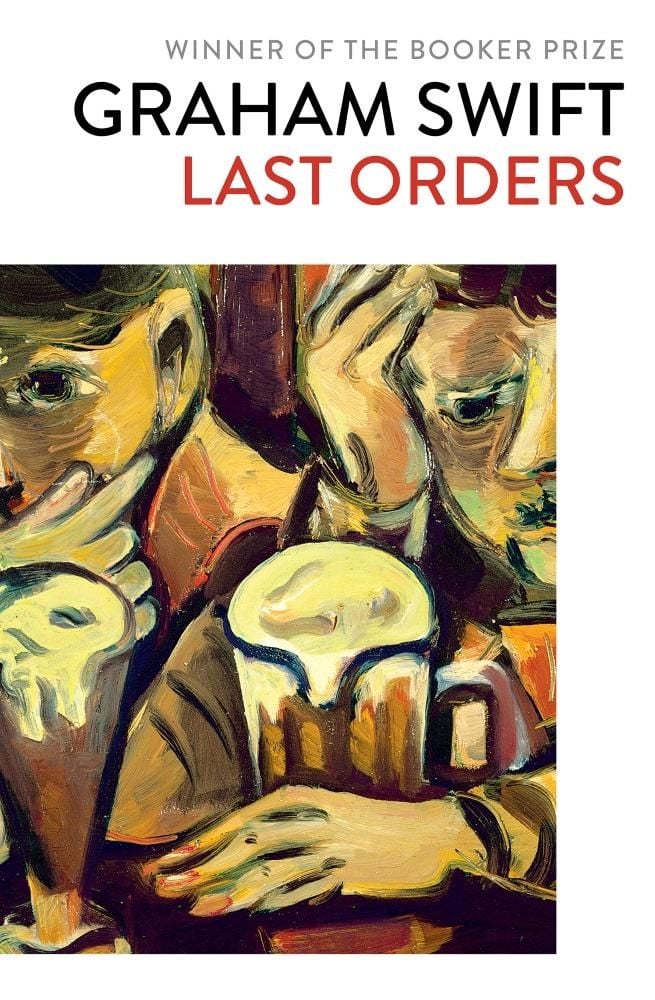
Winner of The Booker Prize 1996