The Enlightenment of The Greengage Tree
by Shokoofeh Azar
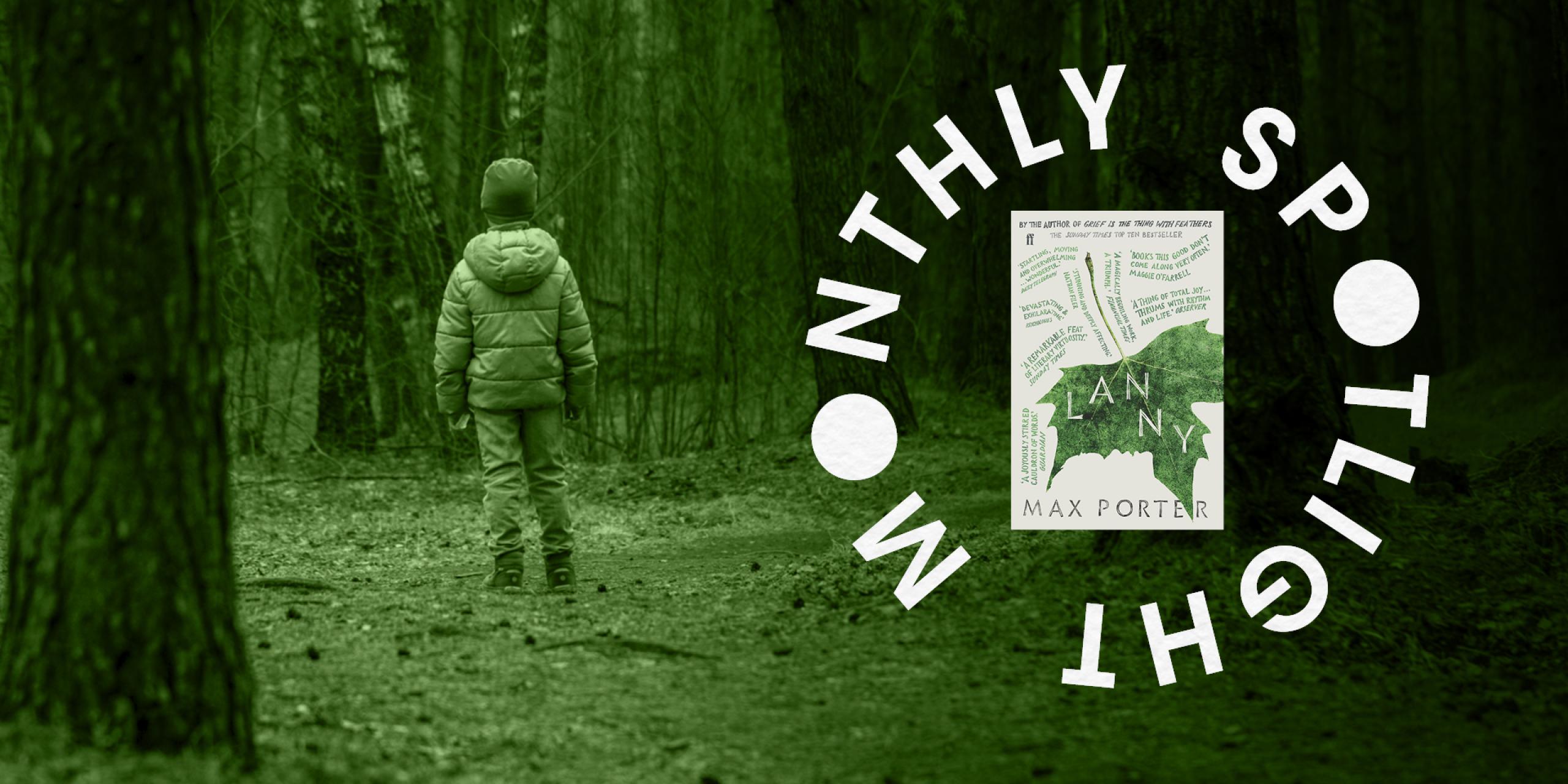
In Max Porter’s shapeshifting novel, the arrival of an unusual young boy awakens a mysterious presence in the woods
Whether you’re new to Lanny or have read it and would like to explore it more deeply, here is our comprehensive guide, featuring insights from critics, our judges, and the book’s author, as well as discussion points and suggestions for further reading.
Not far from London, there is a village. This village belongs to the people who live in it and to those who lived in it hundreds of years ago. It belongs to families dead for generations, and to those who have only recently moved here, such as the boy Lanny and his family. But it also belongs to Dead Papa Toothwort, who has woken from his slumber in the woods. Dead Papa Toothwort, who is listening to them all.
Lanny
Lanny is an inquisitive, imaginative and unconventional young boy. His curiosity connects him to the natural world, where he sees possibilities and mysteries that adults can overlook. Absent when he is present and present when he is absent; we mostly understand Lanny through others’ perception of him, so we question how well anyone truly understands him at all.
Lanny’s mother
Lanny’s mother, Jolie, is an out-of-work actress and aspiring crime novelist. She writes from home, while her husband works in the City. Jolie is affectionate, attentive and fascinated by her son’s unusual ways. This strengthens her bond with him, one shaped by deep love and protective instincts. She struggles with the frustrations and conflict between her role as a mother and a creative individual.
Lanny’s father
Lanny’s father, Robert, is an asset manager. He works in London and commutes from the village, perversely beholden to his city commute. More practical and conventional than his wife, he struggles to make sense of Lanny’s eccentricity and wandering imagination. He has difficulty reckoning with fatherhood, and this reveals an uncomfortable gap. A gap between loving and knowing your child.
Pete
A once famous ‘septuagenarian artist’ who comes to teach Lanny how to draw, paint and relish the natural world around him. Regarded by locals as strange, or even mad, Pete forms a warm friendship with Lanny through their art lessons. These lessons become just as much about conversation and curiosity as drawing and painting. Their friendship is built on creativity, freedom and understanding. Yet his outsider status makes him vulnerable when Lanny disappears.
Dead Papa Toothwort
A mischievous kind of ‘Green Man’, once fearfully worshipped by the villagers, and now a mythical spirit of local folklore. He can metamorphose at will, and readers are left pondering what he is responsible for: pranks and mishaps or more serious happenings. Part nature spirit, part embodiment of England’s history and collective memory, he observes village life with fascination and an unsettling sense of possession. His interest in Lanny challenges the boundary between the human and natural worlds.
Max Porter is a bestselling Booker Prize-longlisted author.
Max Porter’s first novel, Grief Is the Thing with Feathers, won the Sunday Times/Peters, Fraser + Dunlop Young Writer of the Year Award and the International Dylan Thomas Prize, among others, as well as being shortlisted for the Guardian First Book Award and the Goldsmiths Prize. Lanny was longlisted for the Booker Prize and was a Sunday Times bestseller and Shy was an instant number one bestseller.
He is a fellow of the Royal Society of Literature and is a frequent collaborator with, and mentor to, musicians, artists, theatre makers and arts and literacy charities. He was previously Editorial Director at Granta Books, where he published The Luminaries by Eleanor Catton, which won the Booker Prize 2013, and The Vegetarian by Han Kang, winner of the International Booker Prize 2016.
Porter was the Chair of judges for the International Booker Prize 2025.
Max Porter
© Betty Bhandari
Daniel Soar, London Review of Books,
‘What’s weird and wonderful about Lanny is that it pays attention to and celebrates all the things ordinary people in an ordinary village say, finding them remarkable … it finds a way – with no time wasted – to bring together all the essential signs of England.’
Maggie O’Farrell
‘It’s hard to express how much I loved Lanny. Books this good don’t come along very often. It’s a novel like no other, an exhilarating, disquieting, joyous read. It will reach into your chest and take hold of your heart.’
Alexandra Harris, Guardian
‘Max Porter’s second novel is a fable, a collage, a dramatic chorus, a joyously stirred cauldron of words. Lanny is … remarkable for its simultaneous spareness and extravagance, and again it is a book full of love. It plays pretty close to the edge over which lie the fey and the kooky; anyone allergic to green men may need to take a deep breath. But Porter has no truck with cynicism and gets on, bravely, exuberantly, with rejuvenating our myths.’
Tim Smith-Laing, Telegraph
‘Lanny is every bit as startling, moving and overwhelming as its predecessor. Having swallowed it in a single sitting – which culminated in this hardened cynic crying – I immediately returned to the beginning and started it again.’
‘I started writing Lanny in 2016 [the year of the EU Referendum]. But I wrote Lanny as a poem about ten to fifteen years ago. There was no village and there was no Dead Papa Toothwort in that though, so it’s a different book. The novel was written in the current context, but I wanted to zoom out. While it’s very specifically about an English place, I didn’t want to make it a Brexit novel or about such localized things as membership of the EU. To me, it’s about how a community draws on its superstitious underbelly or how a tiny flicker of something like xenophobia, hostility or even casual racism becomes a flame in times of crisis. That’s what we’re seeing all around the world at the moment.
This isn’t a story of Brexit and Parliamentary decisions. It’s about those funny little loyalties that are teased out in a community unexpectedly when something goes wrong. It’s about the ways in which some people will always seek to see the worst, and the ways some people have what I would project as being a robust, instinctive moral compass. So Toothwort is shuffling all this around in a sort of wine-tasting way.’
Max Porter, in an interview with maisonneuve.
In the novel, Lanny isn’t given his own narrative voice. As readers, we get to know him through the eyes and minds of those around him. How did this shape your understanding of him? Did Lanny read as a fully realised character, or more of a mystery?
Jolie and Robert have different relationships with their son. How does Porter explore the expectations, conflicts and contradictions of parenthood? Does Lanny suggest that knowing and loving your child are different things, or are they not mutually exclusive?
Lanny and Pete are both othered – viewed as eccentric, strange, by those around them. How does the village respond to people who do not fit its routines and expectations? Who does it let be considered normal? Were your perceptions of madness and belonging challenged?
Dead Papa Toothwort has a powerful, omniscient presence in the novel. He plays an important role, as an iteration of English folkore’s Green Man figure. Did you find this role to be threatening, a symbol of the natural world, a personification of England’s history, all the above, or something else entirely? Did your interpretation of him change as the story progressed?
The village is fictional, yet Porter writes it to be a place of familiarity. But he also writes it to be a place of gossip, judgement and exclusion. Through this contradiction, is Porter critiquing its insularity and how it may compare with life in a city?
Following Lanny’s disappearance, the villagers’ responses reveal competing motives, as well as their own fears and prejudices. What does the search for Lanny reveal about human behaviour? Discuss how much of the village’s response is driven by genuine concern, and how much is driven by selfish interests or desire to find blame?
Porter writes nature to be a source of wonder, creativity and belonging for Lanny. And also an unsettling and almost threatening presence in Dead Papa Toothwort. How does Porter distinguish what is natural from what is human, and how does he then blur and manipulate this boundary?
The novel incorporates fragments of overheard conversations and murmurings through shifting rhythms and unconventional, shapeshifting typography. What did you find that this experimental and fragmented presentation communicated more than a traditional typographical form might?
Through Dead Papa Toothwort and the village’s everyday conversations, Porter creates a collage of folklore, history and contemporary life. How does Lanny explore the relationship between England’s past and present? Does Porter’s collage suggest that history is something we inherit, a cycle we repeat, or an opportunity to change?
Lanny is written in a polyphonic blend of first-person narrative voices, all with different feelings, motives and experiences. How did this stylistic choice affect how you interpreted the novel’s ending? Were you satisfied or did it leave you questioning what is true? Did it change how you read Lanny, his family, or Dead Papa Toothwort?
Maisonneuve: The Pathetic, Lovely Smallness of Human Life: An Interview with Max Porter
The Guardian: Max Porter: ‘Writing allows me to worry about stuff better’
The Millions: Max Porter Is Afraid of Bad Writing
BBC Radio 4: Max Porter – Lanny
by Shokoofeh Azar
by Daisy Johnson
by Ben Okri (prize winner)