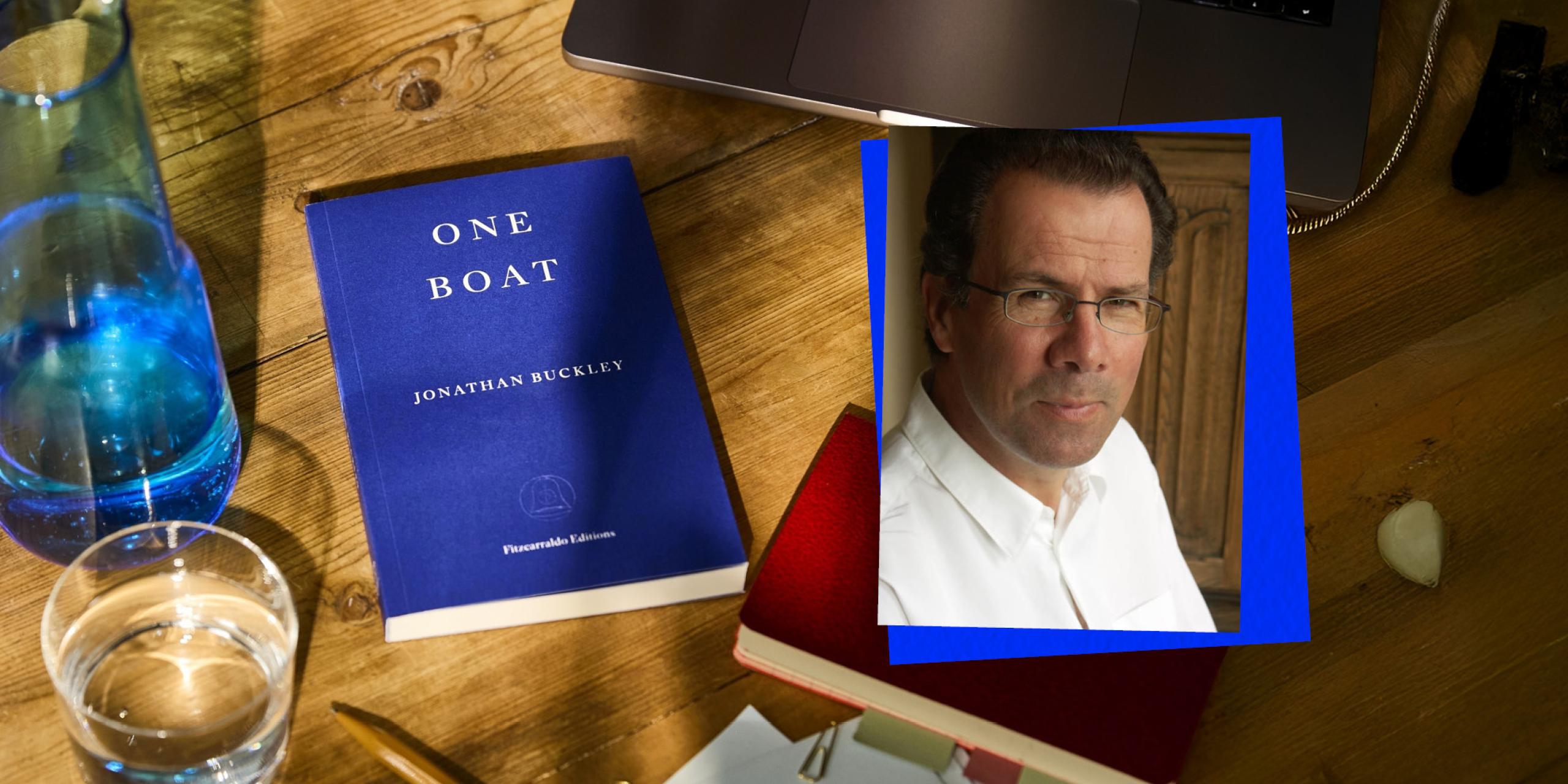

‘Then I saw the town, and the words arose in my head, as clearly as if they were being spoken: This will be the place’
- Published
The author of One Boat, longlisted for the Booker Prize 2025, talks about how writing became a daily necessity and about the books he reads again and again
Buy the book
The inspirations behind my Booker-longlisted book
The setting of One Boat is a town in the Peloponnese, which I last visited several years ago, and aspects of the novel arose from a number of books I’ve read in the interim, on the culture of ancient Greece, for example. There are also clear connections with some of my previous novels – questions about the idea of selfhood, for instance, have long been a preoccupation. But I really don’t know why these elements should have come together in this way, at this time.
The book that made me fall in love with reading
I read very little fiction until my mid-teens – before then, the archaeologist Louis Leakey was my inspirational figure. I think it was Eliot’s The Waste Land that brought about a swerve to literature. And Shakespeare. I was a memorably awful Macbeth in our school’s end of year production.
The book that made me want to become a writer
No book gave rise to any thought of my becoming a writer, and at no point did I ever envisage becoming a novelist. It was rather that I found that writing was something I had to do – at first, the writing was sporadic; it soon became a daily necessity.
The book I read again and again
I’ve returned to Ulysses and Finnegans Wake many times, and for the past decade I’ve read Dante’s Divine Comedy every year, one canto per day for three months. Dante, like Joyce, is inexhaustible.
The book that changed the way I think about the world
The first encounter with the Philosophical Investigations was something of a shock to the system, and it’s remained a constant corrective. Lichtenberg, a rather more companionable thinker than Wittgenstein, is also someone who refreshes and adjusts my outlook each time I go back to him. Montaigne as well.
For sustained writing, I have to be at home, at my desk. When the writing begins, I have to have silence
The book that changed the way I think about the novel
First Ulysses, then The Man Without Qualities, then Proust. Of earlier novels: Tristram Shandy and Moby-Dick. Of work by contemporary writers: the novels of Pascal Quignard, Gerald Murnane and Rosalind Belben. This list could be much longer. All good novels make you think about what the novel can do.
The book I’m reading right now
I’m currently immersed in Peter Weiss’s colossal The Aesthetics of Resistance – an extraordinarily dense quasi-documentary novel that’s focused on left-wing resistance in Nazi Germany. It’s been described as an ‘essay-novel’, and WG Sebald wrote of its ‘monstrous weight of ideological ballast’, but he nonetheless admired it greatly. From time to time, I surface to read a few pages of the Collected Poems of A.R. Ammons, and the journals of R.F. Langley, another poet to whose work I frequently return.
The Booker-nominated book everyone should read
Muriel Spark, The Driver’s Seat.
Where and when I most like to write, and the tools I need
I’m never without a notebook, but for sustained writing, I have to be at home, at my desk. Music is extremely important to me, but not as any kind of tool. When the writing begins, I have to have silence.
My dream book club, what we’d read, and where we’d meet
I prefer gatherings that are rather smaller than a club, so my ideal would be an afternoon’s stroll and conversation with Eudora Welty, or Sylvia Townsend Warner, or William Maxwell. I’d be happy to read whatever they wanted to talk about.
One Boat
- Published by
- Fitzcarraldo Editions
Artfully constructed, absorbing and insightful, One Boat grapples with questions of identity, free will, guilt and responsibility


