
‘Names that end with ‘son’, spelled with just one ‘s’, they sound American. Easy to pronounce in English. Couldn’t tell you why, but it’s true. A name is important, a marker you should finesse if you can. Ia … is that short for something?’
- Published
The International Booker Prize 2026 nominated author and translator on their influences, how translation can dissolve divisions, and the writers whose work they always look out for
Ia Genberg
Could you tell us about the inspirations behind Small Comfort?
My inspiration for the book was that I wanted to write several stories that flowed into one another, where one story ended in the next, and so on. Unfortunately, I don’t think I managed to achieve that. No book you write ever turns out the way you plan. That’s why authors keep writing new books all the time.
How did you go about writing the book?
I wrote the first dialogue between 4am and 7am in Vietnam, during a trip with my family. I would get up, pour myself a coffee, and write until the rest of the family woke up. We were there for three months, traveling around like maniacs with far too much luggage. It’s incredibly chaotic to travel like that with children – I don’t recommend it to anyone.
The book kept me in good spirits. Those quiet hours on some veranda or in a guesthouse kitchen – they were something special. The opening dialogue practically wrote itself; it was like taking minutes at an annual general meeting.
I don’t have anywhere of my own to write, so I move between cafés, borrowed apartments, and places like that. I wrote some parts sitting in our car – it was quite nice to be able to adjust the seat and change position. Most of the time, I would park the car outside a café so I could use their Wi-Fi whenever I needed to look something up.
The theme of this year’s International Booker Prize campaign is ‘Fiction beyond borders’ – how do you think translated fiction helps readers see beyond geographical boundaries, and why is that important?
Translators are living bridges – not only between languages but between cultures and worlds. At heart, we are one humanity on a single Earth, but it seems that many have forgotten that right now.
Translated literature and performing arts and visual art and music – and all kinds of culture and art that move across geographical borders – dissolve the imagined division between ‘us’ and ‘them’. That’s why translators should bathe in gold and honey. Everyone should kiss their cheeks. They should receive medals from the king on a daily basis.
The International Booker Prize is celebrating its 10th birthday in its current form this year – how do you think the award has changed the perception of translated fiction over the last decade?
I hope the award has helped draw more attention to translated literature. The award also highlights the translator themselves, which is long overdue.

Ia Genberg
© Sara Mackey
No book you write ever turns out the way you plan. That’s why authors keep writing new books
Ia Genberg
Could you tell us about a book that made you fall in love with reading as a child?
I loved the lyrics on ‘London Calling’, and I also loved the books by Astrid Lindgren, especially Mio, min Mio, as well as the Swedish poets Gunnar Ekelöf and Tomas Tranströmer. I read a lot of things I absolutely didn’t understand – the Beat poets, Arthur Rimbaud, Howl – but I still felt, somewhere, that there was something in there for me.
And could you tell us about a book that made you want to become a writer ?
I was deeply impressed by the opening of Saturday by Ian McEwan. I read it over and over again, trying to understand: ‘How does he DO it?’ It’s like a perfectly executed 400-metre race – powerful and seemingly effortless.
I was already working on my first book when I read Saturday, but it inspired me to keep going. It was like a revelation: every sentence has to sit in the right place in relation to the sentences around it.
Is there a book that changed the way you think about the world?
Didn’t everyone start thinking a little differently when they read Sapiens, or was it just me?
Philip Kapleau: To Cherish All Life. I believe that future generations will judge us harshly for how we treat other species.
Which book written in Swedish should everyone read?
A Living Soul by P.C. Jersild, about a brain preserved in a jar of formalin in a laboratory, told in the first person. A masterful novel.
And, finally, which International Booker-nominated book do you think everyone should read?
I like Jenny Erpenbeck’s books. She is literarily agile and writes idea-driven novels that are very different from one another. A typical Nobel Prize winner within 10 years.
Kira Josefsson
Could you tell us what it was about Small Comfort that made you want to translate it?
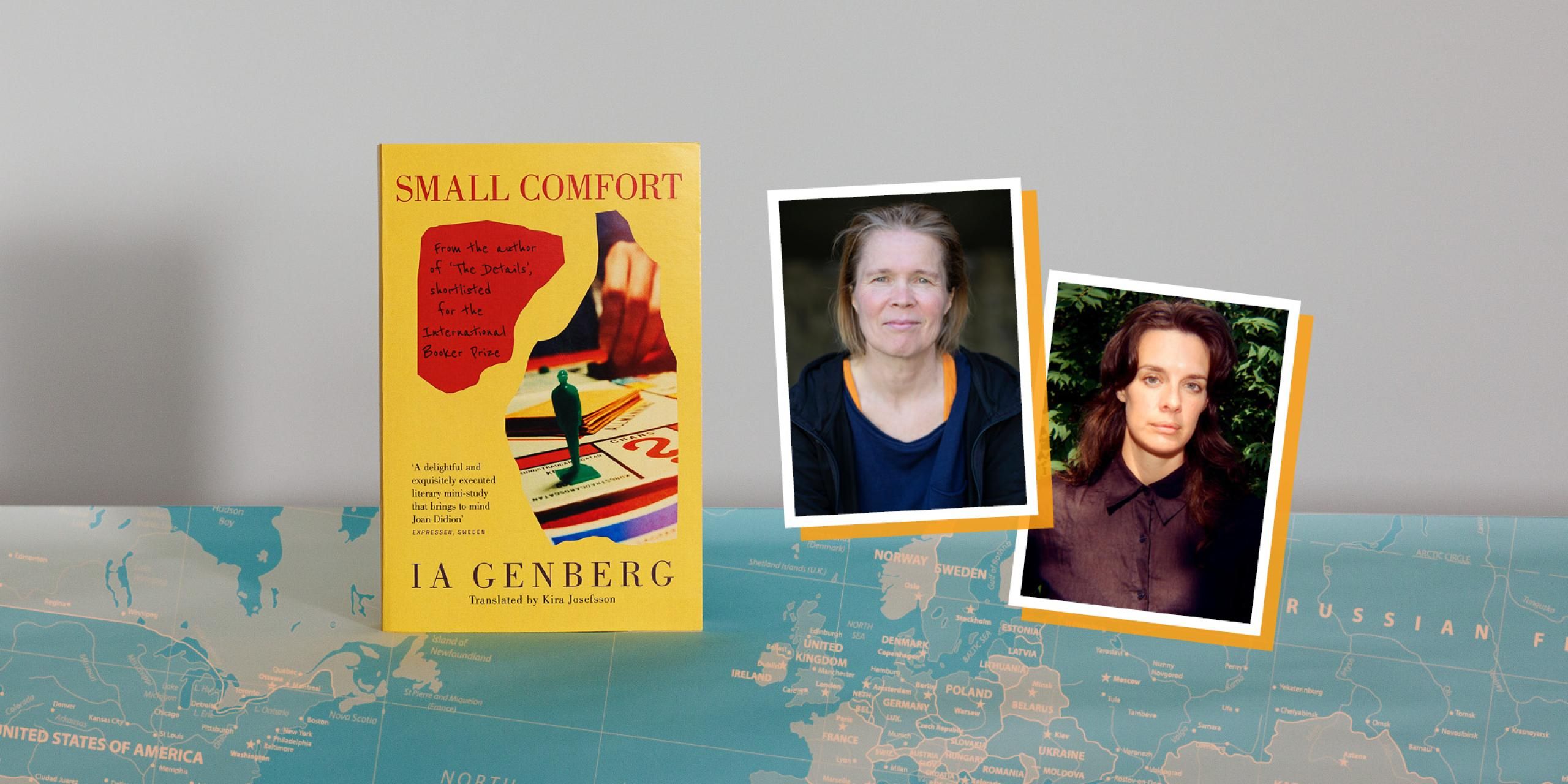
Because I was lucky enough to translate The Details, the first of Ia’s books to be published in English (and a 2024 International Booker shortlistee!), I was asked to do Small Comfort, and I was thrilled when I got the request.
Small Comfort is one of my favourites in Ia’s oeuvre. It has so much to say about the moment we’re currently living through, where money, in increasingly naked ways, mediates every value that actually matters, including who gets to live and who doesn’t. It could be heavy-handed, but Ia tells these stories in a subtle, slantwise way that’s both funny and complex.
How did you go about translating the book?
The five interlinked short stories are different in both tone and style. For instance, one is written as an interview transcript between the journalist Ia Genberg and a former child actor turned petty thief; another is set up as the notes of a young researcher studying the effects of wealth on social relations; a third is a wedding speech with a dramatic ending.
Finding the right English for all these voices was a fun challenge, especially the interview transcript, which is fast and chatty. In some ways it reminded me of the way Ia herself talks – a Stockholm Swedish – and I often imagined how the words I was writing in English would sit in her mouth. Maybe that’s weird! I tend to sit with the original more than I look for references in English; I find that a thoughtfully written novel will guide the translator to where she needs to go.
The theme of this year’s International Booker Prize campaign is ‘Fiction beyond borders’ – how do you think translated fiction helps readers see beyond geographical boundaries, and why is that important?
During Trump’s first term, talking about translation, my dear friend, the writer and translator Madhu Kaza, noted that many countries have endured fascist and authoritarian governments, and that US-Americans have a lot to learn from those histories. It might seem like an obvious point, but at the time there was still a sense in some quarters that the new US presidency was a unique aberration.
I think translated literature should be treated as literature, period, and not some exotic special genre – but in the anglosphere, reading in translation might have the welcome effect of tilting one’s perspective a bit, from every sort of city upon a hill to a sense that teachers (as well as sources of fortitude and comfort) are everywhere.
The International Booker Prize is celebrating its 10th birthday in its current form this year – how do you think the award has changed the perception of translated fiction over the last decade?
There is no doubt that the sharing of the prize between the author and the translator has contributed greatly to the growing visibility of translators. When Ia and I were lucky to be shortlisted with The Details, it was really cool to see how many readers are avid fans of the prize and follow the nominations closely.
To me, realising that (at least) two hands, two minds, have put down the words you read on that paper makes translated literature that much more interesting and multi-layered. And of course, for translators, who are often struggling financially, the existence of an award with such a significant prize sum is certainly not trivial.

Kira Josefsson
© Ben Tousley
I often imagined how the words I was writing in English would sit in Ia’s mouth… A thoughtfully written novel will guide the translator to where she needs to go
Kira Josefsson
Could you tell us about a book that made you fall in love with reading as a child?
One of my first deep reading memories is of a picture book: Mauri and Tarja Kunnas’s The Nighttime Book (as it is called in Airi Kärkäinnen’s English translation – I read it in Swedish). I loved reading about what people (animals) who were out at night were up to: baking bread, walking their dog, driving ambulances, partying in the club. There was a whole world outside my toddler bedroom!
Later on, I remember being captivated by Astrid Lindgren’s The Brothers Lionheart, which follows two young brothers who die shortly after one another and end up in Nangijala, where they find themselves in a struggle against a tyrant ruler. It’s a beautiful novel. Lindgren – as the first story in Small Comfort discusses – took children and their ability to know the world seriously. Of course, I didn’t think of it this way as a child, but now I see that the invitation to think about death and freedom bestowed the young reader with dignity. It might have been my first experience of literature as a portal to bigger questions.
And could you tell us about a book that made you want to become a translator?
Pooneh Rohi’s The Arab was the first book I wanted to translate, and it is also the book that made me a translator. In 2014, when it was first published in Sweden, there was still this sense internationally that the country was a near-perfect Social Democracy, when in fact neoliberal politics had long been dismantling a welfare state that was, furthermore, always to some extent conditioned on a certain homogeneity.
The Arab is a striking portrait of the alienation produced by racism, and it told a story about my first country I wanted more people to know. Pooneh is a beautiful writer, and I can’t wait for her books to be published in full in English.
Is there a translator whose work you always look out for?
To be honest, more than I have space to name. Several of my closest friends (including my partner) are translators, and I think part of what draws us to each other is a shared sensibility.
Nicholas Glastonbury’s translations of Turkish and Kurdish authors have an amazing range, from the lyrical Every Fire You Tend by Sema Kaygusuz to the dishy and scandalous Summer House by Yiğit Karaahmet to the experimental and winding The Competition of Unfinished Stories by Sener Ozmen.
I also love Mayada Ibrahim’s luminous work from Arabic, including her translations of Najlaa Eltom, whose stories always seem to leave me with my mouth open in surprise and awe.
Is there a work of fiction originally written in Swedish that you’d recommend to English-language readers?
One of my favourite Swedish authors is Johannes Anyuru, who has been translated into English by three stars: Rachel Willson-Broyles, Saskia Vogel, and Nichola Smalley. I especially love the book titled They Will Drown in Their Mothers’ Tears in English, translated by Saskia. Anyuru is a poet who thinks deeply about the feeling of history and its turning points, and They Will Drown… is both devastating and somehow holy about nationalism’s terrible reverberations.
And, finally, which International Booker-nominated book do you think everyone should read?
I’d recently started reading Gabriela Cabezón Cámara’s We Are Green and Trembling and was thrilled to see it on the longlist. Robin Myers is another translator whose work I admire: she’s a poet, and her shimmering way with language is really visible in this world-expanding novel.