
‘Maybe this is the last time he will walk down the familiar corridor as the man called Noon Merckem, that door there on the left with those welcoming panes of glass could mean the end of his existence, weak in the knees like a man being dragged to the gallows, that’s how he feels in this instant’
- Published
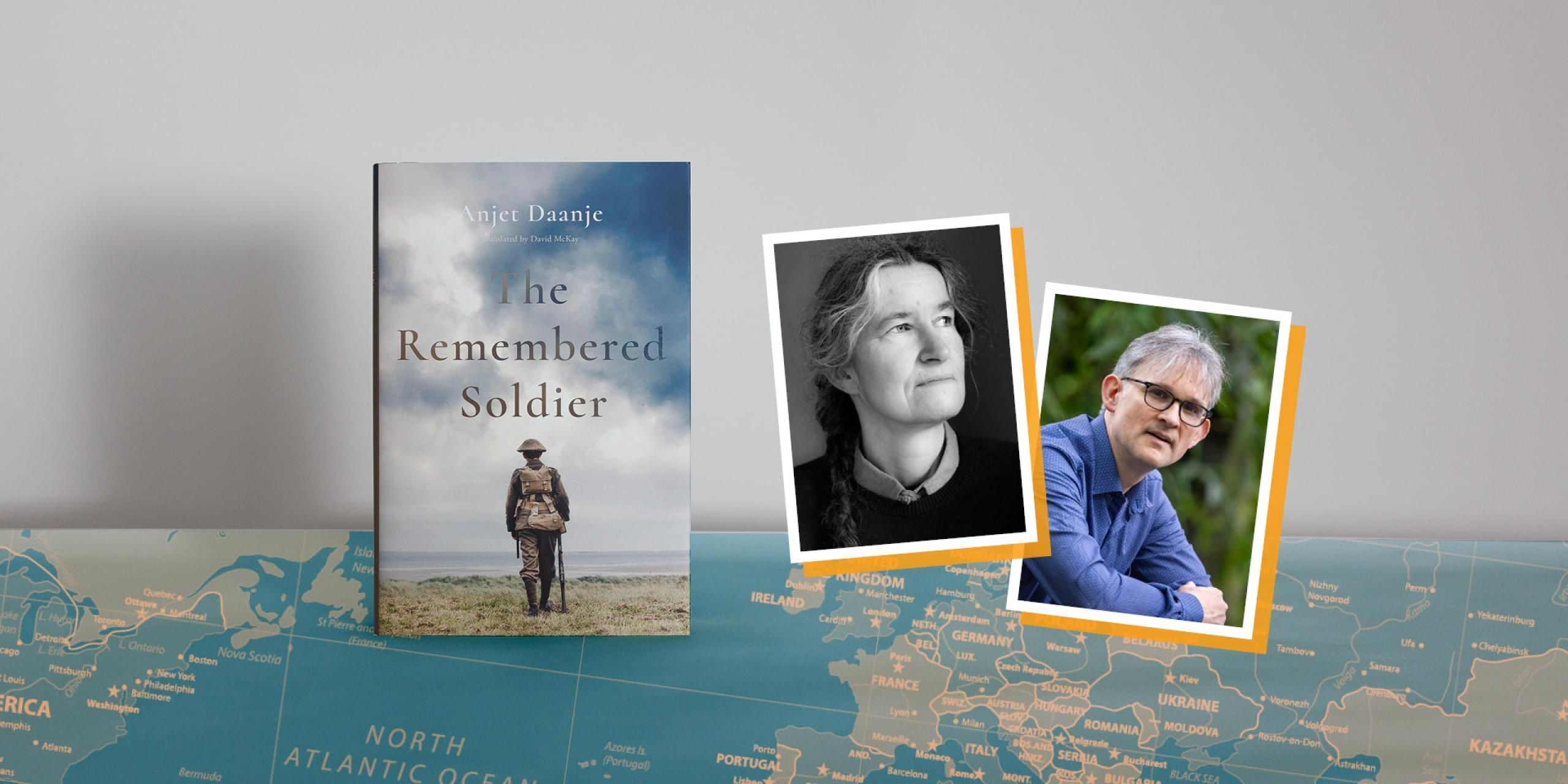
The International Booker Prize 2026 nominated author and translator reflect on their writing processes and influences, and discuss how translated fiction can expand our horizons
Anjet Daanje
Could you tell us about the inspirations behind The Remembered Soldier?
I saw a documentary in which the French soldier Anthelme Mangin was mentioned. He lost his memory during World War I, so profoundly that he didn’t remember who he was. The asylum to which he was committed put an ad in the newspaper asking people if they recognised him. Lots of desperate women responded claiming he was their lost husband or son. One of them even persevered when it turned out that her husband was two centimetres longer than Anthelme Mangin. She maintained that the war had shrunk him. The severe memory loss of Mangin and the desperation of these women inspired me to write The Remembered Soldier. I took a small part of the real story and made up the rest.
How did you go about writing the novel?
First, I did a lot of research about World War I and daily life at the beginning of the 20th century. Then I wrote a first draft of the novel. It turned out much too long, so I had to cut half of it in the second draft. It took me three years to write the novel. I always write at my desk on my computer. I write about two pages a day, and I always start the next day by reading these pages and rewriting them a bit, and then, without really noticing, I go on writing new pages.
The theme of this year’s International Booker Prize campaign is ‘Fiction beyond borders’ – how do you think translated fiction helps readers see beyond geographical boundaries, and why is that important?
I think it is really important to read about other people, how they live, feel and think. Books tell you that people can be very different from you and at the same time have a lot in common with you. In this way books turn you into a more open-minded person. This is especially true for books written in other languages, in other countries and cultures. You yourself could have been born in a different country, in a different body, even in a different century, and look what you could have experienced. It is written in a book.
The International Booker Prize is celebrating its 10th birthday in its current form this year – how do you think the award has changed the perception of translated fiction over the last decade?
I hope the International Booker Prize has helped English-speaking readers to read and appreciate translated fiction more.

Anjet Daanje
– author photo supplied by Scribe UK
Books turn you into a more open-minded person – this is especially true for books written in other languages, in other countries and cultures
Anjet Daanje
Could you tell us about a book that made you fall in love with reading as a child?
When I was young I read Dutch children’s books. I liked reading a lot, especially from the age of seven till the age of 12. I loved historical fiction and books for boys (that was what they were called back then), I hated girlish books.
But I didn’t really fall in love with a book till I was 16 years old, and read Jane Eyre for my English classes at school. The greatest thing about the book is the passion and honesty with which Charlotte Brontë wrote it. As a reader you get the idea that she has thrown her feelings on paper, and that she didn’t eat or sleep till the book was finished.
And could you tell us about a book that made you want to become a writer?
My parents read a lot, I grew up in a house with thousands of books, so I didn’t decide I wanted to read, I just read books. It was like that with writing, there was not one book that made me a writer, there were a lot of books.
From a young age I liked to make up stories, and I was good at it. I loved to write, but I never wanted to become a writer. I felt being a writer meant you had to be a very impressive, older man, saying sensible things in interviews, and generally being very important. I didn’t want that, I still don’t. The hardest thing was, when I had written my first novel, to let someone else read it. Writing, and making public what you have written are two completely different things, for which you need opposite skills.
Is there a book that changed the way you think about the world?
That can only be Marcel Proust’s À la recherche du temps perdu (In Search of Lost Time). I read the thousands of pages (in Dutch translation) when I was in my late twenties. Not all of it is riveting, some parts are even boring. But the way Proust tries to make sense of his own emotions, why he has them, why they change over time, and how he could describe them most honestly and realistically, really had an influence on how I thought of the inner world of a people. Emotions are complex, unpredictable, and sometimes puzzling, so in a novel you should not describe them as simple, then you are deceiving your readers.
Which book written in Dutch should everyone read?
Louis Couperus: De boeken der kleine zielen, written in 1901. It was translated in that same year as Small Souls, but I don’t know if this is a good translation. Since then it has not been translated in English.
Couperus was a very famous Dutch writer in his time. This particular novel is about the ‘small souls’ of a family of well-to-do people in The Hague. You could say it is a kind of soap, but with so much depth, interesting characters and psychology.
Couperus’ writing style is what makes it a really great novel. He wrote all his novels like beautiful poetry, making up words, repeating sentences for dramatic effect and rhythm, changing the order of words within a sentence. I love his style.
And, finally, which International Booker-nominated book do you think everyone should read?
In 2016 The Story of the Lost Child, the fourth novel of Elena Ferrante’s Neapolitan novels, was shortlisted. I devoured all four novels about Elena and her brilliant friend Lila. Elena Ferrante has a lot of psychological insight, and uses all of it to describe the volatile friendship between two girls becoming women, loving and hating each other at the same time.
David McKay
Could you tell us what it was about The Remembered Soldier that made you want to translate it?
After reading The Remembered Soldier, I wanted to go on living in that world and with those words, and I wanted to share the experience with as many people as possible. The novel’s quality of intimacy, urgency, and momentum is absolutely unique, and I found myself itching to take on the challenge of recreating it in English.
The first time I read the first paragraph, I sensed that this is great literature, the work of a master wielding her powers to plumb the depths of the human psyche. I can hardly believe my good fortune to have stumbled upon this novel in time to become its translator.
How did you go about translating the novel?
The propulsive quality of Anjet’s writing helped to keep the energy level high as I translated. I could often create the same flow by much the same means in English, and when I couldn’t, I enjoyed reflecting on the differences between the two languages and finding new ways to craft the sentence in English.
I rooted out excess words to keep things moving, and most importantly, I allowed the book to cast its spell over me again, so that the characters and setting became vividly real to me. My many questions about linguistic and narrative details received prompt, friendly, and enlightening responses from the author, and the translation owes much of its success to her input and feedback.
The theme of this year’s International Booker Prize campaign is ‘Fiction beyond borders’ – how do you think translated fiction helps readers see beyond geographical boundaries, and why is that important?
At the heart of fiction is always the human experience, and translated fiction teaches us that no country or language has a monopoly on either human suffering or human imagination. Translation is empathy in action: when we translate, we walk in someone else’s shoes and learn to appreciate both their differences from us and our common humanity. The journey changes us, and if we are lucky, the resulting translation will also change its readers, questioning cherished beliefs and opening new horizons. The more we learn to open our minds to our fellow humans, the better we will understand that borders themselves are human fictions, and when our stories about borders cease to serve us well, we can start to tell new ones.
The International Booker Prize is celebrating its 10th birthday in its current form this year – how do you think the award has changed the perception of translated fiction over the last decade?
It’s always marvellous to see the excitement about the International Booker on social media and in the press: the predictions, the group reads, the blog reviews, the photographs of towering stacks of novels…
The prize has captured the imagination of readers in a unique way, and each year, the International Booker longlist helps a substantial number of the best translated works of fiction to reach a much wider readership, not just in the UK but around the world. All literary translators owe the organisers and sponsors of the prize a debt of gratitude for raising the profile of our profession and expanding the audience for our work.
I’m also impressed by the work of the International Booker Prize organisation and judges to achieve meaningful diversity in their selection of books. I hope the organisers and sponsors will continue looking for new ways to support literature in languages underrepresented in translation, whose translators and writers receive much less institutional support than I have.

David McKay
– author photo supplied by Scribe UK
Translation is empathy in action: when we translate, we walk in someone else’s shoes
David McKay
Could you tell us about a book that made you fall in love with reading as a child?
The books I remember best from childhood include many translations, and I look back with special fondness on the Moomin books by Tove Jansson. Jansson created a land of beauty, mystery, adventure, melancholy, and longing that we can return to as often as we like – an incredible gift. It didn’t occur to me as a young child that a translator had brought those English versions into being, but I appreciate it all the more now, and I’m thrilled that we have the revised 80th anniversary edition of Comet in Moominland in Sarah Death’s scintillating new translation.
And could you tell us about a book that made you want to become a translator?
Not long after moving to the Netherlands, I read a short story from the collection Het lente-eiland en andere verhalen by the Dutch author J. Slauerhoff that reminded me of the finest short stories by Jorge Luis Borges. It felt wrong to leave a story like that inaccessible to English-speaking readers, and perhaps for the first time, I gave serious thought to the fact that Borges’s stories had required translators to make them available in English. Much later I had the opportunity to translate Slauerhoff’s magical novel Adrift in the Middle Kingdom for the doughty Handheld Press.
Is there a translator whose work you always look out for?
I look out for new translations by Juliet Winters Carpenter and always feel confident that I’ll enjoy them. She makes stories originally told in Japanese feel lucid, immediate, and evocative in English translation, while preserving the uniqueness of the writer’s voice and the sense of cultural specificity – a self-effacing achievement, but when you start to scrutinise it, astounding. I’ve often thought back to her sublime translation of A True Novel by Minae Mizumura, a retelling of Wuthering Heights, while working on Anjet Daanje’s latest novel The Song of Stork and Dromedary, which is likewise inspired by Brontë’s work.
Is there a work of fiction originally written in Dutch that you’d recommend to English-language readers? What do you like about it?
In the Dutch-English language pair, I always look out for David Doherty’s translations, especially of Jaap Robben’s novels. The charming, tender Summer Brother was shortlisted for the International Booker Prize a few years ago, and I would especially recommend the more recent Afterlight. I’m grateful to know that Robben’s delicate, incisive prose is in David’s sure hands, so that I can recommend this book without reservation to family and friends.
I’m also very proud to have worked with two world-class fellow translators, Lucy Scott and Sarah Timmer Harvey, whose moving translations of Astrid Roemer’s On a Woman’s Madness and Jente Posthuma’s What I’d Rather Not Think About were longlisted and shortlisted for the Booker, respectively.
And, finally, which International Booker-nominated book do you think everyone should read?
I’m glad we don’t all read the same books, and the International Booker Prize longlists offer a many-splendoured selection, with books to suit the tastes of all sorts of readers. I’ve mentioned a number of International Booker-nominated books already; another that I loved is The Unseen by Roy Jacobsen, translated by Don Bartlett and Don Shaw, along with the rest of Jacobsen’s magnificent Barrøy Chronicles.


