- Book recommendations
An extract from The Land in Winter by Andrew Miller
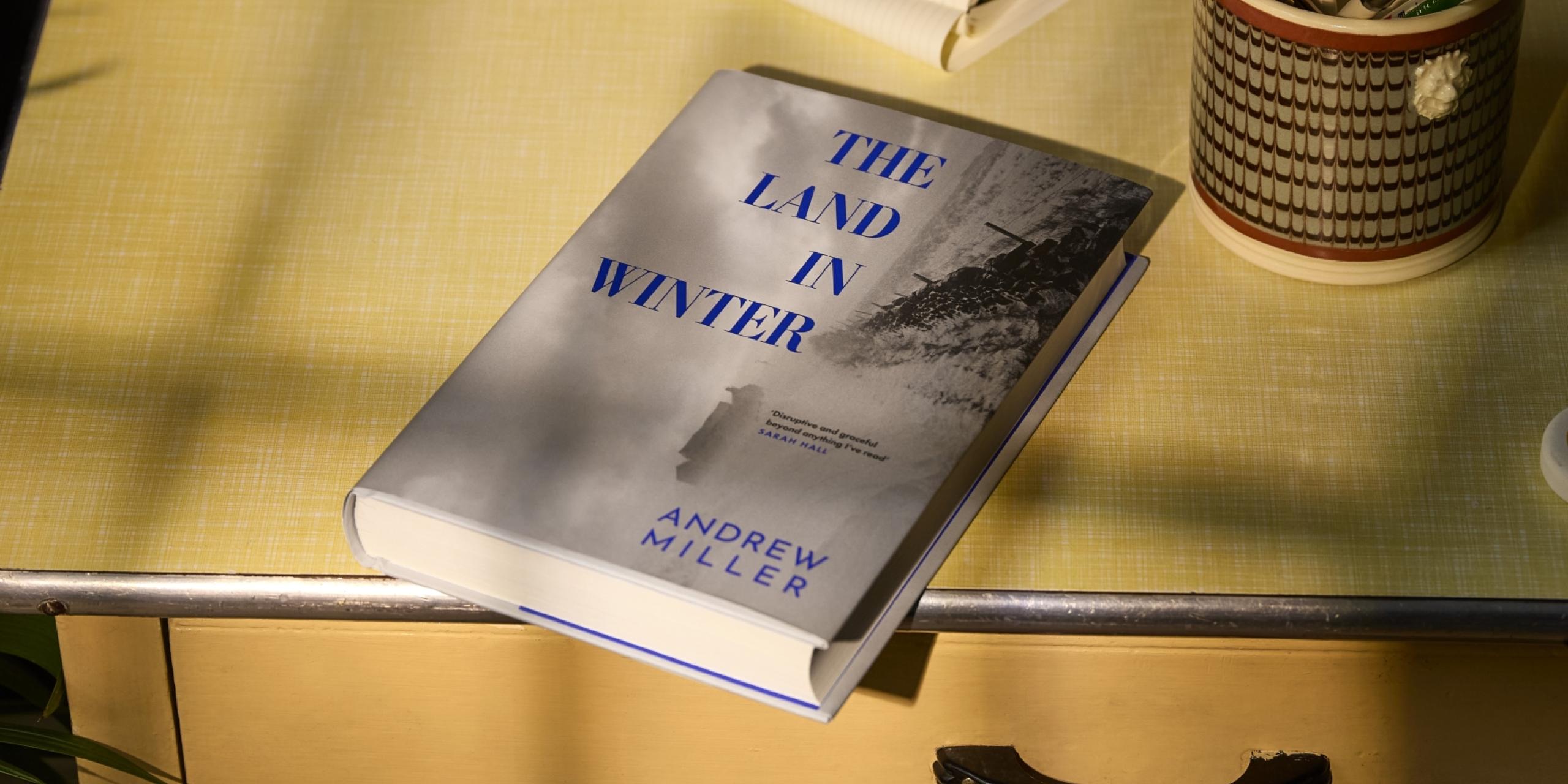
An extract from The Land in Winter by Andrew Miller
- Written by
- Andrew Miller
- Published
The Land in Winter is shortlisted for the Booker Prize 2025. Read an extract here
December 1962, the West Country.
Local doctor Eric Parry, mulling secrets, sets out on his rounds, while his pregnant wife sleeps on in the warmth of their cottage. Across the field, funny, troubled Rita Simmons is also asleep, her head full of images of a past life her husband prefers to ignore. He’s been up for hours, tending to the needs of the small dairy farm where he hoped to create a new version of himself, a project that’s already faltering.
But when the ordinary cold of an English December gives way to violent blizzards, the two couples find their lives beginning to unravel.
Where do you hide when you can’t leave home? And where, in a frozen world, can you run to?
The Land in Winter is published in the UK by Sceptre. This extract is taken from chapter 6 of the novel.
Buy the book
Since the spring, when it had kicked off with an afternoon of pleasure that left him so altered he had not dared go home until he had sat for an hour in the coombe above the cottage, calming himself under the new green of the trees and making a kind of study of his former self and what seemed, suddenly, the banalities of the life he had, until that morning, been content to live with; since then, the outset, the very beginning, there had been various understandings between them, the most fundamental of which was that nothing of what was taking place (had taken place and would continue to) could ever be known. It was not just his marriage: it was the impossibility of carrying on in a country practice with his name mired in scandal. In a big city you might get away with it but not out here. All other understandings were derived from this one. Where they might meet and where they should never be seen together; what days and times of day he might visit, the frequency. There were to be no telephone calls unless it was urgent (Frank will be back early today). She wore, habitually, a heavy perfume, but on their appointed days it was agreed she would not use it (Irene had an acute sense of smell). He was careful of what he touched or moved. In her bedroom, afterwards, he always scanned the room, the floor, checking he had not left anything behind, something for Frank to pick up, squint at and think, But this isn’t mine.
When she saw him doing it, watched him from the bed where she lay on her side, tipping the ash of her cigarette into a mother-of-pearl ashtray, she sometimes laughed. It wasn’t unkind (he knew she liked him and that it might, in fact, be better if she liked him a bit less). And she, too, had much to lose, something, at intervals, he reminded her of. Reputation, marriage, house, even, potentially, her son. But she only smiled and gazed at him as if he was some bright-eyed child she had found whose ideas about the world were hopelessly naive. It was money confidence, of course. Come what may, Daddy would be waiting in his faux-Jacobean mansion, cheque book at the ready. She would not be on the streets; she would not have to take a job waitressing in a café somewhere nobody knew her; she would not be shamed. He was completely unsure what her morality was. He didn’t know her in that way. He sometimes thought she was the kind of person who might choose to bring the house down simply to find out what kind of noise it made.
But if he was the one who preached caution, who insisted on it, who had once dreamed that her bedroom floor was a minefield with pressure plates under the Wilton and nasty little charges that would take his legs off, what on earth was he doing driving to her house through the dregs of the afternoon on an unappointed day? Was it just this business at the asylum? Had he allowed the Administrator to spook him? The Administrator! One of those types you found propping up hotel bars, some suggestion of a good war, now just out to make money and screw the secretary. As for the boy, that was another matter. He was sorry about it, of course he was. But patients died all the time. Not, it was true, nineteen-year-olds, not basically healthy ones, and not as a result of something he had given them. But if you got into a funk every time … The point being … But he could not think yet what the point was.
He sometimes thought she was the kind of person who might choose to bring the house down simply to find out what kind of noise it made
There was a lay-by up ahead. It would be a good place to stop and turn around, but when he came to it the car sped past, tunnelling into the teatime failing of the light.
He was not afraid of running into Frank. He knew Frank’s routine. He was rarely back from Bristol before six-thirty, more usually seven. Occasionally she had visitors, other wives without much to do. That might be awkward – some of these women had sharp eyes – but he was, after all, her doctor (Frank’s too, for that matter). He was making a house call. He was dropping off a sort of medicine. That should cover it.
He turned off the main road and drove at the side of a high stone wall. He came to the open gate and slowed the Citroën to walking pace. Her car was there, alone. He drove another thirty yards to the second gate, narrower, its gravel lined with woody evergreens that had got out of hand, rhododendrons and azaleas that in early summer were studded with fat blooms of pink and crimson and white. Alison called it the tradesman’s entrance, and perhaps it had been when the house was new. In theory – though he did not care to test it – a car could pull up in the first drive and a car pull out of the second without the drivers ever getting sight of each other.
He parked opposite the garage. The long slope of his headlights cut across the blue of one of her lawns. Where the beams met he could see the archery target that Frank and his son, John, shot at when the boy was home from boarding school. Frank had once shown Eric his collection of bows. He had handed him an English longbow and invited him to draw it. He had managed to, but it had taken visibly more effort than he’d expected. This was at a time when they might have become friends.
He walked across the grass to the French windows at the back of the house. The curtains had not been drawn yet and a yellow light pooled around the steps. He went up to the glass and looked in. She was there, alone. He could see the back of her head as she sat on the sofa, the thickness of her hair. Smoke rose from her cigarette. There was music. He tapped on the glass, then tapped more loudly. She looked round, startled, then stood, and moved cautiously towards the glass, the beginnings of a smile on her face. Once she was sure of him, the smile widened and she turned the key.

The Land in Winter by Andrew Miller
© Yuki Sugiura for Booker Prize Foundation
The Land in Winter
- Published by
- Sceptre
A masterful, page-turning examination of the minutiae of life and a dazzling chronicle of the human heart
Features

- Book recommendations
Booker Prize authors on the childhood books that made them fall in love with fiction

- Book recommendations