

- Book recommendations
An extract from Universality by Natasha Brown
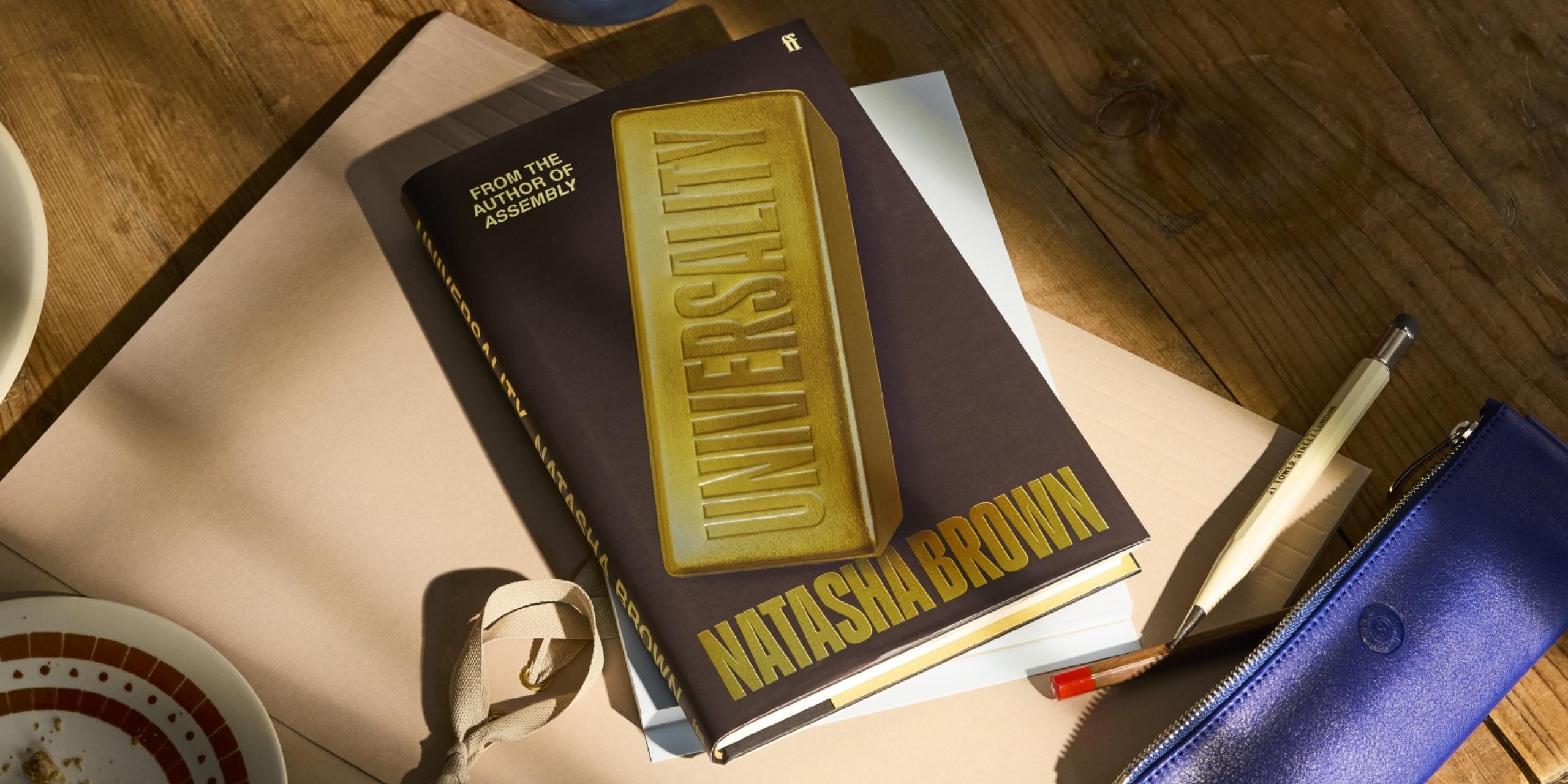
An extract from Universality by Natasha Brown
- Written by
- Natasha Brown
- Published
Universality is longlisted for the Booker Prize 2025. Read an extract here
‘Remember – words are your weapons, they’re your tools, your currency.’
Late one night on a Yorkshire farm, a man is brutally bludgeoned with a solid gold bar.
A plucky young journalist sets out to uncover the truth surrounding the attack, connecting the dots between an amoral banker landlord, an iconoclastic columnist, and a radical anarchist movement. She solves the mystery, but her viral longread exposé raises more questions than it answers.
Through a voyeuristic lens, Universality focuses on words: what we say, how we say it, and what we really mean. The follow-up novel to Natasha Brown’s Assembly is a compellingly nasty celebration of the spectacular force of language. It dares you to look away.
Universality is published in the UK by Faber.
This extract, which includes depictions of a sexual act, is taken from the third part of the book.
Buy the book
It was getting chilly; he’d been rooted to the doorstep for nearly an hour. The thought of leaving, walking away from his family again, gave him a sense of unease. He had not, could not, shake off the destructive fear that some vague, bad thing was still on its way. This same nagging, inexplicable fear had driven him to buy the farm, along with the small-denomination gold bars. Even before that he’d bought freeze-dried foods, tinned foods, candles, lighter fluid, distilled water, solar batteries, everything his family might need, packed away in their basement. Lenny was perhaps the only person he’d met who understood this fear. She’d even said she felt it too, although for her it materialised differently, blossoming into an all-consuming fury at seemingly everything and everyone. As the only two residents left in his building, they’d become unlikely friends. He hadn’t met anyone like Lenny before; she could be funny, even sweet, and was always incredibly sharp. He hadn’t taken her rhetoric too seriously. Not back when he’d known her. It was something more like a joke. Irony sparkled in her eyes whenever she said and did outrageous things.
‘White men,’ Lenny told him, those eyes sparkling, ‘that’s who. White men have it hardest these days.’
She’d said this before taking him into her mouth and sucking earnestly. He exhaled. Granted, there were things you couldn’t say anymore. Or do. He looked up at the ceiling, absently grabbing a fistful of her short hair. Relatively harmless things could really land you in it, that was true. But he’d had a decent run. No major scrapes. And besides, some of the things they’d got up to, back in the good years – well, it had all got a bit out of hand, hadn’t it? He certainly wouldn’t want his daughter involved in any of that. He looked down; Lenny’s mascara-heavy lashes masked her eyes. Along her side parting, the hair looked soft, fine enough to see through to the scalp beneath. He cringed – why had he thought of his daughter? What the fuck was wrong with him? He tried to re-engage with the present scene; anticipating, more than feeling, the wet of Lenny’s mouth, her cheeks – slack, then tensing – a smooth ridge of teeth – the tongue roving – all framed by smudged lipstick – up and down. He wove his fingers together at the base of her neck, closed his eyes, and relaxed into a rhythm.
White men,’ Lenny told him, those eyes sparkling, ‘that’s who. White men have it hardest these days
When he finished, she smiled and excused herself to the en-suite, coming back fresher-faced a few minutes later. Even as she lay beside him on the crumpled bedsheets, Lenny’s body was tense, seemingly primed for attack. So when, instead of launching into one of her diatribes, she asked for a favour, Richard readily agreed. With the world being as it was, so uncertain and fragile, he found himself moved to help her. He hadn’t known then that Lenny was Jake’s mother. That context arrived much later, along with a dawning sense of guilt: had he, however inadvertently, taken advantage of her?
After all, recast as the actions of a concerned parent, Lenny’s sexual aggression made a certain kind of sad sense. People were complicated, yes, but perhaps the same loves and fears motivated them all. Until this strange disaster befell him, so much of his world had been screens of numbers. The tiniest deltas aggregated and integrated, projected and explained; sliced and diced then crushed into monochromatic charts and graphs, wrangled into decks and mulled over, signed off, submitted. And, of course, under the layers of bundling, tranching and repackaging, this was indeed the world. Everyone’s individual choices: dreams and promises. Altogether, packaged up into funds, they amounted to a literal, collective hope for the future.
‘Rich?’
Behind him, a light shone warm and honeyed into the dark. Claire, in her soft cardigan and slippers, leaning against the door, frowned at him with gentle concern.
‘Rich’ – she said his name like music, like magic. ‘What are you doing out there?’

Universality by Natasha Brown
© Yuki Sugiura for Booker Prize Foundation
Features

- Book recommendations


