- Published
International Booker Prize 2026 judge Troy Onyango explains what he’s hoping to find among this year’s submissions, and shares his tips for finding time to read more
Main image © Sophie Davidson for Booker Prize Foundation
You will read more than 100 books over seven months as an International Booker Prize judge. How are you approaching this unique challenge, and what are your tips for busy people who want to find more time for reading?
Having done this while having a full-time job and running a literary magazine, I can say it’s completely changed my relationship to books and reading forever. I have always thought of myself as a big and fast reader (as I have to read almost all day for work and for the magazine) but this was on another level. It’s like the Olympics! Or the Safari Rally!
The trick (if I can call it that) I have found is polyreadership; read everything, everywhere, all at once. Any time you have is for reading. I wake up early and go to bed late to get extra time to read. I have turned down some social events. I haven’t gone to the theatre or cinema as much as the previous years. Everywhere I go, I carry my iPad with me so that I can read and switch between books. It has felt like a fever dream of sorts.
What are you hoping to find as you select the books for the International Booker Prize longlist? Are there certain qualities or attributes that you’re looking for?
The judging process is a treasure hunt and one never knows exactly what or where the treasure is, but for me it has been a case of ‘I’ll know it when I see it’. I have been excited to search through as I read and have stayed as open to possibilities as possible.
In general, I love a book that is bold, daring, ambitious, and loud… loud in the sense that it knows what it is and it takes up so much space there’s little room for others. That’s how I know what’s memorable. I love a book that stays with me long after I’ve read it and leaves me asking questions when I have put it down. I think any great book is a memorable book (and vice versa).
I also love a book that plays with language and is inventive/innovative. Any book that pushes the boundaries of what I know or have seen before has my heart.
What do you think a good translation can bring to the original language version of a work of fiction?
A great translation gives a book a new lease of life. It gets under the skin of the original language and pushes until the resulting text becomes radically different, while the story remains as close to the original as possible, with no less depth or clarity.

The International Booker Prize 2026 judges – l-r Nilanjana S. Roy, Marcus du Sautoy, Troy Onyango, Natasha Brown and Sophie Hughes – photographed at Poon’s London
© Sophie Davidson for Booker Prize Foundation
I love a book that is bold, daring, ambitious, and loud… loud in the sense that it knows what it is and it takes up so much space there’s little room for others. That’s how I know what’s memorable
The International Booker Prize is celebrating its 10th birthday in its current form in 2026. How do you think the International Booker has changed the landscape and the perception of translated fiction over the last decade, and why does this award matter?
This is probably my favourite literary prize in the whole world (and I’m not just saying this because I’m on the judging panel) because it has introduced me to books I would have never been aware of if they weren’t longlisted or shortlisted for the prize. I have followed the prize very closely and I’m always excited when I read the books that have been nominated for it. I should hope this is how the prize makes other people feel, too. The whole project is the Booker Prize Foundation’s gift to the world of literature. We need more translated fiction being placed in the hands of readers, and this is the natural place for it to be celebrated.
The theme of the International Booker Prize 2026 campaign is ‘Fiction beyond borders’. How do you think the International Booker, and translated fiction generally, helps readers see beyond geographical boundaries? Why is that important?
Books allow us to travel to countries and cities and towns and villages we might never go to. We learn so much about other people’s cultures and it is as though we speak their language in the moments we are with them in those pages. Translated fiction expands the list of countries we can travel to, and allows us even greater access to stories from which we would have otherwise been locked out. The International Booker has facilitated this access for so many readers, allowing us to find books and stories beyond those from our own nations or languages.
What’s your favourite International Booker-nominated book since 2016 and what’s special about it? Who would you recommend it to?
Oh, I can’t choose only one. Absolutely not! I love At Night All Blood is Black, Crooked Plow, The Vegetarian, A General Theory of Oblivion, Tram 83, Celestial Bodies, Under the Eye of the Big Bird, Standing Heavy, Minor Detail and many, many more that have been on the International Booker Prize long- and shortlists. They’re all unique and special in their own way and I could spend days talking about them. I recommend them to all who love great books!
What book made you fall in love with reading as a child? How and why did it capture your imagination?
The first storyteller in my life was my great-grandmother who loved to tell stories and made me fall in love with reading. I believe that oral tradition is just as important as written stories. I didn’t have access to many story books as a child as the priority was school textbooks. I sought out as much as I could, whenever I could. As I got older, I loved reading writers like Grace Ogot, Margaret Ogolla, Barbara Kimenye, Ngugi wa Thiong’o, and many others who shaped my literary imagination.

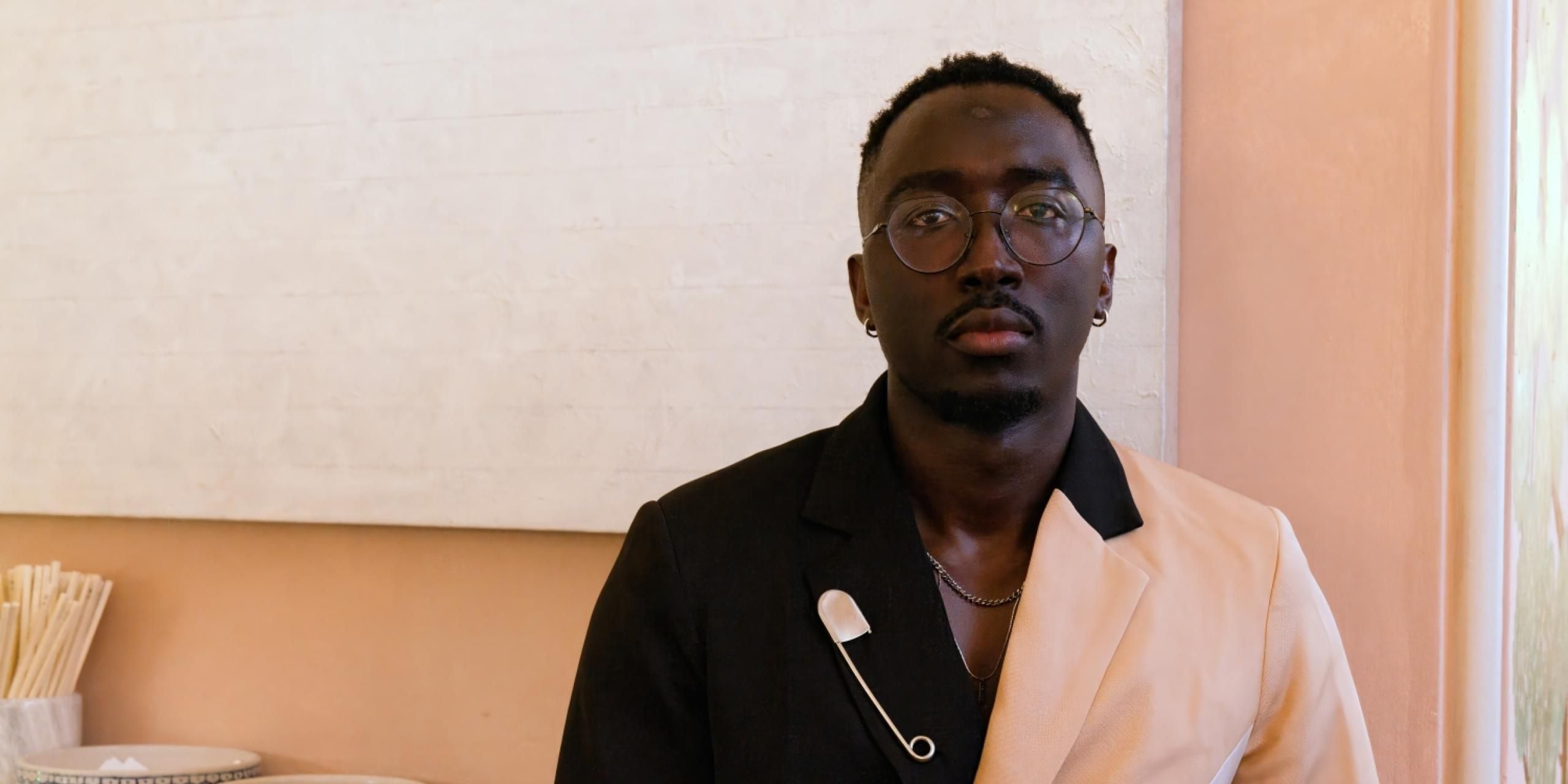
International Booker Prize 2026 judge, Troy Onyango photographed at Poon’s London
© Sophie Davidson for Booker Prize Foundation


